

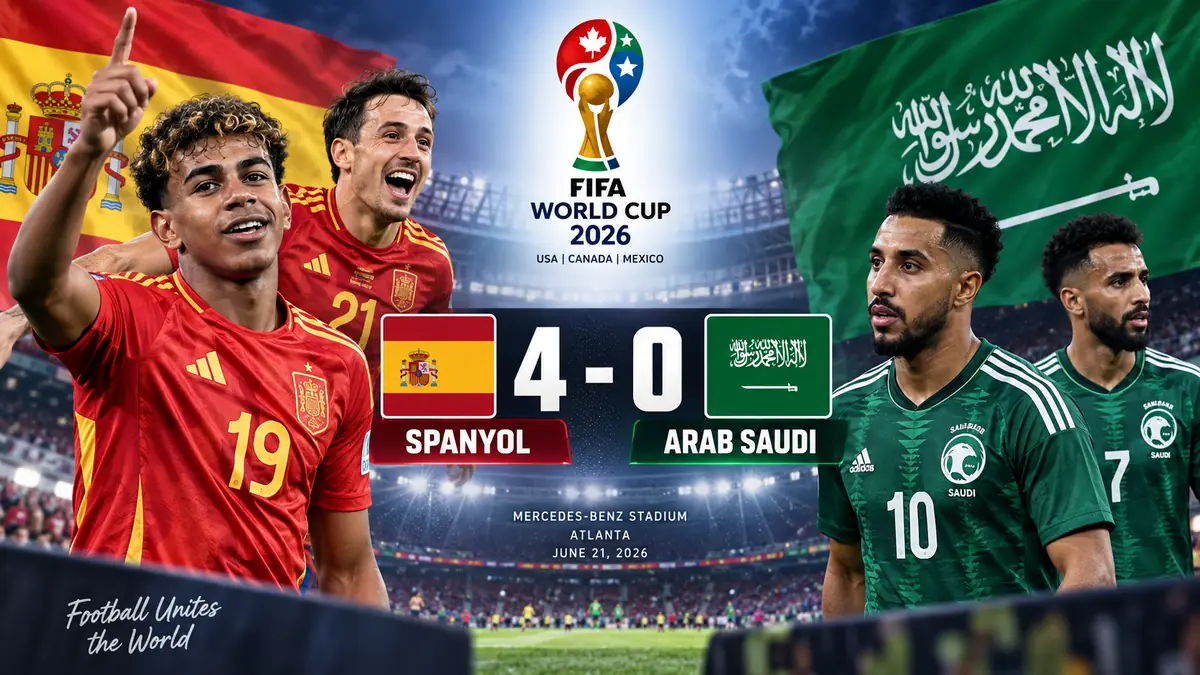
The spanyol vs arab saudi clash at the 2026 FIFA World Cup turned into one of Spain’s most convincing performances of the group stage. After being frustrated in their opening match, La Roja responded with speed, movement, and ruthless finishing against Saudi Arabia.
Spain defeated Saudi Arabia 4-0 on June 21, 2026, in Atlanta, with Lamine Yamal opening the scoring, Mikel Oyarzabal adding two goals, and Hassan Al Tambakti scoring an own goal. Spain led 3-0 at half-time and controlled the match through possession, passing accuracy, and sustained attacking pressure.
spanyol vs arab saudi Match Result at a Glance
The Group H match was played at Mercedes-Benz Stadium in Atlanta as part of the 2026 FIFA World Cup.
| Match detail | Spain | Saudi Arabia |
|---|---|---|
| Final score | 4 | 0 |
| Half-time score | 3 | 0 |
| Possession | 67.1% | 32.9% |
| Shots | 22 | 3 |
| Shots on target | 8 | 1 |
| Corners | 6 | 1 |
| Accurate passes | 668 | 294 |
| Passing accuracy | 92% | 80.8% |
The statistical gap reflects how heavily Spain controlled the game. Saudi Arabia spent long stretches defending and had few opportunities to threaten the Spanish goal.
The four goals were:
- 10′ – Lamine Yamal: Spain 1-0 Saudi Arabia
- 21′ – Mikel Oyarzabal: Spain 2-0 Saudi Arabia
- 24′ – Mikel Oyarzabal: Spain 3-0 Saudi Arabia
- 49′ – Hassan Al Tambakti own goal: Spain 4-0 Saudi Arabia
The match was effectively decided during a devastating 14-minute spell in the first half.
Why the spanyol vs arab saudi Match Mattered
Spain entered the Saudi Arabia game needing a response.
Luis de la Fuente’s side had been held to a goalless draw by tournament debutants Cabo Verde in their opening Group H fixture. Saudi Arabia, meanwhile, had drawn 1-1 with Uruguay.
That made the second group match particularly significant. Spain needed to turn territorial control into goals, while Saudi Arabia had an opportunity to strengthen its chances of reaching the knockout phase.
The difference this time was Spain’s attacking efficiency.
Against Saudi Arabia, the European champions moved the ball quickly enough to create openings before the Green Falcons could settle into their defensive shape.
Quick Takeaway
Spain did not simply have more possession. They converted control into meaningful chances: 22 shots, eight on target and four goals, compared with Saudi Arabia’s three attempts and one shot on target.
Lamine Yamal Opened the Scoring After 10 Minutes
The first breakthrough arrived quickly.
Mikel Oyarzabal delivered the ball across the penalty area and Lamine Yamal arrived at the back post to finish in the 10th minute.
It was an important moment for the young winger. FIFA reported that the goal made Yamal the eighth-youngest player to score at the men’s global showpiece.
His influence went beyond the goal.
Yamal’s movement stretched Saudi Arabia’s defensive structure and helped create space elsewhere. His ability to receive possession wide, attack defenders and then move inside gave Spain several ways to progress into the penalty area.
The goal also changed the nature of the contest.
Saudi Arabia could no longer concentrate entirely on protecting a level score. Any attempt to move higher up the pitch created additional space for Spain’s technical attackers.
Mikel Oyarzabal Took Control of the First Half
If Yamal provided the opening spark, Mikel Oyarzabal became the central figure in Spain’s first-half attack.
He had already assisted Yamal before scoring twice himself.
Oyarzabal Makes It 2-0
Spain doubled the advantage in the 21st minute.
Aymeric Laporte provided the decisive touch to set up Oyarzabal, who converted the opportunity to put Spain firmly in control.
Only three minutes later, Saudi Arabia were breached again.
Oyarzabal Scores Again for 3-0
Oyarzabal’s second goal arrived in the 24th minute, with Dani Olmo involved in the move.
That meant Spain had scored three times before the match reached the 25-minute mark. FIFA’s official recap confirmed Yamal as the opener and Oyarzabal as the scorer of Spain’s next two goals.
The rapid sequence was crucial.
Saudi Arabia had barely had time to reorganize after conceding the second before Spain struck again.
By half-time, the scoreboard read:
Spain 3-0 Saudi Arabia.
How Spain Dominated Saudi Arabia Tactically
The most striking feature of spanyol vs arab saudi was not simply the final score. It was the difference in how comfortably the two teams could progress the ball.
Spain controlled possession while maintaining attacking intent.
According to Sky Sports’ match statistics, Spain recorded 67.1% possession and 668 accurate passes, completing 92% of their passes. Saudi Arabia completed 294 accurate passes at 80.8%.
Spain Stretched the Defensive Shape
Spain’s width forced Saudi Arabia to defend a large area.
When Saudi defenders moved toward the wings, gaps appeared centrally. When they remained compact, Spain could circulate possession around the outside and look for a better entry point.
This is where players such as Dani Olmo, Lamine Yamal and Oyarzabal became particularly useful.
They were not occupying fixed positions for every attack. Their movement created difficult decisions for Saudi defenders about whether to follow a player or protect a particular zone.
Saudi Arabia Could Not Maintain Attacking Possession
Saudi Arabia’s bigger problem came after winning the ball.
Recovering possession is only the first stage of escaping pressure. A team then needs secure passing options to move upfield.
Spain’s counter-pressure frequently reduced those options.
The result was a match in which Saudi Arabia produced only three shots, compared with Spain’s 22. Saudi Arabia managed just one effort on target.
Spain Controlled the Middle of the Pitch
Spain’s midfield also allowed La Roja to repeatedly recycle possession.
Instead of forcing a difficult final pass every time, they could move the ball backward or sideways and restart the attack.
That patience matters against a deep defensive block.
Possession becomes far more dangerous when the defending team is repeatedly forced to shift from side to side. Eventually, a passing lane or one-on-one situation appears.
Spain exploited those moments far better than they had in their opening match.
Hassan Al Tambakti Own Goal Makes It 4-0
Saudi Arabia needed a strong start to the second half to have any realistic chance of changing the contest.
Instead, Spain scored again four minutes after the restart.
A Spanish attack resulted in Hassan Al Tambakti turning the ball into his own net in the 49th minute, extending the lead to 4-0. FIFA lists the own goal as the final score of the match.
At that stage, the competitive part of the contest was essentially over.
Spain could manage minutes, protect players and control possession without needing to maintain the same attacking intensity seen during the first half.
Was There Almost a Fifth Spain Goal?
Yes.
Ferran Torres appeared to add another goal late in the match, but it did not stand.
The goal was cancelled following a VAR review, leaving the official result at Spain 4-0 Saudi Arabia.
This is worth mentioning because readers checking highlights or live-match timelines may see reference to a late Torres effort.
The official final score remained 4-0.
spanyol vs arab saudi Player Impact
Several Spanish players made important contributions, but two names dominated the attacking story.
Mikel Oyarzabal
Oyarzabal produced the defining individual contribution.
He assisted Yamal’s opener and then scored twice himself, directly contributing to Spain’s first three goals.
His performance demonstrated the value of intelligent movement around the penalty area. Rather than simply waiting centrally for service, he participated in combinations and moved into spaces created by Spain’s wide attackers.
Lamine Yamal
Yamal’s return to the starting lineup added another dimension to Spain’s attack.
His 10th-minute goal immediately relieved pressure on a team that had failed to score in its opening World Cup game.
More importantly, his presence forced Saudi Arabia to account for a dangerous one-on-one attacker on the flank.
Dani Olmo
Olmo helped connect midfield and attack and was involved in Spain’s third goal.
His ability to operate between defensive lines made it harder for Saudi Arabia to simply sit deep and protect the penalty area.
Aymeric Laporte
Laporte contributed to Oyarzabal’s first goal while also helping Spain build attacks from deeper areas.
With Saudi Arabia offering limited attacking pressure, Spain’s defenders had time to participate in possession and keep the opposition pinned back.
Spain vs Saudi Arabia Expected Goals Tell the Same Story
Basic statistics already show Spain’s dominance, but expected goals provide additional context.
Different data providers can calculate xG slightly differently. FotMob recorded Spain at 2.30 xG compared with Saudi Arabia’s 0.14, while Sofascore’s report listed Spain at 2.85 and Saudi Arabia at 0.14.
The precise Spain figure therefore depends on the model being used, but the overall message is consistent: Saudi Arabia generated very little genuine scoring threat.
FotMob also recorded Spain with 37 touches in the opposition penalty area compared with only two for Saudi Arabia.
That helps explain why the 4-0 scoreline was more than a case of unusually clinical finishing. Spain repeatedly entered dangerous areas while preventing Saudi Arabia from doing the same.
Spain vs Saudi Arabia Head-to-Head History
The 2026 meeting was not the first time these national teams had faced each other.
Before the Atlanta match, Spain had already defeated Saudi Arabia in their previous recorded senior meetings, including a World Cup encounter in 2006 and friendlies in 2010 and 2012.
| Date | Competition | Result |
|---|---|---|
| June 23, 2006 | FIFA World Cup | Saudi Arabia 0-1 Spain |
| May 29, 2010 | International friendly | Spain 3-2 Saudi Arabia |
| September 7, 2012 | International friendly | Spain 5-0 Saudi Arabia |
| June 21, 2026 | FIFA World Cup | Spain 4-0 Saudi Arabia |
Across those four meetings, Spain won all four.
The combined score is 13-2 in Spain’s favor.
That distinction matters because some head-to-head pages count only World Cup matches rather than every senior international meeting.
Spain vs Saudi Arabia at the FIFA World Cup
If the comparison is limited specifically to the FIFA World Cup, the teams have met twice.
2006 FIFA World Cup
Their first World Cup encounter took place on June 23, 2006.
Spain won 1-0, with Juanito scoring the game’s only goal. FIFA’s pre-match material for the 2026 fixture identified that 2006 group-stage contest as their previous World Cup meeting.
2026 FIFA World Cup
Twenty years later, the margin was much larger.
Spain’s 4-0 victory means its World Cup-only record against Saudi Arabia stands at:
| World Cup H2H | Spain | Saudi Arabia |
|---|---|---|
| Matches | 2 | 2 |
| Wins | 2 | 0 |
| Draws | 0 | 0 |
| Goals | 5 | 0 |
| Clean sheets | 2 | 0 |
Spain therefore has a perfect World Cup record against Saudi Arabia, winning both matches without conceding.
What Changed From Spain’s Opening World Cup Match?
One of the most useful ways to understand the Saudi Arabia performance is to compare it with Spain’s opening fixture against Cabo Verde.
Spain had been held scoreless in that game.
Against Saudi Arabia, the movement was sharper and the finishing far more decisive. Spain scored three goals within the opening 24 minutes, completely changing the tactical demands of the match.
There was also less pressure to force opportunities once the lead became comfortable.
That allowed Spain to control tempo rather than chase the game.
For tournament football, this is significant. Teams frequently encounter opponents using compact defensive systems, and possession alone does not guarantee success. The ability to convert early pressure into a goal can fundamentally change how the rest of a match develops.
What Saudi Arabia Struggled With
Saudi Arabia faced several interconnected problems.
The Green Falcons could not consistently stop Spain from progressing into attacking areas, and when they recovered possession they struggled to retain it long enough to establish their own attacks.
Spain’s early goals made the task even harder.
At 1-0, Saudi Arabia could still prioritize defensive organization. At 2-0 and then 3-0, they needed to take greater risks.
Those risks naturally created more space.
Saudi Arabia’s 32.9% possession, three shots and one shot on target illustrate how difficult it was for them to establish sustained pressure.
The performance also showed the danger of allowing Spain to dictate the speed of circulation. Defending against technically strong possession is manageable when the ball moves slowly. It becomes much harder when passes are combined with constant positional rotations.
What the Result Meant for Group H
The victory transformed Spain’s position after its frustrating opening result.
Spain moved to the top of Group H after two matches, while Saudi Arabia faced increased pressure heading into its final group fixture.
For Saudi Arabia, the defeat made the final group match against Cabo Verde particularly important. The Asian Football Confederation reported that Saudi Arabia needed a victory in that game to retain a chance of progressing to the Round of 32.
That context explains why the scoreline mattered beyond goal difference.
World Cup group-stage matches are interconnected. A heavy defeat can affect not only points but also the calculations surrounding qualification and tiebreakers.
Key Lessons From spanyol vs arab saudi
The match provided a clear example of how an elite possession team can break down an opponent when circulation, movement and finishing work together.
Spain did four things particularly effectively:
- Scored early: Yamal’s 10th-minute goal prevented Saudi Arabia from settling into a purely defensive game plan.
- Attacked from different areas: Spain did not rely on one route into the penalty box.
- Maintained pressure after scoring: Instead of slowing down at 1-0, Spain scored twice more within 14 minutes.
- Restricted counterattacks: Saudi Arabia produced only three shots across the match.
For Saudi Arabia, the biggest lesson was the importance of surviving the early pressure and finding a reliable outlet after recovering possession.
Without that outlet, defending becomes repetitive: win the ball, lose it, reorganize and defend another attack.
Against a team with Spain’s passing quality, that cycle is difficult to sustain.
Final Summary
The spanyol vs arab saudi World Cup 2026 match finished Spain 4-0 Saudi Arabia, with La Roja producing a dominant response after their opening Group H draw.
Lamine Yamal scored after 10 minutes, Mikel Oyarzabal struck twice in quick succession, and a Hassan Al Tambakti own goal completed the scoring shortly after half-time. Spain finished with 22 shots, 67.1% possession and 92% passing accuracy, while Saudi Arabia managed only three attempts.
The result also continued Spain’s strong historical record in the fixture. Across the recorded senior meetings listed above, Spain have won every encounter, while their World Cup-specific record is two victories from two matches with five goals scored and none conceded.
