

Spain and Argentina arrived at the biggest match in international football carrying different kinds of pressure. Argentina were defending world champions, while Spain entered the final with a generation capable of controlling games through possession, width, and an exceptionally strong midfield.
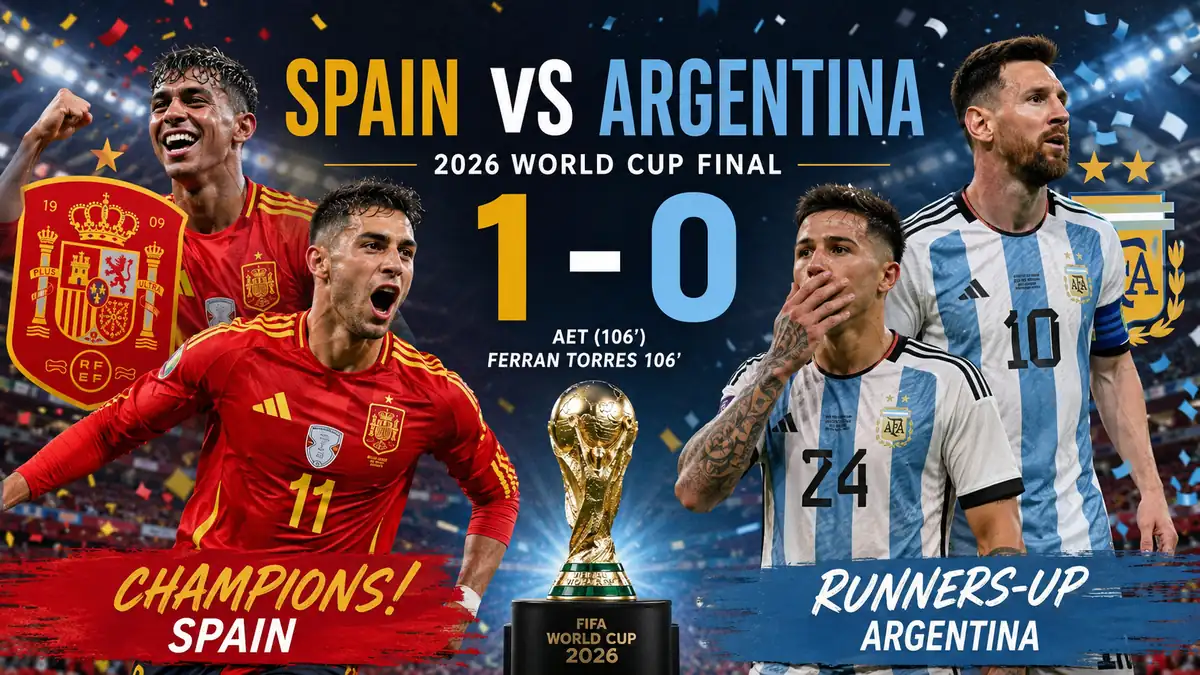
The spain vs argentina 2026 FIFA World Cup final ended Spain 1-0 Argentina after extra time on July 19, 2026. Ferran Torres scored the decisive goal in the 106th minute at New York New Jersey Stadium, giving Spain their second World Cup title and ending Argentina’s reign as champions.
spain vs argentina 2026 World Cup Final at a Glance
The scoreline suggests a narrow contest. The underlying numbers tell a different story.
Spain controlled most of the match, repeatedly forcing Argentina into a deeper defensive shape. Argentina resisted through 90 minutes, but the pressure eventually produced the breakthrough during extra time.
| Match detail | Spain | Argentina |
|---|---|---|
| Final score | 1 | 0 |
| Possession | 65.1% | 34.9% |
| Shots | 20 | 2 |
| Shots on target | 12 | 0 |
| Corners | 9 | 4 |
| Accurate passes | 763 | 357 |
| Passing accuracy | 89.4% | 76.9% |
| Winning goal | Ferran Torres, 106′ | — |
The final was played on July 19, 2026, with an attendance of 80,663. Ferran Torres scored in the 106th minute after the game had finished 0-0 at the end of regulation time.
Who won Spain vs Argentina?
Spain won 1-0 after extra time.
That result made Spain world champions for the second time. Their previous FIFA World Cup triumph came in 2010, when Andrés Iniesta’s extra-time goal defeated the Netherlands in Johannesburg.
The 2026 victory was particularly significant because Spain had already won UEFA Euro 2024. It confirmed that the team’s success in Germany was not an isolated tournament run but part of a sustained period at the top of international football.
How the spain vs argentina Final Unfolded
The first 90 minutes were goalless, but they were far from uneventful.
Spain established territorial control early. Their ability to retain possession forced Argentina to spend long stretches without the ball, while Spain’s midfield continually recycled possession rather than forcing low-percentage attacks.
Argentina’s challenge was to remain compact enough to deny Spain central space while still providing Lionel Messi and the attacking players with an outlet when possession changed hands.
That balance became increasingly difficult to maintain.
Spain controlled possession and territory
Spain finished with 65.1% possession and completed 763 accurate passes. Argentina managed 357.
More striking was the difference in attacking output. Spain attempted 20 shots and put 12 on target. Argentina recorded only two shots and none on target.
Those numbers reveal the fundamental tactical story.
Argentina could defend Spain’s attacks for considerable periods, but they struggled to turn defensive recoveries into sustained possession. That meant another Spanish attack often arrived before Argentina could reorganize higher up the field.
Spain, by contrast, could lose the ball and quickly re-establish control.
Argentina survived the first 90 minutes
For all Spain’s dominance, Argentina kept the match scoreless through regulation.
That matters because tournament finals are not decided by possession percentages. A team can absorb pressure, limit clear openings and wait for one transition or set piece to change the game.
Argentina remained within one moment of winning despite Spain’s statistical advantage.
The physical and disciplinary cost, however, was growing.
Enzo Fernández was dismissed late in regulation, leaving Argentina with an even more difficult task as the game entered extra time.
Ferran Torres’ Goal Decided the World Cup
The breakthrough finally arrived in the 106th minute.
Ferran Torres, who had entered as a substitute for Mikel Oyarzabal, scored the only goal of the final. Nico Williams supplied the decisive ball before Torres finished to put Spain 1-0 ahead.
It was an appropriate winner for the way Spain approached the match.
Rather than becoming impatient after 90 scoreless minutes, Spain continued moving the ball and using fresh attacking options from the bench. Torres provided exactly what a substitute is supposed to provide in extra time: fresh movement against tired defenders and a decisive finish when the opportunity appeared.
Why the 106th-minute goal mattered tactically
Argentina’s defensive task became substantially harder once they were reduced in numbers.
Spain could stretch the pitch, circulate possession and force Argentina to cover increasingly large spaces. Tired legs amplify those problems in extra time.
The Torres goal was therefore more than an isolated flash of finishing. It came after more than 100 minutes in which Spain had repeatedly made Argentina defend.
That cumulative pressure was one of the biggest differences between the teams.
Spain’s Starting Lineup and Key Players
Spain started with Unai Simón in goal and a back line featuring Pedro Porro, Pau Cubarsí, Aymeric Laporte and Marc Cucurella.
Rodri captained the team in midfield, with Fabián Ruiz also playing an important role in Spain’s possession structure. Further forward, Lamine Yamal, Dani Olmo, Álex Baena and Mikel Oyarzabal provided Spain’s attacking options.
The lineup reflected the characteristics that had made Spain so difficult to play against: technical security, intelligent positioning and multiple players capable of receiving the ball under pressure.
Rodri and Spain’s midfield control
Spain’s possession advantage did not simply come from passing sideways.
Rodri’s positioning helped determine where Spain built attacks and how quickly the team could recover its shape after losing possession. Fabián Ruiz and the attacking midfielders gave Spain additional passing angles, allowing the European champions to move Argentina from side to side.
When Argentina tried to protect central areas, Spain could use width.
When Argentina moved outward, spaces could appear between defensive lines.
This is one reason possession-oriented football becomes exhausting to defend against when executed well: the defending team is constantly being asked to make decisions.
Lamine Yamal stretched Argentina’s defensive structure
Lamine Yamal gave Spain another problem-solving tool.
His threat from wide areas meant Argentina could not simply compress every defender into central positions. Even when Yamal was not scoring or providing the final pass, his presence influenced how defenders positioned themselves.
That created space elsewhere for teammates.
This is a key distinction when evaluating attacking players in possession-heavy systems. Their contribution cannot always be measured only through goals and assists. Positioning itself can change the defensive geometry of a match.
Ferran Torres changed the game from the bench
Spain’s squad depth ultimately became decisive.
Torres replaced Oyarzabal in the second half and remained a threat as the match moved into extra time. When the opportunity finally arrived, he scored the goal that decided the World Cup.
Tournament football often rewards teams whose substitutes can maintain or increase the intensity of the starting XI. Spain demonstrated exactly that.
Why Argentina Struggled Against Spain
Argentina entered the final with enormous tournament experience and a squad accustomed to high-pressure knockout football.
But Spain created a matchup that exposed several problems.
The biggest was Argentina’s inability to establish enough possession of their own.
Argentina could not create sustained attacks
Two total shots and zero shots on target are unusually low numbers for a World Cup finalist.
Argentina’s 34.9% possession was not automatically fatal; many successful teams willingly concede the ball. The deeper problem was what happened after Argentina regained it.
They rarely converted those recoveries into long enough attacking sequences to force Spain backward.
As a result, players such as Lionel Messi and Julián Álvarez had limited opportunities to attack an unsettled Spanish defense.
Spain could therefore spend more time playing on their terms.
Spain won the passing battle
Spain completed 763 passes compared with Argentina’s 357, while their passing accuracy was 89.4% against Argentina’s 76.9%.
That gap shows more than stylistic preference.
High passing accuracy allowed Spain to dictate the rhythm and choose when to accelerate. Argentina, meanwhile, had fewer opportunities to rest with the ball.
Over 90 minutes that is demanding.
Over 120 minutes it can become decisive.
Discipline made Argentina’s job harder
Enzo Fernández’s dismissal late in regulation changed the conditions of the match.
Argentina had already spent much of the game defending. Playing extra time while reduced in numbers made it harder to pressure Spain’s ball carriers and cover the width of the pitch simultaneously.
The match became increasingly tilted toward Spain.
This is one of the practical lessons from the final: when facing a possession-heavy opponent, discipline is part of the tactical plan. A red card does not simply remove one player; it changes the amount of space every remaining player must defend.
Quick Takeaway: Spain’s victory was built on sustained possession, superior shot production, midfield control, squad depth and patience. Argentina stayed alive for 90 minutes, but their limited attacking output and disciplinary problems eventually became too costly.
spain vs argentina Head-to-Head History
The rivalry between these national teams stretches back more than seven decades.
Before the 2026 final, Spain and Argentina had met 14 times since their first encounter in 1952. The series was remarkably balanced, with six wins each and two draws.
The World Cup final changed that balance.
FIFA’s updated historical record lists 15 meetings, with Spain moving ahead on seven victories to Argentina’s six, alongside two draws.
Spain vs Argentina historical record
| Category | Record after 2026 World Cup final |
|---|---|
| Total meetings | 15 |
| Spain wins | 7 |
| Argentina wins | 6 |
| Draws | 2 |
| First meeting | 1952 |
| Biggest Spain win | Spain 6-1 Argentina, 2018 |
| Biggest Argentina win | Argentina 4-1 Spain, 2010 |
| Latest meeting | Spain 1-0 Argentina, 2026 World Cup final |
The numbers show why the fixture is so intriguing: neither country has historically dominated the other for long.
Argentina 2-1 Spain — 1966 World Cup
Before 2026, their only World Cup meeting came during the group stage in England in 1966.
Argentina won 2-1, with Luis Artime scoring twice. Pirri scored Spain’s goal. Argentina progressed from the group while Spain were eliminated.
That remained their only World Cup encounter for 60 years.
The next one could hardly have been bigger: a World Cup final.
Argentina 4-1 Spain — 2010
The teams met in Buenos Aires in September 2010, only weeks after Spain had won their first World Cup.
Argentina produced a striking 4-1 victory.
The result is a useful reminder of why friendly results need context. Spain were world champions, but Argentina’s emphatic win did not erase Spain’s competitive achievements.
International friendlies can reveal tactical ideas and individual quality, but tournament knockout matches carry very different pressures.
Spain 6-1 Argentina — 2018
The March 2018 friendly in Madrid produced the largest Spanish victory in the fixture’s history.
Spain won 6-1 at the Wanda Metropolitano.
That result became one of the most frequently remembered Spain-Argentina meetings before 2026.
Again, context matters. Lionel Messi did not play in that match, and a friendly several months before a World Cup is not equivalent to a tournament final.
The 2026 result carries substantially greater historical weight.
What Happened to the Spain vs Argentina Finalissima?
Spain and Argentina were also supposed to meet in the 2026 Finalissima, a one-off match between the champions of Europe and South America.
Spain qualified by winning UEFA Euro 2024, defeating England 2-1 in the final. Argentina qualified as 2024 Copa América champions after beating Colombia 1-0 after extra time. Argentina were also the reigning Finalissima holders after defeating Italy 3-0 in 2022.
The proposed fixture added another layer to the rivalry because it represented a direct meeting between the two dominant continental champions.
The Finalissima format itself grew from cooperation between UEFA and CONMEBOL. Previous editions or predecessor matches had featured France against Uruguay in 1985, Argentina against Denmark in 1993 and Argentina against Italy in 2022.
Ultimately, the match that defined Spain and Argentina in 2026 came on an even bigger stage: the FIFA World Cup final.
Spain and Argentina’s Different Football Identities
A spain vs argentina comparison is interesting because both countries possess elite technical talent but have developed distinct football identities.
Spain’s modern reputation is strongly associated with positional play, ball retention, midfield control and patient buildup. The national team’s golden generation took those principles to extraordinary heights between 2008 and 2012.
Argentina’s identity has historically been more varied.
The Albiceleste have produced creative playmakers, aggressive defenders, technically gifted forwards and teams capable of adapting their style to the opponent. Their recent success also showed the value of tactical flexibility and competitive resilience.
Spain’s strengths
At their best, Spain can:
- dominate possession for long periods;
- create overloads in midfield;
- stretch defenses with wide attackers;
- press immediately after losing the ball;
- control match tempo through technically secure midfielders;
- use patient circulation to create higher-quality openings.
The danger is that possession can become sterile if opponents protect the penalty area effectively.
That was a recurring criticism of some previous Spanish teams.
The 2026 side showed a more direct edge. Twenty attempts and 12 shots on target in the final demonstrate that possession was being converted into genuine attacking pressure.
Argentina’s strengths
Argentina’s best teams combine:
- technical creativity;
- physical competitiveness;
- strong defensive organization;
- rapid transitions;
- individual attacking quality;
- emotional resilience in knockout football.
Those characteristics helped Argentina win the 2022 World Cup and the Copa América in both 2021 and 2024.
Against Spain in 2026, however, Argentina could not produce enough attacking threat to balance the amount of defending they were required to do.
Lionel Messi and the 2026 World Cup Final
Any discussion of Argentina in this era inevitably includes Lionel Messi.
Messi had already completed one of international football’s most celebrated careers before the 2026 tournament, winning the Copa América and then leading Argentina to the 2022 FIFA World Cup title in Qatar.
The 2026 final offered Argentina the chance to retain the trophy.
Instead, Spain denied them back-to-back world championships.
Sky Sports described the match as what was expected to be Messi’s final World Cup appearance, although the historical importance of his international career was already secure regardless of the result.
That distinction matters.
A player’s legacy should not be reduced to the outcome of one final. Messi had already won the World Cup, Copa América and Finalissima with Argentina.
The 2026 defeat changed the ending of this particular tournament, not the achievements that preceded it.
What Spain’s Victory Means Historically
Spain’s 2026 triumph placed another landmark alongside the country’s first World Cup victory in 2010.
FIFA records the 1-0 victory as Spain’s second world championship, with Ferran Torres providing the decisive extra-time goal.
There is also a broader significance.
Spain’s Euro 2024 success demonstrated the emergence of another elite generation. Winning the World Cup two years later transformed that promise into a sustained championship cycle.
Young talent such as Lamine Yamal and Pau Cubarsí could coexist with established players including Rodri, Dani Olmo and other experienced internationals.
That combination matters in tournament football.
Youth provides energy and unpredictability. Experience provides game management and composure when matches become tight.
Spain had both.
What the Match Teaches About Tournament Football
The final provides several lessons that extend beyond Spain and Argentina.
Possession matters when it creates pressure
Possession alone does not win football matches.
Spain’s 65.1% share mattered because it was accompanied by 20 shots, 12 efforts on target and sustained territorial pressure.
That is productive possession.
Defending without attacking eventually becomes dangerous
Argentina demonstrated that an organized team can survive long periods without the ball.
But defending needs an attacking release.
Without enough counterattacks or possession sequences, pressure accumulates. Players tire, defensive distances grow and individual mistakes become more likely.
Substitutions can decide finals
Ferran Torres did not start the match.
He still became its defining player.
Tournament winners often need contributions from beyond their preferred starting XI. Spain’s ability to introduce Torres, Mikel Merino, Nico Williams, Pedri and other options gave the team ways to change the match as fatigue increased.
Discipline is tactical
Cards are sometimes discussed separately from tactics, but they are closely connected.
When a player is dismissed, every remaining player inherits additional defensive responsibility. Against a team that already controls possession and width, that can be devastating.
Argentina discovered that at the worst possible moment.
Spain vs Argentina: Which Team Has the Better Head-to-Head Record?
After the 2026 World Cup final, Spain hold the advantage.
FIFA lists the overall series at 15 matches: seven Spanish victories, six Argentine victories and two draws.
But the competitive history deserves additional context.
Argentina won their 1966 World Cup meeting 2-1. Spain then won the much more consequential 2026 encounter 1-0 to claim the world championship.
Most other meetings between the countries have been friendlies.
That means raw head-to-head totals are useful, but they do not tell the entire story. Competition, venue, available players and historical context all matter when comparing results across more than 70 years.
Final Takeaway
The latest chapter of spain vs argentina belongs to Spain.
Their 1-0 extra-time victory in the 2026 FIFA World Cup final was built on control rather than a single lucky moment. Spain had 65.1% possession, attempted 20 shots to Argentina’s two and repeatedly forced the defending champions deeper before Ferran Torres finally scored in the 106th minute.
Argentina’s organization kept the match scoreless through 90 minutes, but limited attacking output and the difficulty of defending with reduced numbers eventually caught up with them.
Historically, the result was enormous. Spain secured their second World Cup, moved ahead in the overall head-to-head record and added the sport’s biggest trophy to the European title won two years earlier.
For anyone looking back at spain vs argentina, the 2026 final will now be the defining meeting: two world football powers, 120 minutes of tension, and one Ferran Torres goal separating them on the biggest stage.
