

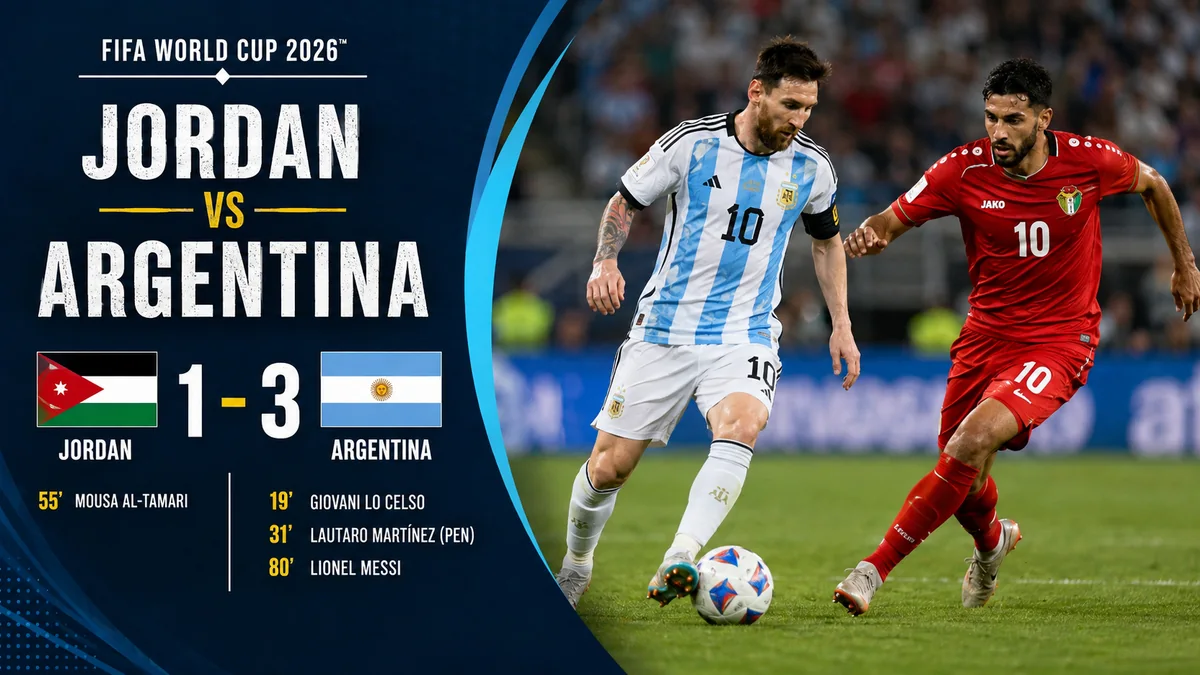
The jordan vs argentina matchup brought together two national teams with very different World Cup histories, but Jordan made sure the contest was more competitive than the final score alone suggests.
Argentina ultimately won 3-1 in their FIFA World Cup 2026 Group J meeting at AT&T Stadium in Arlington, Texas. Giovani Lo Celso and Lautaro Martínez put Argentina 2-0 ahead before Mousa Al-Tamari pulled one back for Jordan. Lionel Messi then came off the bench and scored Argentina’s third goal.
Quick answer: Argentina defeated Jordan 3-1 in their FIFA World Cup 2026 Group J match. Lo Celso opened the scoring in the 19th minute, Martínez converted a penalty in the 31st, Al-Tamari scored for Jordan in the 55th, and Messi completed the scoring in the 80th minute.
jordan vs argentina Final Score and Match Details
The match was played as the final round of fixtures in Group J of the 2026 FIFA World Cup.
| Match detail | Information |
|---|---|
| Competition | FIFA World Cup 2026 |
| Stage | Group J |
| Match | Jordan vs Argentina |
| Final score | Jordan 1-3 Argentina |
| Venue | AT&T Stadium, Arlington, Texas |
| Attendance | 70,649 |
| Jordan scorer | Mousa Al-Tamari, 55′ |
| Argentina scorers | Giovani Lo Celso 19′, Lautaro Martínez 31′ (pen.), Lionel Messi 80′ |
The official match data lists Argentina with a clear advantage in possession and attacking production. Jordan, however, remained within one goal for much of the second half after Al-Tamari’s strike.
How Argentina Beat Jordan 3-1
Argentina controlled the ball from the opening stages and gradually forced Jordan deeper.
Jordan’s approach was understandably more conservative. Rather than trying to dominate possession against one of international football’s strongest technical teams, Jordan focused on maintaining its defensive structure and looking for opportunities to break forward.
That strategy kept the game relatively controlled early on, but Argentina’s passing eventually created the openings it needed.
Giovani Lo Celso Opens the Scoring
The breakthrough arrived in the 19th minute.
Giovani Lo Celso gave Argentina a 1-0 lead, rewarding a period in which the South American side had increasingly controlled possession and territory.
Going behind changed Jordan’s challenge significantly. Sitting deep becomes much harder when the opposition no longer needs to chase the opening goal.
Argentina could now circulate possession patiently and wait for Jordan to leave spaces.
Lautaro Martínez Makes It 2-0
Argentina doubled its advantage in the 31st minute when Lautaro Martínez converted a penalty.
That gave Argentina a comfortable 2-0 lead before halftime.
Martínez’s goal was particularly important because it allowed Argentina to manage the tempo instead of turning the second half into an unnecessarily open contest.
Jordan entered halftime needing at least two goals to get back on level terms.
Jordan Responds Through Mousa Al-Tamari
Jordan did not simply accept the result after falling two goals behind.
Changes at halftime helped produce a more dangerous attacking threat, with Mousa Al-Tamari entering the match and quickly making an impact.
In the 55th minute, Al-Tamari scored to reduce the deficit to 2-1, with Ehsan Haddad credited with the assist in match event data.
Suddenly, the match had a different feel.
Argentina still controlled most of the possession, but a single Jordan goal could have changed the situation completely.
For Jordan, Al-Tamari’s goal represented one of the biggest moments of the match. The team had spent long periods defending without the ball, yet it showed that Argentina could still be punished when Jordan found space to attack.
Why Al-Tamari Was So Important
Against a possession-heavy opponent, Jordan needed someone capable of turning a transition into a genuine attacking threat.
Al-Tamari provided exactly that.
His pace and directness gave Jordan an outlet when possession was recovered. Instead of simply clearing the ball and immediately defending another Argentine attack, Jordan had a player capable of carrying the threat toward the opposite penalty area.
The goal also demonstrated an important tactical lesson: possession does not guarantee complete control.
Argentina had much more of the ball, but Jordan still found a way to create a meaningful moment.
Lionel Messi Scores After Coming Off the Bench
Argentina responded to Jordan’s improved second-half threat by turning to Lionel Messi.
Messi entered around the hour mark, replacing Lautaro Martínez, as Argentina looked to regain complete control of the game.
Twenty minutes later, he scored.
Messi’s 80th-minute goal made the score 3-1 and effectively ended Jordan’s hopes of producing a late comeback.
The goal carried additional historical significance. Sky Sports reported that Messi became the first male player to score in seven consecutive World Cup matches, continuing his remarkable record at the tournament.
For a match already notable because it was Jordan’s first World Cup meeting with Argentina, having Messi add another record made the occasion even more memorable.
jordan vs argentina Match Stats
The statistics illustrate just how much control Argentina had.
| Statistic | Jordan | Argentina |
| Possession | 27% | 73% |
| Shots | 5 | 12 |
| Shots on target | 1 | 4 |
| Expected goals (xG) | 0.74 | 2.13 |
| Big chances | 1 | 3 |
| Corners | 2 | 6 |
| Passing accuracy | 80% | 92% |
| Fouls | 13 | 7 |
| Yellow cards | 3 | 0 |
Official match statistics put possession at roughly 27% for Jordan and 73% for Argentina, while Argentina recorded 12 shots compared with Jordan’s five. Argentina also completed its passes at a 92% rate, compared with Jordan’s 80%.
What the Possession Numbers Tell Us
The possession difference was enormous, but it needs context.
Argentina attempted 801 passes, with 737 finding a teammate. Jordan attempted 285 and completed 228.
That reflects the basic tactical pattern of the match.
Argentina wanted to control territory through the ball. Jordan spent more time defending and attempted to attack through quicker transitions.
Argentina’s passing accuracy also made it difficult for Jordan to create sustained pressure. Winning possession is only the first step against an elite possession team; keeping the ball afterward is equally important.
Jordan struggled to do that consistently.
Shots and Chances
Argentina generated 12 shots, with four on target.
Jordan managed five shots and only one on target—the effort that produced Al-Tamari’s goal.
Expected-goals data produced a similar picture. Argentina generated 2.13 xG, while Jordan recorded 0.74 xG.
Argentina therefore deserved its victory based on both the traditional statistics and the quality of opportunities created.
Quick Takeaway: Jordan was efficient enough to turn its limited attacking opportunities into a goal, but Argentina generated more chances, controlled possession and consistently moved the game into Jordan’s defensive third.
Jordan vs Argentina Lineups and Tactical Setup
Jordan started with a 3-4-2-1 formation, while Argentina was listed in a 4-4-2 setup.
Jordan Starting XI
Jordan’s starting side included:
- Yazeed Abulaila
- Husam Abu Dahab
- Yazan Al-Arab
- Abdallah Nasib
- Mohannad Abu Taha
- Ehsan Haddad
- Noor Al-Rawabdeh
- Nizar Al-Rashdan
- Ali Olwan
- Ali Azaizeh
- Odeh Fakhoury
Jordan’s three-player defensive structure gave the team additional protection centrally, while Haddad and Abu Taha had significant responsibilities across the wider areas.
Argentina Starting XI
Argentina started with:
- Emiliano Martínez
- Nicolás Tagliafico
- Marcos Senesi
- Nicolás Otamendi
- Exequiel Palacios
- Giovani Lo Celso
- Leandro Paredes
- Nicolás Paz
- Giuliano Simeone
- Julián Álvarez
- Lautaro Martínez
Messi therefore did not start the match.
Argentina had enough attacking quality through Julián Álvarez and Lautaro Martínez to begin without him, while Lo Celso provided creativity from midfield.
The decision also showed the depth available to Argentina: Messi, Alexis Mac Allister and Thiago Almada were among the players introduced during the second half.
Key jordan vs argentina Moments
Four goals decided the contest, but the flow of the match can be understood through several key moments.
19′ — Argentina Take the Lead
Lo Celso’s opening goal gave Argentina control of the scoreboard as well as possession.
31′ — Martínez Converts the Penalty
Lautaro Martínez made it 2-0 from the penalty spot, putting Jordan under serious pressure before halftime.
46′ — Jordan Changes Its Attack
Mousa Al-Tamari and Mahmoud Al-Mardi were introduced at halftime as Jordan searched for a route back into the game.
55′ — Al-Tamari Gives Jordan Hope
The substitute needed only around ten minutes to make an impact, scoring Jordan’s only goal.
At 2-1, the possibility of an upset briefly returned.
60′ — Messi Enters
Argentina responded by introducing Messi alongside other second-half changes.
80′ — Messi Makes It 3-1
Messi’s goal restored Argentina’s two-goal cushion and effectively settled the result.
What Worked for Argentina?
Argentina’s biggest advantage was its ability to control the match without becoming overly dependent on one attacking route.
The team could build through midfield, use combinations around the penalty area or bring fresh creative players from the bench.
Three things stood out.
1. Passing Control
A 92% passing accuracy over such a large volume of possession made it extremely difficult for Jordan to establish momentum.
Argentina repeatedly recycled possession rather than forcing low-percentage attacks.
2. Multiple Goal Threats
Argentina did not depend exclusively on Messi.
Lo Celso and Lautaro Martínez had already established a two-goal lead before Messi entered the match.
That attacking variety matters in tournament football because opponents cannot simply design their defensive structure around stopping one player.
3. Stronger Squad Depth
Jordan improved after halftime and cut the deficit to one goal.
Argentina could answer by introducing Messi, Mac Allister and Almada.
That difference in available depth became increasingly important as the match progressed.
What Jordan Did Well Despite Losing
A 3-1 defeat can make Jordan’s performance look more straightforward than it actually was.
Argentina deserved the win, but Jordan produced several encouraging moments.
Jordan Stayed Competitive
Even after conceding twice in the opening 31 minutes, Jordan continued trying to find a route back into the match.
The halftime substitutions were proactive rather than merely defensive.
Al-Tamari’s goal rewarded that approach.
Defensive Work Rate Remained High
Jordan made 19 interceptions and 13 clearances, according to the detailed match statistics.
Those numbers reflect how much defending the team was required to do.
Jordan could not stop Argentina completely, but it repeatedly disrupted attacks and prevented the possession advantage from producing an even larger score.
Jordan Scored Against Elite Opposition
Jordan generated only one shot on target, but it converted it.
For a team spending most of the game without possession, that efficiency matters.
The problem was creating enough additional opportunities after reaching 2-1.
Was jordan vs argentina Their First Meeting?
Yes, this was the first World Cup meeting between the two countries.
Available head-to-head records list the 2026 encounter as the only FIFA World Cup match between Argentina and Jordan, giving Argentina a record of one win from one meeting and a 3-1 aggregate goal advantage.
The significance was particularly high for Jordan because 2026 marked the country’s World Cup debut. The Group J match therefore created a new chapter in Jordanian football history rather than extending an established rivalry.
That distinction matters when interpreting the keyword “Jordan vs Argentina.” This was not a long-running international rivalry with decades of previous results. It was a first-time World Cup matchup between teams with dramatically different tournament histories.
What Did the Result Mean for Group J?
Argentina’s victory completed a perfect group stage.
The final Group J standings showed:
| Position | Team | Played | Wins | Draws | Losses | Goal Difference | Points |
| 1 | Argentina | 3 | 3 | 0 | 0 | +7 | 9 |
| 2 | Austria | 3 | 1 | 1 | 1 | 0 | 4 |
| 3 | Algeria | 3 | 1 | 1 | 1 | -2 | 4 |
| 4 | Jordan | 3 | 0 | 0 | 3 | -5 | 0 |
Argentina finished first with nine points from three matches, scoring eight goals and conceding only one.
Jordan finished fourth after three defeats, scoring three goals and conceding eight.
For Argentina, the Jordan victory confirmed an excellent group-stage campaign and maintained momentum heading into the knockout rounds.
For Jordan, the tournament ended without a point, but simply competing at the World Cup represented a major milestone for the national team.
Jordan vs Argentina: What the Match Really Showed
The scoreline reflected Argentina’s superiority, but the match also demonstrated why international tournament games cannot be reduced to reputation alone.
Argentina dominated possession, completed far more passes and created more chances. Its technical quality and squad depth eventually produced a deserved 3-1 victory.
Jordan still had its moment.
Al-Tamari’s second-half goal turned a comfortable 2-0 match into a genuine contest for a period. Jordan’s willingness to make attacking changes at halftime also showed that the team was prepared to challenge Argentina rather than simply protect the scoreline.
The difference was Argentina’s ability to respond.
When Jordan created uncertainty, Argentina could bring Lionel Messi onto the field. His 80th-minute goal restored the two-goal advantage and closed the door on a comeback.
For anyone reviewing jordan vs argentina, the essential story is straightforward: Argentina controlled the match and deserved the victory, Jordan produced a spirited second-half response, and Messi supplied the final defining moment of a historic first meeting between the two national teams.
