

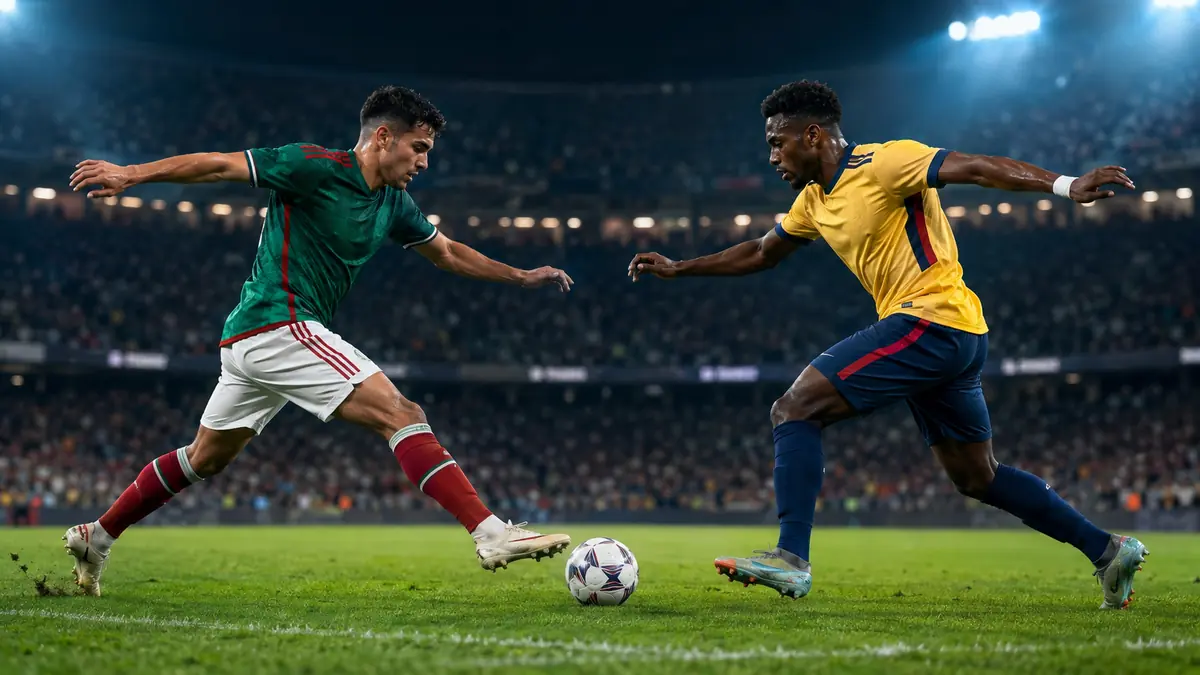
Mexico’s long wait for a World Cup knockout victory finally ended in front of an energized home crowd. El Tri defeated Ecuador 2-0 in the Round of 32, combining an aggressive first-half attack with disciplined defending to secure a place in the last 16.
Mexico beat Ecuador 2-0 at Mexico City Stadium on June 30, 2026. Julián Quiñones opened the scoring in the 22nd minute, and Raúl Jiménez doubled the advantage nine minutes later. Ecuador had more possession but created few clear chances, while Mexico recorded 15 attempts and protected another clean sheet.
mexico vs ecuador Final Score and Match Details
| Match detail | Information |
|---|---|
| Competition | 2026 FIFA World Cup |
| Stage | Round of 32 |
| Final score | Mexico 2-0 Ecuador |
| Date | June 30, 2026 |
| Venue | Mexico City Stadium, Mexico City |
| Mexico scorers | Julián Quiñones 22’, Raúl Jiménez 31’ |
| Ecuador red card | Piero Hincapié 90+5’ |
| Result | Mexico advanced to the Round of 16 |
Mexico entered the knockout round after winning all three of its group-stage matches without conceding. Ecuador arrived as one of the best third-place teams, having secured a notable 2-1 victory over Germany in its final group fixture.
That contrast shaped expectations. Mexico had momentum, home support and a settled defensive structure, while Ecuador possessed the athleticism and midfield quality to disrupt the host nation. The match initially looked balanced, but Mexico’s sharper execution in the final third settled it.
According to the official FIFA match centre, Mexico finished with 15 attempts compared with only two from Ecuador. That difference explains the result more clearly than possession alone.
How Mexico Defeated Ecuador 2-0
Mexico did not simply sit back and wait for its opponent to make a mistake. Javier Aguirre’s side pressed with purpose, attacked through several channels and moved the ball forward quickly whenever Ecuador’s midfield structure opened.
Julián Quiñones scored the opening goal
The breakthrough came in the 22nd minute. Roberto Alvarado found Julián Quiñones, who produced a powerful finish to give Mexico a 1-0 lead.
The goal rewarded Mexico’s stronger opening phase. El Tri had already created promising opportunities through Gilberto Mora and Raúl Jiménez, forcing Ecuador to defend closer to its own penalty area than intended.
Quiñones’ movement was central to the attack. He occupied spaces between Ecuador’s defenders, stretched the back line and provided a direct running threat whenever Mexico recovered possession.
Raúl Jiménez doubled Mexico’s lead
Nine minutes after the opener, Jiménez made it 2-0. The experienced striker’s goal gave Mexico control before halftime and raised his international tally to 47.
Jiménez offered more than finishing. His ability to hold up the ball allowed teammates to advance, while his movement pulled Ecuadorian defenders away from their preferred positions. Mexico could therefore attack without committing every player forward.
The second goal changed Ecuador’s task completely. A team designed to remain compact and attack selectively now needed to take greater risks against an opponent thriving in transition.
Ecuador could not turn possession into chances
Ecuador saw more of the ball during portions of the match, but much of that possession occurred away from Mexico’s goal. The South American side struggled to break through César Montes, Johan Vásquez and the wider defensive cover provided by Mexico’s full-backs.
John Yeboah came close when an effort struck the woodwork, while goalkeeper Raúl Rangel made an important intervention before halftime. Those moments showed Ecuador was not entirely without danger, but clear openings were rare.
Moises Caicedo helped Ecuador circulate possession and recover loose balls, yet the team lacked penetration around the penalty area. Enner Valencia was frequently isolated, and Mexico prevented Gonzalo Plata and Nilson Angulo from consistently attacking favorable one-on-one situations.
mexico vs ecuador Match Statistics Explained
The headline statistics reveal two different approaches. Ecuador attempted to control stretches of the game through possession, whereas Mexico generated substantially more attacking output.
| Statistic | Mexico | Ecuador |
|---|---|---|
| Goals | 2 | 0 |
| Total attempts | 15 | 2 |
| Attacking possession | 37% | 52% |
| Possession in contest | 11% | 11% |
| First-half goals | 2 | 0 |
| Red cards | 0 | 1 |
Possession can be misleading when considered on its own. Ecuador’s 52% attacking-possession figure did not produce sustained pressure or a high volume of shots. Mexico’s 37% was far more productive because the host nation progressed the ball quickly and entered dangerous areas with greater frequency.
Mexico also understood the game state. Once ahead by two goals, the team did not need to dominate the ball. Its priority became controlling space, limiting transitions and forcing Ecuador to attack through crowded central areas.
Piero Hincapié’s red card in the fifth minute of second-half stoppage time came too late to influence the outcome. It instead reflected Ecuador’s frustration at being unable to find a route back into the contest.
Tactical Analysis: Why Mexico Controlled the Match
Mexico’s victory rested on four tactical advantages rather than one spectacular individual performance.
1. Mexico pressed Ecuador’s buildup
El Tri applied pressure when Ecuador tried to construct attacks from the back. Jiménez screened central passing options while Quiñones and the wide players moved toward the defenders receiving the ball.
This did not mean Mexico pressed at maximum intensity for all 90 minutes. The pressure was selective. Mexico accelerated when Ecuador played toward a vulnerable area, then dropped into a compact defensive shape if the first press was bypassed.
2. Gilberto Mora connected midfield and attack
Seventeen-year-old Gilberto Mora played with unusual composure for a match of this importance. He operated between Ecuador’s midfield and defensive lines, combined in tight spaces and helped Mexico move from recovery to attack.
Mora’s performance mattered because Ecuador’s midfield contained Caicedo, one of the strongest ball-winning midfielders in international football. Rather than confronting that strength through predictable central play, Mexico used intelligent movement and quick combinations to create alternative passing angles.
3. Mexico attacked before Ecuador could reset
A major difference between the teams was the speed of their attacking transitions. Mexico looked forward immediately after regaining possession. Ecuador often required additional passes before entering the final third, giving El Tri time to reorganize.
Quiñones was particularly valuable in these moments. His direct running forced Willian Pacho, Joel Ordóñez and Hincapié to retreat, creating room for Jiménez and arriving midfielders.
4. The defensive unit protected central space
Mexico accepted that Ecuador could have spells of possession. The crucial decision was where that possession would occur.
Montes and Vásquez stayed compact, while Jorge Sánchez and Jesús Gallardo balanced their attacking responsibilities with defensive positioning. Erik Lira provided protection in front of the center-backs and helped restrict passes into Valencia.
The result was a familiar pattern: Ecuador moved the ball across midfield but encountered several defenders once it approached the penalty area.
Quick takeaway: Mexico won because its attacks were faster, its chances were clearer and its defensive structure remained intact after taking the lead. Ecuador had possession without enough penetration.
What the Result Meant for Mexico
This was more than another knockout-round victory. Mexico had not won a World Cup elimination match since defeating Bulgaria in the Round of 16 in 1986.
Seven consecutive tournaments between 1994 and 2018 had ended for Mexico at the same stage. The team then failed to advance from its group in 2022. That history created a psychological barrier around World Cup knockout football.
The 2-0 victory ended the 40-year drought and returned El Tri to the last 16. Mexico also opened the 2026 tournament with four consecutive victories and four clean sheets, having previously beaten South Africa, South Korea and the Czech Republic.
Home advantage played a role. Mexico was competing in the first men’s World Cup hosted across Canada, Mexico and the United States, with the Mexico City crowd adding intensity to every successful tackle and attacking move.
Aguirre’s side nevertheless had to turn that emotion into controlled football. The impressive part was not merely that Mexico won at home; it was that the team handled the pressure without becoming tactically reckless.
What Went Wrong for Ecuador?
Ecuador entered the match with legitimate reasons for confidence. Sebastián Beccacece’s team had finished second in the CONMEBOL qualifying standings and possessed a young, physically strong squad featuring several players based at prominent European clubs.
Its weaknesses against Mexico were primarily structural.
The attack became too predictable
Ecuador struggled to move the ball through the center, so attacks increasingly shifted toward the wings. Mexico anticipated those passes and prevented the wide players from receiving in enough space to accelerate.
When crosses arrived, Valencia was often surrounded by multiple defenders. There were too few late runs from midfield to unsettle Mexico’s defensive line.
Early chances were not converted
Yeboah’s effort against the woodwork could have changed the rhythm of the match. At 0-0, Ecuador still had the option to remain compact. Once Mexico scored twice, Ecuador had to chase the game.
Knockout matches often turn on a small number of moments. Mexico converted its strong first-half period; Ecuador did not.
Possession lacked urgency
Ecuador’s midfield was capable of retaining the ball, but circulation sometimes became too cautious. Sideways passes allowed Mexico’s defensive block to shift without opening significant gaps.
Caicedo could influence the buildup, but he could not perform every role simultaneously. Ecuador needed more creativity between the lines and more coordinated movement around Valencia.
Mexico disrupted Ecuador’s strongest players
Hincapié and Pacho were prevented from stepping forward as freely as usual because Mexico left runners near the defensive line. Plata received close attention, while Valencia lacked consistent service.
By isolating those players, Mexico reduced Ecuador’s ability to transform possession into meaningful attacks.
Mexico vs Ecuador Head-to-Head Record
Mexico has historically held the advantage in this matchup, although totals vary between databases because some sources include a different selection of friendlies and unofficial fixtures.
One widely used historical database records 26 senior meetings before or including the latest tournament encounter, with Mexico winning 15, Ecuador winning four and seven ending in draws. Other platforms display smaller totals because they count only matches covered within their databases.
The safest way to interpret the rivalry is straightforward: Mexico leads the overall series, but recent meetings before the 2026 World Cup were competitive.
| Recent meeting | Competition | Result |
|---|---|---|
| June 30, 2026 | FIFA World Cup | Mexico 2-0 Ecuador |
| October 14, 2025 | International friendly | Mexico 1-1 Ecuador |
| June 30, 2024 | Copa América | Mexico 0-0 Ecuador |
| June 5, 2022 | International friendly | Mexico 0-0 Ecuador |
| October 27, 2021 | International friendly | Mexico 2-3 Ecuador |
| June 9, 2019 | International friendly | Mexico 3-2 Ecuador |
The sequence shows why the 2026 result was not considered automatic. Mexico had failed to win the previous four encounters, including the decisive Copa América meeting in 2024.
Previous Mexico vs Ecuador World Cup Meetings
The two national teams have met twice at the FIFA World Cup.
Mexico 2-1 Ecuador in 2002
Their first World Cup encounter took place during the 2002 tournament in South Korea and Japan. Agustín Delgado gave Ecuador an early lead in the fifth minute, scoring his country’s first goal at a World Cup.
Mexico responded through Jared Borgetti in the 28th minute before Gerardo Torrado completed the comeback in the 57th. The 2-1 win helped Mexico progress from Group G, while Ecuador was eliminated despite later defeating Croatia.
Mexico 2-0 Ecuador in 2026
The second World Cup meeting carried greater immediate consequences because it was a knockout match. Goals from Quiñones and Jiménez again gave Mexico the victory, preserving its perfect World Cup record against Ecuador.
Across those two tournament meetings, Mexico has:
- Won both matches
- Scored four goals
- Conceded one goal
- Recorded one clean sheet
- Eliminated Ecuador directly in 2026
How the 2026 Match Differed From Copa América 2024
The 0-0 draw at the 2024 Copa América provides the clearest comparison with the World Cup meeting.
In 2024, Ecuador needed a draw to advance from Group B, while Mexico needed to win. Ecuador defended compactly, managed the game effectively and survived a late penalty decision that was overturned following a video review. Mexico generated pressure but lacked the finishing quality required to score.
The 2026 match reversed that pattern in several ways:
| Area | Copa América 2024 | World Cup 2026 |
|---|---|---|
| Mexico’s finishing | Wasteful | Clinical in the first half |
| Ecuador’s defensive shape | Compact for most of the match | Exposed during transitions |
| Match pressure | Mexico had to chase a winner | Ecuador had to chase after falling behind |
| Final score | 0-0 | Mexico 2-0 Ecuador |
| Consequence | Ecuador advanced; Mexico exited | Mexico advanced; Ecuador exited |
Mexico learned from the earlier frustration. Rather than relying on prolonged possession around Ecuador’s defensive block, the team attacked more directly and used movement to create higher-quality opportunities.
Key Players Who Decided the Game
Julián Quiñones
Quiñones supplied the opening goal and consistently threatened Ecuador with his pace. His willingness to attack space made Mexico less predictable and prevented the opposing back line from stepping into midfield.
Raúl Jiménez
Jiménez combined experience, physical play and composed finishing. His 31st-minute goal gave Mexico breathing room, while his hold-up work helped the team retain possession during difficult phases.
Gilberto Mora
Mora demonstrated creativity and maturity in midfield. His confidence under pressure allowed Mexico to progress the ball without depending entirely on wide attacks.
Raúl Rangel
Rangel preserved Mexico’s advantage when Ecuador threatened before halftime. Goalkeepers can appear peripheral in controlled victories, but one save at the right moment can prevent the entire match from changing.
Moises Caicedo
Caicedo remained Ecuador’s most important midfield presence. He recovered possession and helped his team control portions of the ball, but Mexico limited the progressive options around him.
Piero Hincapié
Hincapié was central to Ecuador’s defensive structure, although his late dismissal ended a frustrating evening. Mexico’s movement repeatedly forced Ecuador’s defenders to make decisions while retreating toward their own goal.
Final Assessment
The latest mexico vs ecuador contest demonstrated why effective possession matters more than possession volume. Ecuador held the ball for longer stretches, but Mexico created far more opportunities, scored twice in nine first-half minutes and defended the penalty area with discipline.
For Mexico, the 2-0 victory ended four decades without a World Cup knockout win and confirmed the value of Aguirre’s balanced approach. Quiñones supplied the breakthrough, Jiménez added experience and finishing, Mora connected the attack, and the defense delivered another clean sheet.
For Ecuador, the elimination exposed a need for greater creativity and sharper movement in the final third. The team had the technical and physical quality to compete, but it could not convert territorial control into shots.
The clearest lesson from mexico vs ecuador is simple: Mexico recognized the decisive moments and executed them. Ecuador controlled periods of play; Mexico controlled the outcome.
