

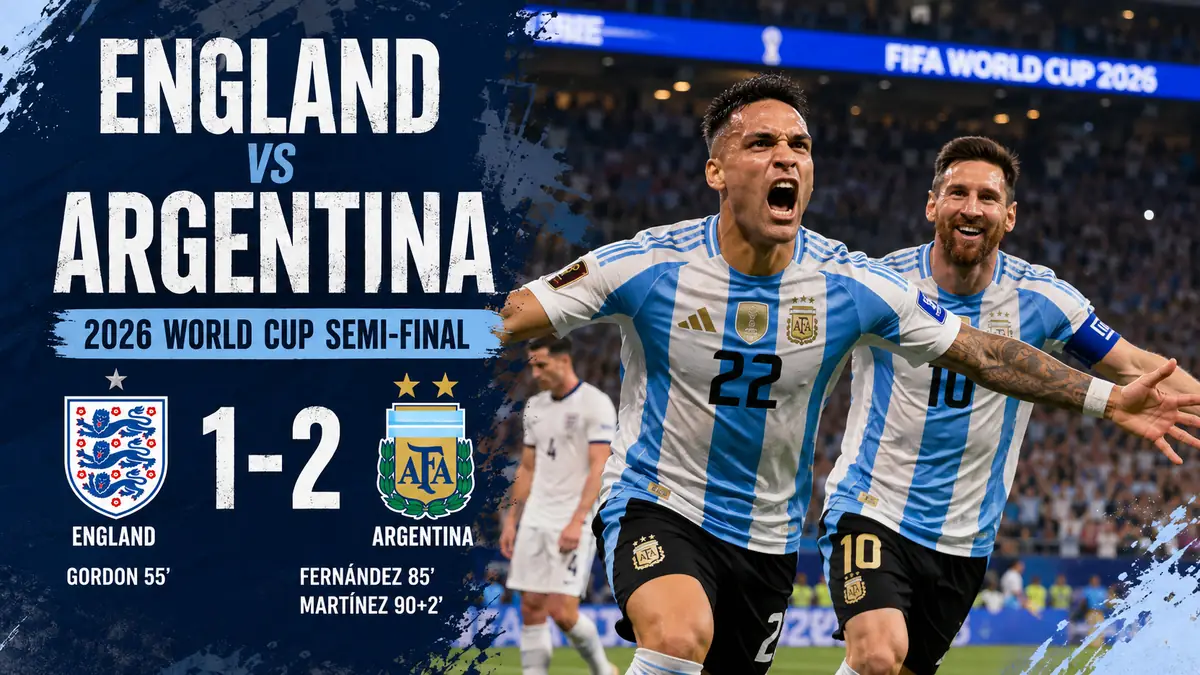
Few international football fixtures carry the history of england vs argentina, and their long-awaited reunion at the 2026 FIFA World Cup delivered another unforgettable chapter.
England appeared to be heading for their first World Cup final since 1966 after Anthony Gordon put the Three Lions ahead. Argentina refused to fold. Enzo Fernández equalised in the 85th minute before Lautaro Martínez completed a stunning turnaround in stoppage time, sending the defending champions into another final.
Quick answer: Argentina defeated England 2-1 in the FIFA World Cup semi-final on July 15, 2026, in Atlanta. Anthony Gordon scored for England in the 55th minute, but Enzo Fernández equalised in the 85th before Lautaro Martínez headed home the winner in the 92nd minute. Lionel Messi assisted both Argentina goals.
england vs argentina 2026 Match at a Glance
The semi-final was played at Mercedes-Benz Stadium in Atlanta in front of 68,239 spectators. England entered the game seeking a return to the World Cup final for the first time in 60 years, while Lionel Scaloni’s Argentina were attempting to defend the title they had won in 2022.
| Match detail | England | Argentina |
|---|---|---|
| Final score | 1 | 2 |
| Goals | Anthony Gordon 55′ | Enzo Fernández 85′, Lautaro Martínez 90+2′ |
| Possession | 35.8% | 64.2% |
| Shots | 5 | 15 |
| Shots on target | 2 | 5 |
| Corners | 1 | 6 |
| Accurate passes | 273 | 537 |
| Passing accuracy | 84% | 91.3% |
| Yellow cards | 1 | 3 |
Argentina’s statistical advantage tells much of the story. They recorded roughly 64% possession, attempted three times as many shots and completed almost twice as many accurate passes as England.
The numbers alone, however, do not explain how close England came to winning.
How Argentina Beat England 2-1
A tense first half produced few chances
Given the attacking talent on the pitch, the opening period was remarkably cautious.
Neither team managed a shot on target before half-time. According to Opta, the teams committed 19 fouls in the first half, while their combined expected goals figure was only 0.08. It was also the first World Cup match in Opta’s records going back to 1966 without a shot during the opening 30 minutes.
John Stones came close when he headed wide from a Declan Rice free-kick. At the other end, Enzo Fernández fired over after a Lionel Messi attempt had been blocked.
England were disciplined without the ball, while Argentina patiently circulated possession looking for openings.
The pattern changed dramatically after half-time.
Anthony Gordon gives England the lead
Argentina initially came out with greater attacking intent.
Julián Álvarez tested England’s defence, but Jordan Pickford and the players in front of him kept Argentina out.
Then England produced the breakthrough.
Declan Rice moved the ball to Morgan Rogers, whose delivery found Anthony Gordon. Gordon finished the move in the 55th minute to make it England 1-0 Argentina.
For England supporters, the possibility of a first World Cup final since the famous 1966 triumph suddenly felt very real.
Gordon’s contribution also continued an impressive individual run. Opta noted that he had been directly involved in six goals across his previous seven England appearances after the strike.
But scoring first eventually changed England’s approach.
Why the Match Changed After England Scored
The most important tactical story of england vs argentina was not simply Argentina’s late goals. It was how the balance of the match shifted once England went ahead.
Thomas Tuchel attempted to protect the advantage with defensive substitutions.
Anthony Gordon was replaced by Ezri Konsa in the 72nd minute. Later, Nico O’Reilly replaced Declan Rice and Dan Burn came on for Reece James as England moved toward a more defensive structure.
The intention was understandable: reduce space, strengthen the penalty area and survive Argentina’s pressure.
The unintended effect was that England became increasingly passive.
Sky Sports reported that England averaged only 12% possession between Gordon’s opening goal and Martínez’s winner. Tuchel subsequently acknowledged that his side had become too passive after taking the lead.
That allowed Argentina to push higher and attack repeatedly.
Argentina’s pressure keeps building
Lionel Scaloni also used his bench.
Rodrigo De Paul, Gonzalo Montiel and eventually Lautaro Martínez were introduced as Argentina searched for a way back.
Djed Spence produced an important intervention against Giuliano Simeone, while Pickford denied Nico González.
Then Alexis Mac Allister struck the inside of the post with a header.
England were still ahead, but the pressure was becoming difficult to sustain.
Enzo Fernández makes it 1-1
The equaliser finally arrived in the 85th minute.
Messi found Fernández, who bent an excellent finish through the crowded defensive area and beyond Pickford.
After spending much of the second half trying to break down England, Argentina had their reward.
It was 1-1, and suddenly the momentum was entirely with the reigning champions.
Lautaro Martínez wins it in stoppage time
Argentina did not settle for extra time.
Mac Allister hit the woodwork again during another attack. Argentina recovered possession, and Messi delivered a cross into the penalty area.
Lautaro Martínez had found space.
The Inter striker powered his header into the net in the 92nd minute.
England had gone from being minutes away from the World Cup final to trailing 2-1.
There was no meaningful recovery.
Argentina were through.
Lionel Messi’s Influence on england vs argentina
Messi did not score, but his influence became decisive when Argentina needed him most.
He supplied the assists for both late goals, first finding Enzo Fernández and then delivering the ball for Lautaro Martínez’s winner.
His performance also extended a remarkable World Cup record.
Following the semi-final, Messi had scored or assisted in 11 consecutive World Cup appearances, the longest recorded sequence since detailed records began in 1966. His two assists took him to 12 World Cup assists overall, with 10 coming in knockout matches.
It demonstrated why defending Messi cannot simply be reduced to stopping him from shooting.
He can spend periods operating away from the most dangerous areas and still decide a knockout match with two passes.
Argentina’s experienced tournament core was equally significant. Emiliano Martínez, Cristian Romero, Lisandro Martínez, Nicolás Tagliafico, Alexis Mac Allister, Enzo Fernández, Julián Álvarez and Messi gave Scaloni a group accustomed to handling high-pressure international matches.
Quick Takeaway
England contained Messi as a direct scoring threat, but they could not remove his creative influence. When Argentina’s pressure peaked, he created both decisive goals.
england vs argentina Starting Lineups
England started in a 4-2-3-1 shape, with Harry Kane leading the attack and Jude Bellingham operating behind him.
Argentina used a 4-4-2 formation featuring Messi alongside Julián Álvarez.
England starting XI
Goalkeeper: Jordan Pickford
Defenders: Reece James, John Stones, Marc Guéhi, Djed Spence
Midfielders: Declan Rice, Elliot Anderson, Morgan Rogers, Jude Bellingham, Anthony Gordon
Forward: Harry Kane
Argentina starting XI
Goalkeeper: Emiliano Martínez
Defenders: Nahuel Molina, Cristian Romero, Lisandro Martínez, Nicolás Tagliafico
Midfielders: Giuliano Simeone, Leandro Paredes, Alexis Mac Allister, Enzo Fernández
Forwards: Lionel Messi, Julián Álvarez
The teams approached the game differently.
England were comfortable allowing Argentina more possession and looking for moments to attack quickly through Gordon, Rogers and Bellingham.
Argentina depended more heavily on sustained possession, midfield control and Messi’s ability to find spaces between defensive lines.
That difference became particularly important once England retreated after scoring.
england vs argentina Head-to-Head History
The 2026 semi-final was significant for another reason: England and Argentina had not played each other since a 2005 friendly.
Their rivalry stretches back decades and contains some of the most famous moments in World Cup history.
The nations’ World Cup meetings now include:
| World Cup | Match | Result |
|---|---|---|
| 1962 | Group stage | England 3-1 Argentina |
| 1966 | Quarter-final | England 1-0 Argentina |
| 1986 | Quarter-final | Argentina 2-1 England |
| 1998 | Round of 16 | 2-2; Argentina won 4-3 on penalties |
| 2002 | Group stage | England 1-0 Argentina |
| 2026 | Semi-final | Argentina 2-1 England |
FIFA describes the fixture as one of the World Cup’s compelling rivalries, shaped by famous matches involving figures including Diego Maradona and David Beckham.
The 2026 meeting added Messi, Fernández, Gordon and Lautaro Martínez to that history.
Why Is England vs Argentina Such a Famous Rivalry?
Plenty of international teams have played each other more frequently.
Few have generated as many unforgettable World Cup incidents.
The rivalry developed through a combination of sporting controversy, elite players, knockout matches and the broader historical relationship between the two countries.
Three World Cups in particular transformed the fixture.
1966: a controversial quarter-final
England hosted the 1966 World Cup and faced Argentina in the quarter-finals at Wembley.
Geoff Hurst scored the only goal as England won 1-0 on their way to becoming world champions.
The match became highly controversial after Argentina captain Antonio Rattín was sent off. The dismissal and surrounding confrontation intensified tensions between the teams.
Yet even that controversy would eventually be overshadowed.
1986: Maradona’s Hand of God and Goal of the Century
If one match defines the Argentina-England football rivalry, it is the 1986 World Cup quarter-final at the Estadio Azteca in Mexico City.
Diego Maradona scored twice as Argentina won 2-1.
His first became one of football’s most controversial goals.
Maradona challenged England goalkeeper Peter Shilton for the ball and used his hand to send it into the net. The officials did not see the infringement, and the goal stood.
It became known worldwide as the “Hand of God.”
Four minutes later came something completely different.
Maradona collected the ball inside his own half and dribbled through England’s defence before beating goalkeeper Shilton. The extraordinary individual effort became known as the Goal of the Century.
Gary Lineker pulled a goal back for England, but Argentina held on and eventually won the 1986 World Cup.
The match also carried significance beyond football because it took place only four years after the Falklands War, adding another emotional dimension to an already heated sporting rivalry.
1998: Michael Owen, David Beckham and Penalties
Twelve years later, Argentina and England produced another World Cup classic.
Their 1998 round-of-16 match in Saint-Étienne finished 2-2 after extra time.
Gabriel Batistuta and Alan Shearer converted early penalties before an 18-year-old Michael Owen scored one of England’s most memorable World Cup goals.
Javier Zanetti equalised before half-time.
Then came another defining controversy.
David Beckham was sent off early in the second half following an incident involving Diego Simeone.
England survived with ten men and took the match to penalties, but Argentina won the shootout 4-3 after Paul Ince and David Batty failed to convert their kicks.
For Beckham, the dismissal became one of the defining episodes of his early England career.
Four years later, he received an opportunity for redemption.
2002: Beckham Gets His Redemption
England and Argentina were drawn together during the group stage of the 2002 World Cup in Japan and South Korea.
The storyline almost wrote itself.
Mauricio Pochettino fouled Michael Owen, giving England a penalty.
David Beckham stepped forward.
Four years after being sent off against the same opponent, the England captain converted the penalty and gave his country a 1-0 victory.
England eventually advanced from Group F, while Argentina surprisingly failed to reach the knockout stage.
It remained their last World Cup encounter for 24 years.
Then came Atlanta.
How the 2026 Match Fits Into the Rivalry
Previous England-Argentina matches are remembered through individual moments:
1966: Antonio Rattín’s dismissal.
1986: Maradona’s Hand of God and extraordinary second goal.
1998: Owen’s goal, Beckham’s red card and Argentina’s shootout victory.
2002: Beckham’s penalty and redemption.
The 2026 semi-final now has its own defining sequence:
55th minute: Anthony Gordon puts England ahead.
85th minute: Enzo Fernández equalises.
90+2: Lautaro Martínez completes Argentina’s comeback.
And behind both Argentina goals was Lionel Messi.
The context also made the result particularly painful for England. This was not a group-stage setback or even a quarter-final elimination. A place in the World Cup final was minutes away.
Argentina instead advanced to their seventh World Cup final, second only to Germany’s eight appearances at the time. It was also the second occasion on which Argentina reached consecutive finals, following 1986 and 1990.
What Went Wrong for England?
There was no single cause, but several factors combined.
1. England stopped controlling possession
England did not need to dominate the ball to win.
They did, however, need enough possession to relieve pressure.
Once they dropped deeper, Argentina repeatedly recovered the ball and began another attack.
2. Defensive substitutions changed the balance
Tuchel’s changes were designed to close spaces, but they also reduced England’s ability to threaten Argentina going the other way.
Without the same counter-attacking danger, Argentina could commit more players forward.
3. Argentina controlled midfield
Fernández and Mac Allister became increasingly influential as the game progressed.
Argentina eventually completed 537 accurate passes compared with England’s 273 and finished with 64.2% possession.
4. England couldn’t stop the pressure at source
Defending crosses and shots is only one part of protecting a lead.
Preventing those attacks from developing is equally important.
England’s increasingly deep position meant Messi and Argentina’s midfielders had more opportunities to dictate possession around the final third.
5. Argentina kept believing
Tournament experience mattered.
Rather than panicking after Gordon’s goal, Scaloni’s side continued pushing and creating chances.
The two late goals were dramatic, but they did not arrive completely against the run of play.
Argentina had already hit the woodwork and forced England into several defensive interventions.
What the Statistics Tell Us
The england vs argentina statistics reinforce the tactical story.
Argentina had 15 shots to England’s five, five attempts on target compared with two, and six corners compared with England’s one. Their passing accuracy was also significantly higher at 91.3%, versus England’s 84%.
England were efficient enough to lead despite those numbers.
The problem was sustaining that efficiency while absorbing increasing pressure.
One especially revealing statistic came from the first half: the combined xG was just 0.08.
This means the semi-final effectively developed into two different games.
The first was controlled, physical and low-risk.
The second became increasingly open and ultimately dominated by Argentina.
What Did the Result Mean for England?
The defeat continued a frustrating pattern in major tournaments.
England won their first World Cup semi-final in 1966 but have subsequently been eliminated at this stage in 1990, 2018 and 2026.
The 2026 defeat was particularly difficult because England scored first.
A similar situation occurred against Croatia in the 2018 World Cup semi-final, when England took the lead but eventually lost 2-1 after extra time.
After the Argentina defeat, Harry Kane acknowledged that simply trying to protect a 1-0 advantage had not been enough. Tuchel also said the team became too passive after scoring.
Those comments capture the central lesson from the match.
At the highest level, defending a lead does not necessarily mean defending deeper.
Sometimes the safest way to protect an advantage is to remain capable of creating another goal.
What Did the Victory Mean for Argentina?
For Argentina, the comeback reinforced their reputation as an exceptionally resilient tournament side under Lionel Scaloni.
They entered the competition as defending world champions and survived another enormous knockout test to reach the final.
Their progression also created a historic championship matchup against Spain. Opta noted that it would be the first World Cup final between the reigning UEFA European champions and reigning CONMEBOL Copa América champions.
Messi’s continued influence was another major storyline.
The Argentine captain had already experienced virtually everything possible at international level. Yet when his team was five minutes from elimination, he created the equaliser and then the winner.
england vs argentina: Another Classic Added to the History Books
The england vs argentina rivalry has never required frequent meetings to remain compelling.
Its reputation has been built on moments.
Geoff Hurst and Antonio Rattín in 1966. Diego Maradona and the Hand of God in 1986. Michael Owen, David Beckham and Diego Simeone in 1998. Beckham’s redemption in 2002.
Twenty-four years after their previous World Cup meeting, the 2026 semi-final produced another.
England led through Anthony Gordon and stood just minutes from reaching the final. Argentina responded like champions: Enzo Fernández equalised in the 85th minute, Lionel Messi continued creating, and Lautaro Martínez delivered the decisive header in stoppage time.
The final score — England 1-2 Argentina — only tells part of the story.
For Argentina, it represented another demonstration of tournament resilience. For England, it was another painful lesson about the danger of protecting a narrow lead too passively.
And for one of international football’s greatest rivalries, Atlanta 2026 became another match that will be remembered alongside 1966, 1986, 1998 and 2002.
