

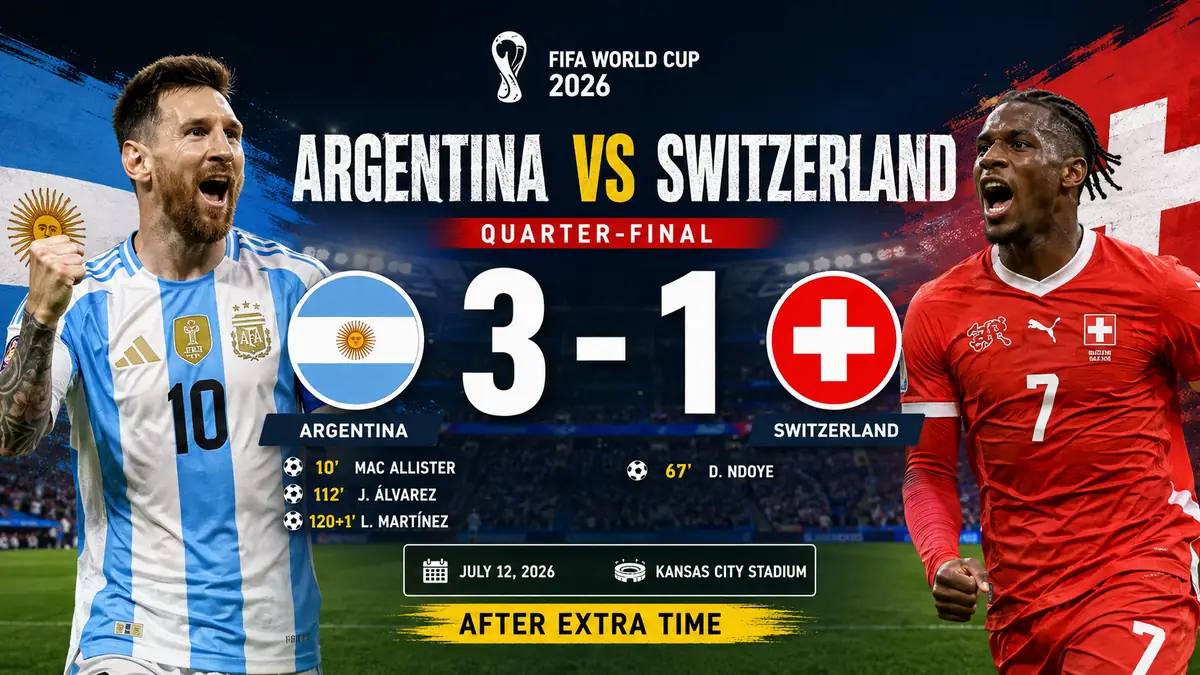
Argentina and Switzerland produced another tense World Cup knockout battle on July 12, 2026, this time with a place in the semi-finals at stake. The match stayed level deep into the contest before Argentina took control in extra time, turning a difficult night in Kansas City into a 3-1 victory.
Argentina beat Switzerland 3-1 after extra time in their 2026 FIFA World Cup quarter-final. Alexis Mac Allister opened the scoring in the 10th minute, Dan Ndoye equalized in the 67th, and extra-time goals from Julián Álvarez and Lautaro Martínez sent Argentina into the semi-finals.
The result continued Argentina’s strong record against Switzerland while adding a new chapter to a rivalry remembered particularly for their dramatic 2014 World Cup meeting.
argentina vs switzerland Match Result at a Glance
The quarter-final was played at Kansas City Stadium, also known as GEHA Field at Arrowhead Stadium, with 69,045 spectators in attendance. Argentina eventually won 3-1 after the teams finished regulation time level at 1-1.
| Match detail | Argentina | Switzerland |
|---|---|---|
| Final score | 3 | 1 |
| Score after 90 minutes | 1 | 1 |
| Possession | 59% | 41% |
| Shots | 22 | 11 |
| Shots on target | 7 | 5 |
| Corners | 8 | 2 |
| Goals | Mac Allister, Álvarez, Martínez | Ndoye |
| Result | Advanced | Eliminated |
The numbers tell much of the story. Argentina controlled 59% of possession and attempted 22 shots compared with Switzerland’s 11. Both teams still created genuine danger, with Argentina recording seven shots on target and Switzerland five.
argentina vs switzerland Goals
The four goals came at very different stages of the match:
- 10′ – Alexis Mac Allister (Argentina): Argentina struck early, with Lionel Messi involved in creating the opening.
- 67′ – Dan Ndoye (Switzerland): Switzerland responded in the second half and brought the quarter-final level.
- 112′ – Julián Álvarez (Argentina): Álvarez restored Argentina’s lead during extra time.
- 120+1′ – Lautaro Martínez (Argentina): Martínez added the final goal to seal a 3-1 victory.
That timeline makes the final score slightly deceptive. Switzerland remained within one goal—or level—for virtually the entire match before Argentina pulled away late.
How Argentina Beat Switzerland 3-1
Argentina’s victory was built on patience rather than an easy period of dominance.
Lionel Scaloni’s team enjoyed more possession, completed more passes and generated twice as many total attempts. Switzerland, however, stayed competitive and forced the defending champions to play an additional 30 minutes.
Mac Allister Gives Argentina the Perfect Start
Argentina needed only 10 minutes to take the lead.
Alexis Mac Allister found space during a corner routine and converted to make it 1-0. Lionel Messi supplied the assist, giving Argentina the early breakthrough that appeared capable of opening the game up.
Instead, Switzerland recovered.
Murat Yakin’s side did not abandon its structure after conceding. The Swiss continued to contest midfield areas and looked for opportunities to attack Argentina’s defensive line rather than simply sitting deep for the remainder of the game.
Argentina still controlled larger stretches of possession, but a second goal did not arrive before halftime.
Dan Ndoye Changes the Match
Switzerland’s persistence was rewarded in the 67th minute when Dan Ndoye equalized.
Suddenly, argentina vs switzerland was back at 1-1 with less than half an hour of normal time remaining. The goal changed the pressure of the quarter-final: Argentina could no longer manage a narrow advantage, while Switzerland had renewed belief that an upset was possible.
The Swiss situation became considerably more difficult shortly afterward.
Breel Embolo was sent off in the 72nd minute, leaving Switzerland with 10 players for the remainder of regulation and extra time.
Playing a man down against Argentina meant absorbing sustained pressure while still trying to preserve enough attacking threat to prevent Scaloni’s side from committing everyone forward.
Switzerland survived until the end of the 90 minutes.
Quick takeaway: Argentina had the territorial and numerical advantage, but Switzerland’s organization kept the game at 1-1 and forced extra time.
Extra Time Decides argentina vs switzerland
Extra time is where the difference finally became decisive.
Switzerland had already spent nearly 20 minutes playing with 10 men by the end of regulation. Maintaining defensive concentration against Messi, Álvarez and Argentina’s midfield for another half-hour was an enormous physical challenge.
Argentina kept searching rather than forcing low-percentage attacks.
Julián Álvarez Scores in the 112th Minute
The breakthrough arrived in the 112th minute.
Julián Álvarez scored to put Argentina 2-1 ahead. With only eight minutes of extra time remaining, Switzerland now needed to attack despite being a player short.
The goal effectively shifted the entire risk profile of the match. Switzerland could no longer concentrate primarily on keeping Argentina away from goal.
Spaces began to appear.
Lautaro Martínez Finishes the Job
Lautaro Martínez delivered the final blow in stoppage time at the end of extra time.
His 120+1-minute goal made the score 3-1 and removed any remaining possibility of a Swiss comeback.
Argentina had required 112 minutes to establish a permanent lead, yet scored twice in the closing stages.
That is why simply looking at the 3-1 scoreline misses an important part of the match: this was a competitive quarter-final for much longer than the two-goal margin suggests.
Argentina vs Switzerland Match Stats Explained
Statistics reinforce Argentina’s overall advantage.
According to the official competition match data published by Concacaf, Argentina held 59% possession to Switzerland’s 41%. Argentina recorded seven shots on target and had an expected-goals figure of approximately 2.0 compared with Switzerland’s 0.53. Passing accuracy was 89% for Argentina and 85% for Switzerland.
Possession: Argentina 59% – Switzerland 41%
Argentina’s possession advantage allowed Scaloni’s team to dictate much of the tempo.
Players such as Enzo Fernández, Rodrigo De Paul, Leandro Paredes and Mac Allister gave Argentina several ways to progress the ball through midfield.
Switzerland’s lower possession figure did not mean the Swiss were harmless. Their five shots on target demonstrate that they could threaten Emiliano Martínez when they broke through Argentina’s structure.
Shots: Argentina 22 – Switzerland 11
Argentina doubled Switzerland’s shot total.
More revealingly, Argentina maintained pressure for long enough to produce eight corners compared with Switzerland’s two.
The attacking volume became particularly significant once Switzerland went down to 10 men.
Passing and Control
Argentina completed 614 accurate passes compared with Switzerland’s 398, according to Sky Sports’ match statistics.
That difference illustrates how Argentina increasingly controlled territory and possession.
Against a full-strength Swiss side, recycling possession could have allowed Switzerland time to reset. Against 10 players, however, repeatedly moving the ball forced defenders to cover larger spaces while fatigue accumulated.
argentina vs switzerland Starting Lineups
Argentina started in a 4-1-3-2 structure, while Switzerland lined up in a 4-2-3-1.
Argentina Starting XI
Emiliano Martínez started in goal behind a defensive unit featuring Nahuel Molina, Cristian Romero, Lisandro Martínez and Nicolás Tagliafico.
Leandro Paredes operated in midfield alongside Rodrigo De Paul, Enzo Fernández and Alexis Mac Allister.
Lionel Messi captained the team, with Julián Álvarez also starting in attack.
The setup provided Argentina with technical quality throughout central areas while keeping Messi close enough to goal to influence decisive attacking sequences.
Switzerland Starting XI
Switzerland started Gregor Kobel in goal.
The Swiss lineup included Ricardo Rodríguez, Manuel Akanji, Nico Elvedi and Denis Zakaria, while Granit Xhaka and Remo Freuler supplied experience through midfield.
Fabian Rieder, Djibril Sow and Dan Ndoye supported Breel Embolo in the attacking structure.
Xhaka remained one of Switzerland’s most important figures because of his ability to organize possession and control tempo under pressure.
Lionel Messi’s Role Against Switzerland
A discussion of Argentina’s performance inevitably leads to Lionel Messi, but this was not simply a match decided by individual dribbling or goals from Argentina’s captain.
Messi contributed to the opening goal, assisting Mac Allister in the 10th minute. His presence also influenced Switzerland’s defensive positioning because defenders had to account for his movement between midfield and the penalty area.
The broader story was Argentina’s range of contributors.
Mac Allister scored the opener. Álvarez produced the crucial extra-time breakthrough. Lautaro Martínez sealed the result.
That distribution of goals mattered because Argentina did not have to depend on Messi scoring himself to survive a World Cup knockout game.
Why Switzerland Made the Match So Difficult
Switzerland’s 3-1 defeat should not be confused with an easy Argentina victory.
The Swiss reached their first World Cup quarter-final in 72 years before facing Argentina, demonstrating the progress made under Murat Yakin.
Several factors kept the quarter-final competitive.
Switzerland Stayed Organized
Switzerland generally protected central areas and forced Argentina to work for clear openings.
Even after conceding early, the Swiss did not collapse into an uncontrolled game. They remained close enough to capitalize when the opportunity for an equalizer arrived.
Ndoye Offered a Direct Threat
Dan Ndoye’s 67th-minute goal was the reward for Switzerland remaining ambitious enough to attack.
It also demonstrated why Argentina could not treat possession as security. Switzerland needed relatively few opportunities to change the match.
The Red Card Changed the Physical Battle
Embolo’s dismissal was one of the biggest turning points.
Switzerland managed to reach extra time despite the numerical disadvantage, but the additional workload eventually mattered. Defending for such a long period with 10 players against a possession-heavy opponent makes maintaining spacing and pressure increasingly difficult.
Argentina’s two extra-time goals came after Switzerland had been forced to absorb that pressure for an extended period.
Argentina vs Switzerland Head-to-Head History
The countries do not meet frequently, but their World Cup encounters have produced memorable moments.
Before their 2014 knockout match, Argentina and Switzerland had already faced each other six times, including a 1966 FIFA World Cup group-stage game that Argentina won 2-0.
Their modern World Cup history is especially significant because both recent knockout meetings required extra time.
| World Cup | Stage | Result |
|---|---|---|
| 1966 | Group stage | Argentina 2-0 Switzerland |
| 2014 | Round of 16 | Argentina 1-0 Switzerland (AET) |
| 2026 | Quarter-final | Argentina 3-1 Switzerland (AET) |
What Happened in Argentina vs Switzerland 2014?
The 2014 FIFA World Cup Round of 16 meeting remains one of the most famous matches between the teams.
Argentina and Switzerland were locked at 0-0 throughout normal time in São Paulo.
With the possibility of penalties approaching, Lionel Messi carried the ball forward and supplied Ángel Di María, who scored in the 118th minute to give Argentina a 1-0 victory.
Switzerland almost produced an extraordinary equalizer moments later when Blerim Džemaili hit the post with a header before sending the rebound wide.
Argentina advanced to face Belgium in the quarter-finals and eventually reached the 2014 World Cup final.
2014 vs 2026: What Changed?
The similarities are striking.
Both knockout meetings went into extra time. Both featured Lionel Messi. And in both cases, Argentina eventually found the decisive breakthrough.
The differences are equally revealing.
In 2014, Argentina needed a single 118th-minute Di María goal. In 2026, Switzerland managed to score an equalizer, but Argentina’s deeper attacking options eventually produced goals through Álvarez and Lautaro Martínez.
Only a small number of figures from the 2014 encounter were still involved in the rivalry 12 years later, including Messi, Granit Xhaka and Ricardo Rodríguez.
What Argentina’s Victory Showed
The strongest lesson from the quarter-final was Argentina’s ability to remain patient.
Knockout football often punishes teams that react emotionally when an expected victory becomes complicated. Switzerland’s equalizer could easily have pushed Argentina toward hurried crosses, speculative shots and increasingly risky positioning.
Instead, Argentina continued creating volume.
The 22 total shots, 59% possession, eight corners and 614 accurate passes show how consistently the South American side kept applying pressure.
Another positive was the variety of goalscorers.
Argentina received goals from Mac Allister, Álvarez and Lautaro Martínez rather than relying exclusively on Messi. That attacking depth becomes increasingly valuable late in a major tournament when opponents naturally build their defensive plans around limiting the captain.
What Switzerland Can Take From the Defeat
Switzerland left the World Cup after pushing Argentina much harder than the final score suggests.
Reaching the quarter-finals itself represented a major achievement. The Swiss then recovered from conceding after only 10 minutes and found an equalizer against the defending world champions.
Playing the closing stages with 10 men ultimately made an already difficult assignment substantially harder.
The biggest positive was competitiveness.
Switzerland demonstrated that its identity under Murat Yakin could combine defensive organization with enough attacking ambition to trouble elite opposition. Ndoye’s goal was evidence of that balance.
The challenge going forward is turning competitive performances against tournament favorites into victories.
What Happened After argentina vs switzerland?
The 3-1 extra-time victory sent Argentina into the 2026 FIFA World Cup semi-finals.
For Switzerland, the defeat ended a notable tournament run after reaching a World Cup quarter-final for the first time in 72 years.
For Argentina, the match provided another demonstration of the qualities required in knockout football: control, patience, squad depth and the ability to find decisive moments after more than 90 minutes.
Final Takeaway
argentina vs switzerland finished 3-1 after extra time, but the match was considerably closer than that scoreline suggests.
Mac Allister’s early goal gave Argentina the advantage before Ndoye equalized in the second half. Embolo’s red card increased the pressure on Switzerland, yet the Swiss still survived regulation at 1-1. Only in extra time did Álvarez and Lautaro Martínez finally settle the contest.
Argentina’s statistical advantage—59% possession, 22 shots, seven efforts on target and eight corners—showed which side controlled more of the game. Switzerland’s resistance showed why World Cup knockout matches cannot be judged by possession alone.
Much like their dramatic 2014 meeting, Argentina and Switzerland once again needed extra time to determine a winner. Twelve years later, Argentina emerged victorious again, this time with a 3-1 scoreline and a place in the 2026 World Cup semi-finals.
