

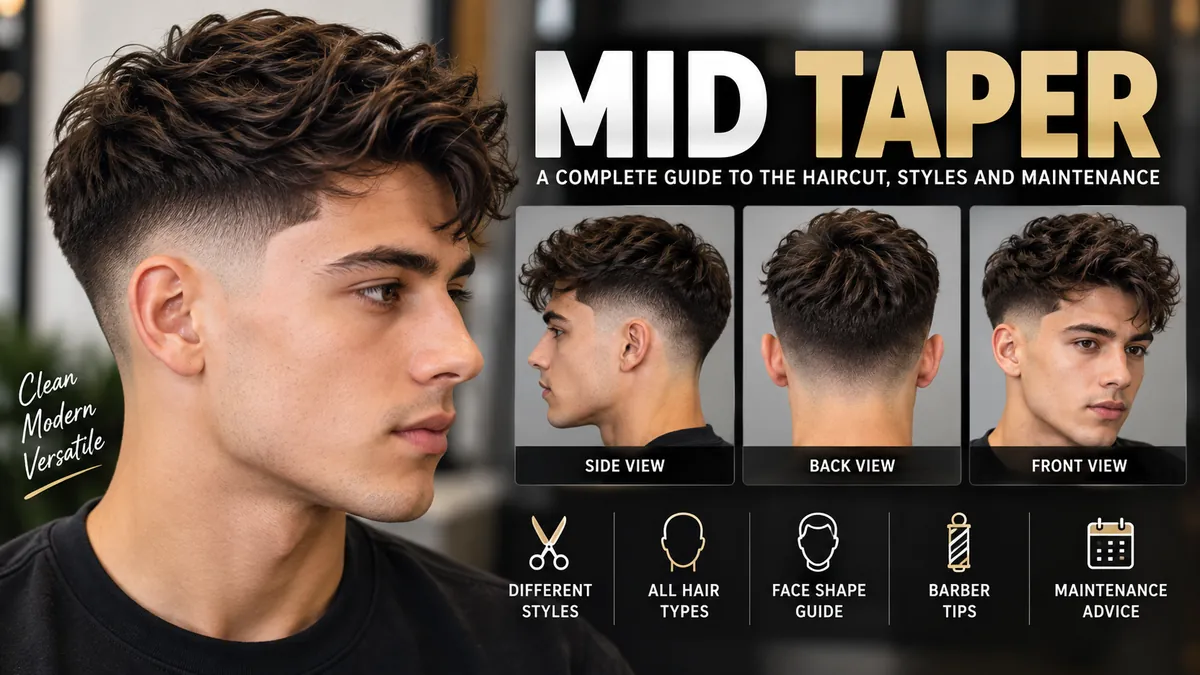
A haircut can look completely different depending on where the sides begin to shorten. That small detail is exactly what gives the mid taper its balanced appearance.
Sitting between a subtle low taper and a more aggressive high taper, this cut provides enough contrast to sharpen your hairstyle without removing too much hair from the sides. It can complement short crops, textured fringes, curls, waves, afros, twists, locs and longer styles.
A mid taper is a haircut in which the hair gradually becomes shorter around the middle of the sides, typically near the temple area, before blending toward the sideburns and neckline. It creates moderate contrast while preserving more hair and weight than a full mid fade.
The terminology can get confusing because barbers do not always use “taper,” “taper fade” and “fade” in exactly the same way. Understanding the placement, finish and top hairstyle matters more than relying on the name alone.
What Is a Mid Taper?
A taper is a gradual reduction in hair length. Instead of moving abruptly from long hair to extremely short hair, the barber blends several lengths together so the transition looks smooth.
The mid part describes the general placement of that transition.
A mid taper normally begins around the middle portion of the temple or sides—higher than a low taper but below the placement associated with a high taper. The exact starting point varies with head shape, hairstyle and barbering technique.
The barber usually works around two important areas:
- Temple and sideburn area: Hair becomes progressively shorter toward the ears and sideburns.
- Nape and neckline: The back is tapered so longer hair transitions naturally into a cleaner neckline.
Unlike an undercut, there should not be a hard, disconnected line separating the top from the sides. A properly executed taper has a smooth gradient.
One distinction matters: a mid taper does not automatically mean a skin fade. The shortest section can finish at bare skin, but it can also retain a small amount of visible hair.
What Does a Mid Taper Look Like?
From the front, the most obvious change usually appears around the temples and sideburns. The shorter perimeter makes the longer top appear more defined.
From the side, you should see a gradual transition rather than an obvious shelf or weight line. The taper becomes tighter as it approaches the ear and sideburn.
From the back, the neckline is cleaned and blended while the crown can retain considerably more length.
This combination creates the characteristic balanced look: enough contrast to appear fresh without exposing as much scalp as a high or full skin fade.
Quick Takeaway: Think of the mid taper as a placement rather than a complete hairstyle. The taper determines what happens around the sides and neckline; you still choose what happens on top.
Mid Taper vs Low Taper, High Taper and Mid Fade
One reason haircut requests go wrong is that similar barbering terms are treated as interchangeable.
They aren’t always.
| Haircut | General Starting Area | Contrast | Hair Left on Sides | Overall Effect |
|---|---|---|---|---|
| Low taper | Close to ears and lower hairline | Low | More | Subtle and conservative |
| Mid taper | Around mid-temple/sides | Moderate | Moderate | Balanced and clean |
| High taper | Higher around temples | Stronger | Less | Sharper and bolder |
| Mid fade | Midway up sides | Moderate to high | Less than taper | More exposed and dramatic |
| Skin fade | Varies by height | High | Blends to bare skin | Very sharp |
Mid Taper vs Low Taper
A low taper keeps the transition closer to the ears and neckline. Because the blend starts lower, considerably more weight remains around the sides.
That makes it useful when you want the haircut to stay understated.
A mid taper moves the transition upward and therefore creates more visible separation between the top and lower sides. It tends to look sharper without reaching the dramatic territory of a high taper.
Mid Taper vs High Taper
A high taper places the transition noticeably higher around the temples.
This exposes more of the sides and creates stronger contrast with the top. It can work particularly well when the top itself is meant to command attention, such as a textured afro or longer curls.
The mid version is the middle ground. It provides definition while retaining enough side length to keep the haircut balanced.
Mid Taper vs Mid Fade
This distinction causes the most confusion.
In traditional barber terminology, a taper generally concentrates the shortest graduation around the temples, sideburns and neckline while preserving more weight across the sides.
A mid fade usually removes more hair across a broader portion of the sides and back.
In everyday barbershop language, however, these definitions overlap. Some barbers use “mid taper fade” for a taper that finishes at or near the skin.
For that reason, a reference photo is often more useful than terminology alone.
Does a Mid Taper Have to Go to Skin?
No.
You can request:
- A soft taper that leaves visible hair
- A shadow taper with very short stubble
- A zero taper
- A skin or bald finish
Going shorter increases contrast but also makes regrowth more noticeable.
If you like a softer haircut or need something appropriate for conservative professional settings, stopping slightly above skin can make the transition less aggressive.
Best Mid Taper Styles
The strongest advantage of this haircut is flexibility. You are not locked into one top length or texture.
Classic Mid Taper
The classic version keeps enough length through the sides for a natural transition while cleaning the temples, sideburns and nape.
It works particularly well when you want something polished without looking heavily faded.
The top can be worn naturally, brushed back or given light texture.
Mid Taper Fade
The mid taper fade increases the contrast by taking the shortest portion closer to the skin.
You still retain more weight than you normally would with a complete mid fade, particularly around the upper sides.
This version creates a crisp perimeter and makes textured hair on top stand out.
Mid Taper With Textured Top
A textured top prevents short or medium-length straight hair from appearing flat.
The barber can use point cutting or other texturizing techniques on top while keeping the perimeter tightly tapered.
At home, a small amount of matte clay, paste or texture product can create separation without making the hair look greasy.
Mid Taper With Textured Fringe
A fringe directs visual attention forward rather than upward.
The sides remain controlled while the front can be worn loose and slightly messy. This is especially useful for thick straight or wavy hair that naturally falls toward the forehead.
Avoid making the fringe excessively heavy. Removing strategic bulk helps it move naturally.
Mid Taper With Middle Part
The middle part, sometimes called curtains depending on length and styling, gives the haircut a completely different character.
The top needs enough length to separate naturally around the center. The taper then removes unnecessary bulk near the temples without destroying the flow of the longer hair.
For this combination, preserving weight above the taper is crucial. Taking the fade too high can disconnect the curtains from the sides.
Mid Taper With Quiff
A quiff creates height at the front while the taper reduces width around the sides.
That combination can visually lengthen the face and create a strong silhouette.
A blow dryer is usually more useful than piling on styling product. Direct the front upward and slightly backward, then use a small amount of clay, paste or pomade to establish the final shape.
Mid Taper With Comb Over or Side Part
A side part or comb over gives the cut a more structured finish.
Rather than creating extreme contrast, the taper cleans the perimeter while the longer top provides the formal shape.
This combination can transition easily between professional and casual settings simply by changing the styling product and finish.
Mid Taper With Slick Back
Longer straight or wavy hair can be swept backward while the sides remain controlled.
The important detail is transition.
Removing too much weight near the upper sides can make the haircut resemble a disconnected undercut. Ask the barber to maintain enough length through the parietal ridge to connect the slicked-back top naturally.
Mid Taper With Buzz Cut
You do not need long hair to make a taper visible.
A buzz cut paired with a clean taper creates subtle contrast between the uniformly short top and the tighter temples and neckline.
A sharp line-up can increase definition, although maintaining a natural hairline is usually better than repeatedly pushing the edge farther backward.
Mid Taper With Crew Cut
The crew cut leaves slightly more length toward the front than a basic buzz cut.
Adding a taper around the sides reduces bulk and gives this practical short hairstyle more structure.
It is also relatively easy to style because the top requires little daily work.
Mid Taper With French Crop or Caesar
Both styles pair a compact top with a forward-directed fringe.
The French crop generally emphasizes texture, while a Caesar typically has a shorter, more uniform fringe.
A tapered perimeter prevents either style from looking too heavy around the ears.
Mid Taper for Different Hair Types
Hair texture changes how a taper should be cut.
A reference image featuring hair completely different from yours may create unrealistic expectations, even if the haircut itself is technically possible.
Mid Taper Curly Hair
Curly hair is one of the most natural matches for this cut.
The taper controls bulk around the sides while allowing curls to retain their shape and volume on top. The contrast also makes the curl pattern more noticeable.
The main mistake is cutting the transition too high. Removing too much hair can leave the curls looking isolated on top rather than connected to the overall shape.
For styling, prioritize moisture and definition rather than heavy hold. Curl cream or a lightweight leave-in product can help control frizz without flattening the curl pattern.
Mid Taper Wavy Hair
Wavy hair offers enough natural movement to create texture without requiring aggressive styling.
Medium-length waves can be pushed backward, parted, worn loose or directed forward into a textured fringe.
A light styling cream or sea-salt-style texture product can emphasize movement, but overusing drying products can make waves appear rough rather than defined.
Mid Taper Straight Hair
Straight hair reveals the quality of the blend clearly because there are fewer curls or waves to disguise transitions.
For that reason, clean clipper work matters.
Straight hair can be paired with:
- A textured crop
- Quiff
- Side part
- Comb over
- Middle part
- Slick back
- Short fringe
Fine straight hair usually benefits from lighter styling products. Thick straight hair may require some weight removal to stop the sides from sticking outward.
Mid Taper Coily Hair
Coily and tightly textured hair can create striking contrast because the taper establishes a clean perimeter while the top preserves natural density.
Popular combinations include afros, short curls, sponge curls, twists, braids and locs.
Moisture is particularly important. The goal is to maintain healthy-looking texture on top while keeping the perimeter controlled.
Mid Taper With Afro
An afro provides volume above the taper, making the difference between the top and perimeter easy to see.
The barber can preserve a rounded natural silhouette while tightening the temple and nape areas.
How much volume you retain is personal preference. A compact afro gives a cleaner profile; a longer afro creates much stronger contrast.
Mid Taper With Waves
A taper can frame 360 waves without removing the pattern across the top.
The barber should work carefully around the transition because cutting too high can interrupt the visual flow of the waves.
Regular brushing, appropriate moisture and compression practices matter more for the wave pattern itself than the taper does.
Mid Taper With Twists
Twists provide texture and movement while the shorter perimeter creates separation.
This works with both relatively short twists and longer versions. The barber should understand where the twists are sectioned before removing hair so the taper does not unnecessarily reduce the foundation of the style.
Mid Taper With Braids
Braids and a clean taper can work together when the hairline and braid pattern are planned properly.
Instead of tapering excessively high, the barber can focus on the temples and nape. This maintains enough hair for the braid sections while still creating a clean outline.
Mid Taper With Locs
Locs create significant visual weight on top, so a clean perimeter can make the overall style feel more structured.
The biggest consideration is preserving enough hair around the base of the locs. An overly aggressive taper can gradually reduce the available growth area, particularly if the haircut is repeatedly pushed higher.
Choosing a Mid Taper for Your Face Shape
There is no strict rule saying one face shape can or cannot wear a particular haircut.
What matters is proportion.
The top hairstyle often influences facial balance more than the taper itself.
Oval Face
Oval faces can usually accommodate a broad range of top styles because their proportions are already balanced.
A crop, middle part, quiff, curls or slick back can all pair comfortably with a medium taper.
Round Face
Reducing bulk around the sides can make a round face appear slightly narrower.
Adding height through a quiff, textured top, curls or controlled volume can further lengthen the overall silhouette.
A very flat top combined with excessive side width generally does the opposite.
Square Face
A square face has a prominent jaw and strong angles.
A clean taper can complement that structure without competing with it. Crew cuts, textured tops, short curls and side parts are particularly easy combinations.
Oblong or Rectangular Face
Be more careful with height.
A tall quiff plus tightly tapered sides can make an already long face appear even longer. Keeping moderate side weight and choosing a flatter top often creates better balance.
A low-to-mid placement may also be preferable to an aggressively high transition.
Heart-Shaped Face
A heart-shaped face is typically wider through the forehead and narrower toward the chin.
Avoid removing unnecessary width too high around the temples. A balanced taper combined with moderate texture on top can keep the proportions natural.
Diamond Face
Diamond-shaped faces often have prominent cheekbones with narrower forehead and jaw areas.
Leaving some weight through the upper sides can help. A medium taper works because it can clean the lower perimeter without stripping the entire side.
Quick Takeaway: Choose the top hairstyle based on your face proportions first. Then adjust the taper height and side weight to support that shape.
How to Ask Your Barber for a Mid Taper
Simply saying “mid taper” gives your barber a starting point, but it does not define the finished haircut.
Different shops—and even different barbers in the same shop—may interpret the term differently.
Use these steps instead.
- Show a reference photo. A front and side view is ideal because taper placement is much easier to understand visually.
- Describe the height. Ask for the transition around the mid-temple rather than very low around the ear or high toward the crown.
- Say how short you want the bottom. Specify whether you want visible hair, a zero, or a skin finish.
- Explain the top separately. Tell the barber whether you want a crop, curls, middle part, quiff, waves or another style.
- Discuss the neckline. Decide whether you prefer a natural tapered nape or a more defined shape.
- Explain your styling routine. If you never use a blow dryer or styling products, tell the barber. The cut should work with your actual routine.
Guard numbers can be helpful, but they should not be your only instructions.
Clipper systems and barber techniques vary. Saying exactly how you want the haircut to look is usually more reliable than trying to prescribe every guard.
A Simple Barber Request
You can describe the desired result as a mid-height taper around the temples and neckline, specify whether the shortest section should reach skin, and then explain how much length and texture you want left on top.
The reference photo fills in anything terminology misses.
Should You Ask for a Line-Up?
A line-up or edge-up creates defined edges around the forehead and temples.
It can make a fresh taper look exceptionally crisp, particularly with short, curly or coily hairstyles.
But sharper is not always better.
If your natural hairline is uneven, repeatedly forcing an artificial straight line can lead to the edge being pushed backward. Ask the barber to keep the line-up close to your natural growth pattern rather than chasing perfect symmetry.
How Barbers Create the Blend
Understanding the process helps you recognize a good taper.
The exact method varies, but professional clipper work generally involves establishing a starting guideline and progressively blending different lengths until visible lines disappear.
Barbers may use:
- Clippers
- Trimmers
- Clipper guards
- Adjustable clipper levers
- Foil shavers for skin finishes
- Scissors
- Clipper-over-comb
- Scissor-over-comb
- Texturizing techniques
- Detail trimmers for edges
The barber first decides where the taper will sit. The shortest guideline is established around the temple and/or nape, then progressively longer sections connect that area to the surrounding hair.
The critical skill is removing the transition lines without pushing the blend unnecessarily higher.
A good taper should look gradual from multiple angles. Harsh dark bands, sudden shelves or uneven placement between the left and right sides usually indicate that the blend needs more refinement.
How to Style a Mid Taper
The tapered portion itself requires almost no daily styling. Most of your routine concerns the top.
For a Textured Top
Start with slightly damp hair.
Use a blow dryer to establish direction and volume, then work a small amount of matte clay, paste or styling cream through the hair. Apply less than you think you need; you can always add more.
For Curls
Avoid repeatedly disturbing the curl pattern once it has formed.
Apply leave-in conditioner or curl cream to damp hair, distribute it evenly and allow the curls to set. Depending on your texture, air drying or using a diffuser can help maintain definition.
For a Quiff
Direct warm air upward through the front while lifting the hair with your fingers or a brush.
Once the basic shape is established, use a modest amount of styling product for hold.
For a Slick Back
Medium or longer hair usually works best.
Comb or direct the hair backward while drying, then finish with pomade, cream or another product appropriate to the amount of shine and hold you want.
For a Middle Part
Find the natural center or preferred part while the hair is damp.
Direct each side away from the part with a blow dryer. A lightweight cream can reduce flyaways while preserving movement.
How Often Does a Mid Taper Need a Haircut?
There is a difference between needing another haircut and wanting the taper to look freshly cut.
Very short sections show growth quickly.
If you want consistently crisp edges, you may prefer a touch-up roughly every two to three weeks. If you are comfortable with a softer, grown-in appearance, you can often wait longer.
Your ideal schedule depends on:
- Hair growth rate
- How short the bottom was cut
- Natural hair color and density
- Desired sharpness
- Top hairstyle
- How quickly the neckline becomes untidy
A skin finish generally shows regrowth sooner than a shadow taper because the initial contrast is stronger.
A full haircut is not always necessary at every appointment. Some people alternate between complete cuts and smaller perimeter cleanups.
How to Keep a Mid Taper Looking Fresh
The easiest maintenance strategy is surprisingly simple: avoid trying to recreate the fade yourself unless you understand clipper blending.
You can maintain the hairstyle more effectively by focusing on basic grooming.
Keep the Hair Clean Without Overwashing
Wash according to your scalp, hair type and product use rather than following an arbitrary daily rule.
Frequent shampooing can be appropriate for some oily scalps, while dry, curly and coily textures may benefit from less frequent shampooing and more conditioning.
Protect Your Scalp
Very short taper or fade sections expose more scalp than longer hair.
If exposed areas receive significant sunlight, appropriate sun protection becomes more relevant.
Maintain Moisture
Curly, coily and longer textured styles usually benefit from conditioning and suitable moisturizing products.
Healthy texture on top makes the entire haircut look better—even when the taper itself is technically perfect.
Do Not Push the Hairline Back
Cleaning obvious stray hairs is different from constantly reshaping your natural hairline.
Aggressive home line-ups can gradually change the apparent edge and make the next professional cut harder to balance.
Common Mid Taper Mistakes
The difference between a great haircut and a disappointing one is often not the haircut category. It is communication and execution.
Asking Only for “a Mid Taper”
That phrase leaves several decisions unanswered.
How short? Skin or shadow? How high? What happens to the top? How much side weight should remain?
Give the barber the complete picture.
Confusing a Taper With a Full Fade
If you expect significant hair to remain through the sides but the barber interprets your request as a mid skin fade, you may lose considerably more hair than intended.
Reference photos solve much of this problem.
Taking the Blend Too High
Once hair is removed, it cannot be put back.
Starting conservatively is safer, especially when you are trying the style for the first time.
Ignoring Your Natural Texture
A straight-hair reference photo will not behave exactly the same way on tight curls, and a curly fringe cannot be recreated identically on naturally pin-straight hair without additional styling.
Use inspiration from people with a similar hair texture and density whenever possible.
Choosing a Style That Requires More Daily Work Than You Want
A taper may be low-effort, but the top hairstyle might not be.
A voluminous quiff, slick back or defined curly style can require regular styling. A buzz cut, crew cut or short textured crop usually requires less.
The best haircut is one you can realistically reproduce after leaving the barbershop.
Is a Mid Taper Good for School and Work?
Usually, yes.
One reason this haircut works across different settings is that its intensity is adjustable.
A soft taper with a neat side part or short textured top can look conservative enough for many schools and workplaces. A skin taper with designs, dramatic volume or an extremely sharp line-up produces a much bolder effect.
The taper itself does not determine whether the hairstyle looks formal. The finish and top styling matter just as much.
For environments with grooming policies, check the actual requirements rather than assuming every type of fade or taper is permitted.
Does a Mid Taper Work With Long Hair?
Yes, provided the transition is planned correctly.
Longer hairstyles can benefit from removing bulk around the temples and neckline. Middle parts, flowing styles, slick backs, man buns, braids, twists and locs can all incorporate tapered areas.
The main risk is taking the taper too far upward.
Long hair relies on sufficient density and weight for its shape. Removing too much from the upper sides can create a disconnected appearance or interfere with braids, twists and loc sections.
Tell the barber that preserving the long top is a priority before the clipper work begins.
Is a Mid Taper Worth Getting?
For someone who wants cleaner sides without committing to a dramatic full fade, the mid taper is one of the most adaptable options.
Its biggest strength is balance. It sits between low and high placements, works with straight, wavy, curly and coily textures, and can support everything from a buzz cut and French crop to an afro, middle part, twists or locs.
The most important decision is not simply asking for a mid taper. Decide how high you want the transition, whether the bottom should reach skin, how much weight should remain through the sides, and what you want to do with the top.
Bring a reference photo showing a similar hair texture and explain those details to your barber. That gives you a much better chance of getting the haircut you pictured rather than relying on a name that different barbers may interpret differently.
