

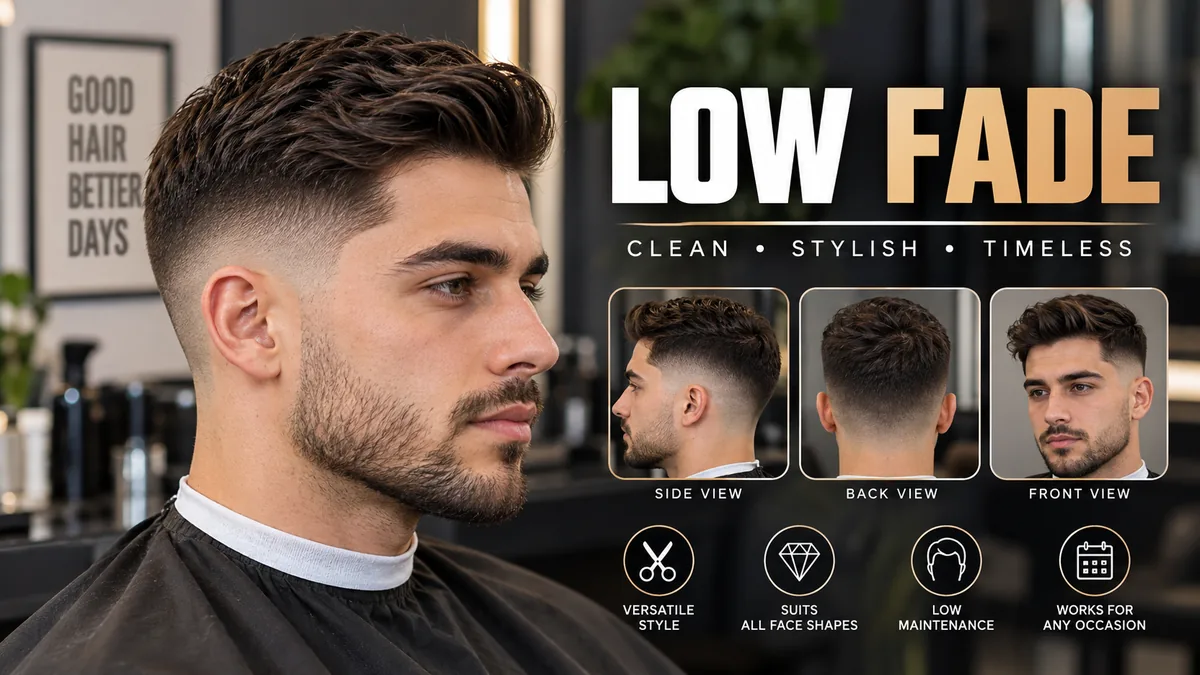
A low fade is one of those haircuts that can look understated from across the room and impressively sharp up close. Instead of removing a large amount of hair from the sides, it keeps the transition close to the ears and neckline, leaving more weight and shape above.
A low fade is a barbering technique in which the hair gradually transitions from very short near the lower hairline to longer hair above, with the blend beginning just above the ears and around the neckline. It creates less contrast than a mid or high fade and works with short, long, straight, wavy, curly, and coily hair.
The biggest advantage is flexibility. The fade itself does not dictate what happens on top. You can pair it with a textured crop, curls, quiff, pompadour, side part, buzz cut, slick back, fringe, Afro, or longer hairstyle.
This guide explains how the cut works, the major variations, who it suits, what to tell your barber, and how to keep the blend looking clean.
What Is a Low Fade?
A fade is a gradual transition between different hair lengths. The barber uses clippers, different guards, lever positions, clipper-over-comb techniques, and sometimes a trimmer or foil shaver to remove visible lines between those lengths.
With a low fade haircut, that graduation stays relatively close to the bottom of the head.
It generally starts just above the ears and continues around the lower sides and back toward the neckline. Because the transition begins low, substantially more hair remains on the sides than with a high fade.
That distinction matters.
“Low” describes where the fade begins, not necessarily how short the bottom becomes. A low fade can finish at bare skin, a near-skin shadow, or a longer clipper length.
That gives you several possible finishes:
- Low skin fade: transitions all the way down to exposed skin.
- Low zero fade: finishes extremely short without necessarily using a razor or foil shaver.
- Low shadow fade: retains a visible shadow of hair at the bottom.
- Low taper fade: concentrates the shortest transition around the lower edges, particularly the temples, sideburns, and neckline.
- Low drop fade: curves downward behind the ear rather than following a relatively level fade line.
This is why showing your barber a reference photo can be more reliable than simply saying, “Give me a low fade.”
What does a low fade look like?
From the front, most of the fullness of the hairstyle remains intact.
Around the sideburns and ears, the hair becomes progressively shorter. Looking from the back, you should see a smooth gradient into the neckline rather than obvious horizontal steps between clipper lengths.
A technically strong fade should look blended rather than striped. You should not be able to easily identify where one guard length ends and the next begins.
Quick Takeaway: A low fade is defined primarily by its low starting position. Skin exposure, guard length and the hairstyle on top can all be customized separately.
Low Fade vs Mid Fade vs High Fade
The words low, mid, and high describe the placement of the fade.
All three rely on essentially the same principle: progressively changing the length of hair to create a gradient. Moving that gradient upward changes the visual balance of the haircut.
| Feature | Low Fade | Mid Fade | High Fade |
|---|---|---|---|
| Starting area | Near ears and lower hairline | Around middle of sides/temple area | High around temples |
| Side fullness | Most retained | Moderate | Least |
| Contrast | Subtle to moderate | Moderate | Strong |
| Overall appearance | Soft, clean | Balanced, modern | Bold, sharp |
| Top hairstyles | Almost any length | Short to medium/long | Often strong-contrast styles |
| Scalp exposure | Depends on finish | Depends on finish | Usually visually greater |
| Grow-out visibility | Generally softer | Moderate | More noticeable |
Low fade
The low version keeps the gradient near the perimeter of the haircut. It preserves side weight and produces a relatively natural transition.
This is often useful if you want a modern haircut without making the sides the dominant feature.
Mid fade
A mid fade moves the transition upward toward the middle of the sides, often around the temple region.
It exposes more of the side of the head and gives the top greater visual separation.
High fade
A high fade begins much farther up the head. Much of the side is therefore cut extremely short, producing the greatest contrast between the top and sides.
One isn’t inherently better than another.
Choose according to the amount of contrast you want, your head shape, hairstyle, hair density and how the haircut should look as it grows.
Best Low Fade Haircut Styles
The low position is best thought of as a foundation. Once that foundation is established, the top can be shaped in many different ways.
Here are the most useful combinations rather than simply variations with different names.
1. Classic Low Fade
The classic version keeps things simple: neat hair on top, gradually shorter sides, and a compact blend near the ears and neckline.
It works especially well when you want something clean enough for professional settings without committing to the scalp exposure of a high skin fade.
The contrast can also be adjusted. Ask for a shadow finish for something softer or skin at the bottom for greater definition.
2. Low Skin Fade
A low skin fade takes the shortest portion down to bare skin while keeping that exposed area low on the head.
This produces more contrast than a guarded low fade without moving the entire blend higher.
The trade-off is maintenance. Because the bottom begins at skin, even a small amount of new growth becomes visible quickly. Skin-close clipping may also be less comfortable for people prone to razor bumps or scalp irritation.
3. Low Taper Fade
The terms taper and fade are sometimes used loosely, so it helps to describe exactly what you want.
A low taper fade usually keeps the graduation concentrated around the sideburns, temples and nape rather than fading a broad section continuously around the whole head. The result tends to retain even more side weight.
Choose this when you want the natural outline cleaned up while preserving a fuller, softer appearance.
4. Low Drop Fade
A standard fade can follow a relatively consistent path around the head. A drop fade deliberately curves lower as it travels behind the ear.
That drop can complement the natural shape of the skull and create a more sculpted profile from the side and back.
It pairs particularly well with textured or curly tops because the curved blend can emphasize the volume above it.
5. Low Fade with Textured Crop
A textured crop combines a short, deliberately uneven top with neat faded sides.
The texture stops short hair from appearing overly flat, while the low placement preserves enough weight around the sides to keep the haircut balanced.
A matte clay, paste, or texture product usually suits this style better than a high-shine product.
6. Low Fade with Fringe
A fringe shifts attention toward the forehead while the fade cleans up the lower sides.
The fringe can be:
- straight and blunt,
- lightly textured,
- messy,
- curly,
- or swept forward.
This pairing is useful when you prefer movement in front rather than height.
7. Low Fade with Quiff
A quiff creates height and volume at the front while the shorter sides provide definition.
Keeping the fade low prevents the sides from becoming excessively tight, which can help the hairstyle look balanced when the top has substantial volume.
Blow-drying the front upward before applying a small amount of styling product generally creates better structure than trying to build the quiff with product alone.
8. Low Fade with Pompadour
A pompadour has considerably more volume and a stronger swept-back shape.
The contrast between a fuller top and gradually shortened lower sides creates a polished silhouette. Unlike a high fade, the low version retains more visual connection between the top and sides.
Thick or medium-density hair usually provides the easiest foundation for this style.
9. Low Fade with Side Part
A side part is one of the more traditional ways to wear the cut.
The top can be combed neatly across while the lower sides are progressively faded. A natural part gives a softer finish, while a barber-created hard part produces stronger definition.
For work or formal settings, a subtle fade with a natural part is usually the less dramatic combination.
10. Low Fade with Slick Back
Longer hair can be brushed backward while the low fade removes bulk around the lower perimeter.
The key is maintaining enough transition between the long top and shorter sides. If too much weight is removed too high, the result can start looking more like an undercut than a smoothly connected fade.
11. Low Fade Buzz Cut
A buzz cut doesn’t require identical length everywhere.
Adding a low fade makes the sides and neckline progressively shorter, giving an otherwise simple short haircut more structure.
Because there is little length on top to distract from imperfections, blending quality becomes particularly noticeable.
12. Low Fade with Crew Cut
The crew cut retains slightly more length toward the front than a conventional uniform buzz cut.
Combining it with a subtle lower fade creates a practical hairstyle requiring little daily styling.
A small amount of matte product can add texture if the top is long enough.
13. Low Fade with Curly Hair
Curls naturally provide volume and movement, and a fade can control bulk around the sides without removing the texture that makes the hairstyle distinctive.
A lower fade is especially useful because it leaves more side weight than aggressive high fading. Some barber guides specifically recommend avoiding excessive tapering when maintaining fullness in curly hair.
Ask the barber to consider curl shrinkage when determining the top length. Curly hair can look substantially shorter after drying.
For styling, start with damp hair and use a curl cream or light mousse rather than repeatedly brushing the curls apart.
14. Low Fade with Wavy Hair
Wavy hair sits between straight and curly textures and works naturally with this cut.
Keeping some length on top lets the wave pattern provide movement, while the shorter lower sides create definition.
Sea-salt spray or a lightweight texture product can emphasize waves without creating an overly rigid finish.
15. Low Fade with Coily Hair
Coily textures can create an especially clean contrast between a shaped top and closely blended lower sides.
The top might be kept rounded, worn as a short Afro, shaped into defined coils, or combined with other textured styles.
Preserving the natural growth pattern is more important than forcing every low fade into an identical silhouette.
16. Low Fade with Longer Hair
You do not need short hair on top to wear a fade.
Medium or longer hair can be swept back, parted, worn loose, or styled with natural movement while the fade cleans up the lower sides.
This creates a subtler contrast than a disconnected undercut because more side length remains between the long top and shortest portion.
Low Fade for Straight, Wavy, Curly and Coily Hair
Hair texture affects the appearance of the blend, not whether you are allowed to wear it.
Straight hair
Straight strands make the graduation particularly visible because the hair lies relatively flat. That can produce an extremely crisp result, but imperfections in the blend may also stand out.
Good top combinations include:
- textured crop,
- side part,
- slick back,
- quiff,
- crew cut.
Matte clay can provide texture, while pomade or styling cream works better for smoother styles.
Wavy hair
Natural waves already provide texture and movement.
Rather than flattening them, leave enough top length for the wave pattern to develop and let the fade handle excess bulk near the lower sides.
Curly hair
The contrast between curls and short sides can make curl definition more noticeable.
Moisture matters. Conditioner, curl cream, mousse, and careful drying can help preserve definition and reduce frizz. Hair professionals also emphasize working with the natural curl pattern rather than unnecessarily manipulating it.
Coily hair
Coily hair can support sharp outlines and highly controlled shapes.
The barber needs to consider density, shrinkage, growth direction and the desired top silhouette rather than treating the texture exactly like straight hair.
Quick Takeaway: Don’t choose the fade purely from an online photo. The same guard sequence can look very different on straight, wavy, curly, and tightly coiled hair.
Which Face Shapes Suit a Low Fade?
Face-shape rules should be treated as useful starting points, not rigid formulas.
Your forehead, jawline, hairline, head shape, beard, hair density and the volume left on top can matter just as much as whether your face is technically round or square.
Round face
A low fade paired with some height on top can create a more elongated visual effect.
A textured quiff, pompadour, or lifted crop can work particularly well.
Avoid automatically taking excessive width out of the sides. A very aggressive fade combined with a flat top won’t necessarily produce the balance you’re looking for.
Oval face
Oval faces can accommodate a broad range of proportions, which makes most fade-and-top combinations workable.
The decision can therefore focus more on hair texture, density and personal style.
Square face
A square face has naturally defined angles around the jaw.
A neat fade can complement that structure, particularly when paired with a crew cut, textured crop, side part, or controlled quiff.
Diamond face
With a narrower forehead and jaw relative to the cheekbones, maintaining some strategic width can be useful.
Because a low fade retains more hair around the sides than a high fade, it can provide a softer balance.
Long or rectangular face
Be careful about adding excessive vertical height.
A tall pompadour plus extremely tight sides can visually lengthen the face further. A lower fade with moderate side fullness and a flatter or textured top often creates better proportions.
How to Ask Your Barber for a Low Fade
“Low fade” is a useful starting instruction, but it leaves several decisions unresolved.
Your barber still needs to know:
- Where the transition should begin.
- How short the bottom should be.
- How much weight you want above the fade.
- What shape you want at the back.
- How the top should be cut and styled.
A clearer instruction would be:
“I’d like a low fade starting just above the ears and staying low around the back. Keep some weight on the sides and blend it smoothly into the top. Don’t take the fade too high.”
Then specify the shortest length.
For example, you could request a #1 at the bottom for a softer appearance or ask for skin if you want the most contrast.
Should you tell your barber a guard number?
You can, but guard numbers alone do not fully describe a fade.
Common clipper guards include:
| Guard | Approximate Length |
|---|---|
| No guard / lever-dependent | Very close |
| #0.5 | About 1.5 mm |
| #1 | About 3 mm |
| #1.5 | About 4.5 mm |
| #2 | About 6 mm |
| #3 | About 10 mm |
| #4 | About 13 mm |
Exact cutting lengths can vary somewhat by clipper system, blade, lever position, technique, and manufacturer.
More importantly, a fade uses multiple lengths, not a single guard.
A barber may create the shortest guideline first and then progressively blend through longer settings using guard changes, lever adjustments, clipper-over-comb, or a combination of techniques.
Instead of memorizing a complicated sequence, communicate the visual outcome you want.
Bring a reference photo
This is one of the simplest ways to avoid misunderstandings.
Choose a photograph showing:
- similar hair texture to yours,
- roughly similar top length,
- the side of the haircut,
- the back if possible,
- and the amount of scalp exposure you actually want.
A photo of a curly low skin fade will communicate something very different from a straight-haired shadow fade, even though both could be described as “low fades.”
Low Fade vs Low Taper: Are They the Same?
Not always.
Terminology varies among barbers and regions, but there is a useful practical distinction.
A low fade normally creates a continuous gradient across the lower sides and back.
A low taper usually keeps the shortest blending more localized around the temples, sideburns, and neckline, leaving more of the sides at their original length.
| Feature | Low Fade | Low Taper |
|---|---|---|
| Area affected | Broader lower sides and back | Mainly edges, temples and nape |
| Contrast | Usually greater | Usually softer |
| Side weight | Less | More retained |
| Overall finish | Sharper | More natural |
| Best for | Defined modern finish | Subtle cleanup |
There is overlap in everyday barber terminology, so describing the result you want remains more useful than arguing over the label.
Low Fade vs Skin Fade
These terms describe different properties of the haircut.
Low describes the height of the transition.
Skin describes the shortest length.
Therefore, a haircut can be both a low fade and a skin fade: a low skin fade.
A skin fade removes the bottom section down to bare scalp. A shadow or guarded fade leaves visible hair at its shortest point.
This distinction affects appearance and maintenance.
Skin creates stronger contrast, but new growth becomes apparent sooner. If your scalp is sensitive or you regularly experience irritation after extremely close cutting, a guarded finish may be more comfortable.
What Makes a Good Low Fade?
A good fade is not simply one that reaches the skin.
Look at the transition.
The strongest work usually has:
A clean gradient
There should not be obvious dark horizontal bands caused by poorly blended clipper lengths.
Appropriate placement
A requested low fade should remain low. Taking the blend too high changes the proportions and can effectively turn it into a mid fade.
Balanced weight
The hair above the fade should connect naturally with the top unless a deliberately disconnected style was requested.
Symmetry
The transition should appear balanced on both sides while still accounting for natural differences in head shape and hair growth.
A clean neckline
The back matters as much as the sides.
A well-executed fade should transition cleanly around the nape without leaving an awkward heavy patch above the neckline.
Respect for hair density
Fine hair and dense hair don’t behave identically.
With fine or thinning hair, aggressive skin exposure can sometimes make sparse areas more noticeable. Keeping a little shadow and carefully controlling contrast may create a fuller appearance.
How to Style a Low Fade
The faded portion itself requires virtually no daily styling. Your routine depends primarily on the hair left on top.
For a textured finish
- Start with slightly damp or dry hair.
- Use a small amount of matte clay, paste, or texture cream.
- Work the product between your hands.
- Distribute it through the top rather than coating only the surface.
- Use your fingers to create separation.
For a quiff or volume
- Begin with damp hair.
- Apply a light pre-styler if needed.
- Blow-dry the hair upward and backward.
- Shape the front while drying.
- Finish with clay, paste, or another suitable hold product.
For a slick finish
Use styling cream or pomade and comb the hair backward or into a side part.
Start with a small amount. Adding more is easy; removing excess product usually means washing your hair again.
For curls
Apply curl cream or mousse while the hair is damp.
Scrunch gently to encourage curl formation and allow it to air-dry or use a diffuser. Excessive brushing after the curls form can separate the pattern and increase frizz.
How Often Does a Low Fade Need a Haircut?
There is no universal schedule because growth rate, fade length, hair color and desired sharpness all affect how quickly the haircut appears untidy.
For a consistently fresh barbered appearance, roughly every two to three weeks is a common practical range. Some people can comfortably stretch a softer taper or shadow fade longer. Skin fades tend to show regrowth sooner because the starting point is bare scalp. Current barbering guides commonly place fade maintenance around this two-to-three-week window.
Consider three levels of maintenance:
Very sharp appearance: around 1–2 weeks.
Clean everyday appearance: around 2–3 weeks.
Relaxed grow-out: around 3–4 weeks or longer, depending on the cut.
The haircut does not suddenly become bad after a particular number of days. The gradient simply becomes less distinct as the shortest areas grow.
How to Make a Low Fade Grow Out Better
The low fade has a useful advantage: because the shortest area occupies less of the side of the head, regrowth can appear less dramatic than with a high, heavily exposed fade.
A few habits help.
Don’t make the initial fade unnecessarily high
If grow-out matters to you, preserve side weight from the beginning.
Choose a shadow fade instead of skin
Starting with slightly more hair reduces the extreme contrast between freshly cut and regrown areas.
Maintain the neckline carefully
The neck can begin looking untidy before the overall fade needs replacing.
Avoid pushing your natural neckline progressively higher when cleaning it up yourself.
Keep the top in shape
Sometimes the fade itself is acceptable, but the top becomes bulky or loses structure.
Regular washing, appropriate conditioning and simple styling can extend the period in which the overall haircut looks intentional.
Common Low Fade Mistakes
The difference between a flattering fade and an awkward one often comes down to small decisions.
Asking only for “a fade”
That doesn’t tell the barber the height, shortest length, top style, or desired contrast.
Be specific.
Taking the fade too high
This is probably the most obvious way to lose the character of a low fade.
Once too much side hair has been removed, it cannot be restored until it grows back.
Choosing skin because it looks “cleaner”
Bare skin isn’t automatically better.
A #0.5, #1, or shadow finish can look just as polished while producing softer contrast and potentially easier grow-out.
Ignoring head shape
The same fade line does not flatter every skull in exactly the same way.
An experienced barber may subtly adjust the curve or drop of the fade to complement the occipital area, temples, and overall head shape.
Removing too much weight from curly hair
Natural curls often benefit from controlled fullness.
Over-thinning the sides can create an abrupt difference between a large curly top and extremely narrow sides.
Copying a photo with completely different hair
Reference images are useful, but texture and density matter.
If the person in the photo has extremely thick straight hair and yours is fine and wavy, the same haircut will not produce an identical silhouette.
Use the picture to communicate shape and placement, then let the barber adapt it to your hair.
Is a Low Fade Professional?
Generally, yes.
Because the gradient remains near the lower hairline and retains more hair on the sides, a low fade can look relatively understated compared with higher, more dramatic fades. Contemporary barbering guides commonly describe it as suitable for professional and everyday environments.
The hairstyle on top matters too.
A neat side part with a low shadow fade creates a very different impression from an extreme long fringe paired with a low skin fade.
If your workplace has conservative grooming expectations, ask for:
- a low starting point,
- no exposed skin or only minimal exposure,
- natural sideburns,
- a softly finished neckline,
- and enough length to keep the overall shape traditional.
Does a Low Fade Work with a Beard?
Yes. In fact, the transition between the sideburn and beard can become part of the haircut.
Instead of ending the fade abruptly above the beard, a barber can blend the sideburn gradually into the facial hair.
This works particularly well with short and medium beards.
The important detail is proportion. A dense beard paired with extremely narrow sides can make the lower half of the face appear disproportionately heavy. Leaving enough side weight and creating a gradual beard transition usually produces a more connected appearance.
Is a Low Fade Good for Thin or Receding Hair?
It can be, but the exact version matters.
For fine hair, a softer shadow fade may be preferable to a dramatic skin fade because excessive scalp exposure on the sides can increase the perceived contrast with sparse areas above.
A short textured top can also make fine hair look more deliberate than attempting to create unsupported height.
With a receding hairline, remember that the fade primarily changes the sides and back. It does not restore or fundamentally alter the front hairline.
A crop, short fringe, crew cut, or buzz-style top may integrate naturally with recession, depending on the pattern.
Who Should Consider a Different Fade?
Despite its versatility, the low fade isn’t automatically the right answer for everyone.
Consider a mid fade if you want a more obvious transition and stronger separation between the top and sides.
Consider a high fade if you deliberately want maximum contrast and minimal side bulk.
Consider a traditional taper if you want to preserve substantially more hair and only clean up the sideburns and neckline.
You may also prefer a scissor-cut side if you want a softer classic shape without the tight clipper gradient associated with a fade.
Choosing Your Low Fade
The most useful way to choose a low fade is to make three decisions separately: height, shortest length, and top style.
First, keep the blend low around the ears and neckline. Next, decide whether you want skin, zero, shadow, or a longer guarded finish. Finally, choose the top according to your natural texture, density, face proportions, and styling routine.
For maximum versatility, a low shadow fade with some natural weight left above the ears is a safe starting point. If you want greater contrast later, your barber can take the next cut shorter. Going conservative first is easier than waiting for an overly high skin fade to grow back.
Most importantly, take a clear reference photo to your barber and describe what you like about it. “Keep the fade low, preserve some weight on the sides, and blend it naturally into the top” communicates far more than a haircut name alone.
That’s what makes the low fade so adaptable: it isn’t one fixed hairstyle. It’s a blending technique that can be adjusted around your hair rather than forcing your hair into one predetermined look.
