

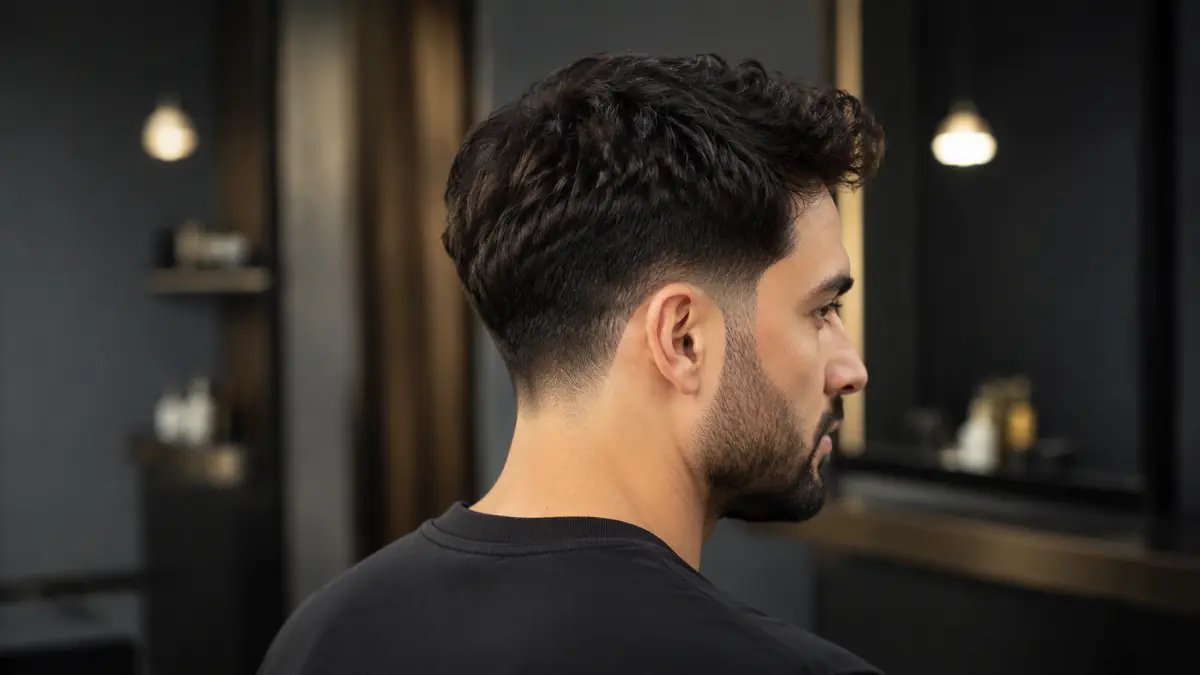
A small difference in where a fade begins can completely change a haircut. The low taper fade creates a clean outline around the temples and neckline without removing the fullness that gives the hair its shape.
A low taper fade gradually blends the hair shorter near the sideburns and nape while leaving more length around the sides and on top. Unlike a full low fade, the transition is concentrated around the edges. This produces a neat, subtle haircut that works with straight, wavy, curly and coily hair.
What Is a Low Taper Fade?
A low taper fade is a haircut in which the barber progressively shortens the hair close to the natural hairline. The closest sections usually appear around the temples, sideburns and nape of the neck.
“Low” describes the position of the blend. It remains near the bottom of the head rather than rising toward the temple line or crown. “Taper fade” describes the smooth transition from longer hair to very short hair—or exposed skin—at selected edges.
The basic structure includes:
- Longer hair on top
- Visible weight and fullness above the ears
- A gradual blend around the sideburns
- A second tapered area at the neckline
- Optional skin exposure at the lowest point
- A natural or sharply lined hairline
This haircut is sometimes associated with a temple fade, Brooklyn fade or blowout. Regional barber terminology varies, however, and those names may describe slightly different shapes. A reference photograph is more reliable than relying on the haircut’s name alone.
Is a Low Taper Fade the Same as a Low Fade?
No. The two haircuts are closely related, but the faded areas are distributed differently.
| Haircut | Where the transition appears | Overall effect |
|---|---|---|
| Low taper fade | Mainly at the temples, sideburns and neckline | Subtle and natural |
| Low fade | Continues around most or all of the head above the ears | Clearer contrast |
| Mid fade | Begins around the middle of the sides | Balanced but noticeable |
| High fade | Starts near or above the temples | Bold and high-contrast |
| Skin fade | Blends completely into bare skin | Sharpest finish |
| Classic taper | Gradually shortens without necessarily reaching skin | Conservative and traditional |
A low fade creates a visible gradient around the sides and back. A low taper preserves more hair in those areas and concentrates the shortest blend at the edges. This distinction makes the taper easier to combine with medium-length and textured hairstyles.
Does It Have to Fade Down to the Skin?
Not necessarily. A barber can finish the bottom with bare skin, a zero setting or a short clipper guard.
A skin taper creates the cleanest contrast but reveals more scalp and loses its freshly cut appearance sooner. A darker taper leaves slight stubble at the bottom. It looks softer, grows out more naturally and can be better for professional or school settings.
Why the Low Taper Fade Works So Well
The main advantage is balance. It cleans the areas where a haircut often begins to look untidy—the sideburns, around the ears and the neckline—while preserving enough density to frame the face.
Its practical benefits include:
- It works with short, medium and long hair on top.
- It keeps curls and waves visible instead of cutting into them.
- It creates less scalp exposure than a full skin fade.
- It can make thick hair look controlled without removing all its volume.
- It grows out more softly than a high or full fade.
- It suits casual, formal, school and workplace environments.
- It can be adapted to most face shapes.
There are trade-offs. A precise skin taper requires regular barber visits, and a sharp line-up may begin losing definition within several days. The haircut also depends heavily on blending skill. A poorly executed version may show dark patches, visible guidelines or uneven temple areas.
Quick takeaway: Choose this cut when you want cleaner edges without turning the entire side of your head into a prominent fade.
Low Taper Fade Styles for Different Hair Types
The fade itself occupies only a small part of the haircut. Texture, density and the length on top determine how the completed style looks.
Low Taper Fade With Straight Hair
Straight hair exposes every transition in a fade, so clean blending matters. The remaining hair can be worn as a textured crop, side part, fringe, comb-over or slicked-back style.
Fine straight hair often benefits from a darker taper rather than a skin fade. Leaving some weight around the sides prevents the top from appearing isolated or overly thin. A matte clay or light styling paste can provide texture without making the strands look flat.
For thick straight hair, the barber may remove internal bulk with point cutting or thinning techniques. The goal is controlled movement, not excessive thinning that causes the sides to stick out as they grow.
Low Taper Fade With Wavy Hair
Natural waves provide movement while the taper adds structure. Popular combinations include a messy fringe, curtains, brushed-back waves and a medium-length textured top.
Avoid heavy pomades if you want the wave pattern to remain visible. A small amount of sea-salt spray or lightweight styling cream usually gives better separation. Diffusing on low heat can add shape without creating excessive frizz.
The barber should assess how the waves sit when dry. Cutting them too short while wet can produce an unexpectedly tight or uneven result after they contract.
Low Taper Fade With Curly Hair
A low taper fade with curly hair preserves the curls as the focal point. The sides remain relatively full while the temples and neckline create a clean frame.
It works with loose curls, dense ringlets and longer curly fringes. The barber can leave a rounded silhouette, shape the top with scissors or create a more pronounced curly blowout.
Curly hair needs moisture more than strong hold. A leave-in conditioner followed by curl cream can improve definition. Sulfate-free shampoo, regular conditioning and limited high-heat styling help reduce dryness and frizz. Those habits matter because a clean fade cannot compensate for dehydrated curls.
Low Taper Fade With Coily or Afro-Textured Hair
Coily hair provides strong natural contrast against a close taper. The cut can complement a shaped Afro, twists, sponge curls, braids, locs or a short textured top.
An edge-up or line-up may be added around the forehead and temples, but it should respect the natural hairline. Repeatedly pushing the line backward can create an artificially high outline and make the corners look thinner over time.
The barber should also avoid excessive pressure and repeated passes over sensitive skin. If clipper bumps or ingrown hairs are a concern, request a short guarded finish instead of shaving directly to the skin.
Low Taper Fade With Long Hair
Longer hair does not have to be removed to get a taper. The barber can clean the sideburns and nape while leaving enough length for braids, a bun, curtains, a middle part or a layered flow.
This is useful for someone growing their hair who wants a polished perimeter without sacrificing progress. The contrast is especially visible when the hair is tied back.
Low Taper Fade for Thinning Hair
A taper can support thinning hair when its placement is conservative. Keeping the fade low retains visual density around the sides, while texture on top can make the hair appear fuller.
A short textured crop or loose side-swept top usually works better than a wet, tightly combed style. Matte products provide separation without exposing as much scalp as shiny gel or pomade.
Haircuts cannot stop or reverse hair loss. If shedding is sudden, patchy or accompanied by scalp irritation, seek advice from a qualified dermatologist rather than relying on styling alone.
Popular Low Taper Fade Variations
The top can be customized without changing the essential low placement of the taper.
Textured Crop
A textured crop uses short, broken-up layers on top, often with a small forward fringe. It is practical for straight or slightly wavy hair and requires relatively little daily styling.
Blowout Taper
The blowout taper keeps substantial height and movement on top, with the hair appearing to expand outward above the clean temple areas. It is particularly effective on thick, curly or coily textures.
Some barbers use “blowout,” “temple fade” and “taper fade” interchangeably. Show the desired amount of volume and the exact fade placement in a photograph to prevent confusion.
Edgar Cut With a Low Taper
An Edgar combines a blunt or textured forward fringe with a structured outline. Adding a low taper softens the sides while retaining the strong front shape. It is a distinctive style and requires more frequent fringe and line-up maintenance than a loose textured top.
Low Taper With a Middle Part
Curtains or a middle part pair naturally with a low taper because the cut preserves the weight needed for the hair to fall on both sides. This combination works best when the top has sufficient length to separate without springing upright.
Pompadour or Quiff
A quiff directs the front upward, while a pompadour creates fuller, swept-back volume. The restrained fade keeps both styles modern without producing a severe disconnect between the top and sides.
Buzz Cut With a Low Taper
A buzz cut can still contain variation. The top remains uniformly short while the temples and neckline transition to an even shorter length. This adds detail and shape to an otherwise simple haircut.
Mullet With a Low Taper
A modern mullet preserves length at the back and often keeps texture on top. Small tapered sections around the temples create separation without cutting away the longer rear silhouette. A burst fade is more circular and dramatic around the ear, so it should not be confused with this subtler option.
Low Drop Taper Fade
A drop fade curves lower behind the ear instead of following a straight horizontal path. A barber can introduce that curved profile while keeping the transition restrained, although the finished cut may resemble a low drop fade more than a traditional temple-focused taper.
Choosing the Right Version for Your Face Shape
No haircut can change bone structure, but its height, width and volume can alter visual proportions.
| Face shape | Helpful approach | What to watch |
|---|---|---|
| Oval | Most top styles and taper depths work | Avoid unnecessary height if the face is already long |
| Round | Add texture or moderate height on top | Heavy, rounded sides can increase width |
| Square | Preserve some side weight and use a clean outline | An extremely sharp top may exaggerate every angle |
| Oblong | Use a fringe or lower-volume top | Tall quiffs can make the face appear longer |
| Heart | Keep the transition soft with controlled volume | Removing too much at the temples can emphasize a wider forehead |
| Diamond | Leave some fullness above and behind the ears | Very tight sides may overemphasize the cheekbones |
Head shape, hairline and growth pattern matter just as much as face shape. Cowlicks, temple recession, scars and an uneven neckline can all influence the best placement. A skilled barber should adapt the blend rather than reproduce a reference image mechanically.
What to Ask Your Barber
“Give me a low taper fade” provides a starting point, but it does not define the full haircut. Barbers may interpret the phrase differently, especially across countries and shops.
Use this process:
- Bring two or three reference photos. Include front, side and back views if possible.
- Specify the faded areas. Say that you want the blend concentrated at the temples and neckline rather than carried around the entire head.
- Choose the shortest length. Request skin, zero or a specific guard based on the amount of contrast you prefer.
- Explain how low it should remain. Ask the barber not to take the blend too high above the ear.
- Describe the top separately. State how much length you want removed and how you normally style it.
- Discuss the hairline. Choose a natural outline, light clean-up or sharper line-up.
- Confirm the neckline. A natural tapered nape generally grows out more smoothly than a hard blocked edge.
- Mention maintenance preferences. If you cannot return every two weeks, ask for a softer transition that will age well.
A useful request might be:
“I want a low taper fade only at the sideburns and neckline. Keep the blend dark rather than taking a large area to skin, leave the weight above my ears and trim the top with scissors while keeping its texture.”
Watch the haircut’s silhouette before the final styling product is applied. Gel, curl enhancer and barber enhancement fibers can temporarily conceal an uneven blend. The shape should look balanced on clean, naturally positioned hair.
How a Barber Creates the Cut
Methods differ, but most professional versions follow the same basic logic.
First, the barber examines the growth pattern and separates the longer top from the areas being tapered. A trimmer or clipper establishes a low initial guideline near the temple and nape.
The shortest section is then blended upward using progressively longer clipper guards and lever positions. Clipper-over-comb or scissor-over-comb may connect the taper to the fuller sides. The barber removes visible lines without spreading the fade higher than planned.
Detailing follows. The sideburns, arches around the ears and neckline are refined with trimmers. A foil shaver or straight razor may be used at the lowest point when a skin finish is requested. The top is then cut and styled according to the chosen look.
The most common technical mistakes are:
- Placing the first guideline too high
- Expanding the fade while trying to erase a line
- Creating different taper heights on each side
- Cutting into the natural corners of the hairline
- Leaving dark patches behind the ears
- Making the neckline unnaturally high
- Failing to account for curls shrinking after drying
Home touch-ups with trimmers may seem simple, but raising one side accidentally is difficult to correct without turning the subtle taper into a larger fade.
Styling a Low Taper Fade at Home
The faded sections need little styling. Most daily work concerns the hair on top.
For a Textured Finish
- Begin with slightly damp hair.
- Apply a small amount of pre-styler or texture spray.
- Dry while directing the hair with your fingers.
- Work a pea-sized amount of matte clay or paste from the back toward the front.
- Pinch small sections to create separation.
For Curls and Coils
- Apply leave-in conditioner to damp hair.
- Distribute curl cream without aggressively brushing out the pattern.
- Scrunch loose curls or use a sponge gently on shorter coils.
- Air-dry or use a diffuser on low heat.
- Avoid repeatedly touching the hair as it dries.
For a Sleek Style
Use a comb and a light pomade for a side part or brushed-back finish. Water-based products generally wash out more easily, while heavier oil-based pomades offer stronger control but may create buildup.
Start with less product than you think you need. Too much can flatten fine hair, separate thinning areas and make the scalp more visible.
Maintenance and Grow-Out
A skin-close taper looks freshest for roughly one to two weeks because even a small amount of growth reduces the contrast. A darker, guarded taper can remain presentable longer.
Typical maintenance intervals are:
- Every 1–2 weeks: Very sharp skin taper or line-up
- Every 2–3 weeks: Standard low taper fade
- Every 3–5 weeks: Softer taper with a longer, textured top
- Every 4–8 weeks: Longer hairstyle with occasional perimeter cleanup
These are practical estimates, not rules. Growth rate, hair color, density and desired sharpness determine the real schedule. Dark, dense hair against lighter skin usually displays regrowth sooner because the contrast is stronger.
Between appointments:
- Wash according to your scalp and hair type.
- Condition curly, coily or chemically treated hair regularly.
- Clean styling residue from the hairline.
- Avoid shaving the faded area higher.
- Use clean pillowcases and sanitized tools.
- Protect curls with a satin bonnet or pillowcase if friction causes frizz.
- Limit aggressive line-ups if the temple area is sensitive or receding.
A taper normally grows out better than a high skin fade because the surrounding hair retains more length. Once the bottom begins filling in, the haircut gradually resembles a conventional short-back-and-sides style rather than developing a strong horizontal band.
Is a Low Taper Fade Low Maintenance?
It is low maintenance in terms of daily styling around the sides, but not necessarily in terms of barber visits. A skin-finished version needs frequent cleanup if you want it to remain crisp.
For less upkeep, request:
- A zero or short guarded base instead of bare skin
- A natural hairline instead of a razor-sharp line-up
- A softly tapered neckline
- Enough side length to prevent harsh grow-out
- A top style that works with your natural texture
That combination preserves the haircut’s clean character while reducing the need for weekly detailing.
Final Thoughts on the Low Taper Fade
The low taper fade is most effective when it remains genuinely low. Its purpose is to refine the sideburns and neckline while preserving the hair’s natural density, texture and overall silhouette.
Choose the top style according to your hair type and face shape, decide whether you prefer a skin or guarded finish, and show your barber clear reference photos. With accurate placement and realistic maintenance, a low taper fade delivers clean edges without the severe contrast of a full fade.
