

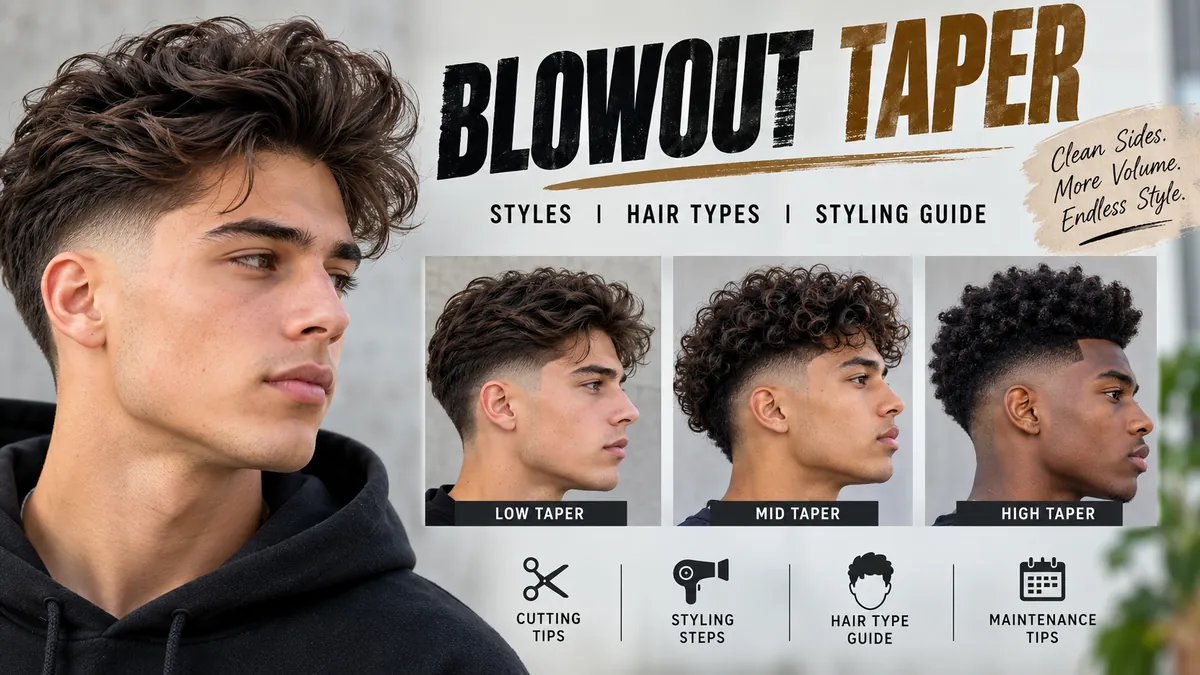
The blowout taper has become one of the most recognizable modern men’s haircuts because it does something many short styles cannot: it keeps the top full, textured and expressive while cleaning up the edges without removing too much hair from the sides. The result can look relaxed, sharp or deliberately messy depending on how it is cut and styled.
A blowout taper combines longer hair on top with a gradual taper concentrated around the temples, sideburns and neckline. The top is styled upward, outward, forward or back to create volume and movement. Unlike a full fade, a traditional taper generally preserves more hair through the sides, creating a softer transition and more natural grow-out.
That simple foundation leaves plenty of room for customization. Low, mid and high tapers can dramatically change the appearance, while straight, wavy, curly and coily textures each create a different version of the blowout shape.
What Is a Blowout Taper?
A blowout taper is best understood as two separate elements working together: the taper creates the clean perimeter, while the blowout creates the volume and silhouette.
The taper gradually shortens the hair around areas such as the sideburns, temples and neckline. Instead of necessarily removing most of the hair across the entire side of the head, it can remain localized around the perimeter.
The blowout describes the longer top and the way that hair is shaped. Blow-drying lifts the roots and creates an airy, fuller appearance. Depending on the haircut, the hair may move upward and backward, forward toward a fringe, or outward around the sides.
This distinction matters because the word “blowout” does not mean that every part of the haircut is extremely short or faded. Much of the recognizable shape actually comes from preserving weight and length.
The Basic Anatomy
| Area | Typical Approach | Purpose |
|---|---|---|
| Top | Longer and textured | Creates volume and movement |
| Front | Usually retains length | Provides lift or a textured fringe |
| Temples | Gradually tapered | Creates a cleaner outline |
| Sideburns | Shortened and blended | Sharpens the profile |
| Sides | Often retain more weight | Maintains the blowout silhouette |
| Neckline | Tapered and cleaned | Gives the back a finished appearance |
One reason reference photographs are useful is that “blowout taper” is not a universally precise cutting formula. Different barbers may interpret how high, short or aggressive the taper should be differently.
Blowout Taper vs Taper Fade: What Is the Difference?
These terms are frequently used interchangeably online, but there can be an important practical difference.
A traditional taper usually concentrates the shortest graduation around the edges—the temples, sideburns and neckline—while retaining considerably more hair across the sides.
A fade generally creates a larger gradient across the side and back of the head and may transition all the way down to skin.
| Feature | Blowout Taper | Blowout Fade |
|---|---|---|
| Shortest area | Mainly perimeter | Larger portion of sides/back |
| Side length | More hair retained | More hair removed |
| Contrast | Soft to moderate | Moderate to strong |
| Grow-out | Usually softer | Regrowth can become visible sooner |
| Overall shape | Fuller | Cleaner and tighter |
| Scalp exposure | Usually limited | Can be substantial with skin fades |
In everyday barber terminology, however, the boundary is not always rigid. Some barbers use “taper fade” for a taper that becomes extremely short around the hairline.
Rather than relying exclusively on terminology, describe where you want the shortest hair and how much weight you want left on the sides.
What Makes It Different From a Regular Taper?
A regular taper describes primarily the graduation of hair length.
The blowout version adds another requirement: noticeable volume, movement or fullness through the longer hair.
Without that shape on top, you essentially have a conventional taper rather than the distinctive modern blowout look.
Low, Mid and High Blowout Taper Styles
Taper height is one of the most important decisions because it controls how much contrast appears between the full top and shorter edges.
Low Blowout Taper
The low blowout taper keeps the transition close to the ears, sideburns and lower neckline.
Because relatively little hair is removed, the sides remain full and connect naturally with the longer top.
This version works especially well when you want:
- A subtle transition
- Plenty of side volume
- Softer grow-out
- Less scalp exposure
- A haircut that does not look excessively faded
A low taper is also a sensible introduction to the style. If you later decide that you want more contrast, your barber can gradually take the taper higher.
Mid Blowout Taper
A mid blowout taper creates more visible separation between the top and perimeter.
The transition usually becomes noticeable around the temple region, producing a balanced silhouette that sits between the subtle low taper and dramatic high version.
It pairs particularly well with thick, wavy or curly hair because the stronger sides provide visual structure underneath the volume.
High Blowout Taper
A high blowout taper moves the shortest transition farther upward.
That creates stronger contrast and makes the top appear even larger. The haircut therefore has a sharper, more dramatic profile.
The tradeoff is grow-out. When a larger visible area is cut extremely short, new growth becomes noticeable sooner.
Quick Takeaway: Low means softer and fuller. Mid gives a balanced amount of contrast. High creates the boldest transition. The best choice depends less on trends and more on how much side length you want to preserve.
Blowout Taper for Straight Hair
Straight hair can produce a particularly clean version of the haircut, but it usually needs deliberate styling to achieve the characteristic lift.
The challenge is that straight strands may naturally fall downward rather than remaining elevated.
A barber can help by retaining enough length through the top and using controlled layering or texture where appropriate. Removing too much weight, however, can sometimes make the style harder rather than easier to build.
At home, root direction becomes crucial.
Start blow-drying near the roots rather than concentrating only on the ends. Direct the airflow upward while lifting the hair with your fingers, vent brush or round brush.
For a fluffy finish, avoid flattening everything with heavy wax immediately afterward.
Fine Straight Hair
Fine hair requires slightly different treatment.
Too much product can quickly collapse the volume, making the top look oily or separated. Lightweight mousse, volumizing spray or a small amount of texturizing product generally makes more sense than a thick pomade.
Also consider keeping the taper relatively low. Preserving more side density can prevent fine hair from appearing unnecessarily sparse.
Blowout Taper for Wavy Hair
Wavy hair is naturally suited to the blowout silhouette because it already contains movement.
Instead of trying to straighten the wave pattern, styling can emphasize it.
A good wavy blowout taper typically retains enough top length for the waves to bend naturally while cleaning the temple and neckline areas.
After washing, remove excess moisture without aggressively rubbing the hair. Apply a light styling product and dry from the roots while using your fingers to guide the waves.
You do not need perfect uniformity.
Slightly irregular sections often create the textured, airy finish that makes this haircut visually interesting.
Blowout Taper for Curly Hair
The blowout taper curly hair combination can create substantial natural volume because curls already provide lift and three-dimensional texture. Current barber guides commonly adapt the style specifically for curly and coily patterns rather than treating them like straight hair.
The key is preserving the curl structure.
If too much bulk is removed from the wrong places, the silhouette can become narrow at the sides and disproportionately large at the crown.
A diffuser is often more useful than concentrating high-speed air directly onto curls. It spreads airflow over a larger area, helping dry the hair while limiting unnecessary disruption to the curl pattern.
A practical curly-hair routine is:
- Start with damp, conditioned hair.
- Apply a lightweight leave-in conditioner if additional moisture is needed.
- Work curl cream through the lengths.
- Lift sections gently from the roots.
- Use a diffuser on controlled heat and airflow.
- Stop manipulating the hair excessively once curls begin setting.
- Finish with minimal product if additional hold is necessary.
The finished result does not need to resemble a straight-haired blowout. Natural curl definition is part of the style.
Blowout Taper for Coily and Afro-Textured Hair
Coily hair provides enough natural structure to create significant height without requiring the same styling process as straight hair.
The taper can sharpen the temple and nape while the top retains its natural texture.
Depending on personal preference, the upper section can remain tightly coiled, sponge-textured, picked outward or shaped into a more rounded profile.
Moisture management is particularly important. Excessive heat and aggressive brushing can work against the natural texture rather than improving the haircut.
Instead, build the shape around the existing curl pattern.
Should Coily Hair Be Blown Straight?
Not necessarily.
“Blowout” describes the visual concept of volume and shape in this haircut; it does not mean every texture must be transformed into straight hair.
A coily blowout taper can retain clearly visible coils while still delivering the full-top, clean-edge contrast associated with the style.
Textured Fringe Blowout Taper
One popular variation combines the haircut with a textured fringe.
Instead of pushing all the top hair backward, the front is allowed to move forward toward the forehead while maintaining height and separation.
The result feels less formal and deliberately more relaxed.
It works particularly well with:
- Naturally wavy hair
- Loose curls
- Thick straight hair
- Medium-length tops
- Hair that naturally grows forward
The fringe can be subtle or intentionally messy. What matters is keeping movement rather than creating one heavy, flat line across the forehead.
Fluffy Blowout Taper
The fluffy blowout taper emphasizes softness rather than sharp definition.
Think airy roots, loose texture and visible movement.
This style relies heavily on blow-drying technique. One current style guide notes that the volume itself is produced during drying, illustrating why the finished appearance can change substantially when the same haircut is simply left to air-dry.
Heavy styling products tend to work against that goal.
For a fluffy appearance, prioritize:
- Root lift
- Lightweight styling products
- Flexible rather than rigid hold
- Finger styling
- Controlled blow-dryer airflow
- Natural separation between sections
The objective is volume without making the hair look stiff.
Blowout Taper With a Messy Top
Not everyone wants a perfectly shaped finish.
A messy blowout keeps the same tapered foundation while allowing greater irregularity through the upper section.
This works particularly well on wavy and thick hair because individual strands naturally move in different directions.
The mistake is confusing “messy” with completely unstyled.
Good messy texture still has structure underneath it: elevated roots, intentional direction and controlled proportions. The finishing stage simply avoids making every section symmetrical.
How Face Shape Changes the Blowout Taper
Haircuts do not need rigid face-shape rules, but understanding visual proportions can help you decide where to place the volume.
Round Face
Extra vertical height can visually lengthen a rounder face.
Keeping the top lifted while avoiding excessive horizontal width may create a more balanced appearance.
A mid taper can also provide stronger definition around the temples.
Oval Face
Oval proportions are adaptable because the barber can adjust height, fringe direction and taper position without needing to compensate strongly for width or length.
Low and mid versions are easy starting points.
Square Face
A square face already has noticeable angles around the jaw.
Leaving some softness and texture on top can balance those sharper lines. A low or mid taper preserves that contrast without necessarily making the haircut excessively severe.
Long or Oblong Face
Maximum vertical height is not always desirable.
Instead of pushing the top straight upward, direct some volume forward or outward. A textured fringe can be especially useful because it reduces the visual emphasis on face length.
Heart or Triangle-Shaped Face
Maintaining some fullness around the sides can help balance proportions.
For that reason, an aggressive high fade may not always be the first choice. A softer taper that preserves side weight can provide more flexibility.
How to Ask Your Barber for a Blowout Taper
Showing your barber a reference photograph is usually more reliable than saying only the haircut name because interpretations of taper height and blowout shape vary.
Before the cutting starts, communicate four things clearly:
- Taper height: low, mid or high.
- Shortest length: natural taper, very short taper or skin-level finish.
- Top length: how much you want removed—or preserved.
- Styling direction: up, back, forward, outward or textured fringe.
For example, you could ask for a low taper concentrated around the sideburns and neckline while keeping the sides full and preserving enough top length to blow-dry upward with texture.
That communicates much more than the haircut name alone.
Bring a Reference Photo
Choose a photograph featuring someone with a hair texture reasonably similar to yours.
A style photographed on very thick Type 3 curls will behave differently on fine straight hair even when the barber follows similar proportions.
Show both the front and side views when possible.
Explain What You Do Not Want
Negative instructions can be surprisingly helpful.
If you do not want the taper taken high, say so.
If you want to retain weight around the back, mention it.
If you do not want skin exposed, specify that before the barber establishes the shortest guideline.
These details prevent the common situation where a requested taper gradually turns into a full fade.
How Much Hair Length Do You Need?
There is no universal minimum because the required length changes with texture and desired shape.
What matters is having enough hair for the top to visibly lift and move.
Very short hair can still be tapered and styled upward, but it will not produce the same fluffy silhouette associated with longer blowout styles.
For a dramatic look, several inches of top length generally gives the barber and wearer much more control. Some current style references describe roughly four inches or more for particularly full versions, while other variations work with less.
If you are growing toward the style, tell your barber.
That allows them to clean the perimeter without repeatedly cutting away the length you are trying to develop.
How to Style a Blowout Taper at Home
The haircut provides the foundation, but styling produces much of the recognizable finish.
You do not need ten products.
You need moisture control, root lift, airflow direction and enough hold to preserve the shape.
Step 1: Start With Damp Hair
Hair should normally be damp rather than dripping wet.
Gently towel-dry it after washing.
Avoid aggressive rubbing, particularly with curly or wavy textures, because friction can increase frizz and disturb natural pattern.
Step 2: Apply a Pre-Styler
Choose according to your texture.
Fine hair generally benefits from something lightweight. Thick hair may need stronger control. Curly hair often benefits more from hydration and definition.
Possible options include:
- Volumizing mousse
- Lightweight styling cream
- Curl cream
- Leave-in conditioner
- Texture spray
- Heat protectant
Heat protection is particularly useful if blow-drying is part of your regular routine.
Step 3: Build Root Volume
This is the most important stage.
Lift the hair from the roots and direct airflow toward the direction you want it to sit.
For upward volume, lift vertically.
For a swept-back finish, begin by creating root lift before gradually directing the lengths backward.
For a textured fringe, create volume first and then guide the front sections forward.
Step 4: Use the Right Dryer Attachment
A concentrated nozzle helps direct airflow on straight and wavy styles.
A diffuser is generally better suited to curly hair because it distributes airflow and helps maintain curl structure.
Keep the dryer moving rather than concentrating high heat on one small area.
Step 5: Shape With Your Hands or Brush
A round brush can create substantial controlled lift on straight or wavy hair.
Finger styling produces a less polished, more separated texture.
Neither is universally better.
Choose based on the finish you want.
Step 6: Finish Lightly
Use the smallest amount of finishing product that reliably holds your style.
Matte paste, styling clay or flexible-hold products can add control, but excessive product can pull elevated hair downward.
Apply primarily where control is needed rather than coating every strand.
Quick Takeaway: The blow dryer creates the architecture. Styling product helps preserve it. Trying to create all the volume with wax or clay alone usually makes the hair heavier instead.
Styling Products by Hair Type
Different textures need different priorities.
| Hair Type | Main Styling Goal | Useful Product Type |
|---|---|---|
| Fine straight | Lightweight volume | Mousse or texture spray |
| Thick straight | Control + lift | Light paste or cream |
| Wavy | Definition + movement | Styling cream |
| Curly | Moisture + curl definition | Curl cream/leave-in |
| Coily | Moisture + shape | Hydrating cream |
| Frizz-prone | Smoother finish | Lightweight anti-frizz product |
Products should support the natural characteristics of your hair rather than force it into an entirely different texture.
Common Blowout Taper Mistakes
A great reference image does not guarantee a great result. Several mistakes repeatedly cause this haircut to lose its intended shape.
Taking the Taper Too High
A taper that climbs farther than intended removes side weight.
That can transform a subtle blowout into something closer to a conventional fade.
Decide how much contrast you actually want before the clippers start moving upward.
Cutting Too Much From the Top
The blowout needs enough length to generate movement.
Taking off substantial top length simply because the ends need cleaning can eliminate the very volume that defines the haircut.
Removing Too Much Internal Weight
Texture is useful, but excessive thinning is not automatically better.
Very aggressive thinning can make some hair types difficult to control and prevent the top from holding the desired silhouette.
Using Too Much Product
More product does not equal more volume.
Heavy waxes and creams can pull the hair toward the scalp, especially on fine or medium-density hair.
Start with less. Add more only where necessary.
Ignoring Natural Growth Direction
Cowlicks, crowns and front growth patterns affect how hair responds to blow-drying.
Rather than fighting them every morning, a good haircut incorporates those patterns into the final shape.
Copying a Different Hair Texture Exactly
A curly blowout and straight blowout may share the same basic structure, but they will not produce identical silhouettes.
Use inspiration photographs as references for proportions—not as promises of identical texture.
How Often Does a Blowout Taper Need Maintenance?
Maintenance depends heavily on taper height and how crisp you want the edges.
A subtle taper generally grows out more gracefully because there is less contrast between extremely short and longer areas. More aggressive fades show regrowth faster.
Current haircut guides commonly place professional maintenance somewhere around the two-to-four-week range, with higher-contrast versions often needing attention sooner.
That does not mean the haircut suddenly becomes bad after a particular number of days.
It gradually becomes softer.
Some people prefer that lived-in appearance and wait longer between appointments. Others want consistently sharp temples and neckline detailing and therefore return sooner.
Between Haircuts
You can extend the appearance of the style by:
- Keeping the scalp and hair clean without over-washing
- Conditioning according to your texture
- Avoiding excessive heat
- Using heat protectant when appropriate
- Preserving natural curl or wave definition
- Styling from the roots rather than adding excessive product
- Avoiding DIY adjustments to the taper unless you understand clipper blending
A slightly grown taper usually looks better than an accidentally pushed-up hairline.
Does a Blowout Taper Require Styling Every Day?
Not necessarily—but the dramatic version usually requires some styling.
The haircut itself remains after washing. The maximum volume does not.
Straight hair may fall considerably flatter when air-dried, while naturally curly or coily textures can retain more inherent volume.
If you want the full fluffy appearance every morning, expect to spend at least some time resetting the roots.
You can simplify the process by having your barber shape the haircut around the way your hair naturally falls instead of choosing a silhouette that requires constant correction.
Can You Get a Blowout Taper Without a Skin Fade?
Yes.
In fact, a blowout taper does not require a skin fade.
The shortest section can retain visible hair while still graduating smoothly into the longer sides.
This is an important distinction for anyone who likes the general shape but does not want exposed scalp or extremely sharp contrast.
Ask specifically for a softer taper and clarify that you do not want it taken down to skin.
Is the Blowout Taper High Maintenance?
It falls somewhere in the middle.
The cutting schedule can be fairly manageable, particularly with a low taper. The styling commitment depends on how dramatic you want the blowout to look.
A loose curly version might need relatively little daily manipulation. Fine straight hair styled into a large fluffy shape may require blow-drying whenever it is washed or flattened.
So there are really two forms of maintenance:
Barber maintenance keeps the taper clean.
Daily styling maintenance keeps the top voluminous.
Someone comfortable with slightly softer edges can reduce the first. Someone comfortable with natural texture can reduce the second.
Is a Blowout Taper Worth Trying?
The blowout taper works because it is not a single rigid haircut. It is a framework that combines clean tapered edges with deliberately retained volume on top.
A low taper provides the softest transition. A mid version creates more definition, while a high taper produces stronger contrast. Straight hair can achieve an airy, structured finish through blow-drying; wavy hair adds natural movement; curly and coily textures can create substantial volume with less need to manufacture texture.
The most useful next step is simple: decide how much side hair you want to keep, choose the direction and amount of volume you want on top, and take a reference image showing a similar hair texture to your barber. That gives them far more useful information than asking for a haircut name alone.
