

You know the word when you hear it. You may even use it every day. But the moment you try to write it, you stop: Is that one letter or two? Does the “e” stay? Is it “ie” or “ei”?
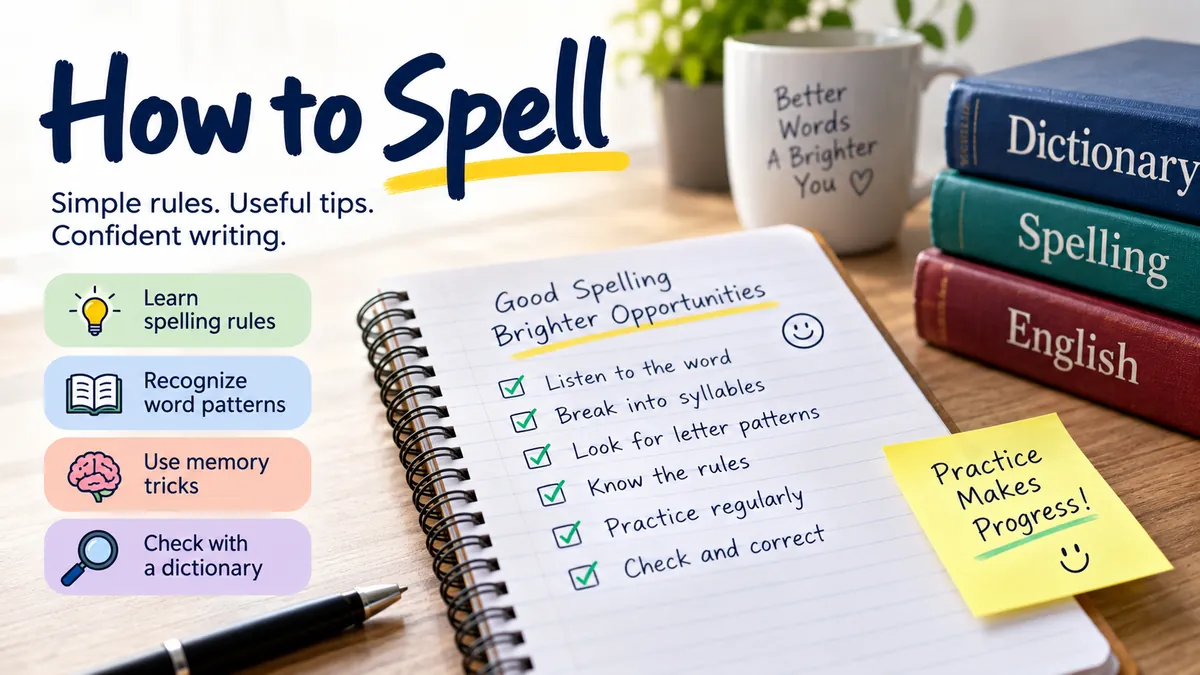
Learning how to spell means learning to put the letters of a word in the correct order. The most reliable approach combines pronunciation, phonics, syllables, common letter patterns, word parts, memory techniques, and dictionary checking. English has exceptions, so strong spelling comes from recognizing patterns while learning irregular words separately.
The good news is that you do not need to memorize every English word individually. Once you understand how sounds, letters, prefixes, suffixes, and word families work together, unfamiliar words become much easier to handle.
How to Spell a Word Correctly
When you are unsure how to spell a word, avoid simply guessing what “looks right.” Use a repeatable process.
1. Say the word clearly
Start by pronouncing the word slowly.
Suppose you want to write important. Saying it carefully helps you hear its major sound units rather than relying on the shortened pronunciation you might use in casual conversation.
This matters because everyday speech can hide sounds and letters. English pronunciation and spelling do not always correspond perfectly. Words such as colonel, yacht, and handkerchief demonstrate why writing purely by sound can lead you in the wrong direction.
2. Break the word into syllables
Divide a difficult word into manageable parts.
For example:
| Word | Useful breakdown |
|---|---|
| remember | re-mem-ber |
| important | im-por-tant |
| beautiful | beau-ti-ful |
| computer | com-pu-ter |
| education | ed-u-ca-tion |
| yesterday | yes-ter-day |
Syllables reduce the amount of information you need to process at once.
They are especially helpful with longer words because instead of trying to remember one large sequence of letters, you can work through several smaller units.
3. Listen for individual sounds
Next, identify the sounds you can hear and connect them with letters or groups of letters.
This relationship between speech sounds and written symbols is central to phonics. In linguistic terminology, a speech sound is a phoneme, while the written letter or letter combination representing it is a grapheme.
For instance, the sound /sh/ can appear in different spellings:
- sh in ship
- ti in nation
- ci in special
- s in sugar
That illustrates one of the main challenges of English: the same sound does not always have the same spelling.
4. Think about familiar spelling patterns
Ask yourself whether the word resembles another word you already know.
If you can spell:
light
you have a useful pattern for:
night, right, sight, fight
Likewise:
nation
can help you recognize the pattern in:
station, information, education, celebration
Learning words in families is usually more effective than treating every spelling as completely unrelated.
5. Write your best attempt
Write the word without immediately checking it.
This forces you to retrieve the spelling from memory rather than merely recognize the correct version on a screen.
For example, if you are learning necessary, write your attempt first. Then compare it with the correct spelling.
That comparison makes the exact mistake easier to notice.
6. Check an authoritative dictionary
When accuracy matters, verify the word.
A dictionary can show you much more than spelling. Depending on the dictionary, you may also find pronunciation, definitions, grammatical information, example sentences, and regional variants.
This becomes particularly useful when American and British spelling differ. Guidance from the Universitat Oberta de Catalunya, for example, recommends authoritative dictionary references when there is uncertainty about British or American forms.
How to Spell Using English Sound and Letter Patterns
English is not perfectly phonetic. That does not mean its spelling is random.
A large proportion of words contain recognizable sound-letter relationships, so phonics remains a valuable foundation for spelling. One evidence-based literacy resource describes spelling as representing a word visually by identifying its sounds and choosing letters that represent those sounds.
Consider:
cat → c-a-t
The sounds map fairly neatly onto individual letters.
Now consider:
ship → sh-i-p
The first sound requires two letters.
Then:
night → n-igh-t
Here, several letters work together to represent the vowel sound, while the written gh is not pronounced in modern standard English.
This is why effective spelling instruction goes beyond “write what you hear.”
Learn common letter combinations
Frequently occurring combinations include:
| Pattern | Examples |
|---|---|
| sh | ship, fish, shop |
| ch | chair, much, child |
| th | think, this, three |
| ph | phone, photograph |
| ee | see, green, sleep |
| ea | eat, read, clean |
| igh | light, night, right |
| tion | nation, action, station |
| sion | vision, decision, television |
Recognizing these chunks can make unfamiliar words less intimidating.
Instead of remembering every letter separately, your brain begins recognizing larger spelling patterns.
How to Spell With Common English Spelling Rules
English spelling rules are useful, but few should be treated as absolute laws. English has been influenced by several languages, including Germanic languages, Latin, Greek, and French, which helps explain why its spelling system contains so many different patterns and exceptions.
Here are the rules that provide the most practical value.
Drop the final e before some suffixes
When a word ending in silent e receives a suffix beginning with a vowel, the final e is often dropped.
Examples:
- make + ing → making
- write + ing → writing
- hope + ing → hoping
- use + ing → using
Compare hoping with hopping.
That extra consonant changes both the spelling pattern and meaning.
Not every suffix requires dropping the e, so learn this as a common pattern rather than an exception-free formula.
Double the final consonant in certain words
A final consonant is often doubled before adding a suffix such as -ing or -ed when a short word ends in a consonant after a short stressed vowel.
Examples:
- run → running
- sit → sitting
- stop → stopped
- big → bigger
Compare:
hop → hopping
with:
hope → hoping
The distinction is small on the page but important.
Change final y to i in many forms
When a word ends in a consonant followed by y, the y often changes to i before certain endings.
Examples:
- happy → happier
- easy → easier
- carry → carried
- baby → babies
But if a vowel comes before the y, it often remains:
- boy → boys
- play → played
- key → keys
And before -ing, the y generally remains:
- carry → carrying
- study → studying
Learn plural spelling patterns
Most English nouns form their plurals by adding -s:
- book → books
- car → cars
- teacher → teachers
Some take -es:
- box → boxes
- bus → buses
- watch → watches
Words ending in a consonant plus y often change y to i:
- city → cities
- baby → babies
- story → stories
Then there are irregular plurals that need to be learned individually:
- child → children
- tooth → teeth
- mouse → mice
- man → men
The British Council specifically highlights irregular plurals as an area where learners should pay attention to spelling.
Is “I Before E Except After C” Always Correct?
You may have learned:
“i before e except after c.”
It can help with certain words:
- believe
- piece
- receive
- ceiling
But it is not a universal spelling rule.
English contains many words that do not fit a simplistic version of the rhyme. Weigh and neighbor/neighbour, for example, use ei with a different vowel sound. Current spelling guidance therefore treats the rhyme as a pattern with exceptions rather than a guarantee.
The practical lesson is simple: use spelling rules to narrow down possibilities, but verify unfamiliar words when accuracy matters.
How to Spell Words You Cannot Sound Out
Some English words resist straightforward phonetic spelling because their pronunciation does not reveal every written letter.
Consider:
Wednesday
Many speakers do not clearly pronounce every letter represented in the written form.
Or:
island
The s is silent.
Then there are words such as:
- knight
- answer
- doubt
- receipt
- psychology
- honest
Trying to spell these entirely by sound can produce errors.
For irregular words, use visual memory, word structure, etymological clues when useful, and repeated retrieval practice.
Look for smaller words inside larger words
One useful memory technique is identifying a familiar sequence inside a difficult word.
The British Council gives this type of strategy for words such as surprise, island, and together, because recognizable chunks can create stronger memory associations.
For example:
together → to + get + her
It is not an explanation of the word’s linguistic origin. It is simply a memory device.
That distinction matters: a mnemonic only needs to help you remember the correct letters.
How to Spell With Prefixes and Suffixes
Understanding morphemes—meaningful units within words—can make spelling much easier.
A prefix comes before a base or root:
- un + happy → unhappy
- dis + agree → disagree
- re + write → rewrite
- mis + spell → misspell
A suffix comes after it:
- help + ful → helpful
- quick + ly → quickly
- teach + er → teacher
- kind + ness → kindness
The British Council notes that prefixes, suffixes, plurals, doubled letters, and letter-dropping patterns are valuable areas to study when improving English spelling.
Learning these structures gives you something more useful than memorizing one word: it gives you a pattern that can apply to many words.
Build word families
Take the root act:
- act
- action
- active
- activity
- actor
- inactive
- react
- reaction
Or educate:
- educate
- education
- educator
- educational
Seeing related words together strengthens your understanding of both spelling and vocabulary.
Quick Takeaway: Learn spelling through sounds, letter patterns and meaningful word parts. When a word breaks the expected pattern, treat it as an irregular word and give it extra practice.
How to Spell Homophones Correctly
Sometimes the problem is not knowing how a word is spelled. The problem is knowing which correctly spelled word belongs in the sentence.
These are common examples:
| Words | Example |
|---|---|
| there / their / they’re | Their house is over there. |
| to / too / two | I have two books too. |
| your / you’re | You’re holding your phone. |
| its / it’s | It’s wagging its tail. |
| hear / here | Come here so you can hear me. |
| one / won | She won one prize. |
| sea / see | I can see the sea. |
A basic spell checker may fail to identify this type of error because the incorrect choice can still be a correctly spelled English word. For example, one and won are both legitimate words even though only one may fit a particular sentence.
Context therefore matters just as much as letter order.
British and American English Spelling
Sometimes two different spellings are both correct.
The answer depends on which variety of English you are using.
| American English | British English |
|---|---|
| color | colour |
| favor | favour |
| center | centre |
| theater | theatre |
| traveled | travelled |
| defense | defence |
Regional spelling conventions are one reason a dictionary may appear to give a different answer from your teacher, editor, or word processor.
Neither version is automatically wrong.
What matters most in formal writing is consistency. If you are writing in American English, follow American conventions throughout. If your publication, school, or employer uses British English, follow its preferred style.
Some conventions also vary within British English itself, including certain -ize/-ise forms. That is another reason to follow a specific dictionary or style guide when consistency matters.
How to Spell Difficult Words With Mnemonics
A mnemonic is a memory aid designed to make difficult information easier to recall.
This technique works particularly well when one specific part of a word keeps causing trouble.
Take:
necessary
A learner may repeatedly wonder how many c’s and s’s it contains. Instead of rewriting the whole word dozens of times without thinking, create a visual or verbal association that emphasizes the troublesome letters.
The same strategy can be applied to words such as:
- separate
- accommodation
- definitely
- rhythm
- tomorrow
- beginning
- occurrence
- pronunciation
Memory techniques can include rhymes, visual images, stories, abbreviations, alliteration, or finding recognizable words inside longer words.
The best mnemonic is not necessarily the cleverest one. It is the one you can actually remember when writing.
The Look–Cover–Write–Check Method
One of the simplest ways to practice how to spell is the look–cover–write–check technique.
The British Council recommends this basic sequence for spelling practice: look carefully at the word, cover it, write it from memory, and then check your attempt.
Here is how to make the method more effective:
- Look — Study the complete word and identify the difficult part.
- Say — Pronounce the word while looking at it.
- Cover — Hide the correct spelling.
- Write — Reproduce it from memory.
- Check — Compare every letter with the original.
- Correct — If it is wrong, identify exactly where the mistake occurred.
- Repeat later — Test yourself again after some time has passed.
The crucial step is retrieval.
Copying beautiful ten times while looking at it mainly practices copying. Covering it and attempting to reproduce it forces your brain to recall the spelling.
How to Spell Names, Places, and Unfamiliar Words
Names create a different challenge because pronunciation often cannot tell you the preferred spelling.
Someone called:
Sara
could instead spell the name:
Sarah
Likewise, many names have multiple legitimate forms.
If the spelling belongs to a particular person, organization, product, or place, confirmation from an authoritative source is better than guessing.
When speaking with someone, simply ask them to spell the name.
For spoken communication, letters that sound similar can also be clarified using recognizable words or a standardized spelling alphabet where appropriate.
The same principle applies to email addresses, usernames, street names, and technical terminology: accuracy is more valuable than confidently guessing.
How to Check Spelling Online
Modern writing software makes spelling verification much faster.
Common options include:
- online dictionaries
- built-in browser spell check
- word-processing software
- search engines
- grammar and spelling checkers
- mobile keyboard suggestions
Tools such as Grammarly can flag suspected misspellings and provide replacement suggestions.
But automated correction should be treated as assistance rather than unquestionable authority.
Consider:
I red the book yesterday.
Every word is a legitimate English word, but red is incorrect in this context. The intended sentence is:
I read the book yesterday.
Contextual writing tools may catch such problems, but traditional spell checking cannot reliably identify every correctly spelled but incorrectly used word.
Always reread the complete sentence after accepting an automatic correction.
Why English Spelling Can Be Difficult
If English spelling sometimes feels inconsistent, there is a historical reason.
Modern English developed through extensive contact with other languages. Its vocabulary and spelling reflect Germanic foundations alongside substantial influences from French, Latin, Greek, and other languages.
Pronunciation also changed over time without every spelling changing alongside it.
That history helps explain unusual relationships between sound and spelling.
Compare:
- though
- through
- thought
- tough
- cough
They share several letters but are not pronounced the same way.
This is why a purely sound-based strategy eventually reaches its limits. Good spellers combine phonics with pattern recognition, morphology, visual memory, vocabulary knowledge, and reference tools.
Common Spelling Mistakes and Why They Happen
Many spelling errors follow predictable patterns.
Missing silent letters
Words such as knight, write, and island contain letters that are not obvious from modern pronunciation.
What works: visualize the whole written word rather than relying exclusively on sound.
Confusing double consonants
Words such as accommodation and necessary can be difficult because learners forget which consonants are doubled.
What works: isolate and repeatedly retrieve the troublesome portion instead of repeatedly copying the entire word.
Mixing up similar endings
Endings such as -able/-ible, -ance/-ence, and -ant/-ent cause frequent uncertainty.
What works: learn common word families and verify uncertain forms.
Writing the word exactly as it sounds
Casual pronunciation can conceal letters or syllables.
What works: pronounce unfamiliar words carefully, but recognize when phonetic spelling stops being reliable.
Trusting autocorrect without checking
Autocorrect can replace your intended word with another valid word.
What works: reread the full sentence after corrections.
How to Improve Spelling Over Time
If you regularly struggle with spelling, focus on the words you actually get wrong.
Keep a small personal spelling list.
For each mistake, record:
| Misspelling | Correct spelling | Problem area |
|---|---|---|
| definately | definitely | middle vowels |
| seperate | separate | second vowel |
| recieve | receive | ie/ei order |
| tommorow | tomorrow | doubled consonant |
| begining | beginning | consonant doubling |
Then practice those words with active recall.
This is more efficient than repeatedly studying hundreds of words you already know.
Read regularly
Reading exposes you to correct spellings in meaningful contexts.
Repeated exposure helps familiar letter sequences become visually recognizable. You begin to notice when a word “looks wrong”—but that visual instinct works best when it has been built through substantial exposure to correctly written language.
Write regularly
Reading develops recognition; writing requires recall.
Use new vocabulary in sentences, short notes, essays, emails, or journal entries. When you make an error, correct it and revisit the word later.
Connect pronunciation, meaning, and spelling
Do not learn a word as an isolated sequence of letters.
Learn:
what it sounds like + what it means + how it is spelled + how it is used
The British Council recommends making connections among sounds, meanings, letter patterns, visual associations, and memory devices to strengthen spelling recall.
A Simple Routine for Any Difficult Word
When you encounter an unfamiliar word, use this sequence:
- Say it carefully.
- Divide it into syllables.
- Identify the sounds you recognize.
- Look for familiar letter patterns.
- Identify prefixes, roots, or suffixes.
- Write your best attempt.
- Check the spelling in a reliable dictionary.
- Notice exactly what you got wrong.
- Cover the correct version and spell it again.
- Use the word in a sentence.
This method teaches more than the answer to one spelling problem. It gradually develops the skills needed to solve future ones independently.
How to Spell With More Confidence
Learning how to spell is not about memorizing an endless dictionary or finding one rule that works for every English word. It is about building several complementary skills: hearing sounds, recognizing phonics patterns, dividing words into syllables, understanding prefixes and suffixes, spotting word families, remembering irregular forms, and checking uncertain spellings.
When a word causes trouble, use say → break down → write → check → correct → repeat.
Over time, the words you once had to look up become automatic—and when an unfamiliar spelling appears, you have a practical system for working it out.
