

Finding a different word is easy. Finding a word that preserves the same meaning, tone, grammar, and context is harder.
That is the real purpose behind searches for synonyms for a word or phrase. Writers, students, editors, language learners, and everyday speakers use synonyms to avoid unnecessary repetition, improve precision, adjust tone, and make communication sound more natural.
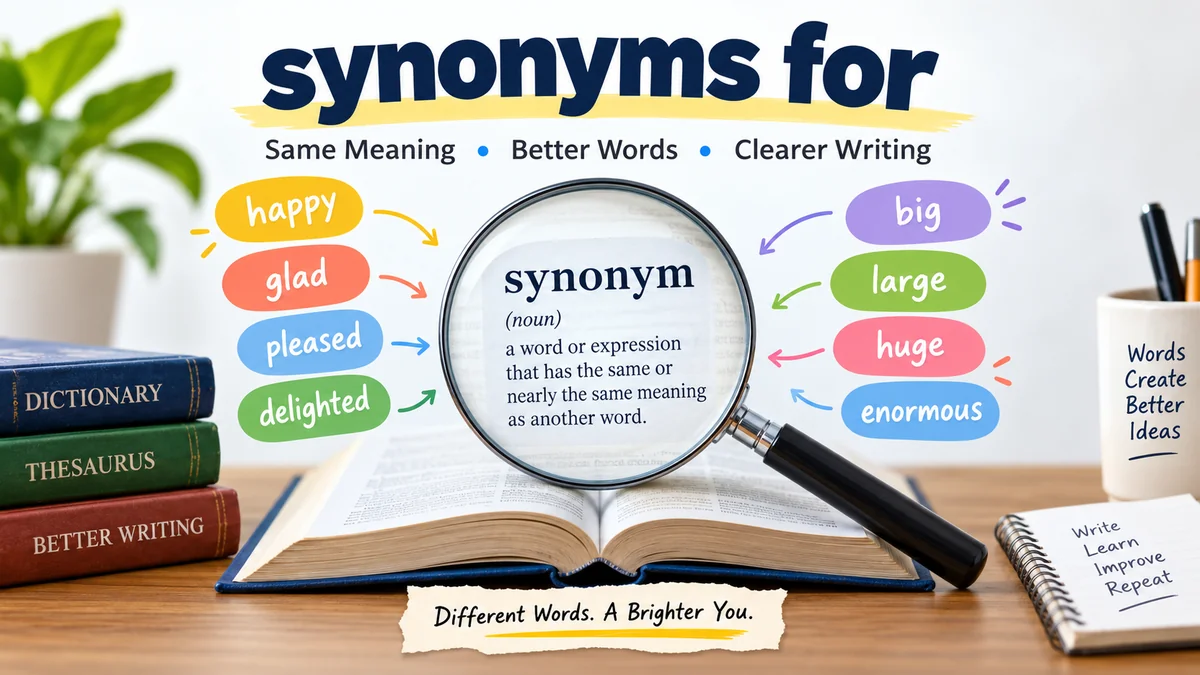
Synonyms are words or expressions that have the same or nearly the same meaning in a particular context. For example, happy, glad, pleased, and delighted are related in meaning, but they are not interchangeable in every sentence. The best synonym depends on context, connotation, formality, grammar, and the exact sense of the original word.
What Does synonyms for Mean?
The phrase synonyms for is commonly used when someone wants words or phrases with meanings similar to a particular term.
For example:
- synonyms for happy
- synonyms for beautiful
- synonyms for important
- synonyms for good
- synonyms for said
- synonyms for however
- synonyms for amazing
- synonyms for help
A synonym is generally a word or expression with the same or nearly the same meaning as another. Collins, for example, gives bucket and pail as an illustration of synonymous words.
The phrase can therefore be understood simply as:
synonyms for + word = other words with the same or a closely related meaning
However, a thesaurus result should be treated as a collection of possibilities rather than a list of automatic replacements.
Synonym vs. exact replacement
Consider the adjective happy:
| Possible synonym | Typical meaning or tone |
|---|---|
| Glad | Pleased about something |
| Pleased | Satisfied or happy |
| Cheerful | Noticeably positive in mood |
| Delighted | Very pleased |
| Joyful | Full of joy |
| Content | Quietly satisfied |
| Ecstatic | Extremely happy |
All belong to the same broad semantic area, yet their intensity and usage differ.
“She was content with the result” suggests calm satisfaction.
“She was ecstatic with the result” expresses a much stronger emotion.
Replacing one with the other changes what the sentence communicates.
What Is a Synonym?
A synonym is a word or expression that shares the same or a very similar meaning with another word or expression. Dictionaries generally emphasize same or nearly the same meaning, rather than requiring two words to be perfectly identical.
Some straightforward examples are:
| Word | Synonyms |
|---|---|
| Big | large, huge, enormous |
| Small | little, tiny, miniature |
| Fast | quick, rapid, swift |
| Smart | clever, intelligent, bright |
| Angry | mad, annoyed, furious |
| Beautiful | attractive, lovely, gorgeous |
| Begin | start, commence, initiate |
| Help | assist, aid, support |
| Difficult | hard, challenging, demanding |
| Important | significant, essential, crucial |
The relationship between synonyms is called synonymy. A collection or reference work used to find related words is commonly called a thesaurus.
WordHippo, for instance, describes alternatives for synonym itself such as equivalent, alternative word, and alternative expression, although some listed linguistic terms have narrower technical meanings and should not be treated as perfect equivalents in every situation.
Are synonyms always interchangeable?
No.
This is one of the most useful things to understand about vocabulary.
Two words can have similar dictionary definitions while differing in:
- emotional tone
- intensity
- formality
- grammatical behavior
- collocation
- regional usage
- positive or negative connotation
- context
Take thin and slender.
Both can describe someone with a relatively small body width, but slender often carries a more positive connotation. Calling someone thin may sound neutral, positive, or negative depending on context.
That difference is why choosing synonyms requires more than matching definitions.
synonyms for Common Words
Many searches for synonyms for come from a simple writing problem: a common word has been repeated too often, or it does not express the intended meaning precisely enough.
Here are useful alternatives for several frequently used English words.
Synonyms for good
Good is extremely broad, so the right alternative depends on what is actually good.
Possible choices include:
Excellent, effective, beneficial, favorable, positive, satisfactory, admirable, skilled, suitable, reliable, valuable, impressive
Compare:
“The software is good.”
That could mean almost anything.
“The software is reliable” tells readers it works consistently.
“The software is intuitive” tells them it is easy to understand.
“The software is effective” tells them it accomplishes its purpose.
Specific language usually communicates more information than simply replacing one broad adjective with another.
Synonyms for important
Depending on context, alternatives include:
Significant, essential, crucial, vital, notable, meaningful, influential, consequential, major, central, key
There are meaningful differences.
An essential requirement is necessary.
A significant result is important or meaningful.
A notable achievement deserves attention.
A crucial decision can strongly affect what happens next.
Synonyms for beautiful
Useful alternatives include:
Attractive, lovely, gorgeous, stunning, elegant, charming, appealing, exquisite, magnificent, picturesque
Again, context determines the best choice.
A picturesque village sounds natural.
An elegant design sounds natural.
A stunning performance can describe something impressive without referring to physical appearance.
The words occupy overlapping rather than identical semantic territory.
Synonyms for happy
Common alternatives include:
Glad, pleased, cheerful, joyful, delighted, content, satisfied, thrilled, ecstatic, upbeat
Intensity matters:
content → pleased → delighted → thrilled → ecstatic
That is not an absolute scale, but it demonstrates why synonym selection should reflect the strength of the intended emotion.
Synonyms for sad
Depending on the situation:
Unhappy, sorrowful, miserable, gloomy, downcast, heartbroken, melancholy, dejected, distressed, mournful
Heartbroken is much stronger than unhappy, while melancholy often describes a reflective or lingering sadness.
Synonyms for big
Possible alternatives include:
Large, huge, enormous, massive, substantial, considerable, immense, gigantic, vast
Not all work with the same nouns.
A substantial increase sounds natural.
A vast landscape sounds natural.
An immense challenge works well.
A gigantic increase is possible, but it may sound exaggerated in formal reporting.
Synonyms for small
Common choices include:
Little, tiny, miniature, compact, minor, modest, slight, limited, narrow
Compare:
a compact apartment
a minor problem
a slight difference
a limited budget
All can express some idea of smallness, but each communicates something more specific.
How to Find synonyms for Any Word
The quickest approach is to search a dictionary or thesaurus. The better approach is to check the word’s meaning in your actual sentence before selecting an alternative.
A practical process looks like this:
- Identify the meaning of the original word. Many English words have multiple senses.
- Generate several possible synonyms. A thesaurus or synonym finder is useful here.
- Match the part of speech. Make sure you are replacing a noun with an appropriate noun, a verb with a verb, and so on.
- Compare definitions. Check whether the alternative actually expresses the intended sense.
- Check connotation and intensity. Decide whether it sounds positive, negative, neutral, weak, or strong.
- Read the complete sentence aloud. Natural collocation matters.
- Keep the original if it works best. Variation is not automatically an improvement.
Tools such as Grammarly can also surface synonym suggestions during writing. Grammarly’s support documentation notes that synonym suggestions are available for many words, although feature availability varies by product and platform.
Quick Takeaway
Don’t ask only, “Is this a synonym?” Ask, “Does this synonym express the same idea in this particular sentence?”
That second question prevents many awkward word choices.
Exact Synonyms vs. Near Synonyms
One reason synonym lists can be confusing is that similarity exists in degrees.
Exact or absolute synonyms
Absolute synonyms would have effectively identical meanings and uses.
They are relatively uncommon because words develop different connotations, collocations, regional preferences, technical meanings, and stylistic associations over time.
Near synonyms
Most everyday synonyms are better understood as near synonyms.
Consider:
angry — annoyed — irritated — furious — enraged
These words belong to the same semantic field, but their intensity differs considerably.
“I’m annoyed that the train is late.”
and
“I’m enraged that the train is late.”
do not describe the same emotional state.
Synonyms and antonyms
Synonyms express similar meanings.
Antonyms express contrasting or opposite meanings.
For example:
| Word | Synonym | Antonym |
|---|---|---|
| Happy | joyful | sad |
| Fast | quick | slow |
| Strong | powerful | weak |
| Easy | simple | difficult |
| Increase | rise | decrease |
| Accept | receive | reject |
A thesaurus commonly provides both relationships, which makes it useful for exploring vocabulary rather than simply replacing words.
Why Context Matters When Choosing synonyms for a Word
Context is the strongest test of a synonym.
A word can have several meanings, with each meaning producing a completely different set of alternatives.
Take light.
Light meaning “not heavy”
Possible synonyms:
Lightweight, slight
Light meaning “not dark”
Possible alternatives:
Bright, illuminated, pale
Light as illumination
Possible related terms:
Glow, illumination, radiance
Searching for synonyms without identifying the intended sense can therefore produce grammatically correct but semantically incorrect writing.
Another example: “run”
The verb run changes meaning dramatically:
“The athlete runs every morning.”
“The manager runs the company.”
“The machine runs quietly.”
“The road runs along the coast.”
A synonym such as sprint might fit the athletic sense, but it cannot naturally replace run in “runs the company.”
For the managerial sense, manages, operates, or leads may be appropriate.
This phenomenon is closely related to polysemy, where one word has multiple related meanings.
How Connotation Changes the Best Synonym
Denotation is a word’s direct or core meaning. Connotation involves the feelings, associations, or implications surrounding it.
That distinction explains why two apparent synonyms can produce different reactions.
Consider:
confident and arrogant
Both can relate to a strong belief in one’s abilities, but confident is usually positive or neutral, whereas arrogant implies excessive self-importance.
Or compare:
determined and stubborn
Both may describe someone who refuses to give up or change course. Determined generally praises persistence; stubborn can criticize unwillingness to change.
A synonym finder cannot always determine which emotional implication you intend. The writer has to make that judgment.
Formal, Informal, and Academic Synonyms
Register is another major factor when searching for synonyms for everyday vocabulary.
Formal vs. informal language
Consider these pairs:
| Informal/common | More formal alternative |
|---|---|
| Ask | inquire |
| Help | assist |
| Buy | purchase |
| Need | require |
| Start | commence |
| End | conclude |
| Show | demonstrate |
| Get | obtain |
| Find out | determine |
| Put off | postpone |
But formal does not automatically mean better.
“Please ask your teacher” is perfectly natural.
“Please inquire of your teacher” sounds unnecessarily formal in many everyday situations.
Synonyms in academic writing
Students often replace simple words because they believe longer vocabulary sounds more academic.
That can backfire.
Instead of replacing every instance of show with demonstrate, ask what the evidence actually does.
A study might:
- show a pattern
- demonstrate an effect
- indicate a possibility
- suggest an association
- reveal a difference
- establish a relationship
Those verbs make different levels of claims.
Precision is more valuable than complexity.
How a Thesaurus Helps Find Better Alternatives
A thesaurus is a language reference resource organized around related words, particularly synonyms and antonyms. WordHippo’s thesaurus entry, for example, identifies terms such as wordbook, dictionary, glossary, lexicon, and synonym dictionary as related expressions, though each resource type can have a somewhat different purpose.
Online thesauruses can provide:
- synonyms
- antonyms
- related terms
- phrases
- parts of speech
- example sentences
- definitions
- usage information
The main advantage is discovery. A thesaurus can remind you of a word you already understand but could not immediately recall.
The main limitation is context.
A large synonym list may contain dozens or even hundreds of semantically related terms. That does not mean every result belongs in your sentence.
For example, a thesaurus entry for power can include concepts related to ability, strength, authority, control, force, and energy. Those terms represent several different senses of the same word rather than a single interchangeable list.
Common Mistakes When Using Synonyms
Synonyms can improve writing, but forced synonym replacement often makes writing worse.
1. Replacing words only to avoid repetition
Repetition is not always bad.
Technical, academic, legal, and instructional writing often benefits from consistent terminology. If customer account has a precise meaning, repeatedly replacing it with profile, membership, record, and user identity may create confusion.
2. Ignoring intensity
Consider:
concerned → worried → alarmed → terrified
They share semantic territory, but they describe very different levels of emotion.
3. Ignoring collocations
A collocation is a combination of words that commonly occurs together.
English speakers normally say:
heavy rain
not usually:
weighty rain
Heavy and weighty can overlap in meaning elsewhere, but their natural word partnerships differ.
4. Choosing a word because it sounds sophisticated
Clear writing usually beats impressive-looking vocabulary.
Instead of:
“The committee utilized the available data.”
Often:
“The committee used the available data.”
is clearer.
5. Forgetting grammatical differences
Related words may belong to different parts of speech.
For example:
decision — noun
decide — verb
decisive — adjective
decisively — adverb
Semantic similarity does not make grammatical forms interchangeable.
6. Treating related words as true synonyms
Words can be associated without being synonymous.
Doctor, hospital, patient, and medicine belong to the same topic, but they are not synonyms.
Similarly, hypernyms and hyponyms describe hierarchical semantic relationships rather than simple synonymy. A broad category such as vehicle can be a hypernym of a more specific term such as car.
synonyms for Better Writing: A Practical Method
When editing, do not replace every repeated word mechanically. Focus on places where another word would improve meaning.
Suppose you write:
“The new policy caused a big change, creating a big challenge for a big group of employees.”
A mechanical edit might replace each occurrence with a random thesaurus suggestion.
A more precise version would be:
“The new policy caused a substantial change, creating a serious challenge for a large group of employees.”
Notice what happened.
The alternatives are not merely decorative. Each one identifies what big means in that particular context.
That is the best use of synonyms.
Use stronger verbs before stronger adjectives
Another useful editing technique is to improve the verb.
Instead of:
“She walked very quickly toward the door.”
Try:
“She hurried toward the door.”
Instead of:
“He said very quietly.”
Depending on context:
“He whispered.”
Precise verbs can make sentences shorter and clearer without making them sound artificially sophisticated.
Preserve terminology when precision matters
Variation is valuable in storytelling and general prose, but consistency matters when a term has a defined meaning.
If a scientific report defines participants, randomly switching among subjects, respondents, people, and users may introduce distinctions the research never intended.
The same principle applies to technical documentation, contracts, policies, and instructions.
Can Two Words Have Exactly the Same Meaning?
Sometimes words appear virtually interchangeable, but complete synonymy is difficult to maintain across every possible context.
Regional vocabulary provides good examples.
British and American English may use different common words for similar things. Even then, geography and cultural context affect usage.
Other words differ primarily in formality:
begin / commence
Others differ in emotional strength:
like / love / adore
Others differ in implication:
slim / skinny
So when dictionaries define synonyms as words with the “same or nearly the same” meaning, the nearly matters.
What Is Another Word for Synonym?
If the word synonym itself needs an alternative, equivalent, alternative word, and alternative expression may work in some contexts. WordHippo also lists more specialized terms, but these should be used carefully because linguistic concepts such as hypernym, hyponym, and metonym describe different relationships and are not universal substitutes for synonym.
In ordinary writing, phrases such as these are often clearer:
- another word for
- similar word
- alternative word
- equivalent expression
- similar expression
- alternative term
For example:
“What’s another word for happy?”
is simply a conversational way of asking:
“What are some synonyms for happy?”
When Should You Use a Dictionary Instead of a Thesaurus?
Use a thesaurus when you need possibilities.
Use a dictionary when you need verification.
A good workflow is:
Thesaurus → shortlist → dictionary → sentence check
First, identify several promising alternatives. Then verify their definitions, grammatical roles, usage, connotations, and examples.
This matters particularly for unfamiliar words. Replacing a familiar word with an unfamiliar synonym solely because it appears in a thesaurus is one of the easiest ways to introduce an unintended meaning.
Quick Takeaway
A synonym finder answers “What words are related in meaning?”
A careful writer still needs to answer “Which one belongs in this sentence?”
Using synonyms for SEO and Online Content
Synonyms also matter in digital writing, but they should be used for readers rather than inserted mechanically for search engines.
A page about car repair, for example, might naturally discuss:
vehicle maintenance, mechanic, engine problems, servicing, diagnostics, and replacement parts.
Some are synonyms or near synonyms; others are simply semantically related entities and concepts.
That distinction matters. Natural topical vocabulary helps explain a subject comprehensively, while repeatedly substituting keywords simply to create artificial variation can make prose awkward.
The better approach is the same one used in ordinary writing: cover the topic clearly and use the terminology that accurately describes each idea.
A Simple Test for Choosing the Best Synonym
Before replacing a word, check five things:
| Test | Question to ask |
|---|---|
| Meaning | Does it preserve my intended idea? |
| Context | Does it fit this particular sentence? |
| Tone | Is it appropriately formal, casual, positive, or negative? |
| Grammar | Does it function correctly here? |
| Naturalness | Would a fluent speaker normally phrase it this way? |
If the alternative passes all five, it is probably useful.
If it only passes the first test, check another option.
A thesaurus is a discovery tool, not an automatic rewriting engine.
Final Thoughts on synonyms for
Searching synonyms for a word is useful when you want clearer, more precise, less repetitive language. The key is to remember that synonyms usually share similar, rather than perfectly identical, meanings.
Start by identifying what your original word means in its sentence. Then compare possible alternatives for definition, connotation, intensity, register, grammar, and collocation. Use a thesaurus to discover options and a dictionary to verify unfamiliar choices.
The best synonym is not necessarily the longest or most unusual word. It is the word that communicates exactly what you mean with the least effort from the reader.
