

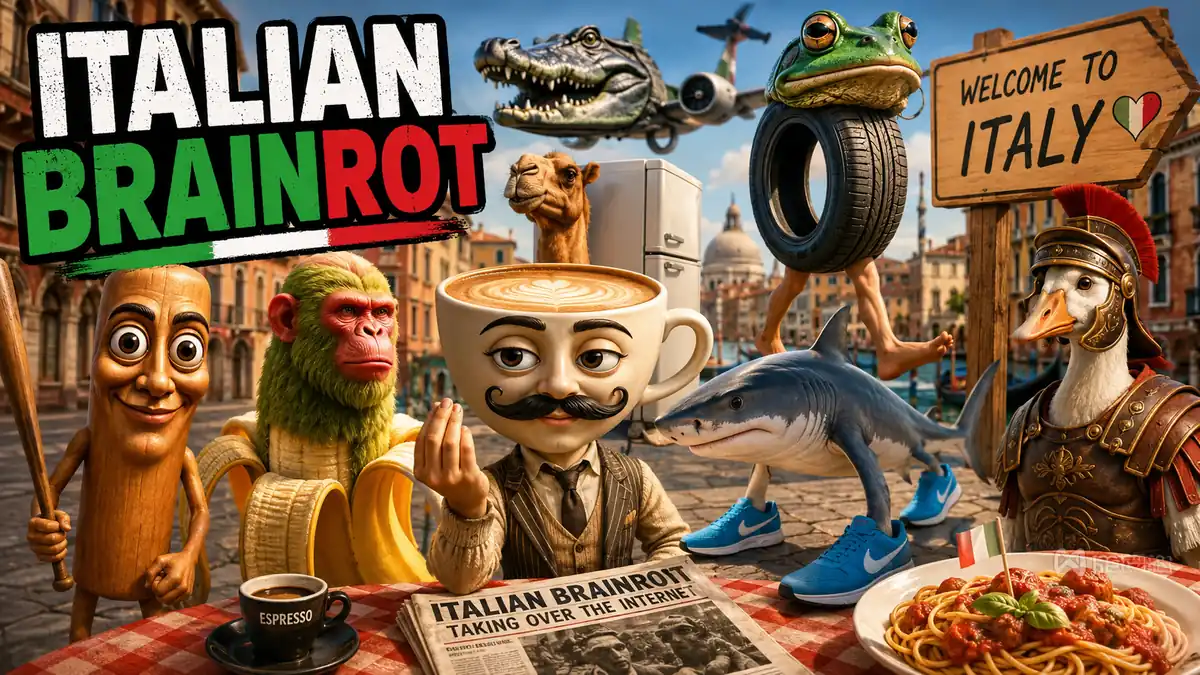
A shark with three legs and sneakers. A crocodile fused with a bomber plane. A ballerina with a cappuccino cup for a head. If these characters keep appearing on your TikTok feed, YouTube Shorts, Roblox games, or meme pages, you have encountered italian brainrot.
The trend looks random because randomness is part of the joke. Behind the nonsense, however, there is a recognizable formula involving AI-generated imagery, strange animal-object hybrids, rhythmic pseudo-Italian names, text-to-speech narration, repetition, and deliberately absurd humor.
italian brainrot is an internet meme genre that became widely popular in 2025, featuring AI-generated creatures with Italian-sounding names and surreal combinations of animals, foods, machines, and everyday objects. Short videos typically pair these characters with rhythmic Italian or Italian-like AI narration, creating intentionally repetitive, nonsensical humor.
What Is italian brainrot?
The phrase italian brainrot describes a family of absurd AI memes commonly associated with TikTok and short-form video platforms.
There is no single official story, creator-controlled universe, or fixed roster. Instead, internet users continually create new characters, remix existing ones, invent relationships and battles, and add unofficial lore.
Most examples share several characteristics:
- AI-generated or AI-styled characters
- Animals fused with objects, food, plants, or machines
- Italian or pseudo-Italian names
- Rhyming and repetitive narration
- Male text-to-speech voices in many early videos
- Surreal situations presented with complete seriousness
- Short, highly repeatable audio clips
- Community-created lore and character relationships
Know Your Meme classifies the phenomenon as an AI-generated meme trend originating on TikTok in 2025 and notes that animals are frequently combined with planes, coconuts, feet, and other objects or anthropomorphic features.
The result feels simultaneously elaborate and meaningless—which is exactly why it works.
What does “brainrot” mean here?
“Brainrot” is internet slang commonly used for media that becomes so repetitive, catchy, strange, or addictive that people jokingly say it has taken over their brain.
In this context, the term is not a medical diagnosis.
Someone saying, “I have italian brainrot,” generally means they have watched enough of these memes that names such as Tralalero Tralala or Bombardiro Crocodilo are stuck in their head.
The exaggerated repetition is central to the humor.
Where Did italian brainrot Come From?
The modern trend emerged on TikTok in early 2025.
Although pinning down the first creator of an internet meme can be difficult because posts are deleted, reuploaded, remixed, and copied across accounts, one character is particularly important to its early history: Tralalero Tralala.
Know Your Meme traces the earliest phase of the trend to early January 2025, when TikTok user @eZburger401 uploaded a Tralalero Tralala video. The original account was subsequently banned. A January 13 post featuring the recognizable shark in blue Nike shoes later accumulated more than 17 million plays according to its archived tracking.
From there, the format was easy to reproduce.
Creators did not need to continue one complicated narrative. They simply needed to invent another bizarre creature, give it a memorable name, generate an image, and add dramatic narration.
The basic viral formula
The early meme structure can be reduced to four elements:
- Create an impossible creature.
Combine an animal or person with another unrelated object. - Give it a rhythmic name.
Use rhyme, repetition, Italian vocabulary, or words that merely sound Italian. - Add AI narration.
Introduce the creature as though its existence is perfectly normal. - Make the description increasingly ridiculous.
The disconnect between the serious delivery and nonsensical subject creates the joke.
Once viewers understood that formula, thousands of variations became possible.
Tralalero Tralala and the Beginning of the Meme
Tralalero Tralala is one of the most recognizable italian brainrot characters and an important starting point for understanding the phenomenon.
The familiar version is a blue shark with three legs wearing Nike sneakers.
There is no biological explanation for the legs. There is no reason for the shoes.
That is the point.
The character demonstrates the visual logic behind the entire genre: take something immediately recognizable, introduce one or two impossible elements, and present the result without explanation.
The name is equally memorable because it resembles a musical refrain rather than a conventional sentence.
Interestingly, “trallalero” also has a genuine Italian cultural connection. It is associated with a traditional polyphonic singing style from Genoa, although the viral character’s name should not be interpreted as a normal Italian phrase.
A warning about the original Tralalero audio
The cute-looking shark sometimes causes people to assume the original audio was equally harmless.
It was not.
The early viral narration associated with Tralalero Tralala contained profanity and offensive religious references. Later reposts, remixes, games, merchandise, and child-friendly versions often separate the character from that original narration.
That distinction matters, particularly for parents encountering the meme through children.
Most Famous italian brainrot Characters
Trying to create a definitive list is surprisingly difficult.
Unlike characters owned by a traditional entertainment franchise, these memes come from many creators and communities. Websites also disagree about what counts as an “official” character. Some include only early Italian memes; others include Indonesian spin-offs, community creations, Roblox characters, and later additions.
Several characters, however, consistently appear in explanations of the trend.
| Character | Common Appearance | Why It Is Recognizable |
|---|---|---|
| Tralalero Tralala | Three-legged shark wearing sneakers | One of the earliest viral characters |
| Bombardiro Crocodilo | Crocodile fused with a bomber plane | Famous early animal-machine hybrid |
| Lirili Larila | Elephant-cactus hybrid | Surreal desert design |
| Brr Brr Patapim | Forest-like creature | Repetitive name and unusual appearance |
| Ballerina Cappuccina | Ballerina with a cappuccino head | Combines ballet and coffee imagery |
| Cappuccino Assassino | Ninja-like anthropomorphic coffee cup | Food/object character with action-meme styling |
| Chimpanzini Bananini | Chimpanzee-banana hybrid | Simple, instantly understandable visual joke |
| Bombombini Gusini | Goose-aircraft style hybrid | Extends the flying-animal formula |
| La Vaca Saturno Saturnita | Cow associated with Saturn | Cosmic variation of the meme format |
| Frigo Camelo | Camel/refrigerator hybrid | Classic unrelated-object combination |
The spelling of names can vary across reposts. You may see, for example, “Bombardiro” and “Bombardino” Crocodilo or slightly different spellings of Cappuccina and other characters.
That inconsistency is normal for decentralized memes.
Bombardiro Crocodilo
Few characters illustrate the darker side of italian brainrot better than Bombardiro Crocodilo.
Visually, the character is a crocodile fused with a military bomber aircraft.
The earliest identified TikTok example found by Know Your Meme was posted on February 20, 2025. It reportedly gained millions of plays within roughly a month and helped inspire related anthropomorphic characters such as Bombombini Gusini.
The image itself follows the perfect brainrot formula:
crocodile + airplane + rhyming name + absurd narration.
However, as with Tralalero Tralala, the original narration was considerably more provocative than the colorful character design suggests. Early Bombardiro Crocodilo material included references to bombing, Gaza, Palestine, children, and religion.
Modern memes frequently detach the character from that context and use it simply as a surreal flying crocodile.
Why Bombardiro became so memorable
Three features helped the character stand out.
First, the image is understandable almost instantly. You do not need any lore to recognize a crocodile-airplane hybrid.
Second, “Bombardiro Crocodilo” has a satisfying rhythmic structure.
Third, the character is easy to remix. Creators can animate it flying, fighting other characters, appearing in games, or participating in fictional battles.
That remixability is essential to meme longevity.
Lirili Larila
Lirili Larila is another early character commonly associated with the core trend.
It is typically depicted as a strange elephant-cactus hybrid wandering through a desert landscape, often wearing oversized sandals or flippers.
Again, the humor comes from incompatibility.
An elephant makes sense.
A cactus makes sense.
Footwear makes sense.
Combining all three does not—and the meme offers no explanation.
The character was among the notable examples that followed Tralalero Tralala and Bombardiro Crocodilo during the trend’s expansion.
That lack of explanation distinguishes these memes from conventional fantasy characters. There is usually no carefully constructed origin story required to understand them.
The image itself is the joke.
Brr Brr Patapim
Brr Brr Patapim expanded the roster further and became another recognizable name during the trend’s early growth. Know Your Meme specifically identifies it among the characters that gained traction after the initial wave.
Its appeal demonstrates another important feature of the genre: names do not need precise translations.
They need rhythm.
“Brr Brr Patapim” works almost like percussion. Saying it aloud is part of the experience, just as repeating Tralalero Tralala becomes more entertaining than simply reading a description of the shark.
This is one reason the trend transfers effectively from TikTok videos into schoolyard jokes and spoken memes.
Ballerina Cappuccina
Ballerina Cappuccina represents the food-and-human side of the meme universe.
Instead of an animal-machine hybrid, she is generally shown as a ballet dancer whose head resembles a cup of cappuccino.
The character was posted by TikTok creator @aironic.fun on March 19, 2025, during the growing popularity of the broader trend. The accompanying narration introduced her as “Ballerina Cappuccina.”
The concept works because two recognizable Italian associations—coffee and Italian-sounding language—are combined with ballet imagery.
Community memes later connected Ballerina Cappuccina romantically with another character, Cappuccino Assassino.
That relationship illustrates how fan-created lore began developing around characters that originally required little or no story.
Cappuccino Assassino
Cappuccino Assassino is typically represented as an anthropomorphic takeaway coffee cup dressed like a ninja and carrying swords.
According to Know Your Meme, TikTok creator @alexey_pigeon posted the character on March 5, 2025. The creator is also associated with characters including Frigo Camelo and Chimpanzini Bananini.
The name is especially effective because both parts are recognizable:
- Cappuccino = coffee
- Assassino = assassin
Even someone who does not speak Italian can usually understand the intended joke.
Cappuccino Assassino also demonstrates how later community storytelling changed the trend. Once fans started giving characters friendships, rivalries, romances, families, powers, and battles, isolated AI images began resembling an informal shared universe.
Chimpanzini Bananini
Chimpanzini Bananini is one of the simplest visual combinations: a chimpanzee merged with a banana.
That simplicity makes it memorable.
There is no complicated joke to decode. The viewer recognizes both components immediately, while the rhyming name reinforces the image.
Modern character guides regularly include Chimpanzini Bananini among the broader roster, although—as with many characters—descriptions and supposed “lore” vary from community to community.
This is a useful rule when researching these memes:
The visual character may be established, but the lore often isn’t.
Why Do the Names Sound Italian?
The names are one of the strongest ingredients in the meme format.
They frequently use recognizable Italian words, altered vocabulary, rhymes, repeated syllables, or endings such as:
- -ini
- -ino
- -ina
- -ello
- -ila
- -ala
But calling all of the names genuine Italian would be misleading.
Many are intentionally pseudo-Italian.
For example, Crocodilo clearly evokes a crocodile, while Bananini immediately suggests banana. Cappuccino is a genuine Italian coffee term. Other components exist primarily because they rhyme or sound funny.
A linguistic analysis of the trend therefore needs to separate three categories:
Real Italian words: terms that actually exist in Italian.
Modified words: recognizable vocabulary altered for rhyme or rhythm.
Pure nonsense: syllables selected primarily because they sound catchy.
Most names mix these approaches rather than following proper Italian grammar.
Do italian brainrot names actually translate?
Sometimes partially.
A name such as Cappuccino Assassino contains recognizable words and conveys a fairly obvious idea.
Others cannot be translated literally because they are sound-based constructions rather than grammatical Italian phrases.
Trying to translate every character name word-for-word can therefore create false meanings that the original creator never intended.
Quick Takeaway: Italian-sounding does not automatically mean Italian. In many cases, pronunciation, rhyme, and memorability matter more than grammatical accuracy.
Why Did italian brainrot Become So Popular?
There was no single reason.
The trend combined several characteristics that work exceptionally well in modern short-form media.
1. The characters are understood instantly
A crocodile airplane needs almost no explanation.
Neither does a banana chimpanzee.
Internet content competes for attention in fractions of a second, and these images communicate their central joke immediately.
2. AI makes endless variations possible
Traditional character creation requires drawing, animation, modeling, or photography.
Generative AI dramatically lowers that barrier.
Someone can imagine an elephant-cactus, coffee ninja, refrigerator camel, or planetary cow and produce a recognizable visual concept quickly.
That scalability helped turn a few characters into an open-ended meme format.
3. The names are designed for repetition
Tralalero Tralala.
Brr Brr Patapim.
Chimpanzini Bananini.
The rhythm is difficult to ignore.
Short-form algorithms benefit from replayable sounds, while human memory naturally favors repetition, rhyme, and unusual phonetic patterns.
4. Anyone can extend the joke
A closed fictional universe has rules.
italian brainrot largely does not.
That allows people to create new characters without needing permission from a central storyteller or understanding years of existing canon.
The result is participatory meme culture rather than conventional fandom.
5. The serious voice makes the nonsense funnier
A bizarre image alone can be amusing.
A bizarre image solemnly introduced by an authoritative-sounding narrator becomes even stranger.
That contrast—absurd subject, confident presentation—is a longstanding comedy technique, now amplified by AI text-to-speech.
6. Children can recognize the characters easily
Bright imagery, animals, food, repetition, funny names, and simple visual concepts make many later versions especially easy for younger internet users to recognize.
That does not mean all original material is child-friendly, however. Some early narrations contain profanity, violence, religious insults, or references to war.
Is Tung Tung Tung Sahur italian brainrot?
This is one of the most common sources of confusion.
Tung Tung Tung Sahur is widely grouped with italian brainrot, but its origins are Indonesian rather than Italian.
The character is commonly portrayed as a wooden humanoid or wooden object carrying a bat.
“Sahur” refers to the pre-dawn meal eaten by Muslims during Ramadan. The repetitive “tung tung tung” references the rhythmic sounds traditionally associated in some communities with waking people for sahur.
Modern meme guides therefore frequently describe Tung Tung Tung Sahur as an Indonesian brainrot character that became absorbed into the broader international brainrot ecosystem rather than an original Italian character.
This distinction is useful because “Italian brainrot” is increasingly used online as an umbrella label for characters that did not actually originate from the Italian-language trend.
Boneca Ambalabu has a similar problem
Boneca Ambalabu is also often placed in large “Italian brainrot character” lists despite belonging to the Indonesian spin-off wave.
As the meme spread internationally, country-specific categories became increasingly blurred.
A character can therefore be part of the broader brainrot fandom without being Italian in origin.
Is There an Official italian brainrot Character List?
No universally authoritative list exists.
This is where many online guides become misleading.
Some websites claim there are exactly 10 characters. Others say 22, 29, 39, or considerably more.
Those numbers depend on what the publisher decides to count.
For example, one 2026 guide describes 29 documented characters, while another current character database contains dozens of official and community-labelled entries.
The disagreement exists because the meme is decentralized.
There is no equivalent of a movie studio publishing an official cast.
A practical way to classify characters is:
| Category | What It Means |
|---|---|
| Core early characters | Memes strongly associated with the original 2025 Italian trend |
| Later Italian-style creations | Characters following the same visual and naming formula |
| International brainrot | Related memes originating in countries such as Indonesia |
| Community characters | Fan-made additions without a widely established origin |
| Game characters | Versions or additions popularized through games |
| Fan lore variants | Existing characters given unofficial relationships, powers, or stories |
This classification is more accurate than pretending every viral character belongs to one canonical franchise.
italian brainrot Lore: Is There a Real Story?
Not really—at least not one universally accepted story.
Early characters were largely standalone absurd memes.
As their popularity grew, creators and fans began connecting them.
Ballerina Cappuccina could be paired with Cappuccino Assassino. Characters could become enemies. Others received children, siblings, transformations, superpowers, alliances, deaths, revivals, and elaborate histories.
Much of this material is fan-created lore.
Different TikTok accounts, YouTube channels, games, wikis, and meme communities can tell completely different stories about the same character.
That means statements such as:
“Character X is officially stronger than Character Y”
or
“Character A is definitely Character B’s brother”
should be treated cautiously unless they refer to a specific game or creator’s version.
There is no universal canon governing the entire phenomenon.
Quick Takeaway: Think of italian brainrot less like Marvel and more like an open meme template. Characters are recognizable, but their histories can change depending on who is telling the story.
How AI Shaped the italian brainrot Aesthetic
Artificial intelligence is not merely a production tool behind the trend. Its imperfections are part of the visual identity.
Early generative images often produced combinations that looked almost believable from a distance but became increasingly strange when examined closely.
A shark can have human-like legs.
A crocodile can seamlessly become an aircraft fuselage.
A coffee cup can have eyes, arms, clothes, and weapons.
The slight visual wrongness makes the image more memorable.
AI turns prompts into visual punchlines
Consider a conventional joke:
“What if a crocodile were an airplane?”
A human illustrator could certainly draw that.
Generative AI, however, can produce an uncanny photorealistic interpretation quickly. The viewer sees something resembling a real photograph of an impossible subject.
That contrast between realistic texture and impossible anatomy became a defining part of the genre.
The narration matters just as much
The accompanying text-to-speech voice completes the effect.
Instead of saying, “Here is a funny AI crocodile,” the narrator frequently presents the creature as if explaining a genuine person, animal, legend, or dramatic event.
The format resembles a tiny documentary about something that obviously cannot exist.
That deadpan presentation gives the meme its distinctive personality.
From TikTok Memes to Roblox Games
The phenomenon did not remain confined to short videos.
Once the characters became recognizable intellectual building blocks for internet communities, they began appearing in quizzes, animations, fan art, ranking sites, games, merchandise, and Roblox experiences.
One of the most visible examples is Steal a Brainrot, which helped expose players to characters from the broader meme ecosystem.
This creates another layer of confusion around “official” characters.
A child may discover Tralalero Tralala through Roblox without ever seeing the original TikTok meme. Another viewer might encounter Ballerina Cappuccina through YouTube Shorts. Someone else may first see Tung Tung Tung Sahur in a game and naturally assume it originated alongside the Italian characters.
By 2026, italian brainrot was therefore no longer simply a collection of TikTok clips. It had become a cross-platform internet culture with games and community databases maintaining expanding rosters.
Why Is italian brainrot So Popular With Gen Alpha?
The trend is frequently associated with Gen Alpha because its structure aligns closely with the media environment younger users encounter online.
The humor is:
- Visual
- Fast
- Repetitive
- Remixable
- Easy to imitate
- Character-driven
- Independent of complex context
You do not need to understand Italian history or even speak Italian to laugh at a chimpanzee shaped like a banana.
You do not need to watch a two-hour film before understanding why a sneaker-wearing shark looks ridiculous.
That low barrier to entry matters.
Recognition becomes part of the game
Once enough characters exist, knowing their names becomes entertainment itself.
Children can quiz one another:
“Who is this?”
“Is that Tralalero?”
“Do you know Bombombini Gusini?”
The meme moves from passive viewing into a recognition game.
That process has happened with countless entertainment franchises, but italian brainrot is unusual because the cast grew largely from decentralized internet creation rather than a traditional studio.
Is italian brainrot Safe for Kids?
The answer depends heavily on the specific content.
Many modern character images are simply silly and visually harmless. A dancing cappuccino or banana chimpanzee is not inherently inappropriate.
The problem is assuming that the cute characters guarantee child-friendly source material.
Some original narrations contain:
- Profanity
- Religious insults
- Violent imagery
- References to war
- Dark humor
- Offensive language
The earliest Tralalero Tralala audio contained explicit and religiously offensive language, while the early Bombardiro Crocodilo narration referenced bombing children in Gaza and Palestine.
Parents therefore need to distinguish between the character and the video using the character.
A Tralalero toy, drawing, or child-friendly animation may have nothing to do with the original audio.
What actually works for parents
Trying to memorize every brainrot character is unnecessary because new ones appear constantly.
Instead:
- Check the actual video or game being watched.
- Listen to the audio rather than judging only the colorful thumbnail.
- Look for profanity and violent or hateful references.
- Explain that AI-generated stories are not automatically factual.
- Treat fan-created lore as fan fiction rather than established truth.
- Use age-appropriate platform controls where available.
The context matters more than the character’s name.
Are the Characters Actually Italian?
Some are associated directly with the Italian-language meme trend.
Others are not.
This distinction became harder to maintain as the phenomenon expanded.
Characters such as Tralalero Tralala, Bombardiro Crocodilo, Lirili Larila, Brr Brr Patapim, Ballerina Cappuccina, and Cappuccino Assassino are closely connected with the core Italian-style wave.
Tung Tung Tung Sahur and Boneca Ambalabu are generally identified as Indonesian spin-offs that became associated with the same wider meme culture.
The word “Italian” therefore describes the original aesthetic and linguistic format more reliably than the nationality of every character now placed under the label.
Is italian brainrot Made Entirely by AI?
AI is fundamental to the genre, but saying everything is entirely AI-made would oversimplify it.
Generative AI can contribute:
- Character images
- Animation
- Voice generation
- Text-to-speech narration
- Scripts
- Music
- Image-to-video transformations
Humans still select prompts, choose images, edit videos, create names, upload content, invent lore, remix other memes, and decide what becomes funny enough to share.
The meme is better understood as AI-assisted internet creativity than a single automated project.
Its success also depends on human participation.
An algorithm can produce an elephant-cactus image, but people are the ones who repeat the name, make reaction videos, turn it into a character, create rivalries, and spread it across platforms.
Why Does italian brainrot Feel So Random?
Because randomness is one of its organizing principles.
Traditional character design normally asks:
- What does this character want?
- Where did it come from?
- Why does it look this way?
- How does its appearance fit the story?
Brainrot often reverses that process.
The creator begins with an absurd combination because the combination itself is entertaining.
Why is the shark wearing sneakers?
There does not need to be an answer.
Why is the crocodile an airplane?
Because “Bombardiro Crocodilo” sounds funny.
Why does a ballerina have cappuccino for a head?
Because the visual is instantly recognizable.
The absence of logic frees creators from having to maintain consistency. Each new character can be stranger than the previous one without breaking the format.
italian brainrot vs Traditional Internet Memes
The trend belongs to a much longer history of absurd internet humor, but AI changes the production process.
| Feature | Traditional Meme | italian brainrot |
|---|---|---|
| Main visual | Existing image or manually created art | Often AI-generated hybrid |
| Characters | Usually limited | Potentially endless |
| Naming | Caption-based | Rhyming pseudo-Italian names |
| Audio | Optional | Often central |
| Lore | Usually minimal | Rapidly created by communities |
| Production | Editing existing media | AI generation plus editing |
| Expansion | Variations of a template | Constant introduction of new creatures |
| Canon | Usually irrelevant | Informal and inconsistent |
The underlying humor is not completely new.
Internet culture has always enjoyed nonsense, repetition, surreal images, deliberate misspellings, strange voices, and inside jokes.
What changed is the speed at which AI allows those ideas to become convincing visual characters.
Does italian brainrot Have a Deeper Meaning?
Usually, searching for a profound hidden meaning misses the appeal.
The trend is primarily absurdist humor.
Still, it reveals several interesting things about modern internet culture.
First, memorability can matter more than narrative depth. A catchy name and bizarre silhouette can establish a recognizable character in seconds.
Second, AI has lowered the cost of visual experimentation. Ideas that once remained text jokes can now become images and animations almost immediately.
Third, internet communities can build fictional universes from the bottom up. There does not need to be a central studio, author, or franchise owner coordinating every addition.
Finally, it demonstrates how quickly context disappears online. A character can originate in an offensive or provocative video and later become a harmless-looking game character known by children who have never heard the original narration.
How to Recognize an italian brainrot Meme
You can usually identify the format quickly.
Look for the following combination:
- An impossible AI-generated creature
Animals may be fused with machines, foods, plants, planets, or human objects. - A rhythmic Italian-sounding name
Rhyme and repetition matter more than linguistic accuracy. - AI or text-to-speech narration
The voice often describes the creature with exaggerated seriousness. - Surreal or nonsensical lore
Stories may intentionally ignore normal logic. - A short-video presentation
TikTok-style clips, Shorts, Reels, edits, and remixes dominate. - Community expansion
Other users invent relatives, enemies, battles, combinations, or entirely new characters.
Not every example needs all six features, but several together strongly indicate the genre.
Why New Characters Keep Appearing
italian brainrot has no natural endpoint because its central formula is generative.
Take:
one recognizable thing + another unrelated thing + catchy name
and you already have the foundation for another character.
A creator could combine a pigeon with a car, a dinosaur with nuclear imagery, a fruit with an animal, or a household appliance with almost anything.
Community character databases now include dozens of entries, demonstrating how far the format has expanded beyond its early core roster.
Not all of these creations will become widely recognized.
Most probably will not.
Successful characters tend to have three things in common:
a simple visual concept, a memorable name, and an audio or joke people want to repeat.
That is harder to achieve than merely generating a strange picture.
How italian brainrot Changed Internet Meme Culture
The trend represents a notable stage in the evolution of AI memes.
Earlier generative-AI humor often focused on the novelty of the technology itself: strange hands, impossible images, celebrities placed in unusual situations, or intentionally bizarre prompts.
italian brainrot moved beyond “look what AI generated.”
The generated creatures became reusable cultural objects.
People recognize Tralalero Tralala without needing to see the original video. Ballerina Cappuccina can appear in a completely different animation and remain identifiable. Bombardiro Crocodilo can become a game character while retaining the same basic visual identity.
That is a meaningful shift.
AI is no longer merely producing individual meme images. It can help create recurring characters that communities collectively remix.
Whether those characters remain popular for years is impossible to know, but the production model is unlikely to disappear.
The Bottom Line on italian brainrot
italian brainrot is a viral internet meme phenomenon built around AI-generated hybrid characters, rhythmic Italian or pseudo-Italian names, surreal narration, and deliberately nonsensical humor.
Its recognizable early wave emerged on TikTok in 2025, with Tralalero Tralala playing an important role in establishing the format before characters such as Bombardiro Crocodilo, Lirili Larila, Brr Brr Patapim, Ballerina Cappuccina, Cappuccino Assassino, Chimpanzini Bananini, and many others expanded the trend.
The biggest misconception is that it forms one neatly organized fictional universe. It does not. Character lists vary, international memes such as Tung Tung Tung Sahur are frequently mixed into the Italian roster, and much of the supposed lore is created by individual fans, games, and communities.
That chaos is not a flaw in italian brainrot. It is the mechanism that keeps it alive.
Once you understand the formula—impossible AI creature, catchy name, repetitive voice, absurd story—the entire phenomenon suddenly makes sense, even when the memes themselves deliberately do not.
