

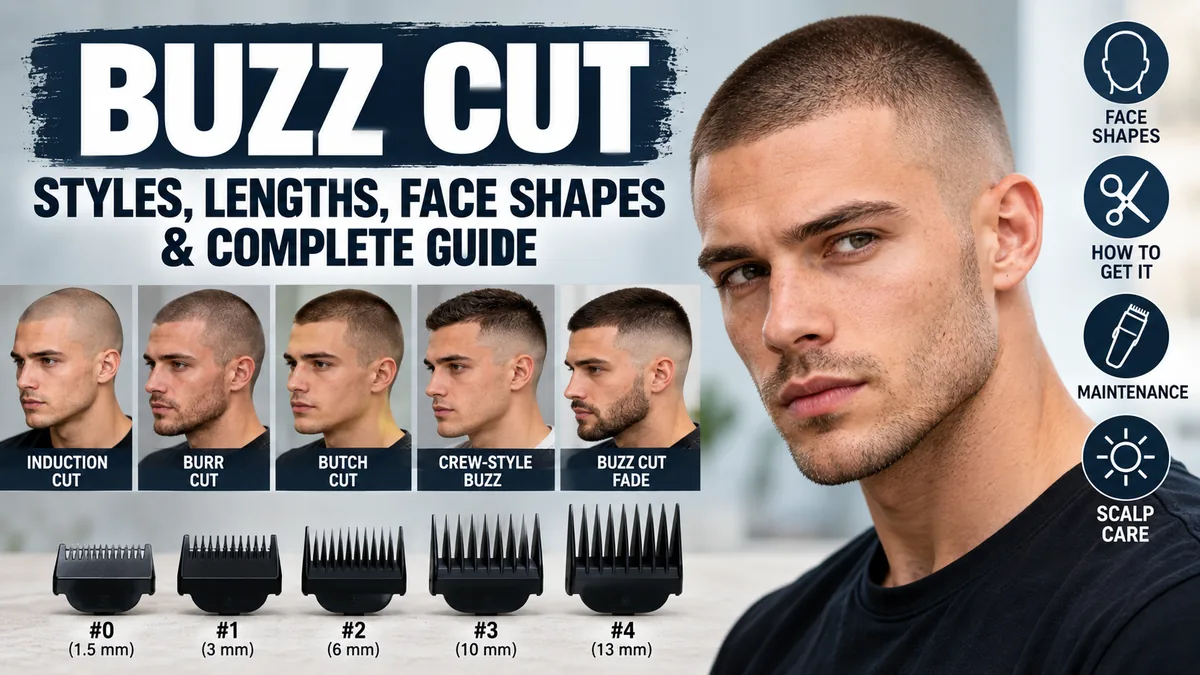
Few haircuts change your appearance as quickly as a buzz cut. It removes almost all styling from the equation and puts your face, hairline, scalp, and head shape front and center.
A buzz cut is a family of very short hairstyles created primarily with electric clippers. It can be one uniform length or combine a slightly longer top with shorter, faded sides. Common versions include the induction cut, burr cut, butch cut, crew-style buzz, and buzz cut fade. Haircut.info
The simplicity is what makes the haircut appealing, but choosing the right clipper guard matters. A #1 buzz looks dramatically different from a #4, even though both qualify as short clipper cuts.
This guide explains the differences, how guard numbers work, which variations complement different face shapes, and how to keep a buzz looking clean as it grows.
What Is a Buzz Cut?
A buzz cut is a short haircut produced mostly or entirely with hair clippers. Traditional versions use the same clipper guard across the head, while modern variations may incorporate a taper, fade, line-up, or additional length on top.
The name comes from the buzzing sound produced by electric clippers.
Although people sometimes use “buzz cut” to describe virtually any extremely short haircut, there is an important distinction between a true uniform buzz and styles such as crew cuts and fades.
With a classic buzz:
- Hair is clipped very short.
- Little or no daily styling is necessary.
- The top and sides are usually similar in length.
- Clippers perform most of the cutting.
- Hair texture, hairline, scalp, and head shape become more visible.
A fade, by comparison, describes a blending technique in which hair becomes progressively shorter toward the lower sides and neckline. A buzz cut can therefore have a fade without every buzz cut being a fade. barber.style
Buzz Cut Lengths and Clipper Guard Numbers
Understanding guard numbers is one of the most useful things you can do before sitting in the barber’s chair.
The basic rule is simple:
Higher guard number = longer hair.
Standard Wahl guide comb measurements run from a #½ at 1/16 inch (1.5 mm) through a #8 at 1 inch (25 mm). Wahl identifies the #1 as a short buzz, #2 as a traditional buzz, #3 as a longer buzz, and #4 as entering crew-cut or brush-cut territory. Wahl USA
| Clipper Guard | Approx. Length | General Appearance |
|---|---|---|
| No guard / #0 | Very close | Near-shaved appearance |
| #½ | 1.5 mm / 1/16 in | Extremely short |
| #1 | 3 mm / 1/8 in | Tight buzz |
| #2 | 6 mm / 1/4 in | Classic short buzz |
| #3 | 10 mm / 3/8 in | Fuller buzz |
| #4 | 13 mm / 1/2 in | Longer, softer buzz |
| #5 | 16 mm / 5/8 in | Long buzz/short crop |
| #6 | 19 mm / 3/4 in | Noticeable texture |
| #7 | 22 mm / 7/8 in | Short styled-hair territory |
| #8 | 25 mm / 1 in | Longest common standard guard |
Exact lengths can vary slightly between clipper systems, so check the manufacturer’s measurements rather than relying exclusively on the number.
What Is the Best Buzz Cut Length?
There isn’t one universally flattering length.
A #1 creates a strong, scalp-revealing result. A #2 remains unmistakably short but leaves more visible hair. A #3 or #4 gives additional coverage and tends to make the transition from longer hair feel less dramatic.
For someone trying a buzz for the first time, starting longer is usually the safer approach.
You can always move from a #4 to a #3 or #2.
You cannot reverse a #1 once the hair is gone.
Main Types of Buzz Cut
“Buzz cut” describes several related hairstyles rather than one exact haircut. Current barbering guides consistently distinguish induction, burr, butch, graduated or crew-style versions, and faded variations. Haircut.info
Induction Cut
The induction cut is the most stripped-down version.
Hair is clipped extremely close and uniformly across the entire scalp, commonly with no guard or a very short setting.
Its name comes from its historical association with military induction haircuts.
Because there is almost no length left, an induction cut exposes:
- the natural hairline,
- scalp-to-hair color contrast,
- scars and marks,
- crown growth patterns,
- head shape,
- differences in hair density.
That makes it visually stronger than longer versions.
It also requires no conventional styling.
Burr Cut
A burr cut leaves slightly more hair than an induction cut.
A #1 or #2 guard is commonly associated with this style, producing approximately 3–6 mm of hair with standard guards. Haircut.info
The extra few millimeters make a surprisingly noticeable difference.
Hair color becomes easier to see, while the overall silhouette remains extremely clean and minimal. The burr is also one of the easier versions to reproduce at home because the same guard can be used across the entire head.
Butch Cut
The butch cut moves into a fuller version of the buzz.
Definitions vary somewhat among barbers, but the term generally describes a longer clipper cut that preserves noticeably more coverage than an induction or burr.
Lengths around #3 and #4 are common reference points.
This can be a comfortable middle ground for someone who likes the convenience of short hair but does not want the scalp exposure of a #1.
Crew-Style or Graduated Buzz
Instead of cutting everything to exactly the same length, a graduated buzz keeps additional length on top and shorter hair around the sides.
For example:
- #3 or #4 on top,
- #1 or #2 on the sides,
- blended transition between them.
That small difference creates more shape.
Technically, a traditional crew cut is distinct from a uniform buzz because the top has greater length and graduation, particularly toward the front. In everyday barbering language, however, the categories sometimes overlap. barber.style
Buzz Cut Fade
A buzz cut fade combines a short top with progressively shorter sides and back.
Instead of maintaining the same guard everywhere, the barber creates a gradient toward the skin.
Common options include:
Low fade: The transition begins relatively close to the ears and neckline.
Mid fade: The transition starts higher and produces more visible contrast.
High fade: Much of the sides is taken extremely short, making the top appear more prominent.
Skin fade: The lowest portion transitions completely to bare or nearly bare skin.
The shorter the sides become, the stronger the visual contrast with the top.
Buzz Cut With a Taper
A taper is subtler than a full fade.
Rather than dramatically shortening the entire side of the head, the barber primarily reduces length around areas such as the temples, sideburns, and neckline.
This preserves the simplicity of the original haircut while cleaning up its edges.
Buzz Cut With a Line-Up
A line-up creates defined edges around the forehead and temples.
It can make the haircut look exceptionally sharp immediately after leaving the barber.
There is a trade-off.
Very crisp artificial lines show regrowth faster than natural edges. They can also look unnatural if the barber pushes the line behind the actual hairline. Barber guidance therefore commonly recommends discussing whether you want a natural hairline or a sharply edged one before cutting. barber.style
Buzz Cut vs. Crew Cut vs. Fade
These terms are frequently confused.
| Style | Top | Sides | Key Feature |
|---|---|---|---|
| Classic buzz cut | Very short | Same/similar length | Uniformity |
| Buzz cut fade | Very short | Progressively shorter | Strong gradient |
| Crew cut | Longer | Shorter | More shape and length on top |
| Induction cut | Extremely short | Extremely short | Near-scalp uniformity |
| Tapered buzz | Short | Gradual change mainly at edges | Subtle cleanup |
The easiest distinction is this:
A buzz cut describes the short clipper-based haircut.
A fade describes how lengths transition.
A crew cut leaves meaningful additional length and shape on top.
Therefore, “#2 buzz with a low fade” gives a barber much more useful information than simply saying “short haircut.”
Does a Buzz Cut Suit Your Face Shape?
There is no rule saying a particular face shape cannot wear short hair.
The more useful question is how the haircut changes the apparent proportions of your face.
Since a buzz removes volume and styling, facial structure becomes considerably more noticeable. Current barbering guides particularly emphasize the interaction between guard length, fade height, face shape, hairline, and head shape. Book of Barbering
Oval Face
Oval faces are generally adaptable to short hairstyles because their proportions are already relatively balanced.
That leaves considerable freedom to experiment with:
- uniform buzz cuts,
- induction cuts,
- burr cuts,
- low fades,
- high fades,
- longer butch cuts.
The decision can therefore be based more on desired scalp exposure and maintenance.
Round Face
An all-over ultra-short cut can emphasize facial width.
One alternative is keeping slightly more hair on top while shortening the sides. A mid or higher fade can create additional contrast between the top and sides.
You don’t need dramatically long hair. Even a small length difference can change the silhouette.
Square Face
Short hair exposes the jawline rather than competing with it.
A #2 or #3 can create a particularly structured appearance, while a somewhat longer #3 or #4 softens the overall result.
Which direction works better depends on whether you want to emphasize or reduce angularity.
Long or Oblong Face
Be cautious about removing too much visual weight from the sides.
A very high skin fade can make an already long face appear longer. Keeping the sides fuller with a low fade, taper, or uniform buzz maintains more horizontal balance. Hairstyle Atlas
Diamond or Heart-Shaped Face
A low or mid fade can preserve some visual weight around the temples while maintaining a short overall shape.
Again, these are proportional guidelines rather than fixed rules.
Personal preference matters more than a face-shape chart.
Head Shape Matters More With Very Short Hair
One of the biggest changes after getting a very short buzz is how visible the skull becomes.
Longer hairstyles can disguise:
- flatter areas,
- bumps,
- scars,
- asymmetry,
- prominent crowns.
A #1 cannot.
That doesn’t mean an imperfectly shaped head should prevent someone from getting a buzz cut. Human heads are naturally asymmetrical.
It simply means going from long hair directly to an induction cut can produce a bigger visual change than expected.
If you’re uncertain, begin with a #3 or #4. After seeing how the shape looks, you can decide whether to go shorter.
Buzz Cuts for Different Hair Types
Hair texture changes how identical guard lengths appear.
Straight Hair
Straight hair usually produces a clean and predictable clipper finish.
At very short lengths, however, changes in growth direction can become visible around the crown.
Running the clippers against the direction of growth helps create a more consistent result.
Wavy Hair
Waves mostly disappear at shorter guard lengths.
With #4 or longer settings, some natural movement may remain, creating more texture than an equivalent straight-hair cut.
Curly Hair
Curly and tightly coiled hair can look dense even at relatively short lengths.
The apparent length may differ from straight hair because curls contract toward the scalp.
Sharp edges and tapered temples can also become more visually prominent against textured hair.
Thick Hair
Thick hair tends to create excellent coverage with a buzz cut.
It can, however, reveal missed patches quickly because uneven clipper passes contrast with the surrounding density.
Cross-checking the haircut from multiple directions helps.
Fine or Thinning Hair
A buzz cut does not increase hair density or stop hair loss.
What it can do is reduce the visual difference between areas containing different hair lengths. For some people, that makes thinning less conspicuous.
For others, cutting extremely short reveals more scalp and makes density differences easier to see.
Try a longer guard before committing to an induction-length cut if this is a concern.
And despite the familiar myth, shaving or buzzing does not cause hair to grow back thicker. Newly cut hairs can temporarily appear darker or coarser because you’re seeing the thicker base of the hair shaft, not because the follicle has changed. Cleveland Clinic
Hairline Considerations Before Getting a Buzz Cut
Hairline shape becomes much more obvious once longer hair is removed.
A buzz cut can reveal:
- recession at the temples,
- widow’s peak,
- uneven corners,
- naturally high forehead,
- differences in density,
- cowlicks near the front.
A skilled barber can adjust the finish around these characteristics without trying to create an unrealistic hairline.
This is another reason to be careful with aggressive line-ups.
Removing hair behind your natural line may look sharp initially but requires frequent maintenance and can make the natural hairline difficult to distinguish as it grows.
How to Ask Your Barber for a Buzz Cut
Avoid simply saying:
“Give me a buzz cut.”
That’s comparable to asking for “short hair.” It leaves several decisions unresolved.
Instead, specify four things:
- Length on top
- Length on the sides
- Fade or taper preference
- Hairline and neckline finish
For a straightforward classic version, you might ask for:
“A #2 all over, with the edges cleaned up and the hairline kept natural.”
For more contrast:
“A #3 on top with a low fade on the sides and a natural hairline.”
If you’re uncertain about the length, ask your barber to start one guard longer.
Seeing a #3 before moving down to a #2 is much safer than immediately discovering that a #1 feels too short.
How to Give Yourself a Buzz Cut at Home
A uniform buzz is one of the more manageable DIY haircuts because you aren’t trying to create complex scissor shapes.
You’ll need:
- electric hair clippers,
- appropriate guide comb,
- hand mirror,
- larger wall mirror,
- cleaning brush,
- clipper oil,
- towel or cape.
1. Start With Dry Hair
Clean, dry hair is generally easier for clippers to cut consistently.
If your hair is currently long, removing some bulk first can make the process easier.
2. Choose a Longer Guard First
Attach the guard securely.
Beginners should generally start longer than their intended final length.
3. Cut Against the Hair Growth
Move the clippers steadily against the direction the hair grows.
Don’t rush.
Let the blade do the cutting rather than pushing hard against your scalp.
4. Work in Overlapping Passes
Cover the same area from slightly different directions.
This is especially important around:
- crown,
- back of the head,
- above the ears,
- changes in growth direction.
Short hair makes missed strips surprisingly obvious.
5. Cross-Check the Entire Head
Run your hand across the scalp.
Uneven patches often feel different before they become obvious in the mirror.
Use two mirrors to inspect the crown and back.
6. Clean Around the Ears and Neck
The difference between a rough DIY buzz and a polished one is often the finishing work.
Carefully clean stray hairs around the ears, sideburns, and neckline.
Avoid aggressively reshaping the front hairline unless you’re experienced.
Should You Buzz Your Own Hair or Visit a Barber?
For an all-over #2 or #3, DIY maintenance can be practical.
A barber becomes considerably more useful when you want:
- a skin fade,
- smooth blending,
- tapered temples,
- precise neckline work,
- a sharp line-up,
- correction of an uneven DIY cut.
Creating one uniform length and creating a seamless fade are very different technical tasks.
The former is beginner-friendly.
The latter requires control over multiple guard lengths and transition zones.
Buzz Cut Maintenance
A buzz requires very little daily styling, but that does not necessarily mean it needs infrequent cutting.
In fact, extremely short hair can lose its intended proportions quickly because a few millimeters of growth represent a large percentage of its starting length.
A very short buzz may look noticeably different after a couple of weeks, while longer #3–#4 versions usually tolerate more growth before losing their shape. barber.style
As a practical guideline:
- very short induction/burr: roughly every 1–2 weeks for maximum crispness,
- classic #2–#3: roughly every 2–3 weeks,
- longer buzz: roughly every 3–4 weeks.
These aren’t deadlines.
If you don’t mind the softer grown-out appearance, you can simply wait longer.
Scalp Care After a Buzz Cut
People often focus so much on the haircut that they forget something important:
Your scalp is now exposed.
Wash Normally
A buzz doesn’t eliminate the need to wash your scalp.
Oil, sweat, dead skin, and product residue can still accumulate even when there is almost no hair.
Use a shampoo appropriate for your scalp and avoid excessive scrubbing if your skin is irritated immediately after cutting.
Moisturize When Needed
Freshly buzzed skin can feel dry or tight, especially after a very close cut.
A lightweight, non-irritating moisturizer can help if dryness develops.
Protect Your Scalp From the Sun
This becomes particularly important with an induction cut or thinning hair.
The American Academy of Dermatology recommends protecting exposed scalp with a hat or sunscreen. For thinning or uncovered scalp, its guidance specifies broad-spectrum, water-resistant SPF 30 or higher and reapplication about every two hours when outdoors, as well as after sweating or getting wet. American Academy of Dermatology
Someone who previously had thick, longer hair may not realize how quickly newly exposed scalp can burn.
Does a Buzz Cut Require Styling Products?
Usually not.
That is one of its major advantages.
At #1 or #2, there simply isn’t enough length for conventional styling.
At #4 and above, you may occasionally use a tiny amount of matte product if you want to control texture, but it isn’t necessary for the haircut to maintain its basic shape.
This makes the buzz particularly convenient for:
- exercise,
- hot climates,
- frequent travel,
- people who dislike blow-drying,
- anyone wanting a minimal morning routine.
Advantages and Disadvantages of a Buzz Cut
The haircut has genuine practical benefits, but it isn’t universally ideal.
| Advantages | Disadvantages |
|---|---|
| Minimal daily styling | Exposes head shape |
| Easy to wash | Makes hairline more visible |
| Can be maintained at home | Very short versions show scalp |
| Works with many hair textures | Sharp fades need frequent upkeep |
| No blow-drying needed | Limited styling flexibility |
| Simple, clean silhouette | Sun protection becomes more important |
| Easy to change guard length | Growing it out requires patience |
One often-overlooked disadvantage is that short does not always equal invisible maintenance.
A longer hairstyle might remain acceptable for several weeks even when overgrown. A skin fade can visibly lose its crisp transition much sooner.
How Long Does a Buzz Cut Take to Grow Out?
Hair growth differs between individuals.
Cleveland Clinic notes that scalp hair averages roughly half an inch to one inch of growth per month, although individual rates vary. Cleveland Clinic
That means moving from an extremely short buzz to a hairstyle with several inches of length requires patience.
The early stages are straightforward because everything grows relatively evenly.
Later, you may encounter awkward areas around:
- sideburns,
- neckline,
- ears,
- crown.
Rather than repeatedly buzzing everything back down, ask a barber to tidy the sides and neckline while leaving the top alone.
That preserves progress while making the grow-out look intentional.
Common Buzz Cut Mistakes
The haircut looks simple, which is precisely why small errors become noticeable.
Going Too Short Immediately
This is the most preventable mistake.
Start longer.
A #4 can become a #3 in minutes. A #1 needs weeks of regrowth before it becomes a #3.
Ignoring Hair Growth Direction
Hair rarely grows uniformly across the entire scalp.
The crown can spiral, while sections near the temples may grow diagonally.
Change your clipper direction accordingly.
Missing the Crown
The crown is probably the easiest place to leave uneven patches when cutting your own hair.
Use multiple passes from different directions.
Forcing an Artificial Hairline
A perfectly straight line isn’t automatically better.
Preserving the natural front edge often creates a softer grow-out and avoids gradually pushing the hairline backward.
Forgetting the Scalp
A newly exposed scalp needs the same basic skin care considerations as other exposed skin, particularly sun protection.
Confusing Low Maintenance With No Maintenance
There may be no styling routine, but faded sides and sharp edges require regular trimming if you want them consistently crisp.
Is a Buzz Cut Good for Summer?
It can certainly feel convenient in hot weather.
There is less hair to wash, dry, or manage after sweating, and it fits easily beneath helmets and hats.
But extremely short hair also removes some natural scalp coverage.
So the summer advantage comes with an obvious responsibility: sun protection.
Wear a hat when appropriate and protect exposed areas of your scalp outdoors.
Does a Buzz Cut Make You Look Different?
Often, dramatically.
Hair creates a frame around the face. Removing that frame changes which features attract attention.
After buzzing their hair, people commonly notice more emphasis on:
- eyebrows,
- forehead,
- jawline,
- ears,
- facial hair,
- overall head shape.
This is why facial hair can also change the visual balance of a buzz cut.
A beard or short stubble adds texture to the lower half of the face, while a clean shave produces a more minimal overall appearance.
Neither is inherently better; they simply create different proportions.
What Is the Safest First Buzz Cut?
For someone moving from medium or long hair, a #3 or #4 is often a sensible starting point.
It gives you the experience of very short hair without immediately exposing as much scalp as a #1.
From there, you can decide whether you prefer:
- more length,
- a #2 all over,
- a low taper,
- a mid fade,
- a skin fade,
- or an induction-style cut.
If you already know that you want a clearly short, traditional clipper look, the #2 is a common reference point; Wahl itself describes its #2 guard as a traditional buzz-cut length. Wahl USA
Buzz Cut: Simple Haircut, Plenty of Choices
The buzz cut looks simple because it removes most of the length, but a few millimeters can completely change the result.
An induction cut produces a stark near-shaved appearance. A #1 or #2 burr creates the familiar close-cropped look. A #3 or #4 gives greater coverage, while fades and tapers introduce structure without sacrificing the low-maintenance character of the haircut.
The key is not choosing the shortest possible guard. It is choosing a length and shape that match your hair density, hairline, head shape, face proportions, maintenance preference, and comfort with scalp exposure.
If you’re getting your first buzz, start slightly longer than you think you need. Once you’ve seen how short hair changes your face and head shape, going shorter is easy.
