

Hair care shelves are crowded with products promising solutions for dandruff, hair fall, frizz, dryness, damage, and thinning. The difficult part is figuring out what a formula actually contains and whether those ingredients make sense for your particular concern.
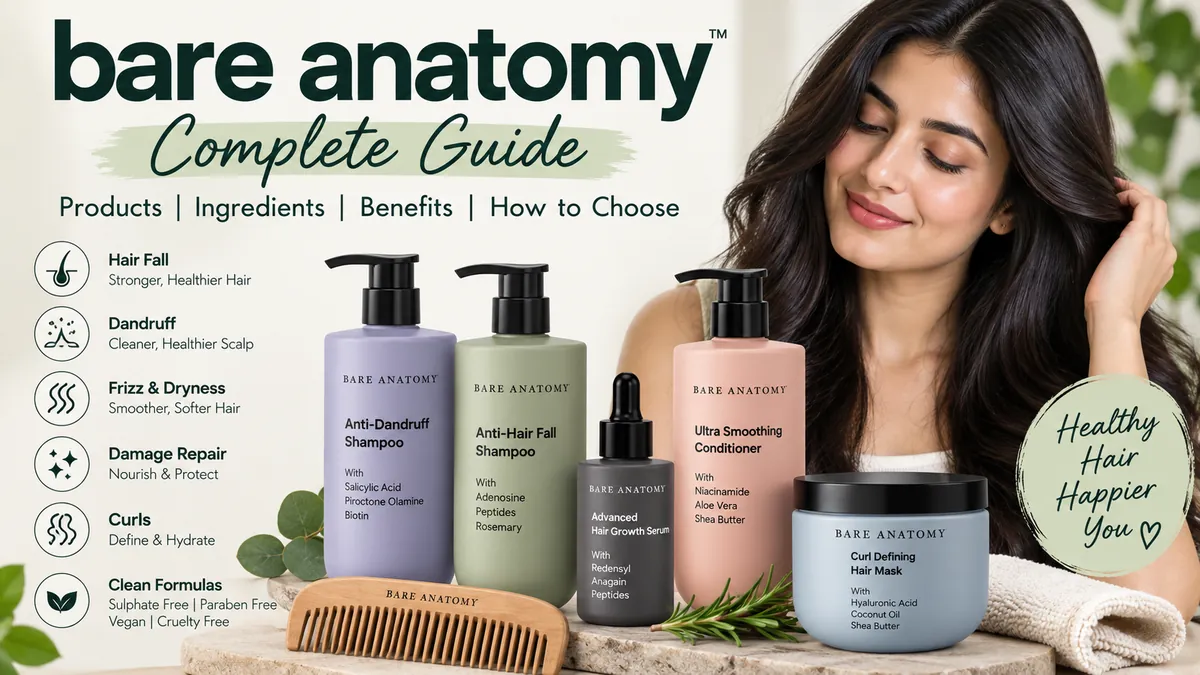
bare anatomy is a hair-care-focused brand associated with Innovist that offers shampoos, conditioners, masks, serums, oils, sprays, leave-in treatments, styling products, and scalp-care formulas. Its ranges target concerns such as dandruff, hair fall, frizz, dryness, damage, low volume, curls, and color-treated hair using ingredients including salicylic acid, piroctone olamine, niacinamide, peptides, hyaluronic acid, Redensyl, rosemary, biotin, and plant extracts.
The useful way to understand the brand is not to ask whether every product is “good.” Different formulas perform different jobs. A dandruff shampoo, for example, should be judged by its scalp-cleansing and anti-dandruff ingredients, while a smoothing mask is primarily about conditioning, lubrication, and reducing roughness.
What Is bare anatomy?
bare anatomy is a hair care brand whose current product catalog focuses on targeted solutions for specific hair and scalp concerns. The brand appears within the Innovist portfolio alongside Chemist at Play and SunScoop. Innovist describes Bare Anatomy as developing targeted hair-care products with science-backed formulations and clinically tested ingredients.
The range has expanded well beyond ordinary shampoo and conditioner. Current listings include products for:
- dandruff and scalp buildup
- hair fall and thinning
- dry and frizzy hair
- damaged hair
- curls
- fine or flat hair
- color-treated hair
- hair growth routines
- styling and finishing
- children’s hair care
There are also supporting accessories such as scalp massagers and wooden combs.
This concern-based approach makes the product name particularly important. Two shampoos from the same brand can have substantially different ingredient profiles because they are intended to solve different problems.
How bare anatomy Hair Care Is Organized
A practical way to understand the catalog is to separate products according to what they are supposed to do.
| Hair concern | Product type commonly used | Notable ingredients in current formulas |
|---|---|---|
| Dandruff | Anti-dandruff shampoo/conditioner | Salicylic acid, piroctone olamine, biotin |
| Hair fall | Shampoo, conditioner, serum | Adenosine, peptides, Redensyl, rosemary |
| Dryness/frizz | Smoothing shampoo, mask, serum | Niacinamide, aloe vera, shea butter, vitamin E |
| Damaged hair | Repair serum | Ceramide A2, coconut milk protein |
| Curls | Shampoo, mask, leave-in, gel | Hyaluronic acid, coconut oil, castor oil |
| Fine/flat hair | Volumizing shampoo and spray | Rice milk protein, peptides |
| Color-treated hair | Color-protect shampoo | Quinoa protein, amino acid complex |
These ingredients and product categories are reflected in the brand’s current catalog.
The table also highlights why choosing by hair concern is usually more useful than simply selecting whatever product is most popular.
bare anatomy Anti-Dandruff Products
Dandruff is one of the brand’s most visible categories. Its current Anti Dandruff Shampoo lists salicylic acid, piroctone olamine, and biotin among its highlighted ingredients. The brand markets the formula for flakes, itching, and scalp cleansing.
What does salicylic acid do for the scalp?
Salicylic acid is a keratolytic ingredient. In scalp products, its practical role is helping loosen and remove accumulated dead skin and flakes.
That makes it useful in a dandruff routine when scaling and buildup are significant problems.
More cleansing is not automatically better, though. A scalp can become uncomfortable when strong or frequent cleansing strips too much oil, especially when someone already has sensitive or dry skin.
What is piroctone olamine?
Piroctone olamine is commonly used in anti-dandruff hair-care formulations. Its inclusion makes the Anti Dandruff Shampoo different from an ordinary cosmetic shampoo intended primarily to remove dirt and oil.
The brand also sells an Anti-Dandruff Hair Conditioner containing salicylic acid, biotin, and rosemary.
A sensible routine is therefore based on the scalp condition rather than simply using every anti-dandruff product available.
If persistent flaking is accompanied by significant inflammation, sores, pain, or hair loss, a dermatologist can help determine whether the problem is ordinary dandruff or another scalp condition.
bare anatomy Products for Hair Fall and Thinning
Hair fall is more complicated than dandruff because shedding can have many causes.
The current Bare Anatomy Anti-Hair Fall Shampoo highlights adenosine and peptides, while its Anti-Hair Fall Conditioner includes Redensyl, rosemary, and peptides. The catalog also includes an Advanced Hair Growth Serum and rosemary-based sprays and oils.
Advanced Hair Growth Serum
The current Advanced Hair Growth Serum listing highlights 3% Redensyl and 4% Anagain, alongside other hair-focused ingredients.
This type of leave-on serum differs from shampoo in one obvious but important way: contact time.
Shampoo is washed away after cleansing. A serum remains on the scalp, so its formulation and usage instructions are designed differently.
Rosemary products
Rosemary appears across several current products, including hair growth sprays, oil, conditioner, and scalp-related formulas. One popular product combines rosemary and rice water, while the Rosemary & Hibiscus Hair Growth Oil includes ingredients such as biotin, bhringraj and aloe vera.
It is worth separating cosmetic hair support from treatment of medical hair loss.
Hair shedding can be associated with stress, nutrition, hormonal changes, illness, medication, genetics, scalp disorders, and hair-care practices. A shampoo or cosmetic serum cannot diagnose the underlying cause.
If shedding becomes sudden, severe, patchy, or continues for months, getting the cause evaluated matters more than repeatedly changing products.
bare anatomy for Dry, Rough and Frizzy Hair
Dry and frizzy hair needs a different strategy from an oily, dandruff-prone scalp.
Bare Anatomy’s Ultra Smoothing range includes shampoo, hair mask, serum, and bundled routines. The current Ultra Smoothing Shampoo features niacinamide and aloe vera extract, while the mask includes shea butter and niacinamide.
The smoothing serum includes vitamin E and omega 3, 6 and 9 ingredients.
Why conditioning matters
Frizz is not simply a cleanliness problem.
Hair that is dry, porous, weathered, chemically processed, or exposed repeatedly to heat can feel rough because the fiber’s surface does not remain smooth.
Conditioning products can improve manageability by reducing friction and helping strands feel softer and smoother.
That is why repeatedly shampooing frizzy hair is rarely the complete solution. The routine normally needs conditioning as well.
Hair masks versus conditioners
A regular conditioner is convenient after washing and is usually enough for routine detangling and softness.
A hair mask is a more treatment-oriented step that may be useful when hair feels especially dry or damaged.
Using both does not guarantee better results. Fine hair can become weighed down by excessive conditioning, whereas coarse or highly porous hair may tolerate richer formulas more comfortably.
Quick Takeaway: Choose conditioning intensity according to how your hair behaves after drying. If it becomes limp and greasy quickly, reduce heavy treatments. If it remains rough and difficult to detangle, a richer mask may be useful.
Damage Repair, Anti-Frizz and Color Protection
The catalog also separates general smoothing from more specific damage concerns.
Bare Anatomy’s Damage Repair Hair Serum currently lists Ceramide A2 and coconut milk protein, while its Anti-Frizz Shampoo uses rice protein and hyaluronic acid.
There is also a Color Protect Shampoo containing quinoa protein and an amino acid complex. It is positioned for maintaining the appearance of colored hair.
These categories overlap, but they are not identical.
Someone with untreated hair that becomes fluffy in humid weather may primarily need frizz management. Someone who frequently bleaches, colors, straightens, or heat-styles their hair may be more interested in damage-focused conditioning.
Can damaged hair actually be repaired?
This term needs some context.
Hair outside the scalp is a non-living fiber. Cosmetic products can condition damaged areas, reduce friction, coat the fiber, improve appearance, and make hair feel stronger or smoother.
They cannot biologically regenerate an already damaged hair shaft in the way living skin can heal.
“Repair” on hair-care packaging should therefore generally be understood as improving the condition, feel, protection, and appearance of damaged strands rather than permanently reversing every structural change.
bare anatomy Curl Care
Curly hair has its own range within the catalog.
Current products include Curl Defining Shampoo, Curl Intensifying Leave-In Conditioner, Curl Enhancing Hair Mask, and Curl Defining Gel. Highlighted ingredients include hyaluronic acid, coconut oil, castor oil, and shea butter.
These products address several different stages of a curl routine.
Cleansing
The shampoo removes scalp oil and buildup while preparing hair for conditioning.
Conditioning
A mask or leave-in conditioner helps with softness, hydration, and detangling.
Definition and hold
Gel serves another purpose: helping curls maintain their shape after styling.
People sometimes judge a curl routine entirely by the shampoo, but styling technique can make just as much difference to the final appearance.
Applying leave-in or gel while hair is adequately wet, distributing it evenly, avoiding excessive touching while drying, and experimenting with product quantity can significantly change results.
Volumizing Products for Fine and Flat Hair
Fine hair presents almost the opposite challenge from coarse, dry hair.
Too much rich conditioner or oil can make fine strands look flat even when the product itself is not inherently poor.
Bare Anatomy’s current Volumizing Shampoo uses rice milk protein and peptides and is positioned for volume and hydration. A Root Lift & Volume Spray is also listed for styling and root lift.
For fine hair, placement often matters.
Apply shampoo mainly where cleansing is needed—the scalp and roots. Conditioner can usually be concentrated through the lengths and ends rather than heavily coating the roots.
Styling products should start with small quantities. You can add more, but removing an excessive amount usually means washing again.
Understanding Popular bare anatomy Ingredients
Ingredient names can make hair care sound more complicated than it needs to be.
Here is what several recurring ingredients broadly tell you about the type of formula you are looking at.
Niacinamide
Niacinamide appears in the Ultra Smoothing range. In a rinse-off or conditioning hair product, it exists as part of the overall formulation rather than acting alone.
The complete formula matters more than spotting one familiar ingredient on the label.
Hyaluronic acid
Hyaluronic acid is associated with moisture and appears in several Bare Anatomy curl and anti-frizz products.
Its presence generally signals a hydration-focused formulation.
Shea butter
Shea butter is a richer conditioning ingredient found in the Ultra Smoothing Hair Mask and curl-focused leave-in products.
It can be particularly relevant for dry-feeling hair, although very fine strands may prefer lighter application.
Aloe vera
Aloe vera extract appears in the Ultra Smoothing Shampoo and other formulas.
Again, the presence of aloe does not by itself determine how a shampoo will perform. Surfactants, conditioning agents, preservatives, fragrance, concentration, and the overall formulation all matter.
Biotin
Biotin appears in several hair-care products, particularly the anti-dandruff and growth-oriented ranges.
Topical biotin in a cosmetic product should not be confused with treating a diagnosed nutritional deficiency.
Peptides
Peptides feature prominently in hair-fall and volumizing products.
The term describes short chains of amino acids, but different peptides and formulations have different functions. Seeing “peptides” on packaging is therefore a starting point for understanding a formula, not proof of a particular result.
Redensyl and Anagain
These are branded cosmetic actives frequently found in hair-density and growth-oriented serums. Bare Anatomy’s Advanced Hair Growth Serum prominently uses Redensyl and Anagain.
Claims surrounding cosmetic actives should be interpreted according to the specific finished product, study design, usage duration, and individual cause of hair loss rather than assuming everyone will obtain the same result.
Is bare anatomy Sulphate and Paraben Free?
The brand describes its hair-care formulations as free from sulphates, parabens, and phthalates, and describes the range as vegan and cruelty-free.
“Sulphate-free” deserves context because sulphates are not automatically harmful.
They are cleansing surfactants, and different surfactant systems vary in strength and formulation. Some people with dry, curly, colored, or easily irritated hair prefer gentler cleansing systems, while others need stronger cleansing because of oil or styling-product buildup.
Likewise, “paraben-free” describes formulation choice; it should not be used as a shortcut for deciding whether an entire product is effective or safe.
A more useful evaluation considers the complete ingredient list, your scalp condition, frequency of use, and how your hair responds over several washes.
Are bare anatomy Products Dermatologically Tested?
Bare Anatomy states that its products use clinically tested ingredients and describes its formulas as dermatologically tested.
That information can be useful, but “dermatologically tested” does not mean that an individual cannot experience irritation or allergy.
Skin and scalp tolerance varies.
Fragrance, botanical extracts, preservatives, surfactants, and other ingredients can potentially cause sensitivity in susceptible people.
Stop using a product if you develop significant burning, swelling, rash, or persistent irritation. A patch test can also be sensible for leave-on products when you know your skin is reactive.
How to Choose the Right bare anatomy Product
The easiest mistake is choosing according to popularity instead of need.
Retail listings show particularly high visibility for products such as the Rosemary Water Spray, Anti-Dandruff Shampoo, Advanced Hair Growth Serum, Anti-Hair Fall range, and Ultra Smoothing products.
Popularity does not tell you which one your hair requires.
Use this process instead:
- Identify your main concern. Decide whether dandruff, shedding, dryness, frizz, breakage, damage, lack of volume, or curl definition is the primary problem.
- Separate scalp problems from strand problems. Dandruff occurs at the scalp; split, rough ends concern the hair fiber. They may require different products.
- Check the active or highlighted ingredients. Match them with the purpose of the product rather than buying because one ingredient is trending.
- Build a minimal routine first. Start with the necessary cleanser and conditioner or treatment instead of introducing five products simultaneously.
- Follow the usage directions. A leave-on serum and rinse-off shampoo should not be treated interchangeably.
- Assess results over an appropriate period. Cosmetic smoothness may be apparent quickly; scalp or hair-density concerns generally require more patience.
- Change one variable at a time. If you introduce several new products together, identifying what caused an improvement or irritation becomes difficult.
This approach applies to almost any hair-care brand, not only Bare Anatomy.
A Simple Routine Based on Hair Type
You do not necessarily need a shampoo, conditioner, mask, oil, spray, serum, and styling treatment all at once.
For an oily scalp
Focus on effective scalp cleansing.
Apply shampoo primarily to the scalp, rinse thoroughly, and use conditioner mainly through the lengths if your ends need it.
If oiliness is accompanied by dandruff, an appropriate anti-dandruff formula may make more sense than a smoothing shampoo.
For dry and frizzy hair
A smoothing shampoo combined with conditioner or a periodic mask is more logical.
A lightweight serum can be used afterward if additional smoothness and manageability are needed.
For dandruff-prone hair
Prioritize scalp treatment rather than coating the scalp with multiple oils and styling products.
The Bare Anatomy Anti Dandruff Shampoo’s salicylic acid and piroctone olamine combination is specifically formulated around this concern.
For curly hair
Use cleansing appropriate to your scalp, followed by adequate conditioning.
A leave-in can help with moisture and detangling, while gel can provide definition and hold.
For damaged or color-treated hair
Minimize unnecessary heat and harsh mechanical handling alongside using conditioning products.
A damage-repair serum or color-protect shampoo can support the cosmetic routine, but prevention remains valuable because severely damaged hair cannot simply be restored to untouched condition.
For fine hair
Keep conditioning lighter and avoid overloading the roots.
Volumizing products and carefully applied styling sprays may provide a fuller appearance without the heaviness associated with richer masks and oils.
How Often Should You Use bare anatomy Shampoo?
There is no universal number of washes per week that suits everyone.
Frequency depends on scalp oil production, sweating, exercise, climate, styling-product use, hair texture, and the specific shampoo.
An oily scalp may need washing more frequently than a dry scalp. Someone who exercises heavily or uses styling products may also accumulate oil and residue faster.
Curly or very dry hair often requires a different balance because frequent cleansing can leave the lengths feeling dry even when the scalp needs washing.
Watch your scalp rather than following an arbitrary calendar.
Persistent greasiness, odor, itching, or buildup can indicate that cleansing is insufficient. Tightness, excessive dryness, irritation, or increasingly rough lengths may suggest that your routine is too aggressive.
Does bare anatomy Work for Everyone?
No hair-care range works identically for every person.
That is normal.
Hair diameter, density, curl pattern, porosity, scalp oil production, chemical processing, environmental exposure, styling habits, and underlying scalp conditions all influence how a product performs.
Retailer listings also show different consumer ratings across Bare Anatomy products rather than one uniform score for the entire brand.
That is why individual product evaluation is more useful than asking whether the brand as a whole “works.”
A person with dandruff might have a positive experience with the anti-dandruff range but find a smoothing mask too heavy. Someone with coarse, frizzy hair could have the opposite experience.
Quick Takeaway: Judge the formula against the problem it is designed to solve. Brand reputation alone cannot predict how your individual scalp and hair will respond.
Common Hair-Care Mistakes to Avoid
Good products can perform poorly when the routine around them does not make sense.
One common mistake is applying conditioner heavily to an oily scalp when only the dry lengths require conditioning. Another is repeatedly using clarifying or dandruff shampoos on already dry lengths.
Product quantity matters too. More serum, mask, or oil does not automatically produce more benefit. Excessive application can create buildup and make hair appear greasy or flat.
Heat deserves attention as well. Frequent high-temperature straightening, curling, or blow-drying can contribute to fiber damage regardless of how sophisticated the shampoo is.
And when investigating a new product, introduce it deliberately. Changing your shampoo, conditioner, serum, oil, and styling products on the same day makes it almost impossible to know which change helped.
bare anatomy vs a Basic Hair Care Routine
A targeted product range offers more choices, but more choices are not always necessary.
| Basic routine | Targeted routine |
|---|---|
| Shampoo | Concern-specific shampoo |
| Conditioner | Concern-specific conditioner |
| Occasional mask | Repair or smoothing mask |
| Optional serum | Growth, damage or smoothing serum |
| Basic styling | Curl gel, leave-in or volume spray |
Someone with healthy hair and no major scalp concern may do perfectly well with a straightforward shampoo-and-conditioner routine.
Targeted products become more useful when there is a clear problem to address.
The key is avoiding the assumption that a complex routine must be better. Hair care should be as simple as possible while still meeting the needs of your scalp and strands.
What to Know Before Using bare anatomy
bare anatomy now covers a broad spectrum of hair-care needs, from dandruff and hair fall to smoothing, curls, damage repair, volume, color protection, children’s shampoo, and styling. Its current formulas feature ingredients such as salicylic acid, piroctone olamine, adenosine, peptides, niacinamide, aloe vera, hyaluronic acid, shea butter, Redensyl, Anagain, rosemary, ceramides, proteins, and amino acids.
The most useful way to approach bare anatomy is to ignore the temptation to build an oversized routine and start with one question: What specific problem am I trying to solve?
For dandruff, focus on the scalp and appropriate anti-dandruff ingredients. For dryness and frizz, prioritize conditioning and manageability. For curls, balance cleansing, moisture, and hold. For hair fall, remember that cosmetic products are only one part of the picture because persistent shedding can have underlying causes.
Once the concern is clear, choosing among the brand’s shampoos, conditioners, masks, serums, sprays, oils, and styling products becomes much simpler.
