

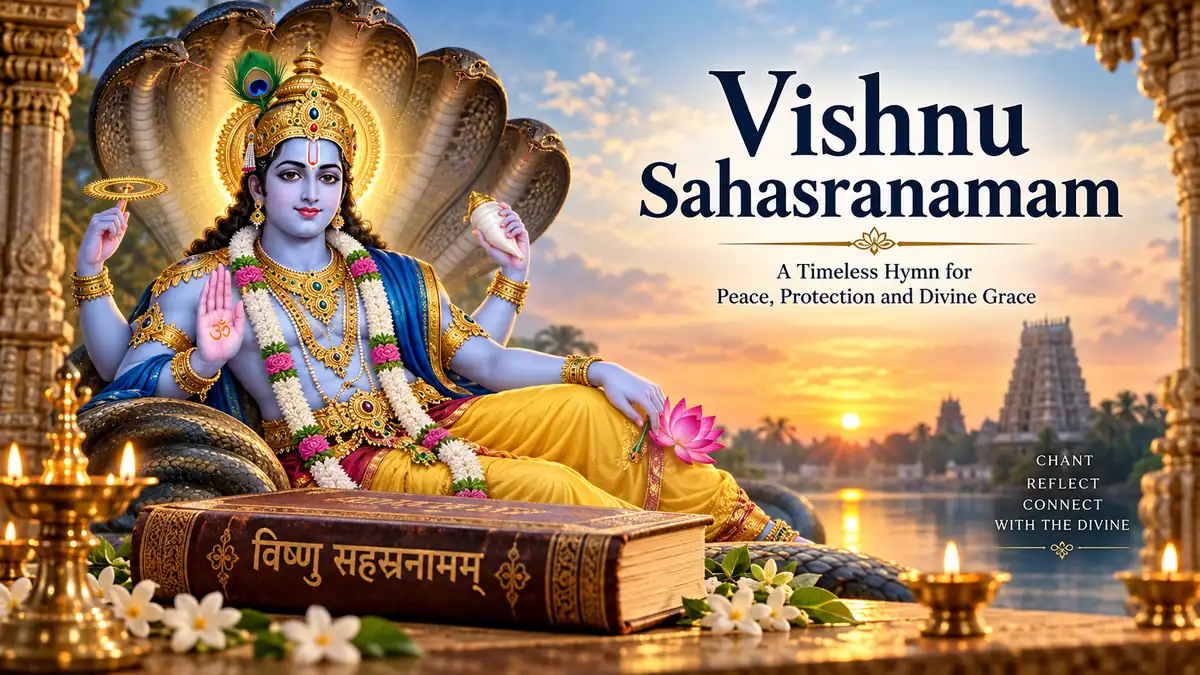
Few Sanskrit hymns have remained as deeply woven into everyday Hindu devotional life as vishnu sahasranamam. It is recited in temples, chanted quietly at home, studied through traditional commentaries, and listened to by people who may not even know Sanskrit.
Its appeal goes beyond repetition of sacred names. Each name offers a different way of contemplating Vishnu—as the all-pervading reality, protector, inner Self, source of creation, refuge of devotees, and embodiment of divine qualities.
vishnu sahasranamam means “the thousand names of Vishnu.” It is a celebrated Sanskrit stotra found in the Anushasana Parva of the Mahabharata, where Bhishma teaches it to Yudhishthira. The hymn presents a thousand names and attributes of Vishnu and is traditionally recited as prayer, remembrance, meditation, and contemplation of the Divine.
What Is vishnu sahasranamam?
The name can be understood through three Sanskrit elements:
- Vishnu — commonly understood as the all-pervading Lord.
- Sahasra — thousand.
- Nama — name.
A sahasranama is a genre of Hindu devotional literature in which a deity is praised through a thousand names or epithets. Such names may describe divine qualities, functions, manifestations, philosophical principles, or relationships with devotees.
So vishnu sahasranamam should not be viewed simply as a directory of 1,000 labels.
Names such as Vishvam, Vishnu, Narayana, Vasudeva, Hrishikesha, Padmanabha, Ananta, Keshava, Madhava, Govinda, Purushottama, Achyuta, and Hari carry layers of devotional and philosophical meaning.
For example, Vishvam can point toward the universe or totality of existence, while Vishnu conveys the idea of the one who pervades everything. Narayana has received extensive theological interpretation in different Vedanta traditions.
This is why simply translating every name into one English word cannot capture the full depth of the hymn.
Is It Exactly 1,000 Names?
The defining feature of the Sahasranama is its 1,000 divine names, although counting and numbering can differ slightly between editions and commentarial traditions.
Some modern sources describe 1,008 names, while the classical work is conventionally known and interpreted as the thousand names of Vishnu. Readers comparing editions should therefore avoid assuming that a numbering difference means one version is necessarily incorrect.
The core hymn is commonly presented in roughly 107–108 verses, depending on how verses and accompanying material are counted. Traditional recitation may also include introductory prayers, dhyana verses and the concluding phala-shruti.
Quick takeaway: The central idea is not the arithmetic of competing editions. It is contemplation of Vishnu through a thousand sacred names.
The Mahabharata Origin of vishnu sahasranamam
Understanding the setting makes the hymn much more meaningful.
vishnu sahasranamam forms part of the Anushasana Parva, the “Book of Instructions,” traditionally identified as the thirteenth book of the Mahabharata.
Its central characters are:
Bhishma — the respected elder of the Kuru dynasty.
Yudhishthira — the eldest Pandava, seeking guidance after the devastating Kurukshetra war.
Vyasa — the sage traditionally associated with the composition and transmission of the Mahabharata.
After the war, Bhishma remains alive on his bed of arrows. Yudhishthira approaches him for guidance about dharma and the highest spiritual good.
The setting matters because this is not presented as casual philosophical conversation.
Bhishma is approaching the end of his life. Yudhishthira has experienced the destruction of war and is searching for moral and spiritual certainty.
Within that context, he asks Bhishma profound questions concerning the highest divinity, refuge, worship and dharma.
Bhishma’s response leads into the praise of the Supreme through the thousand names of Vishnu.
Why Bhishma and Yudhishthira Matter
The dialogue gives the hymn much of its emotional power.
Yudhishthira is not merely asking for an elaborate ritual. He wants to know what human beings can rely upon when faced with suffering and uncertainty.
Bhishma directs his attention toward remembrance and praise of the Divine.
That gives vishnu sahasranamam two dimensions at once:
Devotional: remembering and praising Bhagavan Vishnu.
Contemplative: reflecting on what the thousand names say about ultimate reality.
This combination helps explain why the text became significant both for bhakti practice and Vedantic interpretation.
What Do the 1,000 Names of Vishnu Mean?
A common beginner mistake is to imagine that every name works like an ordinary personal name.
Many do not.
The names can describe qualities, cosmic functions, relationships, metaphysical principles, manifestations, or attributes of the Supreme.
Consider a few representative examples.
| Name | Common interpretive idea |
|---|---|
| Vishvam | The universe; all that exists |
| Vishnu | The all-pervading one |
| Narayana | Supreme refuge; one associated with all beings |
| Vasudeva | The indwelling or all-pervading Lord |
| Hrishikesha | Lord of the senses |
| Padmanabha | The lotus-naveled one |
| Ananta | The infinite or endless one |
| Keshava | A traditional name of Vishnu/Krishna |
| Govinda | A richly interpreted name associated with the Lord |
| Purushottama | The Supreme Person |
| Achyuta | The unfailing or imperishable one |
| Hari | The Lord who removes or takes away |
These are concise glosses rather than exhaustive translations. Classical commentators often derive several meanings from the same name through Sanskrit grammar, etymology, scriptural references and theological context.
Why Are Some Names Repeated?
Readers sometimes notice apparently repeated names.
That does not necessarily indicate accidental duplication.
A Sanskrit name may carry more than one derivation or meaning depending on context. Classical commentators can therefore explain the same-looking word differently at different points.
This is one reason a serious study of vishnu sahasranamam benefits from a traditional bhashya, or commentary, rather than relying exclusively on a one-line English translation.
Why Do Names Associated With Shiva Appear?
Another interesting feature is the presence of names such as Shiva, Shambhu, Ishana, and Rudra.
This has received different theological interpretations.
In the commentary attributed to Adi Shankaracharya, such terms are interpreted as names applicable to the Supreme Vishnu/Brahman through their underlying meanings and attributes. For instance, Shiva can signify auspiciousness rather than functioning only as an exclusive proper name. Other Vedantic commentators develop the point according to their own theological frameworks.
The safest way to approach such passages is to recognize that Sanskrit divine epithets frequently carry meanings broader than modern readers may assume from a single familiar usage.
Adi Shankaracharya and Other Commentaries
The thousand names inspired substantial traditions of interpretation.
Among the best known is the Vishnu Sahasranama Bhashya associated with Adi Shankaracharya.
His explanations use Sanskrit derivation, grammar and scriptural references to explore the philosophical significance of individual names. Within the Advaita Vedanta reading, the names ultimately point toward Brahman, the ultimate reality.
Another influential interpretation comes from Parashara Bhattar, associated with the Sri Vaishnava tradition.
His Bhagavad Guna Darpana interprets the names through a Vishishtadvaita-oriented understanding of the qualities and manifestations of Bhagavan.
The tradition discusses forms and modes such as:
- Para — the transcendent form
- Vyuha — divine emanational forms
- Vibhava — manifestations or avataras
- Antaryami — the indwelling Lord
- Archa — the worshipful deity form
Within these interpretations appear familiar manifestations and names such as Vasudeva, Sankarshana, Pradyumna, Aniruddha, Rama, Krishna, and Narasimha.
These commentarial differences are useful rather than problematic. They demonstrate how the same thousand names have been contemplated through several major streams of Vedanta and Vaishnava theology.
vishnu sahasranamam Benefits in Hindu Tradition
People frequently search for the “benefits of vishnu sahasranamam,” but this topic deserves careful wording.
The text’s phala-shruti, or concluding verses describing the fruits of recitation, associates devotional recitation with various forms of well-being and spiritual benefit. Traditional sources speak of freedom from fear and difficulty, prosperity, knowledge, happiness and spiritual welfare.
These are religious and scriptural claims, not guarantees established by modern scientific research.
That distinction matters.
The most practical benefits of regular recitation can also be understood through the nature of the practice itself.
1. Sustained Spiritual Remembrance
Repeating divine names keeps attention directed toward Vishnu.
In the language of bhakti, this is nama-smarana—remembrance of the Divine Name.
Instead of thinking of prayer only as asking for something, the Sahasranama makes remembering divine qualities the practice itself.
2. A Structured Form of Meditation
A complete recitation requires sustained attention.
The mind repeatedly returns to the names rather than wandering freely. For devotees, this makes chanting a form of devotional concentration.
3. Reflection on Divine Qualities
Studying meanings changes the experience considerably.
A name connected with compassion invites reflection on compassion. A name suggesting infinity points toward a different philosophical idea. Names concerning protection, truth, wisdom, creation and the indwelling Self offer still other contemplations.
The practice can therefore move through three stages:
read → understand → contemplate.
4. Connection With a Living Tradition
The hymn has been transmitted through generations of teachers, families, temples and Vedantic traditions.
Chanting it connects a contemporary practitioner with that larger tradition of stotra, bhakti, Sanskrit learning and scriptural study.
5. A Consistent Daily Practice
One understated advantage is consistency.
A spiritual routine does not have to change every week. Someone can return to the same text for years while gradually discovering deeper meanings.
Quick Takeaway: Traditional Hindu sources describe extensive fruits of vishnu sahasranamam recitation. A balanced modern explanation should present these as teachings of the tradition rather than promising specific medical, financial, or supernatural outcomes.
How to Chant vishnu sahasranamam
There is no need for a beginner to turn the practice into an intimidating ritual.
A simple approach works well.
- Choose a quiet place. Sit comfortably somewhere you can remain attentive without frequent interruption.
- Use an accurate text. A Sanskrit edition with reliable transliteration is especially useful when you are learning.
- Listen before trying to chant quickly. Follow a careful traditional recitation while reading the words.
- Learn in small sections. Master a few verses before adding more.
- Prioritize pronunciation over speed. Slow, deliberate chanting is better for learning than racing through the text.
- Study the meanings. Even a few names each day can turn mechanical repetition into contemplation.
- Finish calmly. Traditional editions normally provide the concluding verses and phala-shruti.
Some traditions begin with preliminary prayers and dhyana verses before the main Sahasranama. A complete recitation may take roughly 25–40 minutes depending on pace and the introductory and concluding material included.
What Is the Best Time to Chant?
Early morning is widely preferred in traditional practice because the surroundings tend to be quieter and the mind less occupied.
However, evening recitation is also common.
Specific communities may particularly observe days such as Ekadashi, Saturdays, or particular festival periods, while other devotees simply chant daily.
The practical principle is straightforward: regular attentive practice is more useful than choosing an “ideal” hour that you cannot maintain.
Someone able to concentrate for 20 minutes in the evening need not abandon the practice because early morning is inconvenient.
Do You Need to Face a Particular Direction?
Some traditional practice guides recommend facing east or north, sitting on a clean asana, bathing beforehand, lighting a lamp, or making offerings such as flowers or Tulsi.
These customs can support devotional practice, but exact procedures differ among families, sampradayas and teachers.
If you follow a particular lineage, temple tradition or guru, its instructions should take precedence over generic internet advice.
Pronouncing vishnu sahasranamam Correctly
Pronunciation is often the hardest part for someone reading the hymn in English transliteration.
Sanskrit distinguishes sounds that ordinary English spelling does not represent precisely.
For example, transliteration systems may use marks such as:
- ā for a long “a”
- ī for a long “i”
- ū for a long “u”
- ṛ for a vocalic Sanskrit sound
- ś and ṣ for distinct “sh” sounds
- ṇ and ṭ for retroflex consonants
This is why two English-language websites can display slightly different spellings while representing essentially the same Sanskrit.
A Better Learning Method
For beginners, this sequence tends to work better than memorizing a huge Romanized page:
Step 1: Listen to one verse from a clear traditional recitation.
Step 2: Read the Sanskrit transliteration while listening.
Step 3: Repeat one phrase at a time.
Step 4: Join the phrases into the complete verse.
Step 5: Check the meaning.
Step 6: Only then work on memorization.
Do not sacrifice clarity to imitate the speed of an experienced chanter.
The goal at first is not performance. It is accurate, attentive recitation.
vishnu sahasranamam Lyrics, Stotram, and Namavali: What Is the Difference?
These terms are sometimes used interchangeably online, which can confuse beginners.
Sahasranama Stotram
The stotram presents the names within metrical Sanskrit verses. This is the familiar continuous form commonly used for chanting.
Sahasranama Namavali
A namavali generally presents the names individually for devotional recitation or worship.
Rather than reading each verse continuously, individual names may be recited separately with devotional formulas.
English Transliteration
This represents Sanskrit sounds using the Roman alphabet.
It is particularly useful for readers who cannot read Devanagari, Telugu, Tamil, Kannada, Malayalam or other Indian scripts.
English Meaning
A translation explains what individual names or verses signify.
For deeper study, look for an edition that includes:
Sanskrit + transliteration + word meanings + commentary.
That combination is far more useful than English transliteration alone.
Understanding the Opening Names
The opening sequence immediately reveals the philosophical scale of the hymn.
It begins with names including Vishvam and Vishnu, followed by expressions describing the Lord in relation to existence and time. Traditional interpretation connects the opening names with the universe, all-pervasiveness, past, present, future, creation, sustenance and the inner reality of beings.
This tells the reader something crucial.
The text does not begin by describing Vishnu merely as one powerful supernatural personality among others. It immediately expands the idea toward cosmic and metaphysical dimensions.
This theme continues throughout the hymn.
Some names concern Vishnu as creator and sustainer. Others emphasize refuge and protection. Some describe spiritual qualities, while still others connect with avatara traditions and Vedantic concepts.
That breadth is precisely why commentarial study can continue for years.
Vishnu, Narayana, Vasudeva, and the Avataras
Readers encountering many different divine names may wonder whether the hymn is moving between separate beings.
Within Vaishnava traditions, names such as Vishnu, Narayana, Hari, Vasudeva, Krishna, Keshava, Madhava, Govinda, and others can express different aspects, manifestations, relationships or theological understandings of the Supreme.
The Sahasranama also intersects with the wider avatara tradition associated with figures such as:
Matsya, Kurma, Varaha, Narasimha, Vamana, Parashurama, Rama, Krishna, and Kalki.
Different schools of Vaishnavism explain the precise relationship among these forms according to their own theology.
This diversity is worth preserving when explaining the text. Hindu traditions do not always interpret every name through one identical philosophical framework.
Can Beginners Chant vishnu sahasranamam?
Yes. A beginner does not need to memorize the complete hymn before starting.
Trying to master everything at once is one of the fastest ways to make the practice frustrating.
Start with a manageable amount.
For example, spend several days learning the opening verse. Once the sounds feel natural, move forward. Meanwhile, read the meanings of the names you are learning.
If a full recitation feels overwhelming, studying and reciting a small section attentively is a reasonable way to begin.
A practical learning schedule might look like this:
| Stage | Focus |
|---|---|
| First few days | Listen and follow the text |
| Next stage | Learn pronunciation phrase by phrase |
| Then | Recite several verses independently |
| As you progress | Add meanings of individual names |
| Long term | Study a traditional commentary |
There is no prize for learning fastest.
A person who learns slowly but understands what is being said may develop a much richer relationship with the text.
Can You Listen Instead of Chanting?
Listening can be valuable, especially during the learning stage.
A clear recording teaches rhythm, pronunciation and verse structure far better than guessing from Roman letters.
But listening and chanting are not identical activities.
Active recitation requires you to form the sounds and maintain attention through the sequence. Listening is more receptive. Reading the meaning adds yet another dimension.
Rather than asking which one is universally “better,” combine them when possible:
listen for pronunciation, chant for active practice, and study for understanding.
Do You Have to Know Sanskrit?
No, but knowing some Sanskrit can deepen your understanding.
Many devotees learn vishnu sahasranamam through oral repetition long before understanding Sanskrit grammar.
The limitation is that a translation can flatten a name that has several possible derivations.
This is especially noticeable in major commentaries.
Adi Shankaracharya’s explanations use vyakarana (grammar), derivation and scriptural connections to draw philosophical significance from individual names. Parashara Bhattar may interpret the same name with a different theological emphasis.
So English meaning is an excellent starting point, not necessarily the final word.
Common Mistakes When Learning vishnu sahasranamam
Trying to Chant Too Fast
Recordings by experienced chanters can sound effortless.
Beginners often copy their speed before mastering the sounds. This usually creates swallowed syllables and recurring pronunciation errors.
Learn slowly first.
Treating It as 1,000 Unrelated Words
The names form a theological and devotional landscape.
Study their meanings and relationships rather than treating memorization as a vocabulary exercise.
Depending on a Poor Transliteration
Roman spellings vary enormously online.
Choose a source with consistent transliteration, preferably one based on a reliable Sanskrit text.
Obsessing Over Perfect Ritual Conditions
Traditional customs deserve respect, but beginners sometimes become so concerned about direction, time, clothing or setup that they never establish a practice.
If you belong to a specific tradition, follow its guidance. Otherwise, begin with cleanliness, attention, respect and consistency.
Treating Traditional Benefits as Guaranteed Outcomes
The phala-shruti belongs to a devotional and scriptural framework.
It should be read in that context rather than converted into promises that chanting will automatically produce a particular job, cure an illness or deliver a fixed financial result.
This distinction makes an explanation of the tradition more trustworthy, not less devotional.
How to Study the Thousand Names More Deeply
Once basic recitation becomes comfortable, shift some attention from how to say the names to what the names mean.
A useful study method is to choose five names at a time.
For each one:
- Read the Sanskrit name.
- Check its basic English meaning.
- Look at its Sanskrit derivation if available.
- Read how a traditional commentator interprets it.
- Consider what quality or philosophical idea the name expresses.
- Notice where the same concept appears elsewhere in Hindu scripture.
This turns Sahasranama study into more than memorization.
Names such as Narayana and Vasudeva, for instance, receive particularly substantial attention in traditional philosophical interpretation.
Over time, the thousand names begin to feel less like a long sequence and more like interconnected perspectives on the same Divine reality.
The Role of Bhakti and Vedanta
One reason vishnu sahasranamam has endured is that it does not fit neatly into only one category.
It is clearly a stotra—a hymn of praise.
It supports bhakti through remembrance and devotion.
It can function as nama-smarana, repeated remembrance of divine names.
And its names provide material for serious Vedanta contemplation.
A devotee can therefore chant the text simply out of love for Vishnu, while a student can spend considerable time investigating the philosophical significance of Vishvam, Narayana, Vasudeva, Purushottama, and other names.
Those approaches need not conflict.
Sound, devotion, meaning and philosophy can reinforce one another.
Making vishnu sahasranamam Part of Daily Practice
The most sustainable routine is usually the simplest.
Choose a regular period when you are unlikely to be interrupted. Keep one dependable text rather than switching constantly between versions. Use the same careful recording while learning pronunciation.
Most importantly, leave room for meaning.
If you have enough time for a complete recitation, chant the complete text.
If you are learning, work carefully through a smaller portion and study it.
If Sanskrit pronunciation remains difficult, listen while following an accurate transliteration.
And if you already know the hymn by memory, consider spending more time with a classical commentary rather than focusing only on completing another repetition.
vishnu sahasranamam has survived as a living devotional text because its thousand names can be approached at several levels at once: as sacred sound, prayer, remembrance, Sanskrit poetry, philosophical teaching, and contemplation of Vishnu.
The best next step is therefore simple: begin with an accurate text, learn the pronunciation patiently, understand the names you are reciting, and allow regular practice to replace the urge to rush through all one thousand.
