

Planning an early morning walk, a photography session, a journey, or simply hoping to catch the first light of day? Knowing when the sun will rise helps you make the most of your morning.
Sunrise tomorrow is the moment when the upper edge of the Sun first becomes visible above the horizon. The exact time depends on your location, date, time zone, and geographic surroundings. You can find your local sunrise time using an astronomical calculator, weather application, or sunrise and sunset timetable.
Unlike a fixed clock time, sunrise changes throughout the year. Even neighboring cities can experience sunrise at slightly different times.
What Time Is sunrise tomorrow?
The exact sunrise time tomorrow depends primarily on where you are located. Sunrise occurs earlier in some regions and later in others because Earth rotates from west to east.
For example, someone in eastern Pakistan will generally see sunrise before someone in western Pakistan on the same date, assuming comparable latitude and local horizon conditions.
For Wednesday, November 18, 2026, the sunrise time should be checked using a location-specific astronomical timetable.
A reliable lookup needs three details:
- Location: Your city, town, or geographic coordinates.
- Date: November 18, 2026, or whichever date you are checking.
- Time zone: The local clock setting, including any applicable daylight saving time.
The most convenient approach is to use a service such as timeanddate.com’s Sun Calculator or NOAA’s Solar Calculator.
These resources provide calculated sunrise and sunset times for specific dates and locations.
How to Find the Exact Sunrise Time for Your Location
There are several practical ways to determine tomorrow’s sunrise.
1. Use an online sunrise calculator
Astronomical calculators are particularly useful because they account for geographic coordinates and dates.
Enter your city or latitude and longitude, choose tomorrow’s date, and review the calculated sunrise time.
Some tools also display solar noon, sunset, day length, and twilight periods.
2. Check your phone’s weather application
Many weather applications display sunrise and sunset alongside the daily forecast.
This method is convenient when you want to combine sunrise information with temperature, cloud cover, and precipitation predictions.
Remember that the astronomical sunrise time and the time the Sun becomes visible through clouds are not necessarily the same.
3. Search for your city and date
A search such as “sunrise tomorrow in Karachi” or “sunrise tomorrow in London” can return a location-specific result.
Include the city name to reduce the chance of receiving a time calculated for an incorrect location.
4. Use an astronomy application
Applications such as Stellarium and Sun Surveyor can help visualize the Sun’s position in the sky.
These tools are especially useful for photographers, hikers, and people planning outdoor activities around the direction of sunlight.
Why Does the Sunrise Time Change Every Day?
Sunrise changes because of Earth’s axial tilt and its orbit around the Sun.
Earth’s rotational axis is tilted approximately 23.4 degrees relative to the plane perpendicular to its orbit. This tilt produces seasonal changes in daylight duration and the Sun’s apparent path across the sky.
During part of the year, the Sun follows a longer daily path above the horizon. During another part, its visible path is shorter.
In the Northern Hemisphere, daylight generally increases from the December solstice toward the June solstice and decreases afterward.
The opposite seasonal pattern occurs in the Southern Hemisphere.
Does sunrise always become earlier in summer?
Not continuously.
Although summer generally brings earlier sunrises than winter at many midlatitude locations, the earliest sunrise does not necessarily occur on the summer solstice.
This happens partly because apparent solar time and civil clock time do not progress at exactly the same rate throughout the year.
The difference is described by the equation of time.
As a result, the earliest sunrise and latest sunset typically occur on different dates around the summer solstice.
Sunrise vs. First Light: What Is the Difference?
Sunrise and first light are related but distinct astronomical events.
The sky usually begins brightening before the Sun itself appears above the horizon.
This gradual illumination is known as twilight.
| Event | Sun’s position | What you observe |
|---|---|---|
| Astronomical dawn | 18° below horizon | First very faint sky illumination under ideal conditions |
| Nautical dawn | 12° below horizon | Horizon becomes more distinguishable |
| Civil dawn | 6° below horizon | Increasing natural light for outdoor visibility |
| Sunrise | Upper edge appears at horizon | Sun becomes visible |
These angular thresholds refer to the Sun’s center, while the standard sunrise calculation uses its upper edge and an allowance for atmospheric refraction.
How long before sunrise does it get light?
At many midlatitude locations, civil dawn begins roughly 20–40 minutes before sunrise, although the interval varies by season and latitude.
Astronomical twilight can begin considerably earlier.
Near the equator, twilight tends to be shorter. At high latitudes, twilight may last much longer, and certain twilight phases may not occur on some dates.
For an early morning activity, checking civil dawn can be just as useful as checking the sunrise time.
Which Direction Will the Sun Rise Tomorrow?
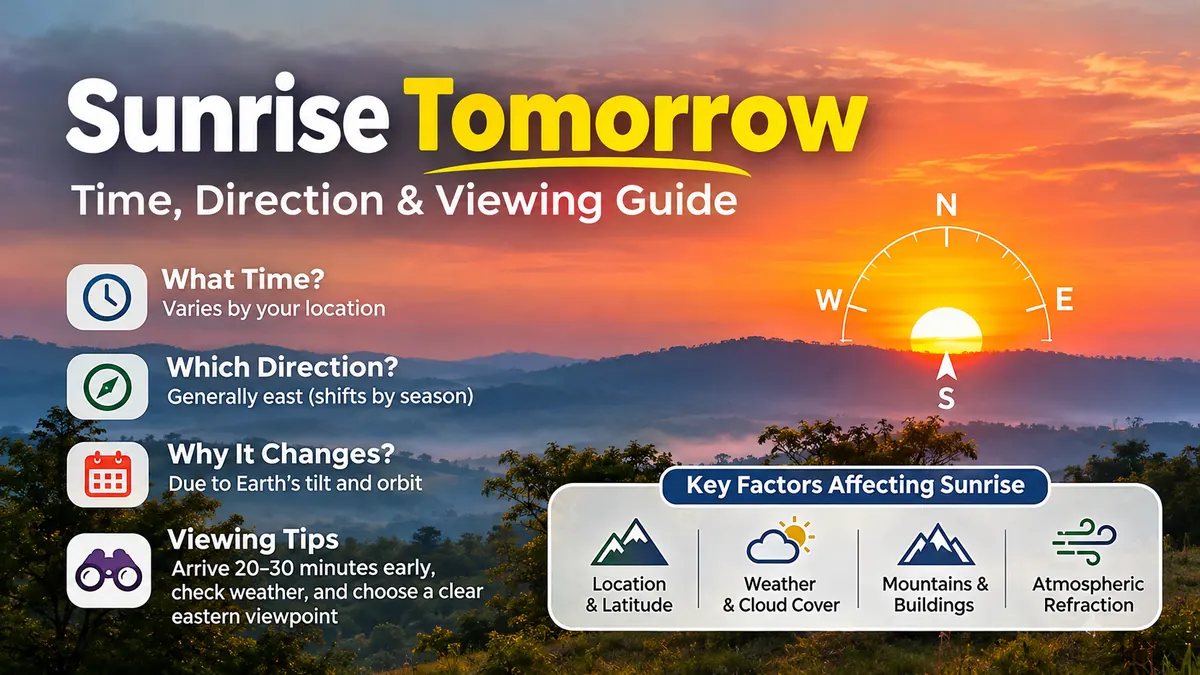
The Sun generally rises in the eastern part of the sky, but its exact direction changes with the season and your latitude.
At most locations outside the polar regions:
- Around the March and September equinoxes, sunrise occurs approximately due east.
- During Northern Hemisphere summer, the Sun rises north of east.
- During Northern Hemisphere winter, the Sun rises south of east.
The seasonal pattern is reversed in the Southern Hemisphere.
Understanding sunrise azimuth
Astronomers describe the Sun’s compass direction using azimuth, measured clockwise from north.
| Azimuth | Compass direction |
|---|---|
| 0° | North |
| 45° | Northeast |
| 90° | East |
| 135° | Southeast |
| 180° | South |
A sunrise azimuth of 110°, for example, indicates that the Sun will appear slightly south of due east.
Sun-position applications can calculate this angle for a particular location and date.
This is especially helpful when planning sunrise photography, selecting a viewpoint, or determining which side of a building will receive direct morning sunlight.
What Factors Affect the Sunrise You Actually See?
An astronomical sunrise calculation assumes a particular horizon and average atmospheric conditions. The actual appearance of the Sun can differ.
Geographic location and latitude
Latitude affects the Sun’s seasonal path and the duration of daylight.
Locations near the equator experience relatively consistent day lengths throughout the year. Higher latitudes experience much greater seasonal differences.
Near the Arctic and Antarctic Circles, there are periods when the Sun may remain above or below the horizon for an entire day.
Mountains, buildings, and elevation
A mountain or tall building to the east can block your view of the Sun after the calculated sunrise time.
Conversely, someone standing on an elevated viewpoint with an unobstructed horizon may see the Sun earlier than someone at ground level.
This distinction matters when planning a hike or photographing a sunrise from a mountain summit.
Atmospheric refraction
Earth’s atmosphere bends sunlight as it travels through layers of air.
This phenomenon, called atmospheric refraction, makes the Sun appear slightly higher than its actual geometric position.
Standard sunrise calculations account for average refraction. The United States Naval Observatory uses a conventional solar zenith angle of approximately 90.8333° for sunrise and sunset calculations. aa.usno.navy.mil+1
However, atmospheric temperature and pressure variations can change the observed timing.
Weather and cloud cover
Clouds do not change the astronomical sunrise time, but they can change when direct sunlight becomes visible.
A clear eastern horizon may reveal the first edge of the Sun immediately. Thick cloud cover can hide the solar disk entirely.
Clouds can also produce striking red, orange, and pink colors when illuminated by low-angle sunlight.
How to Plan for sunrise tomorrow
Knowing the sunrise time is only part of planning a successful early morning outing.
Arrive before the calculated sunrise
For photography or sightseeing, arriving 20–30 minutes before sunrise is often a useful starting point.
This gives you time to observe the changing sky, find a suitable position, and prepare your equipment.
For longer hikes or unfamiliar terrain, allow additional time and account for darkness before civil dawn.
Check the weather forecast
Look at cloud cover, visibility, wind speed, and precipitation.
A partly cloudy forecast can sometimes create colorful skies, while dense low clouds near the eastern horizon may conceal the Sun.
Forecasts are not guarantees, so prepare for changing conditions.
Understand the golden hour
The golden hour is the period of relatively low-angle sunlight around sunrise or sunset.
During this period, sunlight often appears warmer and shadows become longer.
Photographers value this light for landscapes, architecture, and nature photography.
Despite its name, the golden hour does not always last exactly 60 minutes. Its duration depends on latitude, season, terrain, and how the term is defined.
Choose a clear eastern viewpoint
An unobstructed view toward the sunrise azimuth improves your chances of seeing the Sun as it appears.
Beaches, open fields, elevated viewpoints, and east-facing hillsides can provide suitable conditions.
Always consider accessibility, local restrictions, and personal safety when choosing a viewing location.
Sunrise Tomorrow vs. Sunset Tomorrow
Sunrise and sunset are opposite events in the Sun’s apparent daily movement.
Sunrise marks the beginning of the period when the solar disk is above the horizon, while sunset marks its end.
| Feature | Sunrise | Sunset |
|---|---|---|
| Time of day | Morning | Evening |
| General direction | Eastern sky | Western sky |
| Sun’s apparent movement | Above the horizon | Below the horizon |
| Associated twilight | Dawn | Dusk |
| Common photography conditions | Increasing daylight | Decreasing daylight |
The time between sunrise and sunset is commonly called day length.
For example, if sunrise occurs at 6:30 AM and sunset at 5:30 PM, the daylight duration is 11 hours.
Day length varies throughout the year because of Earth’s axial tilt.
Can Sunrise Predictions Be Wrong?
Astronomical sunrise calculations are generally reliable, but their precision depends on the assumptions used.
The National Research Council Canada explains that terrain and variations in atmospheric refraction can cause observed sunrise times to differ from calculated times, sometimes by one or two minutes even with a clear sea horizon. National Research Council Canada+1
Other common causes of apparent discrepancies include incorrect time zones, daylight saving adjustments, and selecting the wrong city.
For example, a calculator set to UTC instead of local time can display a result several hours away from the expected clock time.
Before relying on a sunrise prediction, verify that the selected location, calendar date, and time zone are correct.
For locations with mountains or significant obstructions, distinguish between the published astronomical sunrise and the time direct sunlight reaches your exact position.
How Sunrise Times Change Throughout the Year
The annual sunrise pattern is closely connected to the solstices and equinoxes.
Spring equinox
Around the March equinox, the Sun rises approximately due east and sets approximately due west.
Daylight and nighttime are relatively close in duration, although they are not necessarily exactly equal because of atmospheric refraction and the definition of sunrise.
Summer solstice
Around the June solstice, the Northern Hemisphere experiences its longest daylight period of the year.
Sunrise generally occurs relatively early, and sunset occurs relatively late.
The Southern Hemisphere experiences its shortest daylight period around the same date.
Autumn equinox
Around the September equinox, the Sun again rises approximately due east and sets approximately due west.
In the Northern Hemisphere, daylight continues decreasing after this event.
Winter solstice
Around the December solstice, the Northern Hemisphere experiences its shortest daylight period.
Sunrise generally occurs later, while sunset occurs earlier than during summer.
The latest sunrise does not necessarily coincide with the shortest day because of the equation of time and the relationship between solar time and civil time. Time and Date+1
Why Knowing Tomorrow’s Sunrise Matters
Sunrise information is useful for more than simply watching the sky.
Outdoor enthusiasts use it to plan hikes, camping activities, fishing trips, and morning exercise.
Photographers use sunrise times and solar azimuth to anticipate lighting conditions.
Travelers may check sunrise before early departures, while farmers and gardeners use daylight patterns to organize outdoor work.
Sunrise also has cultural and religious significance in many communities. Some religious observances depend on sunrise, dawn, or related astronomical events, although the relevant definitions can differ.
For example, Islamic Fajr prayer begins at a defined dawn period before sunrise, not at sunrise itself. Local prayer timetables should be consulted for the applicable religious calculation.
The key is to use the correct astronomical event for the activity you are planning.
Final Thoughts on sunrise tomorrow
Finding sunrise tomorrow is straightforward once you know the location and date. A reliable astronomical timetable can provide the calculated sunrise time, twilight periods, daylight duration, and direction of the rising Sun.
For the best experience, check your local sunrise calculation alongside the weather forecast, arrive early enough to enjoy the changing sky, and choose a viewpoint with a clear eastern horizon.
Remember that sunrise is a predictable astronomical event, but the moment you actually see the Sun can depend on clouds, elevation, terrain, and atmospheric conditions.
