

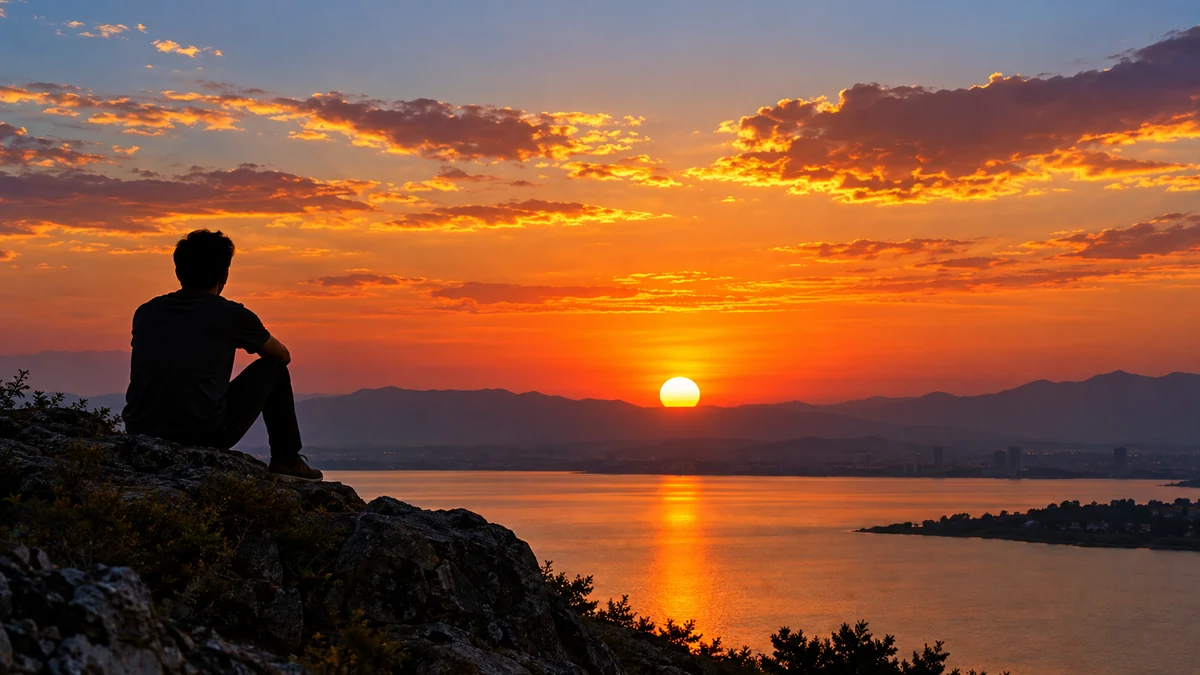
If you searched sunset today, you probably want one simple answer: what time will the Sun go down where you are? The catch is that there is no single worldwide sunset time. Sunset depends on your exact location, date, latitude, longitude, time zone, season, and even how the sunset calculation is defined.
Sunset today is the local time when the Sun’s upper edge disappears below the western horizon. Because Earth rotates and orbits the Sun, sunset occurs at a different time depending on your location and date. For the most accurate result, check a current sunrise-and-sunset service using your city or coordinates.
For example, on September 10, 2026, sunset is around 6:21 PM in Islamabad and 6:27 PM in Peshawar, Pakistan. Even cities in the same country can have noticeably different sunset times.
What Time Is sunset today?
The exact sunset today cannot be determined from the date alone. Your geographic location is essential.
Sunset is fundamentally a local astronomical event. Two people checking the time on the same date can receive different answers because they are observing the Sun from different points on Earth.
Consider several Pakistani cities on September 10, 2026:
| Location | Sunrise | Sunset | Approx. Daylight |
|---|---|---|---|
| Islamabad | 5:47 AM | 6:21 PM | 12 hr 34 min |
| Peshawar | 5:53 AM | 6:27 PM | 12 hr 34 min |
| Faisalabad | 5:48 AM | 6:20 PM | 12 hr 32 min |
These published astronomical times illustrate why a search for sunset time needs a location attached to it.
The difference becomes much greater when comparing cities hundreds or thousands of kilometers apart.
How to find your exact sunset time today
The easiest method is to search for:
sunset today + your city
For example:
- sunset today Islamabad
- sunset today New York
- sunset today London
- sunset today Sydney
For greater precision, use a sunrise-and-sunset calculator that accepts latitude and longitude.
Make sure the result displays the correct date, location and local time zone. This matters particularly when traveling or checking sunset for a location in another country.
What Does Sunset Actually Mean?
In everyday conversation, sunset sounds simple: it is when the Sun goes down.
Astronomically, it has a more precise meaning.
Sunset is generally recorded when the upper limb, or upper edge, of the Sun disappears below the horizon. Atmospheric refraction is also taken into account in standard published sunrise and sunset calculations. Timeanddate, for example, states that its listed local Sun times account for refraction.
That distinction explains something people often notice: the published sunset time does not mean the sky immediately becomes dark.
Quite the opposite. There can still be substantial natural light after sunset.
Sunset vs. dusk
Sunset and dusk are related, but they are not interchangeable.
Sunset is the specific event when the Sun disappears below the horizon.
Dusk describes a later stage of twilight as the remaining natural illumination fades.
Between them is twilight.
This distinction matters if you are planning photography, hiking, outdoor work, driving, stargazing or another activity where available light matters more than the official sunset time.
sunset today and the Three Stages of Twilight
The sky does not switch instantly from daylight to darkness when the clock reaches the listed sunset time.
After sunset, the Sun continues moving farther below the horizon from your perspective. Astronomers divide the transition into civil, nautical and astronomical twilight.
Civil twilight
Civil twilight is the brightest twilight period.
After evening sunset, it continues while the center of the Sun is no more than about 6 degrees below the horizon.
There is usually enough natural illumination for many ordinary outdoor activities, although conditions vary with clouds, terrain and surroundings.
If you want to walk outside, take casual photographs or simply enjoy the colorful evening sky, civil twilight may matter more than the precise sunset minute.
Nautical twilight
Nautical twilight follows civil twilight as the Sun moves roughly 6 to 12 degrees below the horizon.
The horizon becomes less distinct, while brighter stars and planets become easier to see.
The name reflects its historical connection with navigation at sea, when sailors could use visible stars while retaining some view of the horizon.
Astronomical twilight
Astronomical twilight occurs while the Sun is approximately 12 to 18 degrees below the horizon.
After evening astronomical twilight ends, the sky reaches astronomical night, although artificial light, moonlight and atmospheric conditions can still brighten it.
This is an important distinction for astronomers and astrophotographers looking for genuinely dark conditions.
A real example of sunset and twilight
Peshawar provides a useful example for September 10, 2026. Sunset is listed at 6:27 PM, but civil twilight continues until approximately 6:52 PM. Nautical twilight then lasts until about 7:22 PM, followed by astronomical twilight until roughly 7:52 PM.
So if someone asks, “Will it be completely dark at sunset?” the answer is usually no.
Quick takeaway: Sunset marks the Sun’s disappearance below the horizon. It does not mark the instant when complete darkness begins.
Why Does sunset today Change Every Day?
If you check sunset at the same location for several weeks, you will notice that the time gradually moves.
The reason comes from Earth’s motion.
Earth rotates once roughly every 24 hours while simultaneously orbiting the Sun. Its rotational axis is tilted relative to its orbital plane. Together, these factors produce seasonal changes in the Sun’s apparent path across the sky.
Earth’s axial tilt drives the seasons
Earth’s axial tilt is the main reason daylight duration changes throughout the year.
During the warmer part of the year in a hemisphere, the Sun generally follows a longer and higher daily path across the sky. Days become longer and nights shorter.
During the colder part of the year, its apparent path becomes shorter and lower. Daylight decreases.
That is why summer sunset can occur hours later than winter sunset in locations far from the equator.
The solstices
The summer solstice occurs around June in the Northern Hemisphere and December in the Southern Hemisphere. It corresponds closely with the longest daylight period of the year.
The winter solstice produces the opposite pattern and the shortest daylight period.
However, the latest sunset and earliest sunset do not necessarily occur exactly on the solstices. Solar time and clock time do not align perfectly throughout the year.
The equinoxes
Around the March and September equinoxes, neither hemisphere is tilted strongly toward the Sun.
Day and night become relatively similar in duration across much of Earth.
They are not necessarily exactly 12 hours each, partly because sunrise and sunset definitions account for the Sun’s apparent disk and atmospheric refraction.
For Islamabad and Peshawar, the September 2026 equinox occurs on September 23.
Why Sunset Time Depends on Your Location
Date is only half of the calculation. Geography is equally important.
Longitude
Longitude measures how far east or west a location lies.
Because Earth rotates from west to east, locations farther east generally experience solar events earlier than locations farther west when other factors are comparable.
This is one reason nearby cities can have different sunrise and sunset times even when both use the same official clock time.
Latitude
Latitude measures your position north or south of the equator.
It has a major effect on seasonal daylight variation.
Near the equator, sunrise and sunset times remain relatively stable through the year. At higher latitudes, seasonal changes become increasingly dramatic.
Move far enough toward the Arctic or Antarctic circles and there can be periods when the Sun remains above the horizon for 24 hours, or does not rise at all.
Time zones
Sunset is an astronomical event, but the displayed sunset time is a civil clock reading.
Political time-zone boundaries therefore affect what you see on the clock. Two places at similar longitudes can report different clock times if they use different time zones.
Daylight saving time can create another apparent one-hour shift in places that observe it.
The Sun has not suddenly changed its behavior—the clock has.
Elevation and the horizon
Published sunset calculations normally assume a standardized horizon.
Your actual visual experience may differ.
Standing on a mountain, tall building or other elevated location can provide a more distant horizon and allow you to see the Sun slightly longer.
Conversely, mountains, buildings, trees or other obstructions can make the Sun disappear from your view before the official astronomical sunset.
Sunrise, Solar Noon and sunset today
To understand sunset today properly, it helps to look at the entire daily solar cycle.
Sunrise
Sunrise is the morning counterpart to sunset. It marks the Sun appearing at the eastern horizon.
The interval between sunrise and sunset gives the day’s approximate daylight length.
For example, Peshawar’s published times for September 10, 2026 are sunrise at 5:53 AM and sunset at 6:27 PM, producing about 12 hours and 34 minutes of daylight.
Solar noon
Solar noon is not automatically 12:00 PM on your clock.
It is the moment when the Sun crosses the local meridian and reaches its highest position in the sky for that day.
In Peshawar on September 10, solar noon is around 12:10 PM.
Time zones, longitude and the equation of time explain why solar noon and 12:00 PM frequently differ.
Day length
Day length changes continuously through most of the year.
On September 10, Peshawar has approximately 12 hours, 34 minutes and 21 seconds of daylight, about two minutes shorter than the previous day as the Northern Hemisphere approaches the September equinox.
Watching the change from one day to the next is often more useful than looking at one isolated sunset time.
How Accurate Are Online Sunset Times?
Modern astronomical sunset calculations are extremely useful, but you should understand what the number represents.
A website might tell you sunset occurs at 6:27 PM. That does not guarantee that every observer in the broader city will see the final portion of the Sun disappear at exactly that moment.
Several factors affect what you actually observe.
Atmospheric refraction
Earth’s atmosphere bends sunlight.
This phenomenon is called atmospheric refraction. Near the horizon, it makes the Sun appear slightly higher than its geometric position.
Standard sunrise and sunset calculations account for this effect rather than treating Earth as if it had no atmosphere.
Atmospheric conditions can nevertheless vary.
Temperature, pressure, humidity and layers of air can subtly influence refraction near the horizon.
Terrain
A mathematical horizon and your visible horizon may be completely different.
A person standing on an open beach may have an unobstructed western horizon. Someone in a valley could have a mountain blocking the Sun well before the calculated sunset.
Buildings and trees
The same principle applies in cities.
A skyscraper may hide the Sun 15 minutes before official sunset, but that does not mean astronomical sunset has occurred.
The distinction is simple:
Official sunset describes the Sun relative to the astronomical horizon; visible disappearance can depend on your surroundings.
When Is the Best Time to Watch sunset today?
If your goal is to actually watch the sunset rather than merely know its time, arriving at the official sunset minute is usually too late.
Plan to reach your viewing location 20–30 minutes beforehand.
That gives you time to find a clear view toward the western horizon and watch the changing light as the Sun gets lower.
The most dramatic colors can appear before sunset, at sunset, or during civil twilight afterward.
Clouds play a major role. A completely overcast western horizon may obscure the Sun, while broken or high clouds can catch warm sunlight and create vivid reds, oranges and pinks.
For sunset photography
Photographers commonly think in terms of the broader golden hour rather than only the official sunset minute.
The low Sun produces warmer light, longer shadows and softer illumination than midday sunlight.
After the Sun disappears, the scene can remain photographically interesting through twilight. This period can be especially effective for cityscapes because natural sky illumination begins balancing with artificial lights.
There is no universal rule that the best photograph happens exactly at sunset. Some evenings become more colorful several minutes afterward.
What Direction Does the Sun Set Today?
A common shortcut says:
The Sun rises in the east and sets in the west.
That is useful, but not perfectly precise.
The exact sunset direction changes during the year according to your latitude and the Sun’s seasonal position.
Around an equinox, sunset occurs close to due west. Around the solstices, the setting position shifts north or south of west depending on hemisphere and season.
For example, published September 10 data for Islamabad and Peshawar places sunset at an azimuth of approximately 276°, slightly north of due west at 270°.
That information can be useful when choosing a photography location or viewpoint.
If a mountain, building or coastline blocks the western part of your view, checking the sunset azimuth in advance can tell you whether the Sun will actually be visible.
Does Weather Change the Time of Sunset?
Weather generally does not change the calculated astronomical sunset time.
Clouds can hide the Sun, but the astronomical event still occurs.
For example, if the official sunset is 6:30 PM and thick clouds obscure the western horizon at 6:00 PM, sunset has not occurred early. You simply cannot see it.
Weather does, however, strongly affect how sunset looks.
Cloud type, atmospheric moisture, dust, haze, smoke and air pollution can alter visibility and color. Clear air can produce a sharply defined horizon, while aerosols and scattered clouds can create stronger reds and oranges.
So two questions should be treated separately:
What time is sunset?
This is primarily an astronomical calculation.
Will I see a good sunset?
That depends heavily on weather, horizon visibility and local atmospheric conditions.
Why Do Sunset Times Differ Between Websites?
Small differences are possible when comparing sunset calculators.
First, verify that both services are using the same:
| Factor | Why It Matters |
|---|---|
| Location | Different coordinates produce different solar times |
| Date | Sunset changes from day to day |
| Time zone | Determines the displayed local clock time |
| Daylight saving | Can shift displayed time by one hour |
| Elevation | May affect horizon-based calculations |
| Refraction model | Calculation assumptions can differ slightly |
| Sunset definition | Services may apply slightly different criteria |
A one-minute difference does not necessarily mean one source is wrong.
Rounding and calculation models can produce minor discrepancies. Large differences, however, are a sign that you should check the selected location, date and time zone.
How to Check sunset today Correctly
For a reliable result, use this simple process:
- Enter your exact city or coordinates. Location is essential.
- Confirm today’s date. A saved or cached page may display another day.
- Check the time zone. This matters when looking up another city or country.
- Find the official sunset time. Do not confuse it with civil dusk.
- Check civil twilight if you need usable evening light.
- Look at the sunset direction or azimuth if you are choosing a viewpoint.
- Check the weather separately if your goal is actually seeing or photographing the Sun.
For outdoor plans, it is sensible to build in extra daylight rather than treating the published sunset minute as a deadline.
Why sunset today Is Different From Yesterday
Sunset normally shifts a little from one day to the next because Earth’s orbital position changes continuously.
The amount of change depends heavily on latitude and season.
In Peshawar, for instance, daylight on September 10, 2026 is listed as roughly 2 minutes and 4 seconds shorter than the previous day.
The daily change is not constant throughout the year.
Near some parts of the seasonal cycle, sunset times move relatively quickly. Around other periods, the change can become very small before reversing direction.
That is why the earliest or latest sunset of the year does not simply jump from one time to another. It gradually reaches an extreme and then begins moving in the opposite direction.
Is Sunset the Same Time Every Year?
Not exactly.
For the same location and calendar date, sunset will usually occur at a very similar time from one year to the next, but small differences can occur.
Calendar structure, leap years and Earth’s orbital geometry all play a role.
For everyday planning, these differences are generally minor. For precise astronomical work, use calculations for the exact year and date rather than assuming last year’s sunset table is identical.
What You Should Remember About sunset today
The most useful thing to know about sunset today is that it is always location-specific. There is no universal sunset time for a country, time zone or date.
Use your city or coordinates to obtain the correct local time, then distinguish sunset from civil dusk, nautical twilight and astronomical twilight. If you are planning photography or an evening activity, also check the sunset direction, weather and visibility toward the western horizon.
And if you want to watch rather than miss it, arrive early—the official sunset time marks a precise astronomical event, not the entire evening show.
