

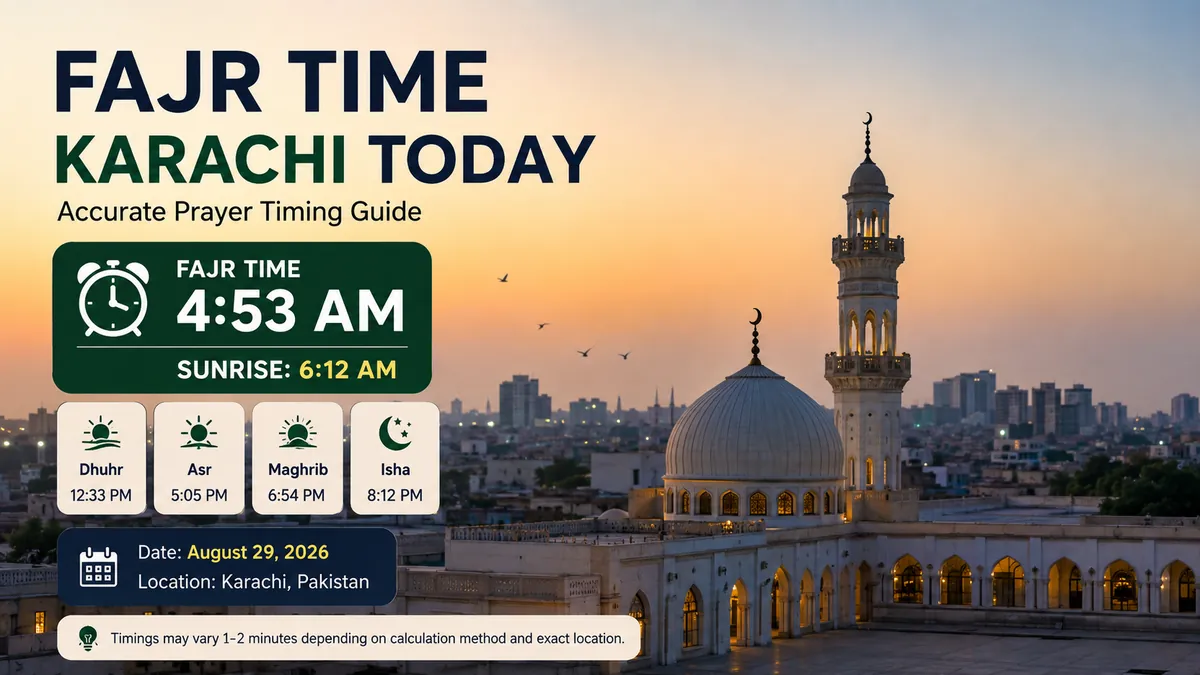
For Muslims starting their day with Salah, knowing the correct fajr time karachi matters because the prayer begins before sunrise and its timing changes gradually throughout the year. On August 29, 2026, Fajr in Karachi is approximately 4:53 AM, while sunrise is around 6:12 AM, based on current Karachi prayer-time data.
Quick answer: The fajr time karachi today is approximately 4:53 AM on August 29, 2026. Fajr begins at true dawn and remains valid until sunrise, which is around 6:12 AM today. Exact schedules can differ by a minute or two depending on the calculation method and local mosque timetable.
fajr time karachi Today
Karachi’s Fajr timing is determined by the beginning of astronomical dawn rather than by a permanently fixed clock time. That is why someone checking the prayer schedule every few weeks will notice that Fajr gradually becomes earlier or later as the seasons change.
Here is the current daily schedule:
| Prayer/Event | Karachi Time |
|---|---|
| Fajr | 4:53 AM |
| Sunrise | 6:12 AM |
| Dhuhr | 12:33 PM |
| Asr | 5:05 PM |
| Maghrib | 6:54 PM |
| Isha | 8:12 PM |
These timings correspond to August 29, 2026. Current sources using Karachi-oriented prayer calculations report Fajr at approximately 4:53 AM, although minor differences can occur between individual timetables.
The most useful number for someone specifically searching for Fajr is not only the starting time. Sunrise matters too because it marks the end of the normal Fajr prayer window.
What time does Fajr start in Karachi today?
Fajr starts at approximately 4:53 AM in Karachi today.
The beginning of Fajr is associated with true dawn, traditionally called al-fajr al-sadiq. This is when morning light begins spreading horizontally across the eastern horizon.
It should not be confused with sunrise. There is a substantial period between the beginning of Fajr and the moment the sun rises.
What time does Fajr end in Karachi?
Fajr ends when the sun begins to rise.
For August 29, 2026, sunrise in Karachi is approximately 6:12 AM, giving a Fajr window of roughly 1 hour and 19 minutes based on the listed timetable.
For practical purposes, Muslims should avoid intentionally delaying the prayer until the final moments before sunrise. A local mosque timetable is particularly useful if you are planning to attend the congregation.
Quick Takeaway: Today’s approximate Fajr window in Karachi is 4:53 AM to 6:12 AM. The first time marks the beginning of Fajr, while sunrise marks the end of its normal prayer period.
Why fajr time karachi Changes Every Day
Fajr is connected to the position of the sun below the horizon. It is therefore an astronomical prayer time, not a conventional time selected for convenience.
As Earth moves through its yearly orbit and the length of daylight changes, the moment of dawn changes as well.
This produces the gradual movement you see in monthly Karachi prayer calendars.
For example, a Karachi timetable using the University of Islamic Sciences, Karachi method shows Fajr at 4:36 AM on August 1, 2026. By the end of August, it has moved to around 4:53 AM.
The change does not happen suddenly. It normally shifts by small amounts from one day to another.
Several factors are involved:
- Karachi’s latitude and longitude
- The date of the year
- The sun’s position below the horizon
- The calculation convention being used
- Local timetable adjustments
This explains why saving a screenshot of one day’s prayer times and continuing to use it for weeks is not a reliable approach.
Does Fajr stay at the same time throughout Karachi?
For everyday religious planning, a single Karachi timetable is commonly used across the city.
However, Karachi covers a large geographical area. Small differences can occur between locations, particularly when calculations use precise coordinates.
For example, current data for Port Qasim lists Fajr at 4:53 AM and sunrise at 6:10 AM on August 29, showing how a location within the wider Karachi region can differ slightly from a central-city timetable.
A difference of a minute or two does not necessarily mean that one source is wrong. It may simply reflect coordinates, rounding or calculation settings.
How Is Fajr Time Calculated in Karachi?
Prayer-time services generally calculate Fajr according to the sun’s position below the horizon before sunrise.
One of the most relevant calculation conventions for Pakistan is the University of Islamic Sciences, Karachi method.
Under this method, the standard Fajr angle is 18 degrees below the horizon. The method also uses an 18-degree angle for Isha. PrayTimes identifies the Karachi convention as commonly used in Pakistan, Afghanistan, Bangladesh and India.
The basic sequence is:
- The geographical coordinates of Karachi are established.
- The sun’s position for the selected date is calculated.
- The point at which the sun reaches the required Fajr angle before sunrise is identified.
- That astronomical event is converted into Karachi’s local clock time.
- Any selected adjustments or calculation conventions are applied.
This is why prayer-time applications can generate schedules months or even years in advance.
University of Islamic Sciences, Karachi calculation method
The University of Islamic Sciences, Karachi method is especially relevant to Pakistani users because it is designed around a convention widely applied across this region.
A commonly published configuration is:
| Setting | Value |
|---|---|
| Calculation method | University of Islamic Sciences, Karachi |
| Fajr angle | 18° |
| Isha angle | 18° |
| Common regional use | Pakistan and neighboring South Asian countries |
| Time zone | Asia/Karachi |
The Muslim World League (MWL) method also uses an 18-degree Fajr angle, although its Isha parameter differs. Other systems include the Egyptian General Authority of Survey, Umm al-Qura University in Makkah, ISNA and several regional conventions.
That leads to an important practical point: always check which calculation method your prayer app or website is using.
Why Different Websites Show Different Fajr Times
You might check two prayer websites and find 4:52 AM on one and 4:53 AM on another.
That one-minute difference is usually not surprising.
Prayer schedules can differ because of:
- calculation conventions;
- geographical coordinates;
- rounding rules;
- local safety adjustments;
- software algorithms;
- mosque-specific schedules.
Recent Karachi listings demonstrate this clearly. One timetable reported 4:52 AM for Fajr on August 28, while current August 29 schedules place it around 4:53 AM.
Different calculation methods can produce larger differences in some circumstances.
For example, the Egyptian General Authority of Survey uses a 19.5-degree Fajr angle, compared with the 18-degree angle used by the Karachi and Muslim World League conventions.
Because the angle changes the definition of calculated dawn, the resulting clock time can change too.
Which Fajr timetable should you follow?
For daily practice, consistency matters.
If your local masjid publishes a prayer timetable, following that schedule is often the simplest approach, particularly when attending congregational prayer.
Online schedules primarily tell you the calculated beginning of a prayer period. A mosque’s iqamah time is a different matter.
The adhan may be given after the prayer period begins, and the congregation may start several minutes later.
A useful routine is therefore:
- Check the current Karachi prayer time.
- Confirm the calculation method if using an app.
- Check your mosque’s timetable when praying in congregation.
- Recheck the schedule periodically because dawn changes throughout the year.
Fajr Time vs Sunrise Time in Karachi
Fajr and sunrise are closely connected, but they are not the same event.
Fajr begins at true dawn. Sunrise marks the end of the Fajr prayer period.
For today, the distinction looks like this:
| Event | Approximate Time | Meaning |
|---|---|---|
| Fajr begins | 4:53 AM | True dawn; Fajr prayer period begins |
| Sunrise | 6:12 AM | Sun begins rising; normal Fajr period ends |
This distinction is especially important for anyone asking, “Can I pray Fajr after sunrise?”
The obligatory Fajr prayer should normally be performed after its time begins and before sunrise. If someone misses it, the rules concerning a missed prayer are a separate fiqh matter and should be followed according to reliable Islamic guidance.
Is sunrise itself a prayer time?
No. Sunrise is listed on prayer calendars primarily as an astronomical reference.
The five obligatory daily prayers are:
- Fajr
- Dhuhr
- Asr
- Maghrib
- Isha
Sunrise helps Muslims identify when the Fajr period has ended.
Fajr, Sehri and Ramadan Timing in Karachi
Fajr becomes especially important during Ramadan because it is closely connected with the end of the pre-dawn eating period.
Sehri, also called suhoor, is the meal eaten before the daily fast begins. The beginning of Fajr marks the start of the fasting period.
This makes accurate dawn timing particularly useful during Ramadan.
You may encounter separate entries labeled:
- Fajr time
- Sehri time
- Suhoor time
- Sehri ending time
- Imsak
These should not automatically be assumed to mean exactly the same thing.
Some calendars list an imsak time several minutes before Fajr as a precaution. Fajr itself remains tied to the beginning of true dawn.
During Ramadan, follow a trusted local timetable or recognized religious authority if your mosque uses a specific Sehri cutoff.
Is Fajr time the same as Sehri ending time?
The start of Fajr marks the beginning of the obligatory fast.
However, some published Ramadan calendars provide an earlier precautionary stopping time for eating. This is why two displayed values can occasionally differ.
Checking the timetable’s labels and calculation notes prevents confusion.
Fajr Adhan and Jamaat Time Are Not Always the Same
Another common source of misunderstanding is the difference between Fajr starting time, adhan time, and jamaat or iqamah time.
They serve different purposes.
Fajr starting time is the beginning of the valid prayer period according to the relevant calculation or observation.
Adhan time is when a mosque gives the call to prayer.
Iqamah or jamaat time is when the congregation actually begins the Salah.
A mosque may schedule its Fajr congregation some time after the prayer period has started.
This means an online result saying Fajr 4:53 AM does not necessarily mean your neighborhood mosque will begin its congregation at exactly 4:53 AM.
If you plan to pray at a masjid, check its current jamaat schedule directly.
Quick Takeaway: Use online prayer calculations to understand when Fajr begins, but use your mosque’s timetable to know when its Fajr congregation starts.
Hanafi and Shafi Prayer Times in Karachi
Karachi prayer calendars frequently mention Hanafi and Shafi settings. This can cause confusion because users may assume every prayer time changes dramatically between the two.
The most visible difference is generally Asr, not Fajr.
One current Karachi timetable, for example, lists Hanafi Asr around 5:05 PM while a standard/Shafi calculation is around 4:02 PM.
Fajr is instead primarily affected by the dawn calculation convention and angle selected by the timetable.
Therefore, when comparing two schedules, look at both:
- the calculation method, such as University of Islamic Sciences, Karachi; and
- the juristic method, particularly for Asr.
Do not assume that a Hanafi label by itself explains every difference between two prayer-time websites.
Karachi Fajr Time Through the Year
The Fajr schedule follows a seasonal pattern.
During some parts of the year, dawn arrives considerably earlier. During others, it arrives later.
The August 2026 timetable illustrates the movement well:
| Date | Fajr |
|---|---|
| August 1 | 4:36 AM |
| August 2 | 4:37 AM |
| August 4 | 4:38 AM |
| August 6 | 4:39 AM |
| August 8 | 4:41 AM |
| August 10 | 4:42 AM |
| August 11 | 4:43 AM |
| August 29 | About 4:53 AM |
The early-August figures come from a monthly Karachi timetable using the University of Islamic Sciences, Karachi method, while current sources place August 29 at approximately 4:53 AM.
The trend shows why a monthly or automatically updated prayer calendar is more useful than memorizing one Fajr time.
Why does Fajr get later during this period?
Seasonal changes alter the length of daylight and the sun’s apparent path relative to Karachi.
As the astronomical dawn occurs later, the calculated Fajr time moves later too. The pattern eventually reverses during another part of the year.
The same seasonal movement affects sunrise, Maghrib and Isha.
How to Check an Accurate Fajr Time Each Morning
A reliable Fajr routine does not require complicated calculations.
Use these practical checks:
- Confirm today’s date. Prayer times are date-specific.
- Make sure the location is Karachi. A Lahore, Islamabad or Hyderabad schedule will not give the same times.
- Check the calculation method. University of Islamic Sciences, Karachi is widely used for Pakistan.
- Look at sunrise too. This tells you the end of the Fajr window.
- Check your local mosque for jamaat. Online Fajr time and mosque congregation time are not necessarily identical.
- Update saved calendars regularly. Do not rely indefinitely on an old screenshot.
The difference between Pakistani cities can be substantial. A nationwide timetable for late August, for example, shows Karachi’s Fajr considerably later than Lahore or Islamabad because each city has different coordinates and astronomical dawn.
What to Do When Two Karachi Fajr Timetables Disagree
Seeing slightly different timings does not automatically mean that either timetable is unreliable.
First, compare the date and location. Then check the calculation method.
If one schedule uses the University of Islamic Sciences, Karachi and another uses the Egyptian method, differences can result from their respective Fajr angles.
Also check whether one source has rounded its calculated value.
For a difference of only one or two minutes, using a trusted local mosque timetable provides a simple practical reference. If there is a much larger discrepancy, verify the location and calculation settings before relying on the schedule.
The same principle applies to prayer apps. Location permissions, manually selected cities and calculation settings can all affect displayed timings.
Today’s Complete Karachi Prayer Schedule
Although Fajr is the focus, seeing the entire Salah timetable gives useful context for the day.
For August 29, 2026, a current Karachi schedule lists approximately:
- Fajr: 4:53 AM
- Sunrise: 6:12 AM
- Dhuhr: 12:33 PM
- Asr: 5:05 PM
- Maghrib: 6:54 PM
- Isha: 8:12 PM
Remember that Asr can differ significantly depending on the Hanafi or standard juristic setting, while small differences in Fajr and Isha can arise from calculation methods.
Final Word on fajr time karachi
The fajr time karachi today, August 29, 2026, is approximately 4:53 AM, with sunrise around 6:12 AM. That gives a Fajr prayer window of roughly 79 minutes according to the current timetable.
Because Fajr follows astronomical dawn, its clock time changes throughout the year. Calculation methods, coordinates and local adjustments can also create small differences between websites and apps.
For everyday use, check an updated Karachi prayer timetable rather than relying on an old saved time. And when praying in congregation, follow your local mosque’s current adhan and iqamah schedule so you know both when Fajr begins and when the jamaat will actually take place.
