

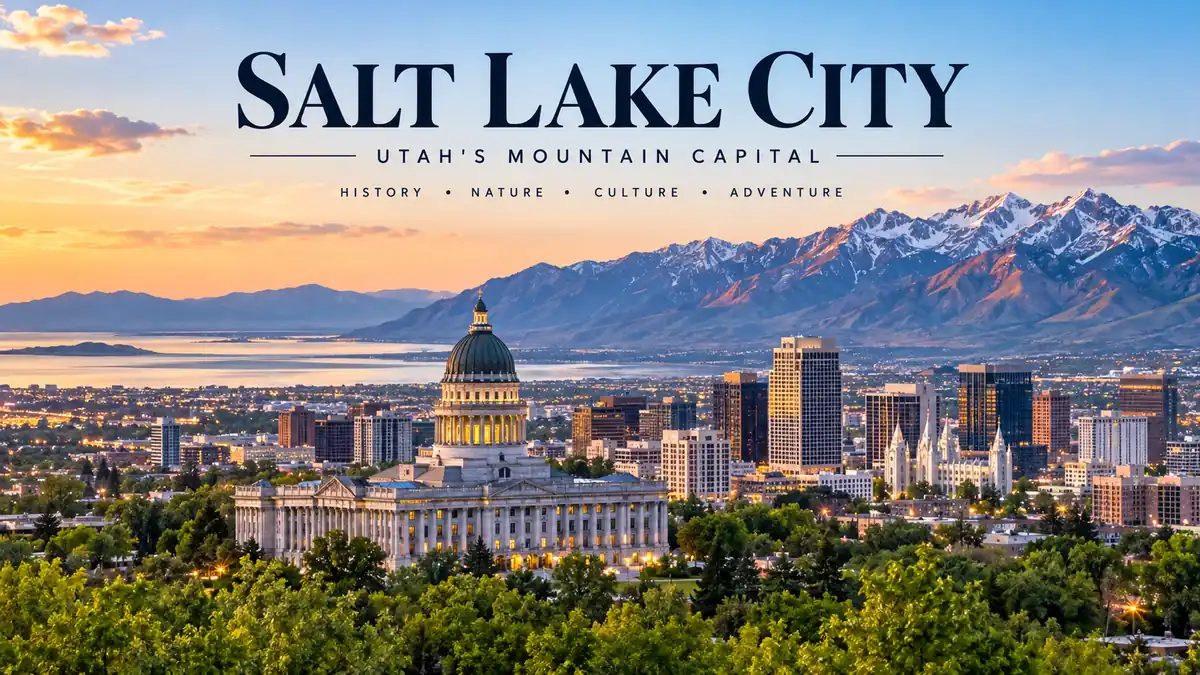
Salt Lake City is one of those places that makes more sense once you see it in person. Downtown streets sit beneath the dramatic Wasatch Mountains, historic landmarks stand beside modern restaurants and cultural venues, and some of Utah’s best-known outdoor experiences are surprisingly close to the urban core.
Utah’s capital combines the Great Salt Lake, Temple Square, museums, mountain recreation, distinctive neighborhoods, and a history shaped by Indigenous peoples, westward migration, and The Church of Jesus Christ of Latter-day Saints. At about 4,330 feet above sea level, the city also serves as a practical base for skiing, hiking, sightseeing, and exploring northern Utah.
Quick answer: Salt Lake City is the capital of Utah and a major urban center along the Wasatch Front. It is best known for Temple Square, the nearby Great Salt Lake, mountain scenery, winter sports, museums, outdoor recreation, and its role as a gateway to Utah’s wider landscapes.
Where Is salt lake city?
Salt Lake City is located in northern Utah in the Salt Lake Valley, with the Wasatch Mountains rising to the east and the Great Salt Lake lying to the northwest.
Its geographic setting is a major part of its identity. Unlike destinations where mountains require a long drive into the countryside, the Wasatch Range forms a visible backdrop to everyday city life.
The city sits at an elevation of approximately 4,330 feet (1,320 meters). Visitors coming from low elevations may notice the thinner and drier air, particularly when combining a city stay with trips higher into the mountains.
Salt Lake City is also an important transportation crossroads. Interstate 15 runs north-south through the region, while Interstate 80 provides a major east-west route. This location has helped establish the city as a natural starting point for trips around Utah and the wider Mountain West.
Salt Lake City quick facts
| Fact | Details |
|---|---|
| State | Utah |
| Role | State capital |
| Elevation | About 4,330 ft / 1,320 m |
| Nearby mountain range | Wasatch Mountains |
| Major nearby lake | Great Salt Lake |
| Main airport | Salt Lake City International Airport |
| Major roads | I-15, I-80 and I-215 |
| Climate | Arid mountain-desert climate |
| Major historic landmark | Temple Square |
| Winter sports legacy | Host city of the 2002 Winter Olympics |
Salt Lake also experiences four distinct seasons, making the character of a visit quite different depending on the time of year.
What Is salt lake city Known For?
Salt Lake City is often associated first with the Great Salt Lake, The Church of Jesus Christ of Latter-day Saints, and Utah’s ski culture. Those associations are valid, but they represent only part of the city.
Modern Salt Lake includes museums, performing arts venues, independent restaurants, shopping districts, universities, historic architecture, parks, nightlife, festivals, and easy access to outdoor recreation.
The Great Salt Lake
The Great Salt Lake is the natural feature most closely associated with the city’s name.
It is a remnant of prehistoric Lake Bonneville and today forms an unusual saline ecosystem important to wildlife, particularly migratory birds. Great Salt Lake State Park is west of the city, making the shoreline accessible as a day trip from downtown.
The lake’s salinity can make swimmers unusually buoyant. However, conditions vary substantially by location and water level, so a visit is better approached as an exploration of a changing natural ecosystem rather than simply a swimming trip.
Temple Square
Temple Square is one of downtown Salt Lake City’s most recognizable historic and cultural areas.
It is closely connected to the headquarters and history of The Church of Jesus Christ of Latter-day Saints and includes prominent religious and historic buildings in the center of the city.
Because construction and restoration projects can affect access to individual buildings, travelers should check current conditions before planning a visit rather than relying on older travel guides.
Skiing and mountain recreation
Another defining feature is access to the mountains.
The surrounding Wasatch Range supports skiing, snowboarding, hiking, mountain biking, scenic drives, climbing, and other forms of outdoor recreation. Utah tourism authorities note that numerous ski areas can be reached within roughly an hour of Salt Lake City International Airport.
That urban-to-mountain connection is one reason Salt Lake works well for travelers who do not want to choose between a conventional city trip and an outdoor vacation.
A Short History of salt lake city
The Salt Lake Valley has a human history stretching far beyond the establishment of the modern city.
Indigenous peoples lived in and traveled through the broader region long before European-American settlement. The Ute are particularly important to the history of the valley and surrounding mountains.
A major turning point came in 1847, when Mormon pioneers led by Brigham Young entered the Salt Lake Valley. The settlement that developed became deeply connected with The Church of Jesus Christ of Latter-day Saints, whose presence remains visible in the city’s architecture, institutions, and historical sites.
Over time, Salt Lake City developed into Utah’s political, economic, and cultural center.
Transportation links, mining, trade, industry, education, and later technology and tourism all contributed to its growth. The city became increasingly diverse, while its location between the Great Salt Lake and Wasatch Mountains continued to shape development.
The Olympic legacy
Salt Lake City hosted the 2002 Winter Olympic Games, leaving a significant sporting legacy throughout the region.
Olympic-related sites remain part of the broader visitor experience. The Utah Olympic Park near Park City, for example, preserves important elements of the region’s winter-sports history.
The Olympics also strengthened Salt Lake’s international reputation as a winter recreation destination. The region is now preparing for another Olympic chapter with the Winter Games scheduled to return to Utah in 2034.
Best Things to Do in salt lake city
A good Salt Lake City itinerary mixes downtown history and culture with at least one outdoor experience.
1. Explore Temple Square
For first-time visitors, Temple Square provides useful context for understanding Salt Lake City’s development.
The surrounding downtown district contains historic architecture and sites connected to the history of The Church of Jesus Christ of Latter-day Saints. Even travelers without a religious interest can approach the area from the perspectives of architecture, settlement history, genealogy, and urban development.
Allow extra flexibility because restoration work can change which spaces are accessible.
2. Visit the Natural History Museum of Utah
The Natural History Museum of Utah is one of the strongest choices for understanding the landscapes surrounding Salt Lake City.
Its collections and exhibitions cover areas such as paleontology, anthropology, zoology, botany, minerals, and Utah’s natural history. The museum is particularly useful before exploring the rest of the state because it provides scientific context for Utah’s fossils, geology, ecosystems, and Indigenous history.
3. See the Utah State Capitol
The Utah State Capitol sits above downtown and is one of the city’s most recognizable civic buildings.
The surrounding Capitol Hill area also provides elevated perspectives over the city. Pairing the Capitol with nearby neighborhoods can turn the visit into a broader architectural and historical walk.
4. Experience the Great Salt Lake
Seeing the lake gives visitors a better understanding of the region’s geography.
Depending on conditions, activities around the lake can include wildlife watching, photography, walking, kayaking, sailing, or simply observing its unusual shoreline environment.
Bring binoculars if birdlife interests you. The lake and its wetlands provide habitat for large numbers of migratory birds.
5. Walk through Red Butte Garden
Red Butte Garden combines landscaped gardens with the natural foothill setting east of downtown.
It works particularly well during the warmer months when visitors want an outdoor activity without committing to a long mountain hike.
The garden can also be combined with the Natural History Museum of Utah because both are in the University of Utah area.
6. Discover Utah’s art and cultural scene
Salt Lake City has a broader arts scene than its outdoor reputation sometimes suggests.
Major cultural institutions and venues include the Utah Museum of Fine Arts, Utah Museum of Contemporary Art, Abravanel Hall, Capitol Theatre, and Eccles Theater. Depending on the calendar, visitors can find symphony performances, ballet, theater, touring productions, exhibitions, and live music.
7. Explore Gilgal Sculpture Garden
Travelers looking for something less conventional can visit Gilgal Sculpture Garden.
The small public garden contains 12 sculptures and more than 70 engraved stones. Its unusual artistic and religious imagery makes it very different from a standard city park or museum.
8. Spend time at Liberty Park
Liberty Park offers a break from downtown sightseeing and is one of the city’s notable green spaces.
The park is also home to Tracy Aviary, making the area particularly useful for families or anyone interested in birds and conservation.
9. Explore downtown
Downtown combines Salt Lake City’s historic core with restaurants, entertainment, shopping, cultural venues, and public spaces.
City Creek Center is one of the best-known shopping destinations, while nearby streets lead toward Temple Square and other central attractions. Public transportation makes it possible to explore much of this area without repeatedly moving a car.
10. Head into the Wasatch Mountains
Leaving the city for the mountains is not an optional extra if you want to understand why people are drawn to this part of Utah.
Winter brings skiing and snowboarding. Warmer seasons open hiking and mountain-biking trails, scenic roads, picnic areas, and wildflower-filled landscapes.
The key advantage is proximity: a traveler can spend part of a day downtown and another part in a dramatically different mountain environment.
Quick Takeaway: For a first visit, combine Temple Square and downtown with the Natural History Museum of Utah, the Great Salt Lake, and one Wasatch Mountain excursion. That gives a balanced picture of the city’s history, culture, geography, and outdoor character.
Best Neighborhoods in salt lake city
Choosing the right area matters because Salt Lake’s neighborhoods offer noticeably different experiences.
Downtown
Downtown is the practical choice for major attractions, public transportation, restaurants, events, and first-time sightseeing.
Temple Square forms one of its principal landmarks, while cultural venues, shopping, hotels, and restaurants are spread across the central grid.
It is especially convenient for a short trip when minimizing driving is a priority.
Capitol Hill
Capitol Hill works well for visitors interested in architecture, history, and elevated city views.
Its location immediately north of downtown means major central attractions remain relatively close.
The Avenues
The Avenues offers a more residential side of Salt Lake City.
Its grid of historic homes, local restaurants, and hillside streets provides a quieter atmosphere than the downtown core. Upper sections also put visitors closer to foothill recreation.
Sugar House
Sugar House is known for a more neighborhood-oriented mix of dining, shopping, parks, and residential streets.
It can be a good area to explore after seeing the major downtown landmarks, particularly for travelers interested in everyday local life rather than only conventional tourist attractions.
Central City
Central City sits close to downtown while offering galleries, restaurants, historic buildings, shops, and places such as Trolley Square and Gilgal Sculpture Garden.
Best Time to Visit salt lake city
There is no single best month because Salt Lake City changes considerably with the seasons.
| Season | Typical experience | Good for |
|---|---|---|
| Spring | Variable temperatures, greener landscapes | City sightseeing, gardens, lower-elevation hiking |
| Summer | Warm to hot, generally dry | Hiking, festivals, mountain recreation |
| Fall | Cooler temperatures and changing foliage | Scenic drives, hiking, photography |
| Winter | Cold with snow in the region | Skiing, snowboarding, winter scenery |
Salt Lake has an arid mountain-desert climate and receives abundant sunshine, but temperatures can vary sharply through the year. Official visitor information reports roughly 20 inches of annual precipitation as rain, about 54 inches of snow, and around 222 sunny days in an average year.
Is summer a good time to visit?
Yes, particularly for travelers focused on hiking and sightseeing.
Summer temperatures in the valley can become hot, so morning and evening are often more comfortable for outdoor activities. Higher mountain elevations may be noticeably cooler.
Is winter worth visiting?
For skiing and snowboarding, winter is one of the region’s defining seasons.
Even travelers who do not ski can experience snowy mountain scenery, museums, restaurants, performances, and other city attractions.
Remember that downtown Salt Lake City and nearby ski areas sit at very different elevations. Weather in the valley does not necessarily represent conditions in the mountains.
Getting Around salt lake city
Salt Lake City is easier to navigate than many larger American metropolitan areas, particularly around downtown.
From the airport
Salt Lake City International Airport provides the primary air gateway to the region and is close to the downtown core. Visit Salt Lake describes the airport as approximately 10 minutes from downtown under normal driving conditions.
Public transportation
The Utah Transit Authority operates the region’s public transportation network, including TRAX light rail, buses, and FrontRunner commuter rail.
For travelers staying downtown and concentrating on central attractions, transit and walking can reduce the need for a rental car.
Driving
A vehicle becomes much more useful when the itinerary includes mountain areas, the Great Salt Lake, trailheads, distant suburbs, or day trips.
I-15 and I-80 are the region’s principal interstate routes, while I-215 provides a belt route around parts of the valley.
Walking and cycling
Central Salt Lake has unusually wide streets and a straightforward grid, so navigation is relatively simple.
Downtown attractions can often be combined on foot, while cycling and bike-share options add another way to cover short urban distances.
Outdoor Adventures Near salt lake city
The outdoors are where Salt Lake City distinguishes itself most clearly from a typical state capital.
Hiking
Trails begin in and around the foothills and continue deep into the Wasatch Mountains.
The best route depends heavily on season, snowpack, elevation, fitness, and weather. A trail that feels straightforward in midsummer can require completely different equipment in winter or early spring.
Skiing and snowboarding
The Wasatch Mountains are internationally known for winter sports.
The broader Salt Lake region provides access to numerous resorts, and the short distance between the airport, city, and mountain can make a ski trip unusually efficient.
Antelope Island
Antelope Island State Park is one of the most distinctive excursions in the Great Salt Lake.
Visitors come for lake views, hiking, wildlife, photography, and the island’s bison population. Conditions around the lake can change with season and water levels, so checking current park information is worthwhile before departure.
Park City
Park City makes another popular excursion from Salt Lake.
Its ski areas, historic Main Street, restaurants, and Olympic heritage create a different experience from downtown Salt Lake City while remaining close enough for a day trip.
Food, Culture, and Nightlife
Older stereotypes can give travelers an incomplete picture of modern Salt Lake City.
The dining scene now ranges from casual neighborhood restaurants and international cuisines to chef-driven dining, bakeries, coffee shops, breweries, cocktail bars, and more experimental concepts. Recent travel coverage has highlighted the city’s growing restaurant and nightlife scene alongside its traditional outdoor appeal.
Utah alcohol laws may differ from what visitors are accustomed to elsewhere, so checking current state rules is more reliable than relying on outdated assumptions.
Live entertainment is another part of the city’s cultural identity. Concerts, theater, dance, festivals, Utah Symphony performances, sporting events, and independent venues provide options well beyond daytime sightseeing.
Practical Things to Know Before Visiting
A little preparation makes a noticeable difference in Salt Lake City.
Respect the elevation. At approximately 4,330 feet, Salt Lake City is already considerably above sea level. Mountain destinations can be thousands of feet higher. Hydration, sun protection, and gradual adjustment become more important as elevation increases.
Dress in layers. Temperatures can shift between morning, afternoon, and evening, while mountain weather can differ significantly from conditions downtown.
Do not underestimate the sun. High elevation and dry air can make sun exposure more intense than expected.
Check mountain conditions. Snow, wildfire conditions, thunderstorms, trail closures, and seasonal road access can change outdoor plans.
Check Great Salt Lake conditions separately. Lake levels, shoreline access, insects, weather, and recreation conditions vary through the year.
Plan around construction. Major historic sites such as Temple Square have undergone extensive renovation, so current official information is more useful than an old itinerary.
How Many Days Do You Need in salt lake city?
For most first-time visitors, two to three days provides enough time for the main city experiences without rushing.
A simple two-day visit could devote the first day to Temple Square, downtown, Capitol Hill, and a museum, then use the second for the Great Salt Lake or a Wasatch Mountain excursion. Utah’s official trip-planning guidance suggests roughly two days for Salt Lake City itself, with additional days for regional stops.
Three or four days provides more flexibility for neighborhoods, museums, hiking, Park City, Antelope Island, or seasonal mountain activities.
For a ski-focused trip, the appropriate length depends more on how many mountain days you want than on the number of urban attractions.
Is salt lake city Worth Visiting?
Salt Lake City offers something relatively unusual: a genuine urban destination positioned immediately beside major mountain recreation.
Its historic identity is visible around Temple Square and other landmarks, while museums such as the Natural History Museum of Utah explain the much older human and geological story of the region. The Great Salt Lake adds an ecosystem found in few other American cities, and the Wasatch Mountains create four-season recreation almost on the city’s doorstep.
The strongest trip does not treat Salt Lake City solely as a gateway to somewhere else. Spend time downtown, explore a neighborhood, learn about the region’s history, see the lake, and then head toward the mountains.
That combination reveals what makes salt lake city distinctive: Utah history, modern city culture, an extraordinary natural setting, and remarkably easy access to the landscapes that define the American West.
