

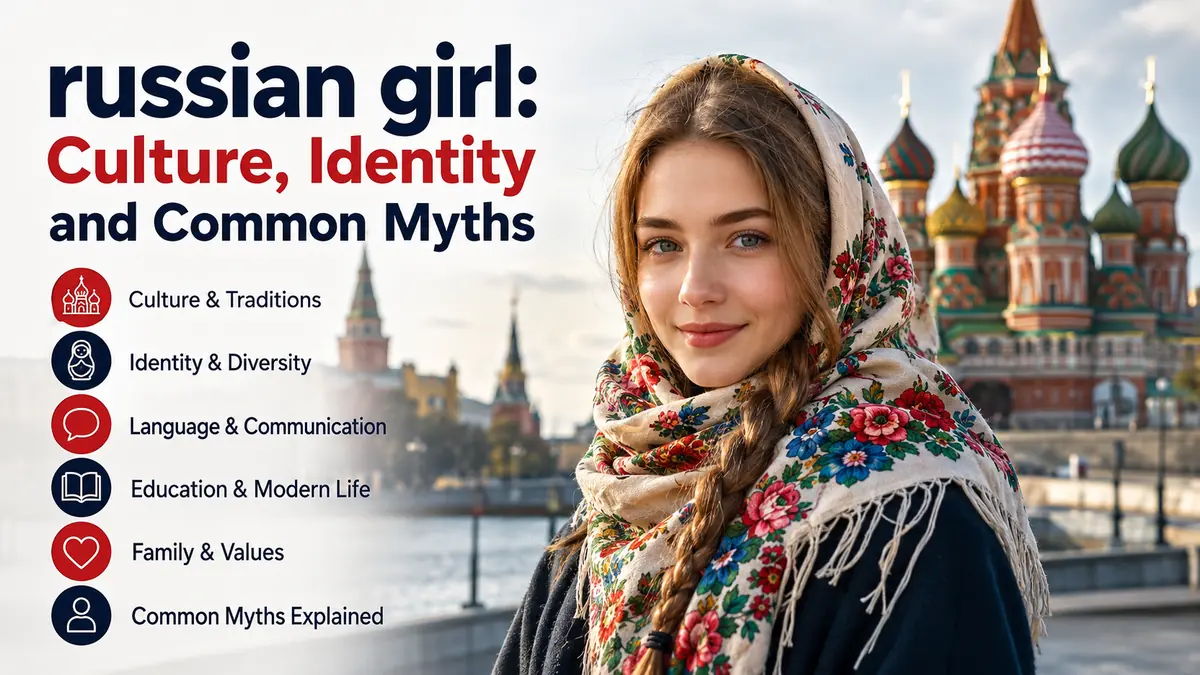
Search for russian girl online and you will quickly run into a strange mix of cultural facts, fashion imagery, dating stereotypes, social-media videos, and fictional characters. That makes it surprisingly difficult to separate everyday Russian life from the exaggerated image created by movies and the internet.
A russian girl generally means a girl or young woman from Russia, although online the phrase is frequently used more broadly for Russian women. There is no single Russian appearance, personality, lifestyle, or set of values. Russia spans a vast territory and contains considerable regional, ethnic, linguistic, religious, and social diversity, so individual identity matters far more than stereotypes.
What Does russian girl Actually Mean?
At its simplest, the expression describes someone from Russia who is female. In everyday English, however, “girl” is sometimes informally used for an adult young woman. When discussing adults in a formal or respectful context, Russian woman is usually the clearer expression.
Nationality should also not be confused with ethnicity.
A citizen of the Russian Federation may identify with any of numerous ethnic and cultural communities. Russia includes people with Russian, Tatar, Bashkir, Chechen and many other backgrounds. Someone can therefore be a Russian citizen without being ethnically Russian.
Likewise, appearances vary enormously. The familiar internet image of a fair-skinned, blonde, blue-eyed woman represents only one possible appearance among millions of people.
Geography adds another layer. Life in Moscow can differ considerably from life in Saint Petersburg, Kazan, Siberia, the North Caucasus, the Volga region or a smaller provincial town.
Quick takeaway: “Russian” can describe nationality, citizenship, language, culture or ethnic identity depending on context. Treating all of those categories as interchangeable creates misleading assumptions.
Why the russian girl Stereotype Became So Popular
Much of the international image of Russian women did not emerge from everyday observation. It came through literature, Soviet imagery, Cold War entertainment, advertising, fashion and later internet culture.
Older Russian literature offered several contrasting ideals. Characters associated with writers such as Leo Tolstoy, Fyodor Dostoevsky and Ivan Turgenev helped create images ranging from sensitive aristocratic women to morally resilient heroines.
After the Russian Revolution of 1917, Soviet visual culture increasingly celebrated another figure: the productive female citizen.
Women appeared in propaganda as workers, farmers, professionals and mothers contributing to the collective state. The famous Worker and Kolkhoz Woman monument in Moscow became one highly visible representation of the Soviet worker ideal.
Western entertainment eventually developed its own set of Russian female characters. During and after the Cold War, these often included spies, mysterious strangers and femme-fatale figures.
Modern films and television have continued versions of these archetypes. Academic research involving Russian women who immigrated to the United States found that participants encountered stereotypes including the “mail-order bride,” exotic beauty and secret agent.
Those representations matter because repetition can make a fictional pattern feel like a cultural fact.
From Soviet worker to glamorous beauty
The stereotype has also changed over time.
Soviet imagery often emphasized strength, productivity and modest presentation. Post-Soviet and international media increasingly emphasized glamour, fashion and conspicuous femininity. Russia Beyond traces this shift through Soviet cultural imagery, Russian literature and later Western popular culture.
That history helps explain why apparently contradictory clichés coexist today. A Russian woman may be portrayed as extremely tough in one story and exceptionally glamorous in another.
Neither tells you much about an actual individual.
What Do Russian Girls Look Like?
There is no scientifically meaningful “Russian girl look.”
Russia stretches across Eastern Europe and northern Asia, and its population includes people from numerous ethnic communities. Hair can be blonde, brown, black or red. Eyes can be blue, gray, green or brown. Skin tones, facial features, height and body types vary as they do across other large populations.
The blonde-haired model often presented internationally is largely a media shorthand.
This becomes particularly obvious when comparing populations from places such as Moscow, Tatarstan, Siberia, Kalmykia and the Caucasus. Even within one city, family ancestry can produce tremendous variation.
A recent Russian-produced cultural video examining precisely this stereotype likewise emphasizes Russia’s diversity rather than presenting a single appearance, highlighting regions including Tatarstan, Siberia, the Caucasus and Kalmykia.
Why fashion became part of the stereotype
Fashion is another area where observation and exaggeration are easily confused.
International portrayals sometimes associate Russian women with:
- carefully styled clothing, makeup and hair;
- dresses, heels and visibly feminine fashion;
- cosmetics such as red lipstick;
- luxury brands and formal-looking outfits;
- greater attention to appearance in ordinary public settings.
Some Russian women certainly enjoy those styles. Others prefer sneakers, jeans, minimal makeup, sportswear or whatever happens to suit their work and lifestyle.
Research on Russian female migrants has even examined how makeup, high heels and feminine presentation can acquire cultural meaning when women move between societies with different gender norms. A study of Russian women in Norway described participants reflecting on associations between Russianness, makeup, red lipstick and femininity.
Teesside University researcher Anna Pechurina has similarly discussed how flamboyant clothing, strong makeup and high heels became part of an internationally reinforced stereotype of Russian femininity.
Fashion can therefore be culturally interesting without becoming a rule about Russian women.
Russian Language and Communication
Russian is the state language throughout the Russian Federation under Article 68 of the Constitution. Republics within the federation may also establish their own state languages alongside Russian.
That distinction is useful because Russia is linguistically diverse.
A young woman from Moscow may primarily speak Russian, while someone from a republic with another linguistic tradition may grow up using Russian alongside a regional or family language.
Names and patronymics
Russian naming conventions can be unfamiliar to English speakers.
A traditional full Russian name commonly consists of:
given name + patronymic + family name
The patronymic is derived from the father’s given name and is commonly used together with a first name in formal or respectful communication.
For example, a woman called Anna whose father is Ivan might have the patronymic Ivanovna.
Russian also distinguishes between informal and formal forms of “you”:
ты (ty) is informal.
вы (vy) is formal or respectful and can also address multiple people.
That distinction means social distance and familiarity can be expressed directly through grammar.
Why Russians may appear serious at first
One international stereotype describes Russians as unfriendly because they may smile less frequently at strangers than people in some other cultures.
That interpretation can be misleading.
Smiling conventions are cultural. A neutral facial expression does not automatically signal anger, coldness or dislike. The meaning of a smile can depend on sincerity, familiarity and context.
The same caution applies to conversational style. Some Russians may prefer relatively direct communication, while personality, age, education, region and social environment remain equally important.
Trying to decode someone’s personality from nationality usually causes more confusion than it solves.
Education, Careers and Modern Life
The image of a Russian woman primarily defined through beauty or romance leaves out one of the most important aspects of contemporary Russian society: women are extensively represented in education and employment.
UNESCO’s Science Report data for 2018 found that 59.6% of Russian women over age 15 in the dataset held a tertiary degree, compared with 53.5% of men.
Women work across medicine, teaching, technology, finance, research, arts, retail, government, entrepreneurship and other fields.
The situation is not accurately described by either of the two extreme stereotypes sometimes found online: “traditional housewife” or “completely Westernized career woman.”
Real lives are more complicated.
A person may value professional independence while maintaining traditional family customs. Another may reject conventional gender roles altogether. Urban and rural experiences can differ. Generational differences can be significant as well.
A woman born after the collapse of the Soviet Union has experienced a different social environment from someone who grew up during the USSR.
Family and Social Traditions in Russia
Family remains an important social institution in Russian culture, but there is no universal model for how Russian families operate.
Some households maintain relatively traditional divisions of responsibility. Others divide work more equally. Younger generations may have different expectations from their parents and grandparents.
One historically important point is that Soviet women were strongly integrated into paid employment while simultaneously carrying substantial domestic responsibilities. Earlier reporting and scholarship frequently described this combination as a “double burden.”
That historical background helps explain why contemporary attitudes toward work, family and femininity can sometimes appear contradictory to outsiders.
Hospitality
Russian hospitality is another recognizable cultural tradition.
Visiting friends or relatives may involve considerably more food than the visitor expected. Tea, sweets, cakes, salads and prepared dishes can turn an ordinary visit into a substantial meal.
Hosting someone well can communicate warmth and respect.
Common foods associated with Russian cuisine include blini, pelmeni, pirozhki, syrniki, borscht and various soups, salads and baked dishes. Cuisine also differs markedly by region and family background.
International Women’s Day
International Women’s Day on March 8 has substantial cultural visibility in Russia and several other former Soviet societies.
Flowers and congratulations traditionally form part of the occasion. Contemporary Russians may interpret the day differently—some emphasize affection and celebration, while others focus more strongly on women’s equality and the holiday’s political history.
Research involving Russian migrants in Norway has shown how March 8 can become connected to ideas of femininity, national identity and different understandings of gender equality.
Common Myths About Russian Girls
Online content frequently presents nationality as if it were a personality test. Several recurring claims deserve particular caution.
“All Russian women are blonde”
False.
Russia is ethnically and geographically diverse. Blonde hair exists, obviously, but so do every common shade from dark brown and black to red.
“Russian women are naturally more beautiful”
Beauty is subjective.
Fashion, grooming conventions, photography, casting choices and social-media algorithms can influence which faces international audiences see. They do not establish an objective national standard of beauty.
“Every Russian woman is traditional”
No.
Traditional gender expectations remain relevant in parts of Russian society, but attitudes vary widely between individuals, families, regions and generations.
“Russian women want foreign husbands”
This is one of the most persistent stereotypes.
Researchers interviewing Russian female immigrants in the United States found participants reporting precisely this kind of “mail-order bride” stereotyping. Their experiences show why turning a niche phenomenon into a presumed national characteristic can affect real people.
“They are cold”
A reserved first impression is not a personality diagnosis.
Different cultures use smiles, small talk, emotional expression and conversational familiarity differently. Someone who initially appears formal may become warm and expressive after a relationship develops.
“They all love luxury”
Another generalization.
Income, profession, city, age and individual preference influence consumer behavior much more reliably than a passport does.
“Russian women are submissive”
This stereotype conflicts even with another popular cliché—that Russian women are unusually strong and dominant.
The contradiction itself shows the problem with national stereotypes. Popular culture often selects whichever archetype is useful for the story being told.
SBS’s examination of Russian female stereotypes notes this recurring split between sexualized/submissive portrayals and authoritarian femme-fatale characters in Western entertainment.
Russian Girl in Movies, Literature and Popular Culture
Few things have shaped international perceptions more strongly than fiction.
Russian literature created globally recognized female characters long before Hollywood developed its Cold War archetypes.
Natasha Rostova in Tolstoy’s War and Peace represents one famous literary example. Anna Karenina became one of world literature’s most recognizable Russian heroines. Dostoevsky and Turgenev likewise created female characters whose moral, emotional and social circumstances influenced Western impressions of Russian womanhood.
Soviet culture later promoted the worker, collective farmer, athlete and mother.
Then Western spy fiction supplied another character entirely: the glamorous Russian intelligence operative.
Films such as Red Sparrow and earlier spy stories reinforced recognizable combinations of danger, sexuality, secrecy and Russianness. SBS has documented how similar archetypes recur across Western film and television.
These characters may be entertaining. They are poor anthropological evidence.
Social Media and the Modern russian girl Image
TikTok, Instagram, YouTube and other platforms have created another version of the russian girl aesthetic.
Videos may emphasize winter clothing, fur hats, makeup, Slavic fashion, ballet imagery, apartment life, Russian music, traditional food or dramatic urban scenes from Moscow and Saint Petersburg.
Some creators use the imagery sincerely. Others exaggerate it for humor or participate in aesthetic trends whose connection with ordinary Russian culture is relatively loose.
Algorithms amplify distinctive content.
A normal commute, university lecture or afternoon doing office work is unlikely to travel internationally as quickly as a beautifully filmed snowy street, elaborate outfit or provocative “things Russian girls do differently” video.
That creates selection bias.
The content viewers repeatedly encounter is not necessarily representative of the population producing it.
Russian, Slavic and Eastern European Are Not Synonyms
This distinction is regularly missed online.
Russian refers to a national, cultural, linguistic or ethnic connection with Russia depending on context.
Slavic refers to a much broader ethnolinguistic grouping.
Slavic peoples include Russians but also Ukrainians, Belarusians, Poles, Czechs, Slovaks, Slovenes, Croats, Serbs, Bulgarians and several other populations.
Eastern European is a geographical and cultural label whose exact boundaries can vary.
Calling every Slavic woman Russian is therefore inaccurate, just as describing everyone from Europe as belonging to one nationality would be inaccurate.
Even inside Russia, not every citizen belongs to a Slavic ethnic group.
How to Understand Russian Culture Without Stereotypes
The most useful approach is to separate cultural context from predictions about an individual.
Learn about Russian history, literature, language, food and social traditions because those subjects provide genuine context. At the same time, leave room for someone to disagree with, reinterpret or ignore those traditions.
Consider generation as well. A 20-year-old Russian woman in 2026 belongs to a radically different historical cohort from her Soviet-born grandmother.
Consider geography. Moscow and Saint Petersburg are huge metropolitan environments, while smaller cities, villages, Siberian communities, the Volga region and republics such as Tatarstan can offer quite different social contexts.
Consider ethnicity and language. The Russian Federation is not culturally uniform, and the Constitution itself recognizes the ability of republics to maintain state languages alongside Russian.
Most importantly, treat cultural patterns as background information—not instructions for predicting someone’s character.
Final Thoughts on russian girl Culture and Identity
The phrase russian girl looks simple, but the identity behind it can involve nationality, ethnicity, language, region, family history and individual experience.
Russian women cannot be reduced to the blonde beauty stereotype, the Soviet superwoman, the glamorous social-media personality, the submissive bride or the Cold War femme fatale. Research shows that some Russian women themselves encounter and negotiate these stereotypes after moving abroad.
Russian culture is far more interesting when those clichés are removed. Its literature, languages, regional diversity, education, family traditions, food, history and changing ideas about femininity offer much more useful ways to understand the subject.
The best next step is simple: learn the culture, recognize the historical context, and judge every person as an individual rather than as a nationality-based stereotype.
