

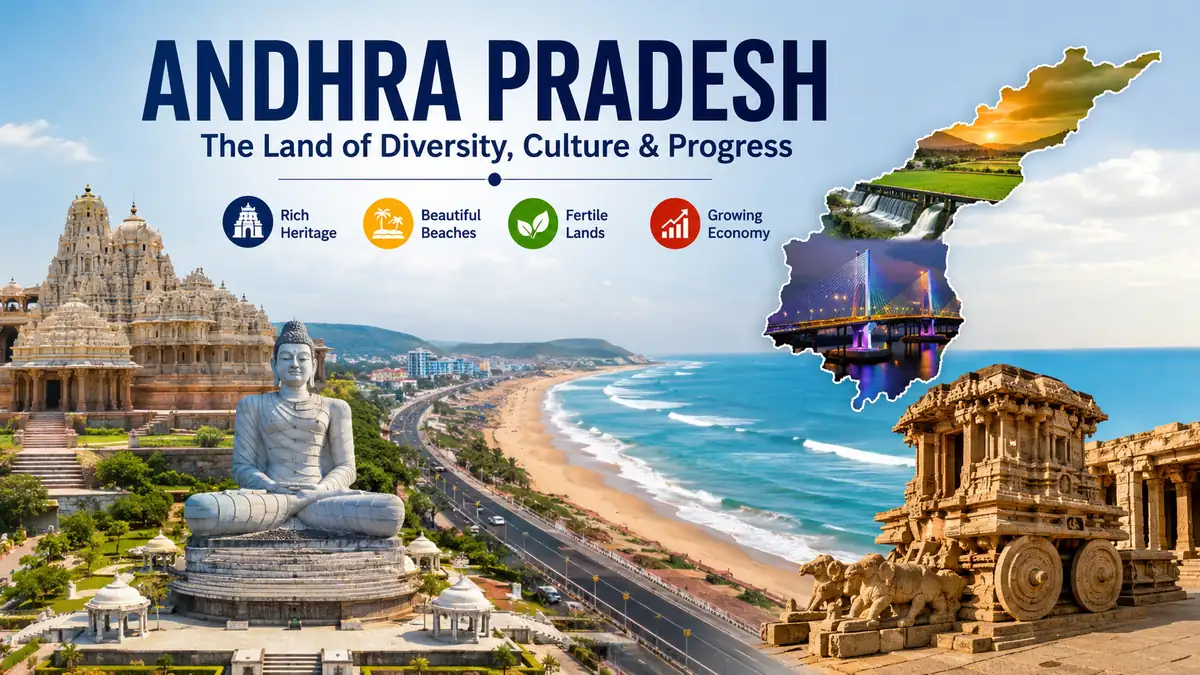
Stretching along the Bay of Bengal in southeastern India, andhra pradesh brings together fertile river deltas, ancient Buddhist sites, major Hindu pilgrimage centers, long beaches, hill country, productive farms, industrial cities, and a deeply rooted Telugu cultural identity.
The state is much more than a collection of famous destinations such as Tirupati and Visakhapatnam. Its geography has shaped its agriculture, ports, cuisine, settlement patterns, economy, and history for centuries.
andhra pradesh is a state in southeastern India with Amaravati as its capital and Visakhapatnam as its largest city. Telugu is its principal official language. The state is known for its long Bay of Bengal coastline, Krishna and Godavari river systems, agriculture, aquaculture, temples, Buddhist heritage, Kuchipudi dance, and diverse landscapes.
andhra pradesh at a Glance
For someone trying to understand the state quickly, a few facts establish the bigger picture.
| Fact | Details |
|---|---|
| Country | India |
| Region | Southeastern India |
| Capital | Amaravati |
| Largest city | Visakhapatnam |
| Principal official language | Telugu |
| Additional official language | Urdu |
| Major rivers | Godavari, Krishna, Penna and others |
| Coast | Bay of Bengal |
| Major regions | Coastal Andhra and Rayalaseema |
| Legislature | Bicameral |
| Legislative Assembly | 175 seats |
| Lok Sabha representation | 25 seats |
| Major economic activities | Agriculture, aquaculture, manufacturing, ports, services and food processing |
Current government sources require some care when quoting the number of districts. Older official pages still display the 26-district structure created in 2022, while newer government datasets and India’s Integrated Government Online Directory list 28 districts. The newer figure is therefore the appropriate one for a current overview in 2026.
This is a useful example of why older summaries of the state can become outdated surprisingly quickly.
Where Is andhra pradesh Located?
Andhra Pradesh occupies a strategic position on India’s southeastern coast. The Bay of Bengal forms its eastern boundary, giving the state a coastline of roughly 970–974 kilometers according to government sources. It shares land boundaries with Telangana, Karnataka, Tamil Nadu, Odisha and Chhattisgarh.
Its location matters economically as well as geographically. Coastal access supports ports, fishing, aquaculture, maritime trade and industrial development, while the major river systems have created highly productive agricultural zones.
Coastal Plains
A long coastal plain runs beside the Bay of Bengal. Some of its most productive landscapes occur around the deltas of the Godavari and Krishna rivers.
These delta areas have fertile soils and extensive irrigation networks, which have helped agriculture remain central to the state’s economy and identity.
Eastern Ghats
Sections of the Eastern Ghats pass through Andhra Pradesh, creating forested hills, valleys and tribal areas that contrast sharply with the flatter coastal districts.
The hill landscapes around Visakhapatnam and northern Andhra Pradesh are among the state’s most recognizable natural environments.
Rayalaseema
Rayalaseema lies primarily in the interior and southwestern part of the state. Its landscape is generally drier than the coastal delta region.
This geographical difference matters. While coastal areas face cyclones and storm surges, parts of Rayalaseema regularly deal with drought and heat stress. India’s climate-action dashboard specifically highlights this coastal-versus-interior contrast.
Rivers and Natural Geography
The rivers of Andhra Pradesh are fundamental to understanding the state.
Among the important river systems are:
- Godavari
- Krishna
- Penna
- Tungabhadra
- Vamsadhara
The Krishna and Godavari are particularly significant because their deltas support intensive cultivation and large populations.
Government development material describes Andhra Pradesh as having diverse agricultural conditions supported by major river systems and millions of hectares of cultivable land.
Godavari River
The Godavari crosses the state before reaching the Bay of Bengal through an extensive delta.
Its importance goes far beyond irrigation. River landscapes, religious traditions, agriculture and tourism are all connected with the Godavari.
One particularly scenic section is Papikondalu, where hills rise around the river. Government tourism information describes boat journeys through the area as a major nature and cultural experience.
Krishna River
The Krishna is another defining river.
Vijayawada and the Amaravati region are closely associated with it, and the river supports agriculture and settlements across central Andhra Pradesh.
Amaravati itself stands on the southern bank of the Krishna River.
History of andhra pradesh
The history of Andhra Pradesh stretches far beyond the creation of the modern state.
References to Andhra appear in ancient sources, while archaeological evidence shows that the wider region participated in important political, commercial, religious and cultural networks across the Indian subcontinent.
Ancient Andhra and the Satavahanas
The Satavahana dynasty is one of the most important names associated with the early history of the region.
The Satavahanas became a major Deccan power, and places such as Amaravati developed into significant centers of Buddhist activity and artistic production.
Gautamiputra Satakarni is among the best-known Satavahana rulers. Historical accounts also connect the period with the growth of Amaravati and the wider Krishna valley.
Buddhism in Andhra
Buddhism has an especially important place in Andhra’s historical landscape.
Amaravati became famous for its Buddhist stupa and distinctive sculptural tradition. Nagarjunakonda is another major site associated with Buddhist history.
The Amaravati artistic tradition eventually became recognized for sophisticated stone sculpture depicting Buddhist subjects and symbols.
Today, the surviving archaeological remains and museums help visitors understand a side of Andhra history that predates many of its best-known medieval temples.
Medieval Kingdoms
Political control of the Telugu region changed repeatedly after the Satavahana period.
Dynasties and powers associated with different parts of the wider region included the Ikshvakus, Pallavas, Eastern Chalukyas, Kakatiyas and Vijayanagara Empire.
These kingdoms left their mark through temples, inscriptions, literature, architecture, administration and regional cultural traditions.
Later political powers included the Qutb Shahis, followed by other Deccan and colonial authorities.
Colonial Period
Parts of present-day Andhra Pradesh eventually came under British administration, including territories associated with the Madras Presidency.
The Northern Circars and Rayalaseema followed different political paths before becoming part of the administrative landscape that eventually produced modern Andhra.
The development of a strong Telugu linguistic identity became especially significant during the late colonial and early post-independence periods.
How Was andhra pradesh Formed?
The formation of the modern state is one of the most important chapters in India’s linguistic reorganization.
Andhra State in 1953
The movement for a separate Telugu-speaking state became closely associated with Potti Sriramulu.
After his campaign and death following a prolonged fast, political pressure for a Telugu state intensified.
On 1 October 1953, Andhra State was formed from Telugu-speaking areas of the former Madras State. Kurnool became its capital, and Tanguturi Prakasam served as its first chief minister.
Creation of Andhra Pradesh in 1956
A larger change followed on 1 November 1956.
Andhra State was merged with the Telugu-speaking Telangana region of the former Hyderabad State under the broader process of linguistic state reorganization.
This created Andhra Pradesh in its earlier, undivided form. Hyderabad served as its capital.
Telangana Bifurcation in 2014
Decades of political movements eventually led to another major reorganization.
On 2 June 2014, Telangana became a separate state under the Andhra Pradesh Reorganisation Act framework, leaving the present-day residual state of Andhra Pradesh.
This explains a common source of confusion: historical references to Andhra Pradesh before 2014 may include places that are now located in Telangana.
What Is the Capital of andhra pradesh?
Amaravati is the capital of Andhra Pradesh. Current state-related and reference sources identify it as the capital, while the Andhra Pradesh Capital Region is centered around the Vijayawada-Guntur-Amaravati area.
The city lies along the Krishna River and has both ancient and modern significance.
Long before the contemporary capital project, Amaravati was an important historic settlement associated with the Satavahana period and Buddhist civilization.
Its famous Buddhist stupa and archaeological heritage make the capital unusual: the modern administrative project sits within a landscape with more than two millennia of recorded cultural history.
Major Cities of andhra pradesh
Andhra Pradesh is not dominated by a single urban center. Several cities perform distinct economic, cultural, administrative and religious roles.
Visakhapatnam
Visakhapatnam, often called Vizag, is the state’s largest city.
Its position between hills and the Bay of Bengal gives it a distinctive landscape. The city is important for maritime activity, industry, services, education, tourism and transportation.
Beaches and surrounding hill areas also make Visakhapatnam one of the best-known leisure destinations in Andhra Pradesh.
Vijayawada
Vijayawada is a major commercial and transport center on the Krishna River.
Its position near Amaravati and Guntur makes it central to the wider capital-region economy.
The Kanaka Durga Temple is one of the city’s major religious landmarks.
Guntur
Guntur is widely associated with agriculture and especially chillies.
The Guntur chilli has become one of the best-known agricultural products connected with Andhra Pradesh. India’s official tourism portal highlights the state’s significance in spice production and its association with Guntur chilli.
Tirupati
Few cities in India have a religious identity as strong as Tirupati.
It serves as the gateway to Tirumala and the Sri Venkateswara Temple, one of India’s most important Hindu pilgrimage destinations.
Pilgrimage drives much of the area’s tourism and service economy.
Kurnool
Kurnool has considerable historical importance because it served as the capital of Andhra State between 1953 and 1956.
It remains one of the major urban centers of Rayalaseema.
Rajamahendravaram
Historically known in English as Rajahmundry, Rajamahendravaram sits beside the Godavari River.
The city is strongly associated with Telugu literature, river culture and access to the scenic Papikondalu region.
Nellore
Nellore and its surrounding coastal region are closely connected with agriculture and aquaculture.
The wider area also provides access to wetlands and coastal ecosystems.
Districts and Administrative Structure
Andhra Pradesh has undergone significant district reorganization in recent years.
A major restructuring in 2022 created a 26-district administrative arrangement. More recent 2026 government listings, however, show 28 districts, including newer entries such as Markapuram and Polavaram.
Among the districts appearing in current government directories are Anakapalli, Ananthapuramu, Annamayya, Bapatla, Chittoor, East Godavari, Eluru, Guntur, Kakinada, Krishna, Kurnool, Markapuram, Nandyal, NTR, Palnadu, Polavaram, Prakasam, Srikakulam, Tirupati and others.
For administrative information, recruitment notices or local government services, readers should check the latest government district directory rather than relying on older maps.
Language and People
Telugu is the language most closely associated with Andhra Pradesh and plays a central role in its cultural identity.
Telugu has a long literary tradition encompassing classical poetry, devotional literature, drama, cinema and modern writing.
Urdu also has official recognition in the state.
English is widely encountered in higher education, administration, technology and business, while local communities also maintain regional and tribal linguistic traditions.
The result is a cultural landscape that is recognizably Telugu but far from uniform.
Culture of andhra pradesh
The culture of Andhra Pradesh has developed through interactions among temple traditions, royal courts, village communities, agricultural societies, Buddhist heritage, coastal trade and modern urban life.
Kuchipudi Dance
Kuchipudi is perhaps the state’s most internationally recognizable classical performing art.
The dance tradition developed in Andhra Pradesh and combines rhythmic movement, expressive storytelling, music and dramatic performance.
Historically associated with dance-drama, Kuchipudi evolved into an important classical dance form performed across India and internationally.
Official tourism material also identifies Kuchipudi as one of the state’s defining cultural traditions.
Festivals
Major Hindu festivals are celebrated throughout the state, often with strong regional customs.
Ugadi, the Telugu New Year, has particular cultural significance.
Other widely observed celebrations include:
- Sankranti
- Dasara
- Deepavali
- Maha Shivaratri
- Vinayaka Chavithi
Sankranti is especially visible in agricultural communities, where harvest traditions remain an important part of celebrations.
Literature
Telugu literature is fundamental to Andhra cultural history.
Poetry, religious writing, court literature, folk storytelling and modern prose have all contributed to one of India’s major literary traditions.
The Godavari region, in particular, has longstanding associations with Telugu literary life.
Cinema
Telugu cinema is another major expression of contemporary Telugu culture.
Although Hyderabad in present-day Telangana is the principal center of the Telugu film industry, audiences, actors, writers and cultural traditions from Andhra Pradesh remain deeply connected to Telugu cinema.
This distinction matters when discussing present-day geography: Telugu culture crosses the political boundary between Andhra Pradesh and Telangana.
Food of andhra pradesh
Andhra cuisine is often associated with bold seasoning, chillies, rice, lentils, pickles and regional variations influenced by geography.
There is no single dish that represents every part of the state.
Coastal Andhra Cuisine
Rice is a staple across much of Coastal Andhra.
The coastline and river systems make fish, prawns and other seafood particularly important in many communities.
Common elements include:
- Rice
- Pappu, or lentil preparations
- Pulusu
- Vegetable curries
- Seafood
- Chutneys
- Pickles
Guntur Chillies
Guntur’s association with chilli production has influenced both the state’s agricultural reputation and popular perceptions of Andhra food.
The cuisine can be intensely spicy, but reducing Andhra cooking to chilli alone misses its balance of sour, savory, fermented, fresh and aromatic flavors.
Rayalaseema Cuisine
Rayalaseema cooking has its own character and often features robust spice combinations, meat dishes, millet-based foods and preparations adapted to the region’s drier environment.
Famous Sweets
Pootharekulu, associated particularly with the Godavari region, is one of the state’s distinctive sweets.
Other regional sweets and festive preparations vary considerably from district to district.
Economy of andhra pradesh
The Andhra Pradesh economy combines agriculture with aquaculture, manufacturing, food processing, energy, logistics, ports and services.
Its long coastline, productive river deltas and strategic location on India’s eastern seaboard provide economic advantages that few inland states possess.
Agriculture
Agriculture remains deeply important.
Andhra Pradesh produces crops such as:
- Rice
- Maize
- Mango
- Chilli
- Sugarcane
- Pulses
- Groundnut
- Oil-palm products
- Tomatoes and other horticultural crops
The fertile Krishna and Godavari systems are particularly important for agricultural production.
The state’s close association with rice has also contributed to its popular description as a “Rice Bowl of India.” Government capital-region material places Andhra Pradesh among India’s leading producers of several agricultural commodities.
Aquaculture and Fisheries
One area where Andhra Pradesh has exceptional national significance is fisheries.
The Andhra Pradesh Socio Economic Survey 2024–25 reports that the state contributes roughly 30% of India’s fish production and 31% of India’s shrimp exports.
Coastal conditions, ponds, river systems and established supply chains have helped aquaculture become an important source of income and exports.
This is one of the economic features that many general descriptions of the state underestimate.
Manufacturing
Manufacturing contributes substantially to the economy, with activity in areas such as:
- Pharmaceuticals
- Automobiles
- Food processing
- Textiles
- Electronics
- Engineering
- Chemicals
- Electric vehicles
- Renewable and green-energy industries
The 2024–25 Socio Economic Survey estimated manufacturing at approximately 11% of Gross State Domestic Product and highlighted policy attention toward automobiles, pharmaceuticals, food processing, electronics, green energy and semiconductors.
Ports and Logistics
The coastline is an economic asset as much as a geographical one.
Ports connect Andhra Pradesh with domestic and international shipping networks, while industrial corridors, highways, railways and airports support inland movement.
Government investment material has emphasized the combination of ports, airports and an extensive road network as a major advantage for industry.
Best Tourist Places in andhra pradesh
Andhra Pradesh works particularly well for travelers who want several different experiences in one state: pilgrimage, beaches, archaeology, caves, forests, hills and river landscapes.
1. Tirupati and Tirumala
For religious tourism, Tirupati and Tirumala are the state’s headline destinations.
The Sri Venkateswara Temple draws pilgrims from across India and abroad.
Travelers should distinguish between Tirupati, the city below, and Tirumala, the hill settlement where the famous temple is located.
2. Visakhapatnam
Visakhapatnam combines an urban trip with a coastal holiday.
Its beaches, hills and access to nearby attractions make it one of the easiest destinations for first-time visitors seeking a broad introduction to Andhra Pradesh.
3. Araku Valley
Araku Valley offers a very different landscape from the coastal plains.
Located in the Eastern Ghats, it is known for green hills, valleys, tribal communities and coffee-growing areas.
The cooler hill environment makes Araku a popular excursion from Visakhapatnam.
4. Borra Caves
The Borra Caves are among the state’s best-known geological attractions.
Their limestone formations and dramatic underground spaces make them a natural complement to an Araku Valley itinerary.
India’s official tourism portal identifies Borra Caves among the notable landmarks of Andhra Pradesh.
5. Amaravati
Amaravati is worth visiting for reasons that extend beyond its status as the capital.
Its Buddhist heritage, museum and ancient stupa remains reveal the region’s historical importance.
Nearby religious sites also demonstrate how Buddhist and Hindu traditions have occupied the same wider cultural landscape across different periods. Government tourism information highlights the famous Buddhist stupa and Amareswara shrine in the Amaravati area.
6. Papikondalu
For scenery, Papikondalu is one of the state’s standout destinations.
The combination of the Godavari River, green hills and boat journeys creates a landscape unlike the urban coast.
A practical tip is to check current authorized boating operations, weather and river conditions before traveling rather than relying on an old itinerary.
7. Gandikota
Gandikota is famous for its dramatic gorge landscape and historic fort.
The Penna River cutting through rocky terrain gives the area its distinctive appearance.
It is particularly appealing to travelers interested in landscape photography, forts and less conventional heritage destinations.
8. Lepakshi
Lepakshi is celebrated for its temple architecture, sculptures, murals and Vijayanagara-era heritage.
The Veerabhadra Temple is its central attraction.
Visitors interested in South Indian art and architecture will find Lepakshi especially rewarding because details that look decorative often carry religious, historical and architectural meaning.
9. Srisailam
Srisailam is a major pilgrimage destination associated with the Mallikarjuna temple and the Nallamala landscape.
Its combination of religious importance and surrounding natural environment distinguishes it from more urban pilgrimage centers.
10. Konaseema
Konaseema represents another side of the Godavari landscape.
Green fields, coconut groves, canals and river channels give the region a distinctive visual identity shaped by the delta.
Beaches and Coastal Attractions
With hundreds of kilometers of Bay of Bengal coastline, Andhra Pradesh has significant beach-tourism potential.
Around Visakhapatnam, popular coastal areas provide convenient access to the sea, while less urbanized stretches offer quieter experiences.
The coastline also supports fishing villages, ports, wetlands and estuarine ecosystems, so it should not be viewed purely as recreational space.
Pulicat Lake
Pulicat Lake, on the Andhra Pradesh-Tamil Nadu coastal region, is a major lagoon ecosystem associated with birdlife and wetlands.
Visitors interested in nature should also consider the state’s mangrove and estuarine environments rather than limiting a trip to conventional beaches.
Wildlife, Forests and Biodiversity
Andhra Pradesh has substantial forest resources.
The state’s 2024–25 Socio Economic Survey reports approximately 38,436 square kilometers of forest area, while national climate information places forest cover at roughly 23% of the state’s geographical area.
Important natural landscapes include parts of the Eastern Ghats, Nallamala forests, mangrove ecosystems and river valleys.
Coringa Wildlife Sanctuary, near the Godavari estuary, is particularly associated with mangrove habitat.
The state therefore contains ecological environments ranging from dry interior landscapes to coastal wetlands and forested hills.
Climate and Best Time to Visit
The climate of Andhra Pradesh varies substantially between the coast, hills and interior.
Coastal areas are generally warm and humid, while Rayalaseema is hotter and comparatively dry. Higher locations in the Eastern Ghats can be noticeably cooler.
For general sightseeing, October through March is usually the most comfortable period because temperatures are milder in many parts of the state.
Summer can become extremely hot, particularly inland.
The monsoon can transform the countryside but also complicate transport and outdoor plans.
Cyclone Risk on the Coast
Travelers should take Bay of Bengal weather systems seriously.
Andhra Pradesh’s long coastline is exposed to cyclones, storm surges and coastal flooding, while drought and heat stress are larger concerns in parts of the interior.
During cyclone season, current forecasts and official warnings are far more useful than fixed seasonal assumptions.
Religion and Pilgrimage
Religious travel is one of the most visible parts of Andhra Pradesh tourism.
Tirumala’s Sri Venkateswara Temple is the most famous example, but the state contains numerous important Shaiva, Vaishnava and Shakti traditions.
Amaravati’s Amareswara shrine, Vijayawada’s Kanaka Durga Temple and other historic temple centers contribute to a dense pilgrimage network.
At the same time, archaeological sites such as Amaravati and Nagarjunakonda preserve evidence of the region’s major role in the development of Buddhism.
That combination makes Andhra Pradesh particularly interesting: living religious traditions exist alongside archaeological evidence from much older spiritual cultures.
Education, Technology and Modern Development
Modern Andhra Pradesh is increasingly shaped by urbanization, infrastructure investment, higher education and industrial development.
Visakhapatnam has developed a substantial technology and services ecosystem, while the Vijayawada-Guntur-Amaravati belt plays a growing administrative and commercial role.
Industrial policy has also targeted electronics, renewable energy, electric vehicles, pharmaceuticals, food processing and semiconductor-related activity.
These developments sit alongside a predominantly rural landscape. Current demographic estimates still show a larger rural than urban population, making balanced rural and urban development a central long-term issue.
What Is andhra pradesh Famous For?
If the state’s identity has to be condensed into a short list, Andhra Pradesh is especially famous for:
- Tirupati and Tirumala — one of India’s great Hindu pilgrimage centers.
- Telugu language and culture — the foundation of the state’s modern identity.
- Kuchipudi — a major Indian classical dance tradition.
- Godavari and Krishna rivers — essential to agriculture and settlement.
- Rice and chilli cultivation — especially the agricultural reputation of Guntur.
- Aquaculture and shrimp exports — a major component of the modern economy.
- Visakhapatnam — its largest city and an important coastal and industrial center.
- Amaravati — both the capital and an ancient Buddhist center.
- Araku Valley and Borra Caves — prominent hill and geological attractions.
- Long coastline — supporting ports, beaches, fisheries and maritime industries.
The more interesting answer, however, is that Andhra Pradesh is famous for the interaction of all these things.
Its rivers support farms and cities. Its coast supports ports and fishing. Ancient trade helped religious ideas spread. Telugu identity shaped modern state formation. And landscapes ranging from the Eastern Ghats to the Krishna-Godavari deltas continue to influence everyday life.
Why andhra pradesh Matters
Andhra Pradesh occupies an important place in both historical and modern India.
Historically, the region contributed to Buddhist art, Telugu literature, South Indian kingdoms and the movement toward linguistic states. Its creation through the Telugu statehood movement became an important episode in post-independence India’s political geography.
Economically, agriculture remains fundamental, but the state is also a national leader in fisheries and aquaculture and is developing manufacturing, port infrastructure, food processing, pharmaceuticals, electronics and renewable-energy industries.
Culturally, Telugu literature, Kuchipudi, temple traditions, cuisine, festivals and regional customs continue to provide a strong shared identity.
Geographically, the state contains an unusually broad mix of fertile deltas, dry interior plateaus, Eastern Ghats, river valleys, forests, wetlands and a long Bay of Bengal coast.
For anyone trying to understand andhra pradesh, the most useful approach is not to see it only as a state on India’s map or a collection of tourist attractions. Its history, geography, economy and culture are closely connected. Start with the Krishna and Godavari river systems, Telugu identity and the 1953–1956–2014 political timeline; from there, the modern state becomes much easier to understand.
