

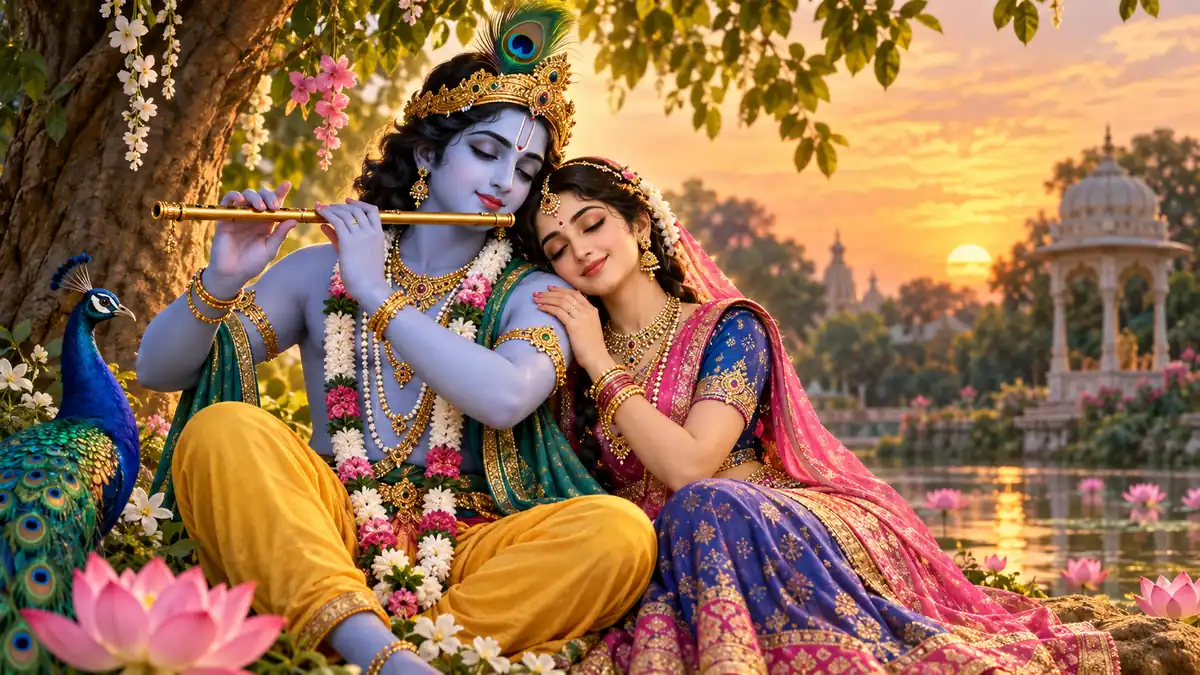
A single picture of Radha and Krishna can carry layers of meaning: devotion, divine love, longing, joy, surrender, music, and the beauty of Vrindavan. That is why these devotional pictures appear in temples, prayer spaces, paintings, festival greetings, phone wallpapers, and homes across generations.
radha krishna images depict Radha with Lord Krishna in devotional scenes associated with divine love and Bhakti. Common elements include Krishna’s flute, peacock feathers, lotus flowers, cows, gopis, forests, the Yamuna, and Vrindavan. Images range from traditional miniature paintings and temple photographs to modern illustrations, HD wallpapers, and digital devotional art.
Image libraries now contain hundreds or even thousands of pictures under this topic. Pixabay, for example, currently lists more than 600 Radha-Krishna images, while Wikimedia Commons preserves hundreds of historical and artistic representations.
Understanding what these pictures represent makes it easier to choose an image for worship, a wallpaper, a festival greeting, an art reference, or simply an appreciation of Indian devotional art.
What Do radha krishna images Represent?
At first glance, many pictures show Radha and Krishna as a loving couple standing or sitting together. Within Hindu devotional traditions, however, their imagery carries a deeper spiritual interpretation.
Krishna is worshipped as a manifestation of the divine, while Radha represents supreme devotion and loving surrender in traditions that give her a central theological role. Their relationship is therefore frequently interpreted through Bhakti, or loving devotion to God.
The visual union of Radha and Krishna can symbolize the relationship between the individual soul and the divine. This interpretation helps explain why their imagery is treated as devotional rather than merely romantic.
Their pictures often communicate several interconnected ideas:
- Divine love — love that transcends ordinary material attachment.
- Bhakti — wholehearted devotion to God.
- Spiritual longing — the devotee’s desire for closeness to the divine.
- Joy and harmony — especially in scenes involving music, dance, flowers, and nature.
- Surrender — devotion without expectation of material reward.
- Togetherness — Radha and Krishna visually express an inseparable spiritual relationship.
This is why a Radha Krishna photo can mean something quite different to a devotee than it does to someone viewing the same work purely as Indian art.
Are Radha Krishna Pictures Only Romantic Images?
No. Describing them simply as romantic pictures misses much of their religious significance.
Poetry, painting, music, temple traditions, and devotional literature have used the relationship between Radha and Krishna to express profound spiritual ideas. Their love is commonly interpreted as a metaphor for the soul’s complete devotion to God.
That distinction is especially useful when looking at historical paintings. Expressions of separation, longing, meeting, music, or celebration can carry devotional meaning beyond the literal scene.
Popular Types of radha krishna images
Search results for this topic include everything from centuries-old paintings to contemporary 4K wallpapers. Major image collections also associate the subject with terms such as Krishna, Radha, Hinduism, Vrindavan, India, religion, Lord Krishna, wallpaper, and devotional art.
Knowing the main categories helps you find a picture that suits its intended use.
Traditional Radha Krishna Paintings
Traditional paintings are among the richest visual representations of Radha and Krishna.
Historical works frequently illustrate scenes inspired by Krishna traditions and devotional literature such as the Gita Govinda. Wikimedia Commons, for example, catalogs works from Guler-school series associated with the Gita Govinda as well as later paintings showing Krishna and Radha with gopis in gardens and other settings.
Styles encountered in collections of Radha Krishna artwork may include:
- Rajasthani miniature painting
- Pahari and Guler painting
- Madhubani-inspired art
- Pichwai-inspired artwork
- Tanjore-style painting
- Folk painting
- Modern Indian devotional painting
These styles differ significantly in composition, color, ornamentation, facial features, landscape, and symbolism.
Some traditional compositions emphasize a quiet meeting between Radha and Krishna. Others show Krishna playing his flute, Radha listening, companions gathering nearby, or the couple surrounded by lush vegetation.
Radha Krishna HD Images
HD images are primarily sought for modern screens.
A high-resolution Radha Krishna image retains details such as jewelry, floral garlands, fabric patterns, facial expressions, and background scenery when displayed on larger devices.
Resolution matters particularly when an image will be used for:
- desktop backgrounds,
- tablets,
- large phone screens,
- presentations,
- digital displays,
- or printing.
“HD,” however, is sometimes used loosely on image websites. Check the actual pixel dimensions instead of relying only on the label.
Radha Krishna 4K Wallpapers
4K Radha Krishna wallpapers are designed for high-resolution displays. They commonly emphasize dramatic lighting, vivid colors, detailed clothing, floral scenery, temples, or fantasy-style interpretations of Vrindavan.
Current devotional media also commonly groups 4K images with phone wallpapers, WhatsApp status pictures, social-media posts, and devotional viewing.
For a 4K display, an image around 3840 × 2160 pixels is normally ideal for a full-screen landscape wallpaper.
Using a smaller picture and artificially enlarging it does not create genuine additional detail. It may simply make the image look soft or pixelated.
Cute Radha Krishna Images
“Cute” versions often use softer facial expressions, bright pastel colors, simplified illustrations, or childlike artistic styles.
These images are especially common in:
- greeting cards,
- social-media posts,
- mobile wallpapers,
- festival messages,
- profile pictures,
- and digital illustrations.
Some depict Krishna with his flute and Radha beside him, while others take considerable artistic freedom with clothing, proportions, backgrounds, and expressions.
Radha Krishna Love Images
Love-themed pictures emphasize the emotional connection between Radha and Krishna.
Typical compositions include the pair:
- sitting beside a river,
- standing beneath a tree,
- walking through a garden,
- looking toward each other,
- surrounded by flowers,
- sharing a swing,
- or listening to Krishna’s flute.
The devotional context remains essential. The “love” represented in Radha-Krishna traditions is often understood through the language of divine devotion rather than ordinary romance.
Radha Krishna Temple Images
Temple photographs provide a different visual experience from paintings.
They may show murtis of Radha and Krishna dressed in elaborate garments and decorated with jewelry, crowns, flowers, and garlands. Decorations can change according to the temple, festival, season, and devotional tradition.
Image collections include numerous photographs of decorated Radha-Krishna deities in temple settings alongside painted and digitally illustrated representations.
Temple images are particularly meaningful for people looking for explicitly devotional imagery rather than decorative artwork.
Radha Krishna Images With Flute: Why the Flute Matters
The bansuri, or flute, is one of Krishna’s most recognizable attributes.
In visual art, Krishna is often shown holding or playing the flute while Radha stands nearby. The scene immediately identifies him even when the artwork contains few other narrative details.
Within devotional interpretation, the flute can suggest the irresistible divine call that draws the devotee toward Krishna.
Artists frequently combine it with other familiar symbols:
| Visual element | Common association |
|---|---|
| Flute or bansuri | Krishna, divine music and spiritual attraction |
| Peacock feather | A recognizable part of Krishna’s iconography |
| Lotus | Purity, beauty and spirituality |
| Cow | Krishna’s pastoral identity |
| Forest | The pastoral world associated with Krishna |
| River | Often evokes the Yamuna |
| Flowers | Beauty, devotion and celebration |
| Gopis | Krishna’s pastoral companions and devotees |
| Garland | Worship, affection and honor |
| Crown and jewelry | Divine or ceremonial presentation |
These symbols are one reason Radha Krishna art can communicate a recognizable story even without text.
Vrindavan in Radha Krishna Pictures
Vrindavan is one of the most important geographical and devotional associations surrounding Krishna imagery.
Many artists create an idealized Vrindavan rather than attempting to portray a precise physical location. Forests, flowering trees, riverbanks, cows, moonlight, gardens, and groups of gopis collectively create the pastoral atmosphere associated with Krishna’s lilas.
This explains why image search collections repeatedly associate Radha Krishna with Vrindavan, Hinduism, India, religion, and Lord Krishna.
The Yamuna and Riverbank Scenes
A peaceful river in the background often evokes the Yamuna, which is deeply connected with Krishna traditions.
Riverbank scenes give artists room to combine several recurring motifs: moonlight, lotus flowers, trees, music, Radha and Krishna, and groups of companions.
They are consequently popular both in traditional painting and modern digital wallpaper.
Cows and Krishna’s Pastoral Identity
Krishna’s association with cowherding also appears frequently in devotional artwork.
A cow standing behind Krishna is not necessarily a decorative addition. It helps establish the pastoral environment and Krishna’s familiar identity as a cowherd.
For someone searching for traditional-looking Krishna artwork, these details can be useful clues.
Radha Krishna Paintings and Indian Art Traditions
Radha and Krishna have inspired Indian artists for centuries, making their imagery far more diverse than today’s digital search results might suggest.
Wikimedia Commons’ historical collection includes works connected with the Gita Govinda, examples attributed to Manaku of Guler, museum-held paintings, and depictions of Radha and Krishna in gardens and other narrative scenes.
This history matters because modern devotional pictures frequently borrow visual conventions established by earlier artistic traditions.
Pahari and Guler Paintings
Pahari painting developed in the Himalayan hill kingdoms and produced some especially refined representations of Krishna themes.
Guler-school works can feature delicate figures, expressive gestures, carefully constructed landscapes, and narrative scenes inspired by devotional poetry.
Historical images can therefore be valuable for someone interested in Radha Krishna art beyond contemporary wallpapers.
Rajasthani Miniature Style
Rajasthani traditions often use vivid color, decorative clothing, architectural elements, stylized landscapes, and carefully arranged figures.
Scenes of gardens, palaces, meetings, music, and festivals translate naturally into Radha-Krishna subjects.
Madhubani-Inspired Radha Krishna Art
Madhubani or Mithila-inspired compositions are recognizable through strong outlines, dense decorative patterns, stylized forms, and extensive use of the available surface.
Modern artists frequently adapt these characteristics when depicting Radha and Krishna.
Pichwai-Inspired Art
Pichwai is strongly associated with Krishna devotional art, particularly traditions centered on Shrinathji.
Contemporary creators sometimes extend its ornamental vocabulary—lotuses, cows, rich patterns, and devotional symbolism—to broader Krishna and Radha-Krishna compositions.
Tanjore-Style Artwork
Tanjore paintings are known for richly ornamented religious compositions, often incorporating gold-colored decorative elements and an iconic central deity.
Radha and Krishna rendered in this manner can look especially formal and ceremonial compared with pastoral miniature paintings.
How to Choose the Right Radha Krishna Image
There is no single “best” image. The right choice depends on what you intend to do with it.
For a Mobile Wallpaper
Use a vertical image that leaves enough space around the figures for clock and notification overlays.
A portrait-oriented image works better than cropping a wide landscape composition. Otherwise, Radha or Krishna may disappear behind interface elements.
Look for:
- strong portrait composition,
- sufficient resolution,
- uncluttered upper areas,
- readable details,
- balanced brightness.
For Desktop Wallpaper
Landscape compositions usually work best.
Scenes featuring Radha and Krishna beneath trees, beside the Yamuna, in a garden, or within a broad Vrindavan landscape naturally fit widescreen displays.
Choose a resolution close to your monitor’s native dimensions whenever possible.
For WhatsApp DP or Social Profile Images
Profile pictures are frequently displayed as circles or small squares.
A close composition works better than a detailed landscape. Make sure both faces remain visible after a center crop.
This practical detail is easy to overlook: a beautiful full-length painting may become unreadable when reduced to a tiny profile icon.
For WhatsApp Status and Stories
Vertical 9:16 compositions are preferable for full-screen stories and status posts.
Images with empty space can also accommodate a short devotional message without covering Radha or Krishna.
For Printing
Pixel dimensions matter more than labels such as “HD.”
For good-quality printing, start with the largest legitimate source file available. Historical repositories can be particularly useful because some provide original scans in multiple resolutions. One Radha-Krishna painting on Wikimedia Commons, for example, is available in an original 3072 × 4096-pixel version.
Do not assume that an image which looks sharp on a phone will produce a sharp large-format print.
How to Find High-Quality radha krishna images
Finding an attractive picture is easy. Finding one that is genuinely high resolution, legally reusable, and suitable for your intended format takes a little more care.
1. Search by Intended Use
Instead of searching only the main phrase, add the format or artistic style you actually need.
Useful variations include:
- Radha Krishna HD wallpaper
- Radha Krishna 4K wallpaper
- Radha Krishna painting
- Radha Krishna with flute
- Radha Krishna Vrindavan painting
- Radha Krishna temple photo
- Radha Krishna mobile wallpaper
- traditional Radha Krishna art
- Radha Krishna miniature painting
This reduces the amount of irrelevant material you have to sort through.
2. Check the Original Resolution
Open the individual image page and inspect its dimensions.
Some websites display compressed previews even when a much larger original is available. Wikimedia Commons, for example, commonly provides several resolution choices for a file.
Download or use the appropriate version rather than taking a screenshot.
3. Inspect Fine Details
Zoom into:
- faces,
- jewelry,
- flute,
- fingers,
- clothing patterns,
- flower garlands,
- and background architecture.
These areas reveal compression artifacts and poor-quality enlargement quickly.
This check is particularly useful with AI-generated devotional artwork, where complex jewelry, hands, musical instruments, and decorative patterns may contain visual inconsistencies.
4. Match the Aspect Ratio
Choose the composition before cropping.
| Purpose | Useful orientation |
|---|---|
| Phone wallpaper | Portrait |
| Desktop wallpaper | Landscape |
| Profile/DP | Square or crop-safe portrait |
| Status/Story | Vertical 9:16 |
| Website banner | Wide landscape |
| Framed print | Depends on frame and artwork |
Starting with the correct orientation preserves more of the original composition.
Free Radha Krishna Images and Copyright
“Available online” does not automatically mean “free to use.”
This distinction matters for bloggers, designers, YouTube creators, businesses, and anyone publishing pictures publicly.
Different images can be:
- copyrighted,
- public domain,
- Creative Commons licensed,
- royalty-free under a platform-specific license,
- or available only for limited personal use.
Pixabay currently presents hundreds of Radha-Krishna results as royalty-free images, while Wikimedia Commons provides individual licensing information for files in its collection.
Always check the specific file’s license.
Can You Download Radha Krishna Images From Google?
Google Images is primarily a discovery interface. Finding an image there does not itself grant permission to reuse it.
Follow the image to its original source and check:
- who created or owns it,
- what license applies,
- whether attribution is required,
- whether modification is permitted,
- whether commercial reuse is allowed.
For private wallpaper use, your practical situation differs from publishing the picture on a website, printing merchandise, or incorporating it into commercial material.
What Does Royalty-Free Mean?
Royalty-free does not necessarily mean copyright-free.
Usually it means an image can be used under specified licensing terms without paying a royalty every time it appears. The exact permissions depend on the platform and license.
Similarly, a Creative Commons license may require attribution or impose other conditions.
Read the license attached to the actual image rather than assuming all pictures on a website share identical terms.
Historical Radha Krishna Images vs Modern Digital Art
Modern search results mix fundamentally different kinds of visual material.
Recognizing those differences helps you select images more thoughtfully.
| Type | Main strength | Potential limitation |
|---|---|---|
| Historical painting | Artistic and cultural context | Original may show age or wear |
| Museum scan | High documentation value | Reuse rights vary |
| Temple photograph | Strong devotional context | Photography rules and copyright vary |
| Contemporary painting | Wide stylistic choice | Usually copyrighted |
| Stock illustration | Convenient digital use | License must be checked |
| Digital devotional art | Optimized for modern screens | Artistic accuracy varies |
| AI-generated image | Highly customizable style | May contain visual or iconographic errors |
Historical art can also reveal how visual storytelling changed over time.
For example, Wikimedia Commons catalogs a circa-1730 Guler-school Gita Govinda series and numerous other Radha-Krishna works, providing a useful contrast with today’s glossy digital wallpapers.
Important Symbols to Notice in Radha Krishna Artwork
Looking carefully at individual details makes devotional artwork much more interesting.
Krishna’s Blue Complexion
Krishna is frequently represented with blue or dark-blue skin in modern devotional imagery. This makes him immediately identifiable alongside Radha.
The exact shade varies considerably by period and artistic tradition.
Peacock Feather
A peacock feather placed in Krishna’s crown is another widely recognized visual attribute.
Modern illustrators frequently emphasize it because it remains recognizable even in simplified profile pictures or wallpapers.
Floral Garlands
Garlands appear in paintings, illustrations, and photographs of temple deities.
Flowers contribute beauty and color while also fitting naturally within Hindu devotional and ceremonial practice.
Lotus Flowers
The lotus has broad significance in Indian religious art and is frequently associated with spiritual purity and beauty.
In Radha Krishna artwork it may appear in a pond, decorative border, garland, or stylized background.
Krishna’s Flute
Of all the objects in these images, the flute is perhaps the quickest visual identifier.
A blue-skinned Krishna holding a flute beside Radha immediately establishes the subject for most viewers familiar with Hindu iconography.
Radha Krishna Images for Festivals
Devotional imagery becomes especially visible around festivals connected with Krishna and Radha.
Janmashtami
Krishna Janmashtami celebrates Krishna’s birth.
Radha Krishna pictures used around Janmashtami often feature elaborate decoration, temple imagery, flutes, peacock feathers, flowers, lamps, and devotional greetings.
Images of Bal Krishna, or child Krishna, are also especially prominent around the festival, although these depict a different stage of Krishna’s life from typical Radha-Krishna scenes.
Radhashtami
Radhashtami celebrates Radha and naturally places her at the center of devotional imagery.
Artwork may emphasize Radha’s beauty, devotion, relationship with Krishna, floral decoration, and the sacred geography associated with their traditions.
Holi
Holi imagery connected with Radha and Krishna is often exceptionally colorful.
Artists may show them with companions throwing colored powders or celebrating amid the festive atmosphere associated with Braj.
These images are well suited to festival greetings because the visual language of Holi—bright colors, movement, laughter, and celebration—is immediately recognizable.
Using Radha Krishna Images Respectfully
Because Radha and Krishna are objects of worship for millions of people, religious images deserve more consideration than ordinary decorative graphics.
There is no universal rule followed by every Hindu household or tradition, but a few principles are sensible.
Use clear, dignified images when the purpose is devotional. Avoid deliberately disrespectful alterations, insulting captions, or placements that treat sacred figures carelessly.
For a home prayer space, many devotees prefer traditional or temple-style imagery rather than heavily stylized graphics.
For social media, avoid covering the faces of Radha and Krishna with excessive text, stickers, advertising, or unrelated branding.
Respect also extends to accuracy. AI-generated pictures can look beautiful while introducing strange hands, malformed flutes, incorrect objects, nonsensical temple details, or unusual iconography. Inspect generated artwork before presenting it as devotional imagery.
Radha Krishna Images for Home and Prayer Spaces
People often display Radha Krishna pictures in prayer rooms and other clean, peaceful areas of the home.
The most suitable image is usually one that supports the atmosphere you want to create.
A temple-style portrait can feel explicitly devotional. A traditional painting may add artistic and historical character. A peaceful Vrindavan composition can create a contemplative mood.
Image quality also matters. A clean, properly framed print generally works better than a low-resolution picture stretched beyond its original dimensions.
Should Radha Krishna Images Be Treated as Sacred?
For devotees, they may carry significant religious meaning even though theological views about images, representations, and worship practices vary among Hindu traditions.
If you are displaying the picture specifically for worship, follow the customs of your family, temple, guru, or devotional tradition rather than treating generic internet advice as a universal religious rule.
That is both more accurate and more respectful.
Choosing Between Photos, Paintings and Digital Illustrations
Each format serves a different purpose.
Temple photographs can provide a direct connection with a particular shrine or form of worship.
Traditional paintings are useful for appreciating Indian artistic history, storytelling, symbolism, and devotional poetry.
Modern digital illustrations are often better suited to phone screens because they can be created specifically for portrait resolutions.
4K wallpapers work well when clarity on large screens is the priority.
Historical museum images are especially valuable for research because their dates, artists, schools, and provenance may be documented.
If your primary goal is learning, explore more than one category. Comparing an eighteenth-century Guler painting with a modern digital Radha Krishna wallpaper reveals how dramatically visual interpretations can change while familiar symbols remain recognizable.
Common Mistakes When Selecting Images
A few problems appear repeatedly when people collect devotional pictures online.
Downloading a Thumbnail
A thumbnail may look fine on a search-results page but become blurry once used as wallpaper.
Open the source and locate the highest suitable resolution.
Assuming “HD” Means High Quality
An image can have large pixel dimensions and still contain compression artifacts or artificial enlargement.
Check the details at full size.
Ignoring Copyright
Saving an image for personal viewing and republishing it on a commercial website are different uses.
Always check the source license before publication.
Cropping Out Important Details
A landscape painting forced into a vertical phone wallpaper may lose Radha, Krishna’s flute, a peacock feather, or important contextual scenery.
Start with an image whose composition matches the final format.
Treating Every Digital Picture as Traditional Art
Many contemporary images borrow elements from historical Indian art without belonging to a recognized traditional school.
If accuracy matters, identify the artist, date, school, museum, or source rather than assigning a traditional label based only on appearance.
Sharing AI Art Without Checking It
Generative tools can produce visually striking religious imagery, but details may be inaccurate.
Check hands, faces, jewelry, flute position, clothing, background figures, written Sanskrit or Devanagari text, and temple architecture before sharing the image.
How to Build a Useful Radha Krishna Image Collection
A thoughtful collection can serve different needs without becoming a folder full of near-identical pictures.
Organize images by purpose:
- Traditional art — historical paintings and museum works.
- Temple imagery — photographs of decorated Radha-Krishna deities.
- Mobile wallpapers — portrait-oriented high-resolution images.
- Desktop wallpapers — wide HD or 4K landscapes.
- Festival images — Janmashtami, Radhashtami, and Holi.
- Flute scenes — Krishna playing the bansuri with Radha.
- Vrindavan scenes — forests, gardens, cows, gopis, and the Yamuna.
- Profile pictures — compositions that remain clear after square or circular cropping.
Keep the original source or license information with downloaded files when you may reuse them publicly later.
That small habit prevents considerable confusion.
What Makes a Beautiful Radha Krishna Image?
Technical resolution alone does not determine whether an image feels powerful.
The most memorable compositions usually balance expression, symbolism, color, and atmosphere.
Krishna’s flute may become the visual center. Radha’s gaze may establish the emotional tone. A moonlit Vrindavan background may suggest quiet devotion, while a colorful Holi composition conveys celebration and joy.
Traditional artworks can achieve this through subtle gestures and carefully constructed landscapes. Modern digital illustrations often rely more heavily on luminous effects, saturated colors, elaborate jewelry, and dramatic backgrounds.
Neither approach automatically makes an image better.
For devotional use, emotional and spiritual resonance may matter more than technical perfection. For art history, provenance and authenticity become more important. For a wallpaper, resolution and composition may dominate the decision.
Final Thoughts on radha krishna images
The enduring appeal of radha krishna images comes from the way visual art brings together devotion, beauty, storytelling, symbolism, and centuries of Indian artistic tradition.
A Radha Krishna picture may show a quiet moment beneath a tree, Krishna playing the bansuri, a richly decorated temple murti, a scene inspired by the Gita Govinda, or a modern 4K interpretation of Vrindavan. Each belongs to a much larger visual tradition than the simple label “wallpaper” suggests.
When choosing an image, look beyond brightness and resolution. Consider the symbols, artistic tradition, intended use, source, copyright status, and devotional context. For historical exploration, museum and Wikimedia collections can provide documented artwork; for contemporary digital use, reputable image platforms provide large collections in multiple formats.
Most importantly, choose and use Radha Krishna imagery with the respect appropriate to sacred subjects. A beautiful image becomes far more meaningful when you understand the devotional ideas and cultural history behind what you are seeing.
