

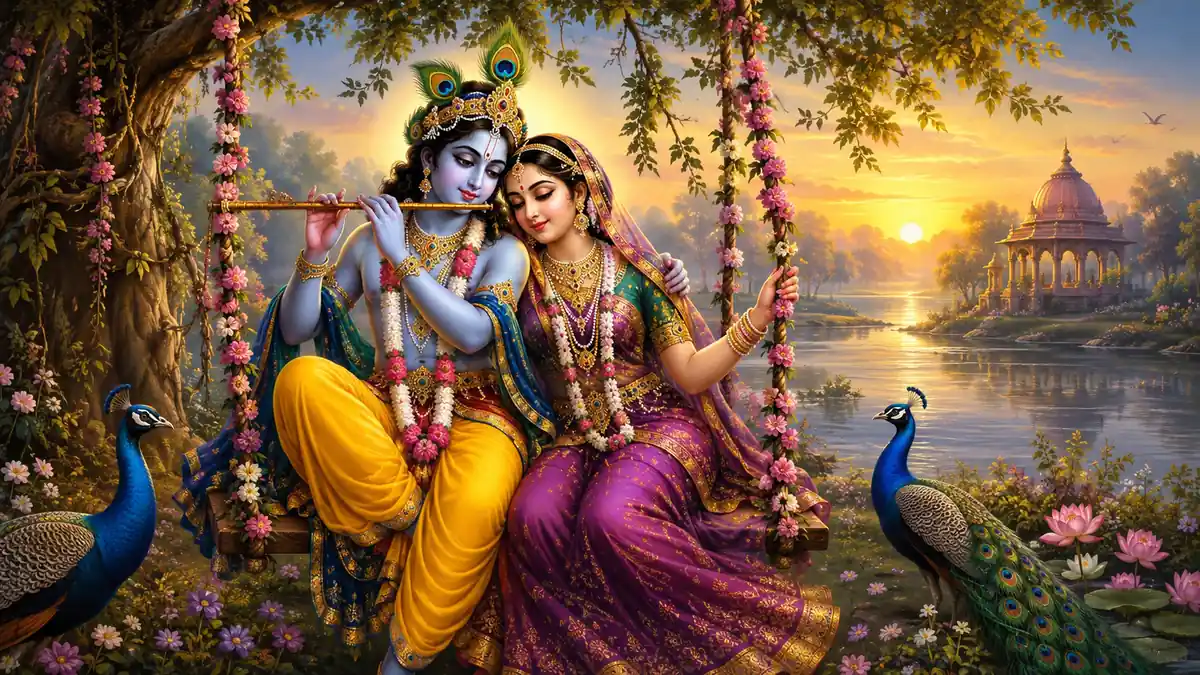
The story of radha krishna is far more than a celebrated romance. Across centuries of Hindu poetry, theology, temple worship, music, painting, and devotional practice, Radha and Krishna have become enduring symbols of love that rises above possession, ego, and personal desire.
Their bond is especially important within Vaishnava and Krishna-centered devotional traditions. Krishna represents the divine, while Radha embodies an intense and selfless love directed toward him. For many devotees, understanding their relationship is therefore a way of understanding bhakti itself.
Radha Krishna represent divine love and the intimate relationship between the devotee and God. Krishna is worshipped as the divine beloved, while Radha embodies complete devotion and spiritual longing. Their relationship is interpreted in several Vaishnava traditions as transcending ordinary romance and expressing the soul’s desire for union with the divine.
Who Are Radha and Krishna?
Krishna is one of Hinduism’s most widely worshipped deities and is particularly central to Vaishnavism and Krishnaism. His stories connect him with places such as Mathura, Gokul, Vrindavan, and the wider Braj region.
Radha, also known as Radhika or Radharani, is traditionally remembered as Krishna’s beloved and the foremost among the gopis, the cowherd women associated with his youthful pastimes in Vrindavan. Later devotional traditions developed Radha into a major theological figure representing love, compassion, devotion, and Krishna’s spiritual potency.
This explains why devotees so frequently speak their names together rather than treating them as unrelated figures.
Who Is Krishna?
Krishna appears in a vast body of Hindu religious literature. His life encompasses very different dimensions: the miraculous child of Gokul, playful cowherd of Vrindavan, beloved of the gopis, prince of Dwarka, and teacher who delivers the spiritual teachings of the Bhagavad Gita.
The Krishna associated with Radha is especially the youthful Krishna of Braj.
Images of this Krishna commonly show him:
- playing a bansuri, or flute;
- standing in a graceful pose beside Radha;
- wearing a peacock feather;
- tending cows;
- dancing with the gopis;
- or spending time in the forests and groves of Vrindavan.
These pastoral images became some of the most recognizable representations of Krishna devotion.
Who Is Radha?
Radha is traditionally associated with Barsana and the Braj region. Various traditions describe her parentage and earthly biography differently, so details should not always be treated as one universally agreed historical narrative.
What is much more consistent is her devotional role.
She becomes the person whose love for Krishna is complete.
In several Krishnaite traditions, Radha is understood as Krishna’s hladini shakti—his bliss-giving or pleasure potency. This theological idea means that she is not merely another person who happens to love Krishna. Radha represents divine love itself taking personal form.
That distinction is essential to understanding why Radha occupies such an elevated place in later bhakti traditions.
The radha krishna Love Story
Popular retellings often introduce Radha and Krishna simply as two lovers in Vrindavan. That captures the emotional beauty of the tradition, but it does not capture its full religious meaning.
Their story unfolds within the sacred landscape of Braj, particularly Vrindavan and surrounding areas.
Krishna’s flute calls the gopis toward him. They leave ordinary concerns behind and seek his company. Among these devotees, Radha eventually becomes the supreme expression of loving devotion.
The forests, the Yamuna, moonlit nights, Krishna’s flute, Radha’s longing, and the Rasa Lila all became powerful motifs in devotional literature and art.
Separation also matters.
In ordinary romance, separation is usually viewed simply as loss. In bhakti poetry, longing for someone who is absent can intensify awareness of the beloved. Radha’s longing for Krishna therefore becomes a metaphor for the devotee who cannot be satisfied by ordinary worldly experience and longs instead for God.
What Does Their Love Actually Mean?
A common spiritual interpretation sees Krishna as the divine beloved and Radha as the perfected devotee.
Their love can consequently symbolize:
| Symbol | Spiritual interpretation |
|---|---|
| Krishna | The divine or supreme beloved |
| Radha | Devotion and complete love for God |
| Krishna’s flute | The divine call |
| Radha’s longing | The soul’s longing for God |
| Separation | Intensification of spiritual yearning |
| Reunion | Spiritual fulfillment |
| Vrindavan | Sacred space of divine play |
| Rasa Lila | Loving participation in divine bliss |
These meanings should not be treated as the only interpretations accepted by every Hindu school. Hindu traditions contain different theological understandings of Radha and Krishna.
Still, the idea of selfless divine love lies at the center of many of them.
Quick Takeaway: The radha krishna story becomes spiritually meaningful when love is understood not as ownership but as devotion—loving without making the beloved an object of possession.
Why Did Radha and Krishna Not Marry?
This is one of the most frequently asked questions about their story, but it does not have one universally accepted answer.
Different scriptures, regional traditions, devotional communities, and later narratives give different accounts of Radha’s life and her relationship with Krishna. For that reason, claims such as “Radha and Krishna definitely never married” or a single explanation for why they did not marry can oversimplify a much more diverse religious tradition.
In the best-known devotional interpretation, their relationship does not depend on a conventional social bond to establish its spiritual importance.
Their love represents something beyond possession and ordinary social categories.
This is precisely why viraha, or separation from the beloved, became so significant in devotional poetry. Physical separation does not necessarily mean spiritual separation.
Instead, longing can make remembrance stronger.
Radha’s love therefore communicates a powerful bhakti principle: closeness to the divine is ultimately measured through devotion rather than physical proximity.
radha krishna in Hindu Scriptures and Literature
Understanding the textual history of Radha requires some care because Radha does not occupy the same position in every early Krishna text.
The Bhagavata Purana and the Gopis
The Bhagavata Purana is foundational to Krishna devotion and contains the celebrated narratives of Krishna’s life among the gopis.
However, scholars and religious traditions have debated Radha’s relationship to the text because the best-known passages do not explicitly present her by name in the straightforward way later literature does.
Some Vaishnava interpreters identify the especially favored gopi in the Rasa Lila narrative with Radha and connect a term in Bhagavata Purana 10.30.28 with her name and devotional significance. Later traditions then make her identity explicit.
This distinction matters.
Saying simply that the Bhagavata Purana tells the later, fully developed Radha-Krishna story would ignore how the tradition evolved.
Gita Govinda
A decisive development came with the Sanskrit poet Jayadeva and his 12th-century Gita Govinda.
The work gives Radha and Krishna’s relationship extraordinary emotional intensity. Love, jealousy, longing, separation, reconciliation, and reunion are presented poetically while later devotional traditions interpret their relationship spiritually.
The Gita Govinda became enormously influential in literature, music, dance, temple culture, and visual art. Its importance helped establish Radha as one of the central figures of Krishna devotion.
Later Devotional Traditions
Radha’s theological importance expanded considerably in later centuries.
Texts and traditions associated with Radha-Krishna include the Brahma Vaivarta Purana, Garga Samhita, Brahma Samhita and, particularly within Gaudiya Vaishnavism, the Chaitanya Charitamrita. Different Vaishnava communities interpret these sources according to their own theological systems.
Rather than emerging from a single book, the Radha-Krishna tradition developed through scripture, poetry, oral tradition, theology, music, regional storytelling, and devotional practice.
Why Is radha krishna a Symbol of Divine Love?
The most important idea behind their symbolism is bhakti—loving devotion to God.
Radha’s love asks for no worldly reward.
She is remembered for devotion so concentrated that Krishna becomes the center of her consciousness. In theological traditions that identify her with Krishna’s own spiritual energy, the relationship becomes even deeper: lover and beloved are distinct enough to experience love yet ultimately inseparable at the divine level.
Radha as Hladini Shakti
The Sanskrit expression hladini shakti is particularly important in Gaudiya Vaishnava theology.
It refers to Krishna’s bliss or pleasure potency.
Radha is identified with this potency, making her the fullest embodiment of divine love and bliss rather than merely an exemplary human worshipper. This provides the theological foundation for the idea that Radha and Krishna can simultaneously appear as two personalities while possessing an underlying divine unity.
The Soul and the Divine
Another common interpretation explains their relationship through the devotee’s longing for God.
Radha represents complete spiritual yearning.
Krishna represents its divine object.
This interpretation helped transform romantic poetic imagery into a language for mystical devotion. Encyclopedia sources similarly describe Radha in devotional religion as representing the human soul’s longing for God.
The emotional power of the story is therefore intentional.
Bhakti is not presented merely as intellectual belief. It is something experienced through remembrance, longing, surrender, joy, and love.
Vrindavan, Barsana and the Sacred Geography of Radha Krishna
The Radha-Krishna tradition cannot be separated easily from Braj, the cultural and sacred region associated with Krishna’s early life.
Vrindavan
Vrindavan is among the most important centers of Krishna worship.
Its sacred landscape is associated with Krishna’s youthful pastimes, the gopis, Rasa Lila, forests, temples, and the Yamuna River.
Today the area contains numerous temples associated with Radha and Krishna, including historic and modern devotional institutions. The wider Braj region—including Vrindavan, Mathura, Barsana, Gokul, and Nandgaon—remains a major center of their worship.
Barsana
Barsana is especially associated with Radha.
The famous Shri Radha Rani Temple, also known as Shriji Temple or Ladli Ji Temple, stands on a hill in Barsana and is one of the area’s major centers of Radha devotion. Local religious traditions connect Barsana deeply with Radha, her companions, Holi, kirtan, and Radhashtami celebrations.
Mathura and Gokul
Mathura is traditionally revered as Krishna’s birthplace, while Gokul is associated with his childhood.
Together with Vrindavan, Barsana, Nandgaon, Govardhan, and other sacred locations, these places create a devotional geography in which stories are tied to physical landscapes.
Pilgrimage through Braj therefore becomes more than sightseeing. For devotees, visiting these places can be an act of remembrance.
The Meaning Behind Famous Radha Krishna Symbols
Radha-Krishna art is full of objects that carry layers of cultural and devotional meaning.
Krishna’s Flute
The bansuri is one of Krishna’s defining symbols.
In devotional interpretation, its music can represent God’s irresistible call. The gopis hearing Krishna’s flute and moving toward him becomes a metaphor for consciousness turning away from distraction and toward the divine.
The flute is also empty inside.
Some spiritual teachers use that quality metaphorically: a person who releases ego becomes capable of allowing divine will to flow through them, just as breath creates music through an empty flute.
Peacock Feather
Krishna’s peacock feather is one of his most recognizable visual attributes.
It contributes to the playful, beautiful, pastoral image of Krishna that developed through painting, sculpture, dance, and temple iconography.
Lotus
The lotus has broad significance throughout Hindu and Buddhist traditions, often representing purity and spiritual beauty.
Radha is also associated with lotus imagery in devotional literature and iconography. Her eyes, feet, hands, beauty, and spiritual qualities are frequently expressed through poetic comparisons to flowers and lotuses.
The Forests of Vrindavan
Vrindavan’s forests are not merely background scenery.
They form the setting of divine lila, or sacred play.
Trees, flowers, riverbanks, moonlight, animals, and groves create an environment in which nature participates in devotion.
Radha and Krishna Standing Together
Perhaps the strongest symbol is simply the pair themselves.
Krishna alone can represent the divine.
Radha beside Krishna emphasizes relationship—the divine together with love for the divine.
This helps explain why their paired image has such importance in temple worship.
Bhakti Traditions That Worship Radha Krishna
Radha and Krishna are especially prominent across several Vaishnava traditions, although their exact theological status differs.
Gaudiya Vaishnavism
Gaudiya Vaishnavism, associated historically with Chaitanya Mahaprabhu, places extraordinary emphasis on Radha and Krishna.
Within this tradition, Radha is understood as Krishna’s supreme loving potency, and their devotional relationship represents the highest form of divine love.
The modern International Society for Krishna Consciousness (ISKCON) developed from the Gaudiya Vaishnava tradition and helped spread Radha-Krishna worship internationally.
Nimbarka Tradition
The Nimbarka Sampradaya also gives Radha and Krishna a central position.
Theological traditions associated with Nimbarka contributed significantly to the development of joint Radha-Krishna worship and the understanding of Radha as inseparably related to Krishna.
Radha Vallabha Tradition
The Radha Vallabha Sampradaya places particularly strong emphasis on Radha.
Her devotional and theological status is so elevated that understanding Krishna becomes inseparable from understanding Radha’s supremacy in divine love.
Other communities—including Pushtimarg and several regional Vaishnava traditions—have also contributed to the vast devotional culture surrounding Krishna, Radha, Braj, and bhakti.
Quick Takeaway: There is no single Radha-Krishna theology shared identically by every Hindu tradition. Their broad significance is widely recognized, but different sampradayas explain Radha’s identity and relationship with Krishna in distinct ways.
Radha Krishna Festivals and Celebrations
Devotion is expressed throughout the year through festivals, temple rituals, music, dance, pilgrimage, and community celebrations.
Janmashtami
Krishna Janmashtami celebrates Krishna’s birth and is one of the major Krishna festivals.
Devotees may fast, sing bhajans, perform kirtan, read Krishna narratives, decorate temples, and participate in midnight worship.
Radhashtami
Radhashtami celebrates Radha’s appearance and is especially significant in places such as Barsana and Vrindavan.
For Radha-centered devotional communities, it is one of the most important days of the religious year.
Holi
Holi has an especially distinctive character in Braj.
The celebrations of Barsana, Nandgaon, Vrindavan, and surrounding communities connect the festival’s colors and playful atmosphere with Radha, Krishna, and their companions.
Lathmar Holi, particularly associated with Barsana and Nandgaon, has become one of the region’s most famous festival traditions.
Jhulan Yatra
During Jhulan Yatra, deities of Radha and Krishna may be placed on elaborately decorated swings.
Flowers, songs, temple decorations, and devotional gatherings create the mood of Krishna’s monsoon-season pastimes.
Sharad Purnima
Sharad Purnima has strong associations with Krishna’s Rasa Lila traditions.
Other celebrations connected with Krishna devotion include Govardhan Puja, Gopashtami, Kartik observances, and related Braj festivals. Festival dates vary from year to year because they follow the Hindu lunar calendar rather than fixed Gregorian dates.
Radha Krishna in Art, Music and Culture
Few devotional relationships have influenced Indian arts as extensively as Radha and Krishna.
Painting
Radha-Krishna themes became particularly important in Pahari and other Indian miniature painting traditions.
Artists portrayed secret meetings, Krishna waiting for Radha, lovers walking through forests, monsoon scenes, moonlit encounters, and moments of separation.
Paintings inspired by Jayadeva’s Gita Govinda translated emotional poetry into visual form. Surviving works demonstrate how deeply Radha-Krishna imagery entered Indian artistic traditions.
Music and Kirtan
Their names appear throughout:
- bhajans;
- kirtan;
- classical compositions;
- temple music;
- folk traditions;
- mantra chanting;
- and regional devotional songs.
The repeated chanting of names such as Radhe, Shyam, and Krishna turns remembrance itself into devotional practice.
Dance and Performance
Radha-Krishna narratives also appear in classical and regional dance traditions.
Expressions of longing, jealousy, joy, separation, and reunion provide performers with a rich emotional vocabulary. Rasa Lila performances likewise bring Krishna’s Braj narratives into living theatrical tradition.
Poetry
Poets found in Radha a particularly powerful language for describing spiritual yearning.
Human emotion could communicate theological ideas that abstract philosophy might struggle to express.
Love poetry thus became, in devotional contexts, a language of spiritual experience.
What Radha Krishna Teach About Love
The continuing appeal of radha krishna comes partly from the fact that their symbolism speaks to questions people still ask: What makes love pure? Does love require possession? Why can separation deepen affection? What happens when ego disappears?
Their tradition offers several answers.
Love Is Not Ownership
Radha’s devotion is celebrated because it is centered on Krishna rather than on possessing him.
Applied carefully to ordinary life, the principle suggests that genuine affection respects another person instead of reducing love to control.
Devotion Requires Attention
Bhakti is sustained through remembrance.
A practical lesson is that whatever receives repeated attention gradually occupies a larger place in consciousness.
Devotional practices such as japa, kirtan, prayer, meditation, reading sacred narratives, and visiting temples use this principle deliberately.
Separation Can Intensify Remembrance
The Sanskrit devotional idea of viraha gives separation spiritual value.
Absence can make the beloved more present in consciousness.
Radha’s longing therefore becomes more than sadness; it becomes concentrated remembrance.
Ego Interferes With Devotion
The Radha-Krishna tradition repeatedly places selfless love above pride.
That does not mean healthy human relationships should imitate every element of sacred poetry literally. The narratives operate primarily in theological and devotional contexts.
Their broader principle is simpler: deep devotion requires moving beyond constant self-interest.
Is Radha Krishna a Historical Story or a Spiritual Tradition?
Questions about historical evidence should be distinguished from questions of religious meaning.
Radha and Krishna belong to an enormous religious tradition containing scripture, theology, poetry, oral narratives, pilgrimage, art, music, and centuries of worship.
The textual history is layered.
Krishna appears prominently in ancient Hindu literature, while the fully developed literary and theological image of Radha becomes increasingly prominent in later sources. Jayadeva’s 12th-century Gita Govinda was particularly influential in shaping her subsequent cultural and devotional importance.
This historical development does not diminish Radha’s religious importance for devotees.
It simply distinguishes two different questions:
Historical study asks: How did texts, beliefs, artistic representations, and devotional movements develop over time?
Religious devotion asks: What do Radha and Krishna reveal about God, love, and bhakti?
Both questions can be explored without pretending they are identical.
Why Radha Krishna Remain So Important
Radha and Krishna endure because their tradition connects philosophy with emotion.
Bhakti can sound abstract when defined merely as “devotion.” Radha gives that concept a humanly recognizable emotional form: longing, remembrance, surrender, joy, pain in separation, and complete concentration on the beloved.
Krishna gives that love its divine center.
Together, they communicate an idea that generations of poets, theologians, artists, musicians, and devotees have explored in different ways: the relationship between the soul and the divine can be understood through love.
Their influence reaches from the sacred geography of Vrindavan and Barsana to temple traditions around the world; from the Bhagavata Purana and Gita Govinda to later Vaishnava theology; and from classical paintings to everyday bhajans and kirtan.
The deepest meaning of radha krishna, then, is not simply a romantic story about two beloved figures. It is a devotional vision in which love becomes a spiritual path.
Radha represents love directed completely toward the divine. Krishna is the divine beloved toward whom that love flows. Their separation expresses longing, their meeting expresses fulfillment, and their inseparability in devotional consciousness expresses the heart of bhakti.
That is why, centuries after poets first gave their relationship some of its most influential literary forms, Radha and Krishna continue to be remembered together—as enduring symbols of devotion, spiritual longing, and divine love.
