

A single number can summarize an entire semester’s academic performance—but only if you understand what it represents. Students often see GPA on transcripts, admission forms, scholarship requirements, and job applications without knowing how it is calculated.
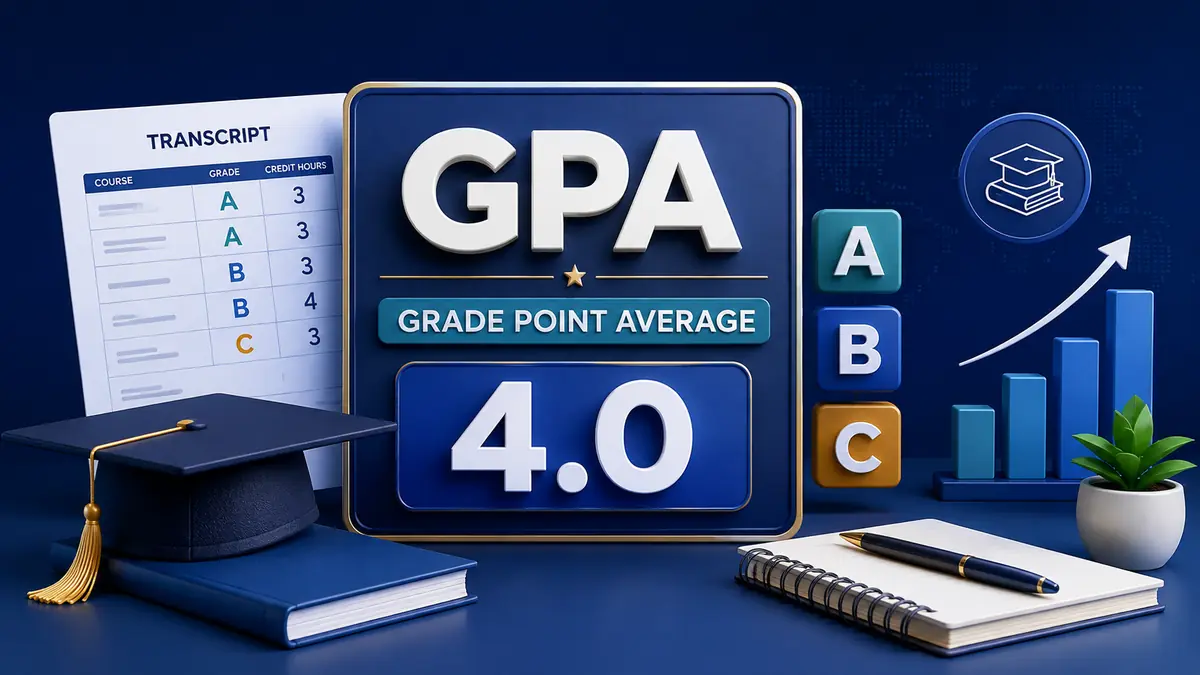
The GPA full form is Grade Point Average. It is a numerical measure of a student’s academic performance over a particular term or entire program. Schools and universities calculate it by converting course grades into grade points, accounting for credit hours where applicable, and averaging the resulting quality points on a defined scale.
What Is the GPA Full Form?
GPA stands for Grade Point Average.
It converts grades earned in different subjects or courses into one numerical average. This gives students and educational institutions a consistent way to review overall academic performance.
In the United States, GPA is commonly reported on a 4.0 scale, where:
- A generally equals 4.0
- B generally equals 3.0
- C generally equals 2.0
- D generally equals 1.0
- F generally equals 0.0
This mapping is only a general example. Some institutions use plus and minus grades, alternative point values, or entirely different scales.
A GPA may represent performance during:
- One semester or term
- One academic year
- High school
- College or university
- An entire degree program
For example, a 3.5 GPA usually indicates that a student’s overall performance falls between a B and an A on a standard 4.0 scale.
What Does GPA Mean in Education?
GPA is a numeric indicator of academic achievement. Instead of examining every assignment, examination, and course grade separately, a school can use the GPA as a summary of a student’s performance.
The three words in Grade Point Average explain how the system works:
- Grade: The result earned in a course, such as A, B, C, or F
- Point: The numerical value assigned to that grade
- Average: The combined result across the applicable courses
Suppose a student earns an A in English, a B in mathematics, and a C in science. On a basic 4.0 scale, those grades would be worth 4, 3, and 2 points. If all three courses carry equal weight, the GPA would be 3.0.
GPA does not necessarily show every aspect of a student’s ability. It does not directly measure creativity, communication skills, improvement over time, extracurricular involvement, or the difficulty of an institution’s grading policies. It is best understood as a structured academic summary rather than a complete assessment of a person.
How Is GPA Calculated?
The correct calculation depends on whether all courses have equal value or carry different credit hours.
Simple GPA formula
When every course has the same weight, use:
GPA = Total grade points ÷ Number of courses
Consider these four course results:
| Course | Letter Grade | Grade Points |
|---|---|---|
| English | A | 4.0 |
| Mathematics | B | 3.0 |
| Science | A | 4.0 |
| History | C | 2.0 |
Total grade points:
4.0 + 3.0 + 4.0 + 2.0 = 13.0
Divide the total by four courses:
13.0 ÷ 4 = 3.25 GPA
This method works only when every course contributes equally to the final average.
Credit-hour GPA formula
Colleges and universities commonly assign each course a specific number of credits. A four-credit course therefore affects the GPA more than a one-credit course.
The formula is:
GPA = Total quality points ÷ Total attempted credit hours
Quality points are calculated by multiplying the grade point for a course by its credit hours.
| Course | Grade | Grade Points | Credits | Quality Points |
|---|---|---|---|---|
| English | A | 4.0 | 3 | 12.0 |
| Mathematics | B | 3.0 | 4 | 12.0 |
| Science | B+ | 3.3 | 3 | 9.9 |
| History | A− | 3.7 | 2 | 7.4 |
| Total | 12 | 41.3 |
Now divide the total quality points by the attempted credits:
41.3 ÷ 12 = 3.44 GPA
The student’s GPA is approximately 3.44.
Steps to calculate GPA correctly
- List every course included in the calculation.
- Record the letter grade earned in each course.
- Find the institution’s official grade-point scale.
- Convert each letter grade into its numerical value.
- Multiply each grade point by the course credits.
- Add all quality points.
- Add all attempted credit hours.
- Divide total quality points by total attempted credits.
- Round only according to the institution’s policy.
Do not assume every school assigns the same value to A−, B+, or other plus-and-minus grades. Always use the grading policy printed in the academic handbook or transcript guide.
GPA Full Form and the Standard 4.0 Scale
A 4.0 GPA scale is widely used in American high schools, colleges, and universities. Under a basic unweighted system, 4.0 is normally the highest possible result.
| Letter Grade | Typical Grade Points | General Interpretation |
|---|---|---|
| A | 4.0 | Excellent |
| B | 3.0 | Good |
| C | 2.0 | Satisfactory |
| D | 1.0 | Needs improvement |
| F | 0.0 | Failing |
Schools that use plus and minus grades may apply more detailed values:
| Letter Grade | Common Grade-Point Value |
|---|---|
| A | 4.0 |
| A− | 3.7 |
| B+ | 3.3 |
| B | 3.0 |
| B− | 2.7 |
| C+ | 2.3 |
| C | 2.0 |
| C− | 1.7 |
| D+ | 1.3 |
| D | 1.0 |
| F | 0.0 |
These values are common, but they are not universal. One university may assign 3.67 to a B+, while another uses 3.3. Some institutions also give an A+ the same 4.0 value as an A, whereas others award more than 4.0.
Quick takeaway: A 4.0 scale is a convention, not a universal law. Use your institution’s official conversion chart before calculating or interpreting a GPA.
Weighted vs. Unweighted GPA
The difference between weighted and unweighted GPA comes down to whether course difficulty affects the number of points awarded.
Unweighted GPA
An unweighted GPA usually operates on a 0.0–4.0 scale. The grade receives the same point value regardless of course difficulty.
For example, an A may equal 4.0 in:
- A regular class
- An honors class
- An Advanced Placement course
- An International Baccalaureate course
This makes the scale easy to understand, but it may not fully reflect the rigor of a student’s curriculum.
Weighted GPA
A weighted GPA gives additional points for academically demanding courses. A school might award:
- 4.0 for an A in a regular course
- 4.5 for an A in an honors course
- 5.0 for an A in an AP or similarly advanced course
Because of these extra points, a weighted GPA can exceed 4.0.
| Feature | Unweighted GPA | Weighted GPA |
|---|---|---|
| Common maximum | 4.0 | 5.0 or higher |
| Course difficulty included | No | Yes |
| Easy to compare | Generally | Only with scale context |
| Advanced-course bonus | No | Usually |
| Common use | General performance | Performance plus course rigor |
A 4.2 weighted GPA is not automatically better than a 3.9 unweighted GPA. Admissions officers need the grading scale, course level, and school profile to interpret the two results fairly.
Semester GPA vs. Cumulative GPA
A semester GPA and a cumulative GPA measure performance over different periods.
Semester GPA
Semester GPA covers courses completed during one semester or academic term. It helps a student see recent performance and identify whether study habits are improving.
For example, if a student earns 42 quality points from 12 credits during the fall semester, the semester GPA is:
42 ÷ 12 = 3.50
Cumulative GPA
Cumulative GPA, sometimes called CGPA or Cumulative Grade Point Average, combines performance across multiple semesters or the entire academic program.
It should not usually be calculated by simply averaging the semester GPAs. If the semesters contain different numbers of credits, that method can produce an inaccurate result.
The correct formula is:
Cumulative GPA = Total quality points from all terms ÷ Total attempted credits from all terms
Suppose a student completes:
- Semester one: 36 quality points from 12 credits
- Semester two: 52 quality points from 15 credits
The cumulative calculation is:
(36 + 52) ÷ (12 + 15) = 88 ÷ 27 = 3.26
The student’s cumulative GPA is approximately 3.26.
GPA and CGPA are not always different
Some institutions use GPA for a single semester and CGPA for an entire program. Others use “term GPA” and “cumulative GPA” instead. In certain countries, GPA and CGPA may be used interchangeably.
The transcript or institutional policy determines the intended meaning.
What Is a Good GPA?
There is no single GPA that is considered good in every situation. The answer depends on the grading scale, educational level, program difficulty, and purpose for which the GPA is being reviewed.
On a standard unweighted 4.0 scale, this broad interpretation can provide context:
| GPA Range | General Interpretation |
|---|---|
| 3.7–4.0 | Excellent |
| 3.3–3.69 | Very good |
| 3.0–3.29 | Good |
| 2.5–2.99 | Fair to satisfactory |
| 2.0–2.49 | Often the minimum satisfactory range |
| Below 2.0 | May create academic-standing concerns |
These descriptions are not admission guarantees. A competitive university or scholarship may expect grades well above its stated minimum. Other programs consider the applicant’s curriculum, personal statement, recommendations, work experience, and academic improvement alongside GPA.
A “good GPA” is therefore one that:
- Meets the requirements of the intended program
- Reflects consistent academic progress
- Keeps the student in satisfactory academic standing
- Supports scholarship or financial-aid eligibility
- Is competitive within the relevant applicant group
Why Does GPA Matter?
Educational institutions use GPA because it offers a convenient way to evaluate academic consistency across several courses.
College and university admissions
Admissions teams often examine GPA alongside course rigor, entrance tests where applicable, recommendations, essays, extracurricular activities, and personal circumstances.
A high number is valuable, but context matters. A student who takes challenging courses may be assessed differently from someone with a similar GPA in a less demanding curriculum.
Scholarships and financial aid
Many merit-based scholarships establish a minimum GPA for initial eligibility or renewal. Students may need to maintain a certain cumulative average throughout the award period.
Some forms of financial assistance also depend on satisfactory academic progress. The exact requirements are set by the institution or funding organization.
Academic standing
Schools use GPA thresholds to determine whether a student is:
- In good academic standing
- Eligible for an honors list
- At risk of academic probation
- Qualified to continue in a program
- Ready to graduate
Required averages vary by institution and degree level.
Internships and employment
Some internship programs and graduate employers request a GPA, particularly when evaluating applicants with limited professional experience. Its importance usually declines as a person builds relevant work experience and a record of professional performance.
Graduate and professional programs
Master’s, doctoral, medical, law, and other professional programs may set minimum undergraduate GPA requirements. Competitive admission may require a substantially stronger record than the published minimum.
GPA Scales Used in Different Countries
The 4.0 scale is strongly associated with the United States, but grading systems vary around the world.
Institutions may report achievement through:
- A 4.0 GPA scale
- A 5.0 scale
- A 10-point GPA or CGPA scale
- Percentage marks
- Numerical grades
- Degree classifications
- Letter-grade systems
A 7.5 on a 10-point scale cannot be accurately converted to 3.0 on a 4.0 scale merely by proportion. Grade distributions, passing thresholds, course requirements, and institutional policies may differ.
International universities may evaluate foreign transcripts through:
- Their own admissions office
- An approved credential-evaluation service
- Country-specific conversion guidance
- An official transcript and grading-scale explanation
This is why students should avoid presenting a self-converted GPA unless an application specifically requests it and provides an approved formula.
How to Convert GPA to Percentage
There is no universal formula for converting GPA to percentage. Any conversion must follow the policy of the school, university, examination board, or application organization receiving the result.
A commonly seen formula is:
Percentage = GPA ÷ Maximum GPA × 100
Using that formula, a 3.2 GPA on a 4.0 scale would become:
3.2 ÷ 4.0 × 100 = 80%
However, this is only a mathematical proportion. It may not represent the institution’s actual grading rules. A university could use grade bands, a fixed multiplier, or a course-by-course evaluation instead.
Likewise, multiplying a GPA by 25 or multiplying a 10-point CGPA by 9.5 may be valid in a specific system but incorrect elsewhere.
Before converting, check:
- The original grading scale
- The institution’s conversion table
- Whether credits must be considered
- Whether failed or repeated courses are included
- The receiving organization’s instructions
- Required rounding rules
When no approved method is provided, report the original GPA together with its scale—for example, 3.4/4.0—rather than creating an unofficial percentage.
What Courses Count Toward GPA?
Not every result shown on an academic record necessarily affects GPA. Institutional policies determine which grades and credits are included.
Courses that commonly count include:
- Standard graded courses
- Required major courses
- Elective courses carrying academic credit
- Repeated courses, depending on the replacement policy
Courses or results that may be treated differently include:
- Pass/fail classes
- Withdrawals
- Incomplete grades
- Audited courses
- Transfer credits
- Remedial classes
- Non-credit activities
- Advanced-placement credits
A withdrawal may have no effect if recorded as a non-punitive “W,” while an unauthorized or late withdrawal could be treated as a failing grade. Pass/fail courses may add earned credits without adding quality points.
Repeated-course rules are especially important. Some colleges replace the original grade, some include both attempts, and others apply grade replacement only under specific conditions.
Common GPA Calculation Mistakes
Most GPA errors occur because students use a generic calculator without matching it to their institution’s rules.
Treating all courses equally
A four-credit laboratory course usually has more influence than a one-credit seminar. Averaging the letter-grade points without using credits can give the wrong answer.
Using the wrong grading scale
A B+ is not assigned the same numerical value everywhere. The official scale must be used, especially when plus and minus grades are involved.
Averaging semester GPAs directly
This works only when each semester contains the same number of GPA credits. Combining total quality points and total credits is the reliable method.
Including excluded courses
Pass/fail, audited, transferred, or withdrawn courses may not belong in the calculation.
Ignoring repeated-course policies
Replacing an earlier grade on your own can make the estimated GPA higher than the official cumulative result.
Rounding too early
Keep the full decimal values during the calculation and round only the final result according to institutional policy.
Quick takeaway: For an accurate result, collect the course grade, grade-point value, credit hours, and institutional treatment of special grades before doing the calculation.
How to Improve Your GPA
Improving GPA is usually a gradual process because a cumulative average includes past credits. The more credits a student has completed, the harder it becomes for one new grade to move the overall number.
A practical approach is to:
- Calculate the current baseline. Confirm the official cumulative GPA and completed credits.
- Set a realistic target. Estimate the grades and credits required to reach it.
- Prioritize high-credit courses. These have a stronger mathematical effect on the average.
- Address weak subjects early. Use office hours, tutoring, study groups, and academic support before falling behind.
- Review repeated-course rules. Retaking a course may help if grade replacement is permitted.
- Protect strong performance. Avoid overloading a semester with too many demanding courses.
- Track progress after each term. Recalculate using actual grades rather than optimistic estimates.
For example, a student with a 2.5 cumulative GPA across 60 credits cannot raise it to 3.5 with one strong 15-credit semester. Even earning a 4.0 during that semester would produce:
[(2.5 × 60) + (4.0 × 15)] ÷ 75 = 2.80
This does not mean improvement is pointless. It shows why realistic planning and sustained performance matter more than expecting one semester to erase the entire academic record.
Final Explanation of GPA Full Form
The GPA full form is Grade Point Average, a numerical summary of academic performance over a term, year, or complete program. It is normally calculated by dividing total quality points by total attempted credit hours, although grading scales and institutional rules vary.
To understand your GPA accurately, do not look at the number alone. Confirm whether it is weighted or unweighted, semester-based or cumulative, which scale it uses, and which courses are included. The best next step is to check your institution’s official grading policy and calculate the result using its exact grade points, credit rules, and rounding method.

Cool blog! Is your theme custom made or did you download it from
somewhere? A design like yours with a few simple tweeks would really make my blog shine.
Please let me know where you got your design. Thank you
Excellent beat ! I wish to apprentice while you amend your website, how can i subscribe for a blog website?
The account helped me a acceptable deal. I had
been tiny bit acquainted of this your broadcast offered bright clear idea
Do you mind if I quote a few of your posts as long as I provide credit and
sources back to your website? My blog site is in the very same
niche as yours and my users would truly benefit from some of the information you present here.
Please let me know if this ok with you. Thanks a lot!
Wonderful post but I was wondering if you could write a litte more on this
subject? I’d be very grateful if you could elaborate a little bit further.
Many thanks!
Hello there! I know this is kinda off topic however I’d figured
I’d ask. Would you be interested in trading links or maybe
guest authoring a blog article or vice-versa? My blog covers a lot of the same subjects as yours and I feel we could greatly benefit from each other.
If you’re interested feel free to shoot me an email. I look forward
to hearing from you! Superb blog by the way!
You’re so interesting! I do not think I have read through a single thing like that before.
So wonderful to discover another person with some original thoughts on this
subject. Really.. thank you for starting this up.
This site is one thing that is required on the internet,
someone with a bit of originality!
Ahaa, its pleasant discussion regarding this paragraph at this place at this weblog, I have read all that, so now me also commenting here.
hi!,I love your writing very a lot! share we be in contact extra approximately your article on AOL?
I require a specialist on this area to solve my problem.
May be that is you! Taking a look forward to see you.
Hi there, after reading this amazing article i am too delighted to share my know-how here with mates.
I all the time emailed this blog post page to all my friends, for the reason that if like to read it then my
contacts will too.