

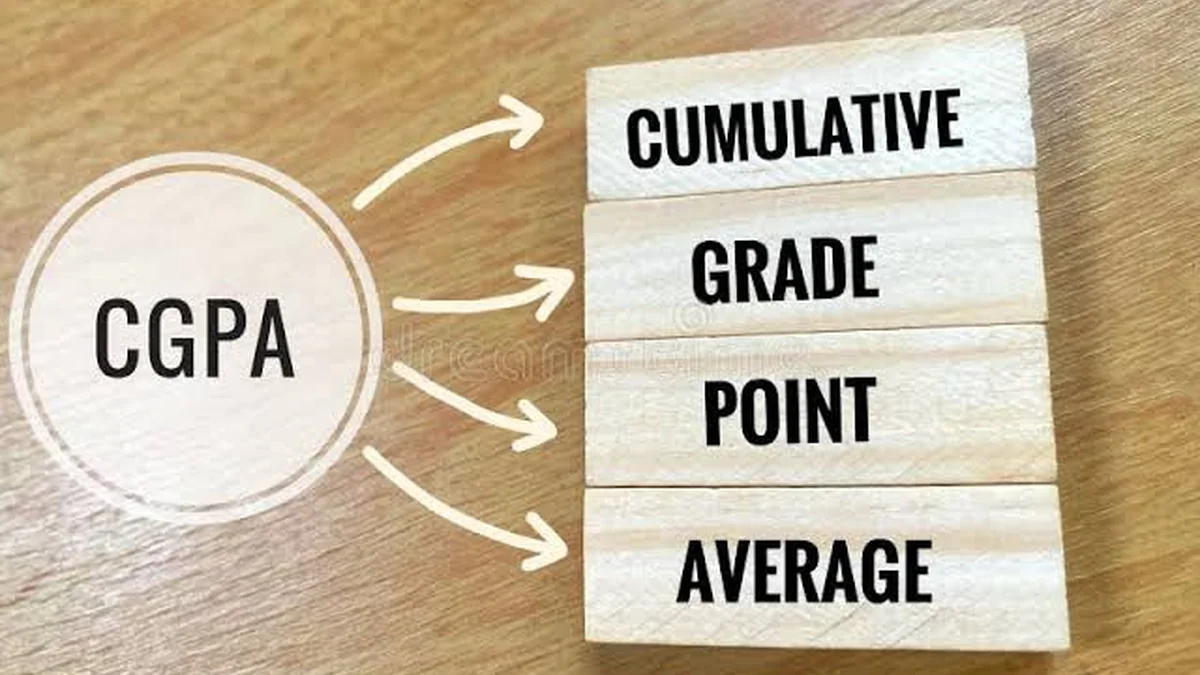
You check your transcript and there it is: one number supposed to sum up years of exams, all-nighters, and the one class you probably shouldn’t have taken pass/fail. That number is your cumulative GPA, and most students only really understand it once they need it for something — an internship application, a scholarship renewal, or a “are you eligible” email from the registrar.
Cumulative GPA is the credit-weighted average of every graded course you’ve completed at an institution, calculated by dividing your total quality points (grade value × credit hours) by your total credit hours attempted. It’s different from a semester GPA, which only reflects one term, and it’s the number colleges and employers actually rely on for eligibility decisions.
To simplify the process of tracking grade points and credit hours, use our GPA calculator.
What Is Cumulative GPA, Exactly?
Cumulative GPA — sometimes written as CGPA, especially outside the U.S. — is your overall academic average across every term you’ve completed at a school. Not just this semester. Not just your major courses. Everything with a letter grade, from freshman year on.
It’s the number that shows up on your official transcript. It’s what determines whether you stay off academic probation, whether you qualify for the Dean’s List, and whether you graduate with honors. A recruiter skimming your resume, a grad school admissions committee, a scholarship office — they’re all looking at this figure, not your best semester.
Cumulative GPA vs. Semester GPA
A semester GPA is a snapshot. It tells you how one term went, full stop. Cumulative GPA is the whole movie — every semester rolled into a single, ongoing average.
Here’s the part that trips people up: a rough semester barely dents a strong cumulative GPA, and one great semester rarely rescues a weak one. The more credits you’ve already banked, the harder it gets to move the cumulative number in either direction. That’s not a flaw in the system — it’s just math, and it means the earlier semesters of college carry outsized weight.
Cumulative GPA vs. Weighted GPA
These two get confused constantly, but they answer different questions.
Weighted GPA is about course difficulty — an A in an AP or Honors class might count as a 5.0 instead of a 4.0, rewarding you for taking a harder course. Cumulative GPA is about time span — it has nothing to do with course rigor and everything to do with combining multiple terms into one number using credit hours as the weight.
You can have a weighted GPA on a 5.0 scale for a single semester, and still have that semester feed into a cumulative GPA calculated on your school’s standard scale. They’re doing two different jobs.
The Cumulative GPA Formula (With the Math Explained)
The formula looks intimidating in shorthand, so here it is in plain terms first:
Cumulative GPA = Total Quality Points ÷ Total Credit Hours Attempted
Where quality points for any single course equal the grade’s point value multiplied by that course’s credit hours. Add up quality points across every graded course you’ve ever taken, add up every credit hour, divide one by the other. That’s it.
Written the way most college advising offices phrase it: Cumulative GPA = Σ (Semester GPA × Semester Credits) ÷ Σ (Total Credits).
Why You Can’t Just Average Your Semester GPAs
This is the single most common cumulative GPA mistake, and it’s an easy one to make because a plain average feels right.
Say you earned a 3.5 GPA one semester and a 3.2 GPA the next. Simple math says the average is 3.35. But if the first semester was 12 credits and the second was 18 credits, that second semester should count for more — you completed more work at that grade level. A credit-weighted calculation accounts for that; a plain average doesn’t.
This is exactly why two students with identical semester GPAs can end up with different cumulative GPAs, depending on how many credits each semester carried.
Quick Takeaway: Cumulative GPA weights by credit hours, not by semester count. A 15-credit semester influences your cumulative GPA more than a 9-credit one, regardless of which came first.
How to Calculate Your Cumulative GPA Step by Step
- List every graded course you’ve completed, across all semesters, with its letter grade and credit hours.
- Convert each letter grade to its point value using your school’s scale (most U.S. schools use a standard 4.0 scale; some add a 4.3 scale for A+).
- Multiply each grade’s point value by that course’s credit hours to get quality points per course.
- Add up all the quality points across every course and every semester.
- Add up all the credit hours for every graded course.
- Divide total quality points by total credit hours. The result is your cumulative GPA.
Worked Example: Three Semesters, One Cumulative GPA
Let’s say a student’s record looks like this:
| Semester | Semester GPA | Credit Hours | Quality Points |
|---|---|---|---|
| Fall 2024 | 3.5 | 15 | 52.5 |
| Spring 2025 | 3.8 | 16 | 60.8 |
| Fall 2025 | 3.2 | 14 | 44.8 |
| Total | — | 45 | 158.1 |
Cumulative GPA = 158.1 ÷ 45 = 3.51
Notice that a simple average of 3.5, 3.8, and 3.2 comes out to 3.50 — close, but not the same as the credit-weighted 3.51. The difference is small here, but on a transcript with wildly uneven course loads across semesters, it can matter enough to change eligibility for a scholarship or honors cutoff.
What Counts — and What Doesn’t
Not every entry on your transcript affects your cumulative GPA the same way. This is where a lot of students misjudge their own standing.
| Course Type | Effect on Cumulative GPA |
|---|---|
| Standard letter-graded course | Fully counted, weighted by credit hours |
| Pass/Fail (Pass) | Credits count toward graduation, no GPA impact |
| Pass/Fail (Fail) | Usually counted as a 0.0, hurting GPA |
| Withdrawal (W) | Typically no GPA impact |
| Withdrawal-Fail (WF) | Often counted as an F, depending on the school |
| Repeated course (with replacement policy) | Old grade may be removed from GPA calculation entirely |
| Transfer credits | Often count toward degree credits but not toward GPA, depending on institution policy |
Policies vary by school on nearly every row in that table, so the honest answer is: check your specific institution’s academic catalog before assuming how a withdrawal or repeat will land on your GPA.
What Different Cumulative GPA Ranges Actually Mean
GPA cutoffs aren’t universal, but there are patterns most U.S. colleges follow closely enough to be useful as a general guide:
- 3.9 and above — typically eligible for summa cum laude honors, highly competitive for top graduate programs and selective employers.
- 3.7–3.89 — commonly the range for magna cum laude, strong for scholarships and competitive internships.
- 3.5–3.69 — usually the Dean’s List cutoff at most schools, solid standing across the board.
- 3.0–3.49 — generally considered “good,” competitive for most graduate programs.
- 2.0–2.99 — meets minimum graduation requirements at most schools, but limits access to competitive programs.
- Below 2.0 — commonly triggers academic probation; policies differ by institution.
Treat these as reference points, not guarantees — every school sets its own thresholds for honors, probation, and Dean’s List eligibility.
Common Mistakes That Quietly Wreck a Cumulative GPA
A few patterns show up again and again in students who are surprised by their cumulative GPA:
- Assuming a plain average instead of a credit-weighted one. As shown above, this can overstate or understate the real number.
- Rounding too early. Many schools allow rounding to the nearest tenth for reporting purposes (3.48 becomes 3.5), but rounding up to a whole number generally isn’t permitted, and rounding mid-calculation compounds errors across semesters.
- Forgetting that a WF isn’t the same as a W. Assuming a messy withdrawal has “no effect” when the school actually codes it as a failing grade.
- Not checking the repeat policy. Some schools replace the old grade in the GPA calculation when you retake a course; others average both attempts. That distinction changes your strategy for which classes are worth retaking.
- Ignoring credit load when comparing semesters. A 3.8 in a 12-credit semester and a 3.2 in an 18-credit semester don’t cancel out evenly — the heavier semester pulls harder.
How to Raise a Low Cumulative GPA (What Actually Works)
The math from earlier explains why this section matters: the more total credits you’ve accumulated, the smaller the effect of any single new semester. That’s discouraging for a senior, but it’s also useful information — it tells you where your effort actually pays off.
- Prioritize high-credit courses for your strongest grades. A 4-credit A moves the needle more than a 1-credit A.
- Check your school’s course repeat or grade-replacement policy. If retaking a class removes the old grade from your GPA calculation, a low grade from freshman year isn’t necessarily permanent.
- Take on a heavier credit load only in terms where you’re confident you can perform well. More credits at a high GPA accelerates recovery; more credits at a mediocre GPA does the opposite.
- Use pass/fail selectively for electives that could otherwise hurt your average, if your school allows it and the course isn’t required to be graded for your major.
- Model it out before committing. Plugging your current GPA and credit hours into a cumulative GPA calculator, then testing “what if” scenarios for the next semester, shows you exactly how many credits at what grade it takes to hit a specific target — far more useful than guessing.
Cumulative GPA and Grad School, Scholarships, and Honors
Admissions committees, scholarship offices, and honors programs almost universally use cumulative GPA rather than a single strong semester, because it’s the metric that reflects sustained performance rather than a good stretch. Graduate programs typically list a minimum cumulative GPA for consideration — commonly somewhere in the 3.0 range for general admission and higher for competitive fields — though the exact bar varies significantly by program and discipline. Scholarship renewal requirements almost always specify a cumulative, not semester, threshold, which is why a single rough term can put continued funding at risk even if the following semester bounces back.
For students and teachers alike, GradeCalcs.com offers a full range of free calculators.
FAQ Section
What is the difference between GPA and cumulative GPA? “GPA” often refers to a single semester’s average, while cumulative GPA combines every completed semester into one credit-weighted average. Cumulative GPA is the figure that appears on official transcripts and is used for academic standing, honors, and graduation requirements.
How do you calculate cumulative GPA with different credit hours? Multiply each semester’s GPA by its credit hours to get quality points, add those quality points across all semesters, then divide by the total credit hours. This credit-weighting is what makes cumulative GPA different from a simple average of semester GPAs.
Does pass/fail affect cumulative GPA? A passing grade in a pass/fail course typically adds credits toward graduation but doesn’t change your GPA. A failing grade in a pass/fail course is usually recorded as a 0.0, which does lower cumulative GPA.
What GPA is needed to graduate with honors? Requirements vary by school, but summa cum laude commonly requires around 3.9 or higher, and magna cum laude around 3.7 or higher. Always confirm exact cutoffs with your institution’s academic catalog.
Can you raise your cumulative GPA after a bad semester? Yes, though the effect shrinks as you accumulate more total credits. Strong performance in high-credit semesters, combined with any available grade-replacement policy for retaken courses, offers the fastest realistic path upward.
Is cumulative GPA the same as CGPA? Yes. “CGPA” is more common internationally, while “cumulative GPA” is the standard term in the U.S., but both describe the same credit-weighted average across all completed terms.
Does a withdrawal (W) hurt your cumulative GPA? A standard withdrawal typically doesn’t affect cumulative GPA at all. However, a withdrawal-fail (WF) may be treated the same as an F by some institutions, so it’s worth checking your school’s specific policy before withdrawing.
What cumulative GPA do graduate schools look for? Many graduate programs set a general minimum around 3.0, though this varies widely by field and program competitiveness. Highly selective programs often expect cumulative GPAs well above that baseline.

Saved as a favorite, I really like your site!