

You got your test back, saw a “B+,” and immediately wondered what that actually means in percentage terms. Converting a letter grade to percentage is one of the most common mix-ups in school — the letters feel abstract, but the number underneath is what actually decides your GPA.
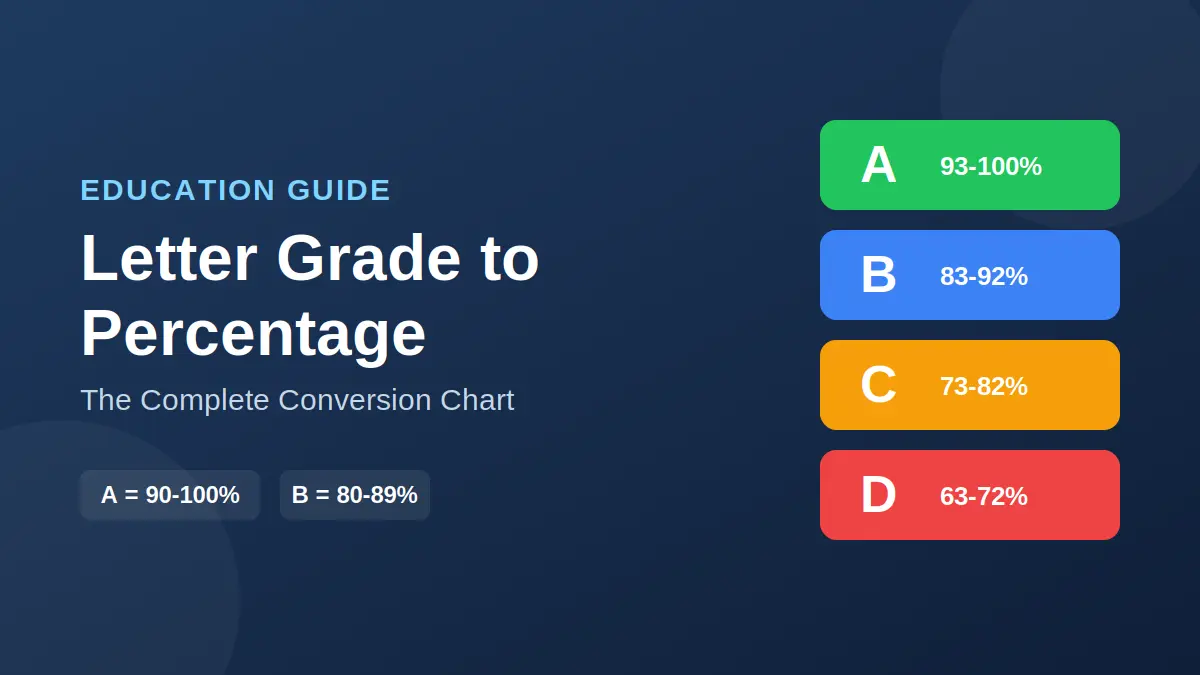
On the standard U.S. grading scale, A ranges from 90–100%, B from 80–89%, C from 70–79%, D from 60–69%, and F is anything below 60%. Plus/minus versions split each letter into three smaller bands (like B+, B, B-), and the exact cutoffs still vary by school.
That’s the short answer. But the details matter more than most people realize, because two schools can report the exact same percentage and land on two different letters. Let’s break down where those differences come from and how to read your own grade correctly.
Try our grade calculator to estimate your final grade.
The Standard Letter Grade to Percentage Chart
Most U.S. high schools and colleges use some version of the plus/minus scale below. It’s not universal, but it’s the closest thing to a default.
| Letter Grade | Percentage Range | GPA (4.0 scale) |
|---|---|---|
| A+ | 97–100% | 4.0 |
| A | 93–96% | 4.0 |
| A- | 90–92% | 3.7 |
| B+ | 87–89% | 3.3 |
| B | 83–86% | 3.0 |
| B- | 80–82% | 2.7 |
| C+ | 77–79% | 2.3 |
| C | 73–76% | 2.0 |
| C- | 70–72% | 1.7 |
| D+ | 67–69% | 1.3 |
| D | 63–66% | 1.0 |
| D- | 60–62% | 0.7 |
| F | Below 60% | 0.0 |
A few schools shift these bands slightly — some start A at 93%, others push it to 94% or even 95%. If your syllabus lists a scale, that one always overrides any general chart, including this one.
Quick Takeaway: The number that matters most is the cutoff for the letter above yours. If you’re at 89%, you’re one point from a B+ becoming an A-. Knowing that changes how you approach the next assignment.
Letter Grade to GPA: How the Two Connect
Percentage grades and GPA are related but not identical systems. Your percentage reflects performance on a 0–100 scale; GPA converts that into a 0–4.0 scale so colleges can compare students across different courses and even different schools.
Here’s the connection in practice: a 94% and a 96% both round to an A and both usually earn a 4.0 GPA. The percentage tells you precisely how you did; the GPA tells admissions committees and scholarship boards where you rank overall. That’s why a student can hold a 3.9 GPA without ever posting a perfect percentage score — small variations within the same letter grade don’t move the GPA needle.
Weighted GPA complicates this further. Honors and AP courses often add extra GPA points (commonly 0.33 to 1.0) for the same letter grade, which is why a “B” in an AP class might carry the same GPA weight as an “A” in a standard class. The percentage-to-letter conversion itself doesn’t change — only how that letter feeds into the final GPA calculation.
Why the Same Grade Can Mean Different Things at Different Schools
This is the part most conversion charts skip, and it’s the actual reason people get confused.
Plus/Minus Scale vs. Straight Letter Scale
Some schools only use five letters — A, B, C, D, F — with no plus or minus at all. On that kind of scale, A typically covers 90–100%, B covers 80–89%, and so on, in ten-point blocks. If your school does this, an 87% and a 99% are both simply an “A.” Compare that to a plus/minus school, where those same two scores split into a B+ and an A+ — two very different results from the same numbers.
Before trusting any general chart, check your syllabus or student handbook for which system your instructor actually follows.
High School vs. College Grading
High schools tend to run the more forgiving version of the scale, often starting A at 90%. Many colleges tighten that threshold, requiring 93% or even 94% for a full A, with anything from 90–92% landing as an A-. This shift catches a lot of students off guard in their first semester — a percentage that would have earned an A in high school might come back as an A- or B+ in a college course with stricter cutoffs.
Common Grade Conversion Mistakes to Avoid
- Assuming every class uses the same scale. Individual professors, especially in college, sometimes set their own cutoffs.
- Rounding too early. An 89.4% might round to 89% (a B+) on one syllabus and be truncated to 89% flat on another — check whether your school rounds decimals up.
- Confusing weighted and unweighted GPA. A weighted A in an AP class and an unweighted A in a regular class both show as “A” on a report card but carry different GPA values.
- Ignoring category weighting. A course average isn’t just an average of test scores — homework, quizzes, and finals are often weighted differently, so your “percentage” is really a blended number.
How to Find Your School’s Exact Scale
The fastest way to get an accurate answer for your own grade is to check the syllabus, student handbook, or learning portal (Canvas, PowerSchool, etc.) your school uses — these almost always list the exact percentage cutoffs. If nothing is posted, ask your instructor directly; it’s a completely normal question, and most are glad to clarify rather than have students guess.
Quick Takeaway
Standard scale: A = 90–100%, B = 80–89%, C = 70–79%, D = 60–69%, F = below 60%. Plus/minus versions split each into three bands. Always confirm your school’s exact cutoffs before treating any general chart as final.
Conclusion
Letter grades feel simple until you need the actual number behind them — and that number depends more on your specific school’s policy than on any universal rule. Use the standard chart above as your starting point, but always cross-check it against your syllabus or handbook, especially if you’re right on a cutoff. If you’re trying to hit a target GPA this semester, working backward from the percentage ranges above is the clearest way to see exactly how many points you need on your next assignment.
From GPA to weighted grades, you can find every calculator you need on our homepage. — Best in last paragraph.
FAQ Section
What percentage is an A?
On the standard U.S. scale, an A typically covers 93–96%, with 97–100% earning an A+. Some schools use a simpler cutoff of 90% and up for any A. Always check your specific school’s chart, since colleges often require a higher percentage than high schools do.
What percentage is a B?
A straight B usually falls between 83–86% on the plus/minus scale, or 80–89% on schools that don’t use plus/minus grading. It reflects solid, above-average work and typically carries a 3.0 GPA value.
What is a 3.0 GPA in percentage?
A 3.0 GPA corresponds to a straight B, which is usually 83–86% on the standard plus/minus scale. Since GPA reflects an average across all your courses, your actual percentages in each class could vary while still averaging to a 3.0.
Is 80% a B or B-?
On most plus/minus scales, 80% is a B-. On schools using straight letters without pluses or minuses, 80% is simply a B. This is one of the most common points of confusion, so check your syllabus if you’re near this cutoff.
What’s the lowest passing grade?
Most U.S. schools set the passing threshold at 60%, which corresponds to a D- or D depending on the scale. Anything below 60% is typically recorded as an F. Some schools set a higher passing bar, particularly for required courses.
Do all schools use the same grading scale?
No. Grading scales vary by school, and sometimes by individual instructor within the same school. High schools generally use more forgiving cutoffs than colleges, and some institutions skip plus/minus grades entirely.
What percentage is a D?
A D generally falls between 60–69%, split into D+ (67–69%), D (63–66%), and D- (60–62%) on plus/minus scales. It’s a passing grade at most schools but reflects below-average performance.
How is GPA calculated from percentage?
Each percentage grade converts to a letter grade first, and each letter has an assigned GPA value (A = 4.0, B = 3.0, and so on, with plus/minus adjustments of about 0.3). Your overall GPA is the average of these values across all your courses, often weighted by credit hours.
