

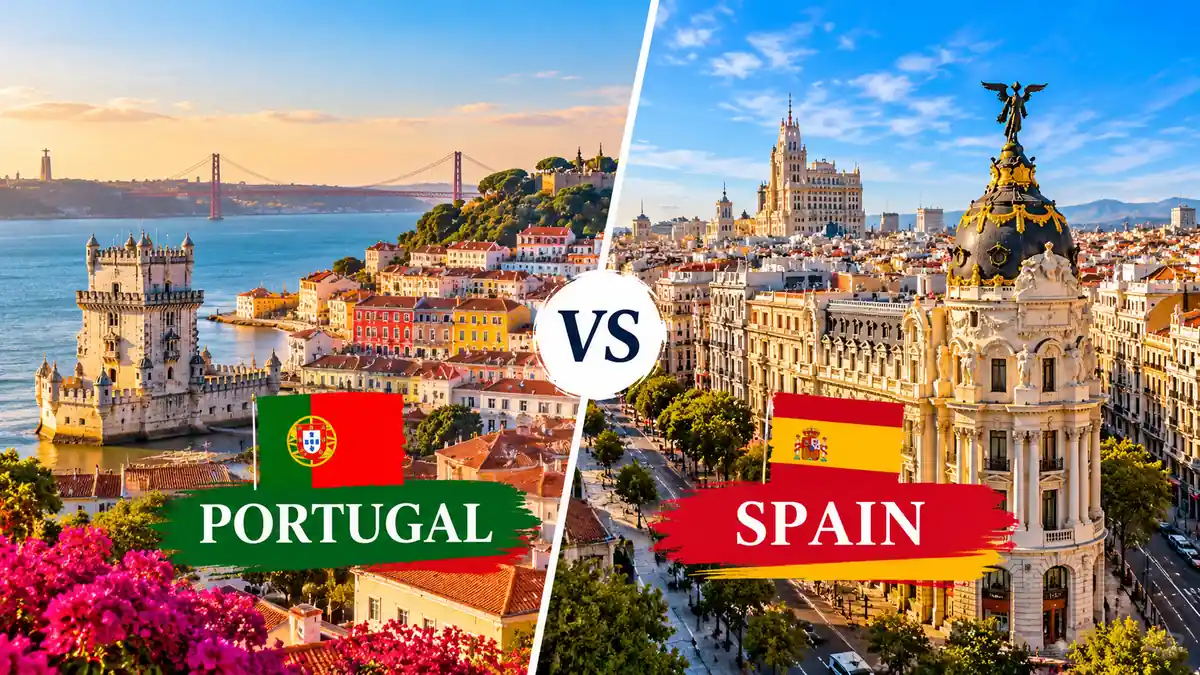
Portugal and Spain share the Iberian Peninsula, centuries of interconnected history, and a reputation for beautiful coastlines, historic cities, and excellent food. Yet visiting or living in these neighboring countries can feel surprisingly different.
The portugal vs spain comparison comes down to more than geography. Portugal is smaller, has an Atlantic-focused coastline, and is known for its Portuguese language, maritime heritage, and relatively relaxed atmosphere. Spain is larger, more populous, and regionally diverse, with Mediterranean and Atlantic coastlines, distinctive regional identities, and a wider variety of major cities.
Both countries belong to the European Union, use the euro, and offer rich cultural experiences. Understanding their differences in climate, affordability, transportation, cuisine, history, and daily life can help travelers, students, and prospective residents make informed decisions.
portugal vs spain: Quick Country Comparison
Lisboa.pt – Website oficial do Município
Portugal
Car Rentals in Madrid from $11/day – Search for Rental Cars on KAYAK
Spain
| Feature | Portugal | Spain |
|---|---|---|
| Capital | Lisbon | Madrid |
| Area | Approx. 92,200 km² | Approx. 506,000 km² |
| Population | Approx. 10.7 million | Approx. 49 million |
| Main official language | Portuguese | Spanish (Castilian) |
| Currency | Euro (€) | Euro (€) |
| Government | Parliamentary republic | Parliamentary constitutional monarchy |
| EU membership | Since 1986 | Since 1986 |
| Time zone (mainland) | UTC+0 / UTC+1 | UTC+1 / UTC+2 |
| Major cities | Lisbon, Porto, Braga, Coimbra | Madrid, Barcelona, Valencia, Seville |
| Coastline | Predominantly Atlantic | Mediterranean and Atlantic |
| Famous cuisine | Bacalhau, pastel de nata | Paella, tapas, tortilla española |
| Notable traditions | Fado, azulejos | Flamenco, regional festivals |
Population figures are rounded estimates and change over time. Mainland time zones include seasonal daylight saving adjustments.
One immediate difference is scale. Spain covers more than five times Portugal’s area and has more than four times its population. That difference affects everything from regional climates to transportation networks and the number of large metropolitan areas.
Geography and Natural Landscapes
Where are Portugal and Spain located?
Both countries occupy most of the Iberian Peninsula in southwestern Europe. Portugal lies along the peninsula’s western edge, while Spain occupies most of the remaining territory.
Portugal borders Spain to the north and east and the Atlantic Ocean to the west and south. Spain borders Portugal, France, Andorra, and Gibraltar, and has access to both the Atlantic Ocean and Mediterranean Sea.
Spain also includes the Balearic Islands in the Mediterranean, the Canary Islands in the Atlantic, and the North African autonomous cities of Ceuta and Melilla. Portugal includes the autonomous island regions of Madeira and the Azores.
Portugal’s landscapes
Douro Valley Bike Tour – Portugal Cycling Holidays
Madeira Road Trip: Funchal & Porto Moniz | Portugal Getaways
7
Portugal offers impressive geographic variety despite its smaller size.
The Algarve is known for golden beaches, limestone cliffs, and sheltered coves. Northern Portugal features green hills, historic villages, and the terraced vineyards of the Douro Valley, a UNESCO World Heritage landscape.
The Serra da Estrela mountains provide hiking and occasional winter snow. Madeira is famous for volcanic terrain, dramatic cliffs, and levada walking routes, while the Azores are associated with crater lakes, geothermal features, and lush scenery.
Spain’s landscapes
Découvrez cette destination secrète de la Costa Brava : plages, histoire et gastronomie réunies
Hiszpania – Andaluzja – Planet Escape
8
Spain’s greater size creates even more climatic and geographical contrasts.
The Pyrenees form a mountainous border with France, while the Sierra Nevada rises above southern Andalusia. Central Spain is dominated by the Meseta Central plateau, and the northern coast has green valleys and rugged cliffs.
Mediterranean regions such as the Costa Brava, Costa Blanca, and Costa del Sol offer warm coastal environments. The Canary Islands introduce subtropical and volcanic landscapes that differ considerably from mainland Spain.
Key difference: Portugal is especially associated with Atlantic scenery, while Spain offers a broader combination of Atlantic, Mediterranean, mountainous, and island environments.
portugal vs spain: Climate and Weather Differences
Climate is one of the most practical considerations when comparing the two countries.
Portugal generally has an Atlantic-influenced climate, although its southern and inland areas can become very hot and dry. Spain’s weather varies more dramatically because of its larger territory, higher central plateau, and Mediterranean coast.
| Region | Typical climate | Seasonal characteristics |
|---|---|---|
| Lisbon | Mediterranean with Atlantic influence | Warm, dry summers; mild, wetter winters |
| Porto | Atlantic-influenced | Cooler, wetter winters; pleasant summers |
| Algarve | Mediterranean | Hot, dry summers; mild winters |
| Madrid | Continental Mediterranean | Hot summers; cold winters |
| Barcelona | Coastal Mediterranean | Warm summers; generally mild winters |
| Seville | Hot-summer Mediterranean | Extremely hot summers; mild winters |
| Northern Spain | Oceanic | Rainier, greener, and relatively mild |
Which country is warmer?
Spain has some of Europe’s hottest major inland cities. Seville and Córdoba regularly experience intense summer heat, sometimes exceeding 40°C during heatwaves.
Portugal’s coastal cities, particularly Porto and Lisbon, are often moderated by Atlantic winds. However, inland Portugal can also experience extreme summer temperatures.
The comparison changes when considering winter. Southern Spain, the Algarve, Madeira, and the Canary Islands are popular for relatively mild conditions, although none guarantees beach weather year-round.
Best seasons for visiting
Spring, particularly April through June, and early autumn, especially September and October, are excellent periods for sightseeing in much of both countries.
July and August are popular for beaches but can be uncomfortably hot in inland Spain and parts of Portugal. Winter suits travelers interested in quieter cities, museums, and some southern coastal destinations.
Cost of Living: Is Portugal Cheaper Than Spain?
Portugal has traditionally been viewed as the more affordable of the two countries, but the reality depends heavily on the city, housing costs, and lifestyle.
Lisbon and Porto have experienced substantial housing-cost pressure, while Madrid and Barcelona remain among Spain’s most expensive urban markets.
At the same time, smaller Spanish cities can be more affordable than Lisbon, and inland Portuguese towns can cost considerably less than either capital.
Housing and everyday expenses
| Expense | Portugal | Spain |
|---|---|---|
| Housing | High pressure in Lisbon, Porto, and popular coastal areas | High pressure in Madrid, Barcelona, and some coastal areas |
| Groceries | Often reasonably priced outside tourist districts | Competitive prices and broad supermarket selection |
| Restaurants | Traditional local eateries can be economical | Affordable local menus and tapas options |
| Public transportation | Strong networks in Lisbon and Porto | Extensive urban and intercity networks |
| Utilities | Vary by season and housing efficiency | Vary by region and heating or cooling needs |
| Healthcare | Public and private systems available | Public and private systems available |
These are broad patterns, not fixed price rankings. Rent, household size, and neighborhood usually have a greater effect on monthly spending than small differences in grocery prices.
Which country offers better value?
For someone working remotely on an external income, smaller Portuguese cities may provide an attractive balance of affordability and lifestyle. Spain can offer comparable value in cities such as Zaragoza, Valladolid, or Granada.
However, purchasing power matters. Spain generally has a larger economy and a broader employment market, while wages in Portugal have historically been lower on several measures.
A realistic comparison should consider after-tax earnings, rent, transportation, healthcare access, and household expenses together rather than relying on average national living-cost figures.
Language and Communication: Portuguese vs Spanish
Portuguese and Spanish are Romance languages that evolved from Latin. They share substantial vocabulary and grammatical similarities, but pronunciation and everyday expressions differ.
Are Portuguese and Spanish mutually intelligible?
Speakers can often recognize written words in the other language, especially when the subject is familiar. Spoken communication is more complicated.
European Portuguese features reduced unstressed vowels and distinctive consonant sounds. Spanish generally has clearer vowel pronunciation, which some learners find easier to distinguish.
Understanding is also asymmetric: some Portuguese speakers understand spoken Spanish more readily than Spanish speakers understand spoken Portuguese. However, this varies with exposure, dialect, and individual experience.
| English | Portuguese | Spanish |
|---|---|---|
| Hello | Olá | Hola |
| Thank you | Obrigado/Obrigada | Gracias |
| Good morning | Bom dia | Buenos días |
| Please | Por favor | Por favor |
| Good night | Boa noite | Buenas noches |
| Water | Água | Agua |
| Where is…? | Onde fica…? | ¿Dónde está…? |
Regional languages in Spain
Spain has a more complex linguistic landscape. Alongside Castilian Spanish, several regional languages hold official status in their respective territories.
Catalan is widely spoken in Catalonia and the Balearic Islands, while Valencian is the regional designation used in the Valencian Community. Galician is spoken in Galicia, and Basque is used in the Basque Country and parts of Navarre.
Basque is especially distinctive because it is not a Romance language and has no established genetic relationship with the Indo-European language family.
Portugal has greater linguistic uniformity, although Mirandese has recognized status in a limited northeastern area.
Culture, History, and National Identity
Portugal and Spain share historical influences from the Roman Empire, Germanic kingdoms, and medieval Islamic rule. Nevertheless, they developed into separate political and cultural identities.
How Portugal and Spain became separate countries
Portugal emerged as an independent kingdom during the 12th century. The Treaty of Zamora in 1143 was an important milestone in the recognition of Portuguese kingship, while subsequent agreements helped establish its political independence.
Spain developed through the consolidation of several Christian kingdoms, especially the dynastic union of Castile and Aragon in the late 15th century.
The two countries were briefly ruled by the same monarchs during the Iberian Union from 1580 to 1640. Portugal restored its independence in 1640, although Spain formally recognized it in 1668.
Today, both are democratic European countries, but their political structures differ. Portugal is a semi-presidential republic, while Spain is a parliamentary constitutional monarchy. European Union+1
Portugal’s cultural identity
Hotéis boutique em Lisboa, hotéis de luxo e apartamentos com estilo
Lisbon: Intimate Fado Show in the Historic Fado District | GetYourGuide
Rejseguide til Porto: Seværdigheder, mad og oplevelser i Portugal
8
Portugal’s cultural heritage is closely connected to the Atlantic Ocean and the Age of Discovery.
During the 15th and 16th centuries, Portuguese explorers such as Vasco da Gama established maritime routes linking Europe, Africa, Asia, and South America. This expansion also involved colonization, forced labor, and the Atlantic slave trade, making its legacy complex.
Distinctive Portuguese traditions include fado music, decorative azulejo tiles, and celebrations such as Lisbon’s Santo António festivities.
The concept of saudade, often associated with longing or nostalgia, is frequently discussed as an important theme in Portuguese literature and music.
Spain’s cultural identity
TABLAO FLAMENCO EL PALACIO ANDALUZ – Spectacles – Séville – Espagne
Monumentos famosos de Europa – Guiajando.com
Spanske fiestas: 10 unikke festivaler du skal opleve i Spanien
8
Spain’s culture reflects strong regional identities.
Andalusia is associated with flamenco, historic Moorish architecture, and festivals such as the Feria de Abril. Catalonia is known for its distinctive language, modernist architecture, and the works of Antoni Gaudí.
The Basque Country has its own language, culinary traditions, and cultural institutions. Galicia shares historical and linguistic connections with northern Portugal.
Spain is also associated with internationally recognized artists, including Pablo Picasso, Salvador Dalí, and Francisco Goya.
Neither country has one uniform cultural personality. Differences between Porto and the Algarve, or between Barcelona and Seville, can be as noticeable as some differences across the international border.
Food and Cuisine: What Makes Each Country Different?
Food is central to daily life in both countries. Olive oil, seafood, bread, vegetables, wine, and regional specialties feature prominently in their culinary traditions.
Traditional Portuguese food
第92話 ポルトガルのバカリャウ・ア・ブラス(黄金色のタラとポテトの卵炒め)🇵🇹|tsukasa
Bacalhau à BrásSalt cod, potatoes, and eggs
Pastel de nata tarts and cinnamon sticks on wooden tray. Top view.
Pastel de nataTraditional custard pastry
Caldo Verde – Receita Portuguesa Tradicional | LusoSabor
Caldo verdePotato and greens soup
What you need to know about Portuguese food | SBS Food
Sardinhas assadasGrilled sardines
Portuguese cooking frequently emphasizes seafood, grilled fish, hearty soups, and simple preparations that showcase ingredients.
Bacalhau, or salted cod, is particularly important. It appears in numerous recipes, including bacalhau à Brás and bacalhau com natas.
Portugal is also famous for pastel de nata, a custard tart often enjoyed with coffee. The Douro Valley produces Port wine, while the Vinho Verde region is associated with fresh, often light-bodied wines.
Traditional Spanish food
PaellaValencian rice dish
Spanish Food in Spain: 2025 Study Abroad Food Guide
TapasSmall dishes for sharing
Spanische Tortilla – wie in Spanien! | Einfach Kochen
Tortilla españolaSpanish potato omelet
What Is Seville’s Famous Food? | ®ExcursionMania
GazpachoChilled Andalusian soup
Spanish cuisine varies significantly by region. Valencia is associated with paella, Andalusia with gazpacho, Galicia with seafood, and the Basque Country with pintxos and an influential restaurant culture.
Jamón ibérico, tortilla española, croquetas, and patatas bravas are widely recognized specialties.
Spanish wine regions include Rioja, Ribera del Duero, and Jerez, the latter famous for sherry.
Dining customs and meal times
Spanish evening meals often begin later than those in Portugal, especially in major cities and during summer.
In Spain, dinner at 9 p.m. or later is common in many settings. Portuguese restaurants generally offer earlier evening dining, although schedules vary by location.
Both countries value social meals, café culture, and leisurely dining experiences.
Tourism: Is Portugal or Spain Better to Visit?
The answer depends on the type of experience a traveler wants.
Portugal is particularly attractive for compact itineraries combining historic cities, Atlantic beaches, and scenic countryside. Spain offers more geographical variety, a greater number of major cities, and extensive regional travel opportunities.
Best places to visit in Portugal
Lisbon
Portugal’s capital offers Alfama’s narrow streets, Belém’s monuments, viewpoints, trams, and riverside neighborhoods.
Investimentos em Propriedades à Beira-Mar em Lisboa: Oportunidades e Desafios
Porto
Famous for the Douro River, historic Ribeira district, Port wine cellars, and distinctive architecture.
Sintra
A UNESCO-listed cultural landscape known for Pena Palace, romantic gardens, and forested hills.
Dit zijn de 10 mooiste stranden van Portugal.
Algarve
A southern coastal region with beaches, sea caves, fishing towns, and striking limestone formations.
Best places to visit in Spain
3 Days in Madrid: Itinerary and Tips – Arrivals Hall
Madrid
The capital combines world-class art museums, royal architecture, parks, and lively neighborhoods.
Inside Sagrada Familia: A Glimpse into Gaudí’s Masterpiece!
Barcelona
Known for Gaudí’s architecture, Mediterranean beaches, cultural attractions, and Catalan heritage.
Seville
A major Andalusian destination with the Alcázar, cathedral, flamenco traditions, and historic plazas.
Granada
Celebrated for the Alhambra palace complex, Albaicín neighborhood, and Islamic architectural heritage.
4.4
4.8
5.0
4.6
5.0
4.6
4.8
4.6
Use two fingers to move the map
Use ctrl + scroll to zoom the map
All groups
Which country has better beaches?
Portugal’s Atlantic beaches are ideal for dramatic coastal scenery and surfing. Nazaré, Peniche, Ericeira, and parts of the Algarve are internationally recognized coastal destinations.
Spain provides a wider variety of beach environments. Mediterranean areas often have calmer, warmer summer waters, while the Atlantic coast offers surfing, rugged scenery, and cooler conditions.
The Balearic Islands are particularly popular for turquoise coves, while the Canary Islands offer distinctive volcanic beaches and generally mild temperatures.
Travelers who prioritize warmer Mediterranean swimming conditions may prefer Spain. Those interested in Atlantic surfing and dramatic cliffs may lean toward Portugal.
Which country is better for families?
Both countries can be excellent for family travel.
Portugal’s relatively compact geography makes it possible to combine Lisbon, Sintra, Porto, and coastal destinations without covering enormous distances.
Spain offers theme parks, museums, beaches, and family-friendly attractions across numerous regions, but longer travel distances may require more planning.
The best choice depends on children’s ages, travel pace, seasonal weather, and the distances between planned activities.
Transportation and Infrastructure
Transportation is an area where Spain has a significant advantage in scale.
Public transportation in Portugal
Portugal has established urban transportation networks in Lisbon and Porto, including metro services, buses, suburban trains, and trams.
Comboios de Portugal (CP) operates the national rail network, with Alfa Pendular and Intercidades services connecting important cities.
Travel between Lisbon and Porto is relatively straightforward by train, while reaching some rural areas or smaller coastal towns is easier by car.
Public transportation in Spain
Spain operates one of the world’s largest high-speed railway networks.
Renfe and other operators provide services linking cities such as Madrid, Barcelona, Valencia, Seville, Málaga, and Zaragoza.
The AVE high-speed rail system has transformed intercity travel by making many journeys practical without flying.
Major Spanish cities also have extensive metro, bus, and commuter rail networks.
Traveling between Portugal and Spain
Despite their shared border, rail connections between the countries are less extensive than many visitors expect.
Travelers often use flights, long-distance buses, or rental cars for cross-border journeys. Certain regional rail connections exist, but direct high-speed service between Lisbon and Madrid is not currently a standard option.
The most convenient route depends on the cities involved. For example, southern Portugal and western Andalusia are geographically close, while Lisbon and Barcelona are much farther apart.
Economy, Employment, and Business Opportunities
Spain has a much larger economy, reflecting its population, industrial base, and domestic market.
Portugal’s economy is smaller but includes important sectors such as tourism, manufacturing, technology services, renewable energy, and international trade.
Economic indicators
| Indicator | Portugal | Spain |
|---|---|---|
| GDP, 2025 | Approx. US$347 billion | Approx. US$1.91 trillion |
| GDP per capita, 2025 | Approx. US$32,082 | Approx. US$38,627 |
| GDP growth, 2025 | 1.9% | 2.8% |
| Unemployment, 2025 | 6.2% | 10.4% |
Source: World Bank, 2025 indicators. GDP values are in current US dollars; unemployment figures are modeled ILO estimates. Data+1
GDP per capita comparison, 2025
Current US dollars, World Bank
$0$15,000$30,000$45,000PortugalSpain
Spain’s larger GDP does not automatically mean every worker earns more or has better job prospects. Employment conditions depend on the industry, qualifications, language ability, and location.
Employment opportunities
Spain has substantial industries in automotive manufacturing, tourism, financial services, agriculture, renewable energy, and technology.
Madrid and Barcelona are major business and employment centers, while Valencia, Málaga, Bilbao, and other cities support important regional industries.
Portugal has growing technology and business-services sectors, particularly around Lisbon, Porto, and Braga. Tourism, textiles, footwear, automotive components, and renewable energy also contribute to employment.
For international job seekers, language requirements can be a major barrier in either country. English-speaking roles exist, but Portuguese or Spanish proficiency often improves long-term career prospects.
Healthcare, Education, and Quality of Life
Portugal and Spain both operate public healthcare systems alongside private healthcare providers.
Healthcare systems
Portugal’s Serviço Nacional de Saúde (SNS) provides publicly funded healthcare services. Spain’s Sistema Nacional de Salud also provides broad public healthcare coverage, with considerable administration handled by regional authorities.
Eligibility depends on residency, registration, insurance status, and applicable legal rules.
Both countries face challenges such as waiting times, staffing pressures, and differences in access between urban and rural areas.
Spain has a somewhat higher reported life expectancy. World Bank figures for 2024 indicate approximately 84 years in Spain and 82 years in Portugal. Data+1
These national averages do not establish which system will be better for a particular patient’s needs.
Education and universities
Portugal’s well-known universities include the University of Lisbon, University of Porto, and University of Coimbra.
Spain has a larger higher-education system, including the Complutense University of Madrid, University of Barcelona, and Autonomous University of Barcelona.
Both countries participate in the European Higher Education Area and follow the Bologna Process framework for many degree structures.
International students should compare tuition fees, language of instruction, accommodation availability, degree recognition, and student residence requirements.
Which country has a better quality of life?
Quality of life is subjective and depends on personal circumstances.
Portugal may appeal to people seeking a smaller urban environment, access to Atlantic beaches, and a relatively compact country.
Spain may be more attractive to people who value larger cities, regional diversity, high-speed transportation, and a wider range of urban and cultural environments.
Both offer strong social traditions, outdoor lifestyles, and access to European infrastructure. However, housing affordability, employment security, and public service access can significantly influence daily satisfaction.
Portugal vs Spain for Expats and Long-Term Residents
Living in a country is different from visiting it for a holiday.
Long-term residents must consider employment, taxes, housing, healthcare eligibility, bureaucracy, language learning, and immigration status.
Residency and immigration
Both Portugal and Spain are members of the European Union and Schengen Area. Citizens of EU and EEA countries generally benefit from freedom-of-movement rights, subject to applicable registration and residency rules.
Non-EU nationals normally need an appropriate visa or residence authorization for long-term stays.
Portugal and Spain have offered different pathways for workers, students, entrepreneurs, family members, and qualifying remote workers. However, immigration policies, income thresholds, tax rules, and citizenship requirements can change.
A tourist’s permission to enter the Schengen Area does not automatically authorize employment or long-term residence.
Housing and neighborhood selection
In Portugal, Lisbon, Porto, and certain Algarve locations experience strong demand for housing.
In Spain, Madrid, Barcelona, the Balearic Islands, and popular coastal destinations can also be expensive.
Smaller cities may offer better value, but they can have fewer specialized employment opportunities and less extensive international infrastructure.
Prospective residents should investigate neighborhood-level rent, commuting options, healthcare access, schools, and local job availability before making decisions.
Is Portugal or Spain better for retirement?
Portugal is often considered for retirement because of its coastal towns, mild regional climates, and comparatively manageable distances.
Spain attracts retirees through its Mediterranean destinations, extensive healthcare infrastructure, established international communities, and diverse regional environments.
Neither country is universally cheaper or more suitable for retirees.
Retirement planning should account for pension taxation, residency eligibility, private insurance where necessary, long-term healthcare needs, and the cost of suitable housing.
Sports, Football, and Famous Rivalries
Football is deeply embedded in the national cultures of both countries.
Portugal has produced internationally celebrated players, including Cristiano Ronaldo, Luís Figo, and Eusébio.
Spain has an equally distinguished football tradition, associated with players such as Andrés Iniesta, Xavi Hernández, Sergio Ramos, and Iker Casillas.
National team achievements
Spain won the men’s FIFA World Cup in 2010 and has won the men’s UEFA European Championship four times, most recently in 2024.
Portugal won UEFA Euro 2016 and the UEFA Nations League in 2019 and 2025.
The countries have also faced each other in major international tournaments, including the 2010 and 2018 FIFA World Cups.
Their encounters are often described as an Iberian football rivalry, although both national teams have their own broader competitive histories.
Club football
Spain is home to internationally prominent clubs such as Real Madrid, FC Barcelona, and Atlético de Madrid.
Portugal’s leading traditional clubs include Benfica, Porto, and Sporting CP.
Spanish clubs have historically achieved greater overall success in the UEFA Champions League, while Portuguese clubs are recognized for talent development, scouting, and international player transfers.
Football is not the only important sport. Basketball, futsal, cycling, motorsport, and various water sports also have significant followings.
Safety and Practical Travel Considerations
Portugal and Spain are generally considered safe destinations for international visitors, although ordinary travel precautions remain necessary.
Petty theft and pickpocketing can occur in busy tourist areas, particularly around major attractions, transportation hubs, and crowded public spaces.
Visitors should keep valuables secure, use reputable transportation services, and understand local emergency procedures.
Both countries use the European emergency number 112.
Travel documentation
Portugal and Spain are both within the Schengen Area.
For many eligible non-EU visitors, short stays across the Schengen Area are generally limited to 90 days within a rolling 180-day period, subject to nationality, visa conditions, and other applicable rules.
Travelers should check current entry requirements before departure, including passport validity and any visa or travel authorization obligations.
Time-zone differences
Mainland Portugal is one hour behind mainland Spain throughout the year under their normal daylight saving schedules.
For example, when it is 3 p.m. in Madrid, it is 2 p.m. in Lisbon.
The Canary Islands follow the same clock time as mainland Portugal, while Madeira follows mainland Portugal’s time zone. The Azores are one hour behind mainland Portugal.
This difference is worth remembering when arranging cross-border transportation or international meetings.
Which Country Should You Choose?
There is no objective winner in the portugal vs spain comparison. Each country offers advantages depending on the experience or lifestyle being considered.
| Your priority | Country to consider | Main reason |
|---|---|---|
| Compact sightseeing itinerary | Portugal | Major destinations can be combined over shorter distances |
| Large-city experiences | Spain | Greater number of major metropolitan centers |
| Atlantic surfing | Portugal | Well-known surf destinations and coastline |
| Mediterranean beaches | Spain | Extensive Mediterranean coast and islands |
| High-speed rail travel | Spain | Larger and more connected high-speed network |
| Traditional seafood cuisine | Both | Strong coastal culinary traditions |
| Regional cultural diversity | Spain | Distinct languages, cuisines, and regional identities |
| Scenic coastal road trips | Both | Different but impressive coastal environments |
| Smaller-city lifestyle | Both | Attractive options outside major capitals |
| Broad domestic employment market | Spain | Larger economy and population |
| Short first-time Iberian trip | Portugal | More compact geography |
| Longer multi-region holiday | Spain | Greater geographic and cultural variety |
For a first visit lasting five to seven days, Portugal can be particularly convenient because Lisbon, Sintra, and Porto are relatively easy to combine.
Spain may be better suited to travelers who want to explore several major cities and different regional cultures over two weeks or longer.
These are practical tendencies rather than fixed rules. A well-planned trip to Andalusia can be just as compact as a trip through Portugal, while exploring Portugal’s islands and mainland requires substantially more travel.
Can You Visit Portugal and Spain on the Same Trip?
Yes. Combining both countries can be an excellent way to experience the Iberian Peninsula.
Travelers with approximately 10 to 14 days can create an itinerary that includes destinations in both countries, provided they account for cross-border travel time.
For example, Lisbon, Sintra, Seville, and Madrid can form a varied route featuring Portuguese coastal heritage, Andalusian architecture, and Spain’s capital-city culture.
Alternatively, Porto, northern Portugal, and Galicia can offer a journey focused on Atlantic landscapes, historic towns, and regional food.
The most common planning mistake is attempting to visit too many distant cities in a short period. Barcelona, Lisbon, Madrid, Porto, and Seville are not all close together.
A more comfortable itinerary generally concentrates on neighboring regions rather than trying to cover the entire peninsula.
Final Thoughts on portugal vs spain
Portugal and Spain share geography, European institutions, historical connections, and many Mediterranean and Atlantic cultural influences. Yet their differences are substantial.
Portugal stands out for its compact size, Atlantic identity, historic maritime cities, coastal scenery, and distinctive Portuguese traditions.
Spain offers a larger geographic canvas, more major cities, extensive high-speed rail connections, varied regional cultures, and a broader domestic economy.
For travelers, the best decision comes down to destinations, weather, available time, and preferred activities. For prospective residents, employment opportunities, housing costs, language requirements, and legal residency options matter more.
Ultimately, understanding the differences between Portugal and Spain makes it easier to appreciate both countries on their own terms rather than treating them as interchangeable destinations.
