

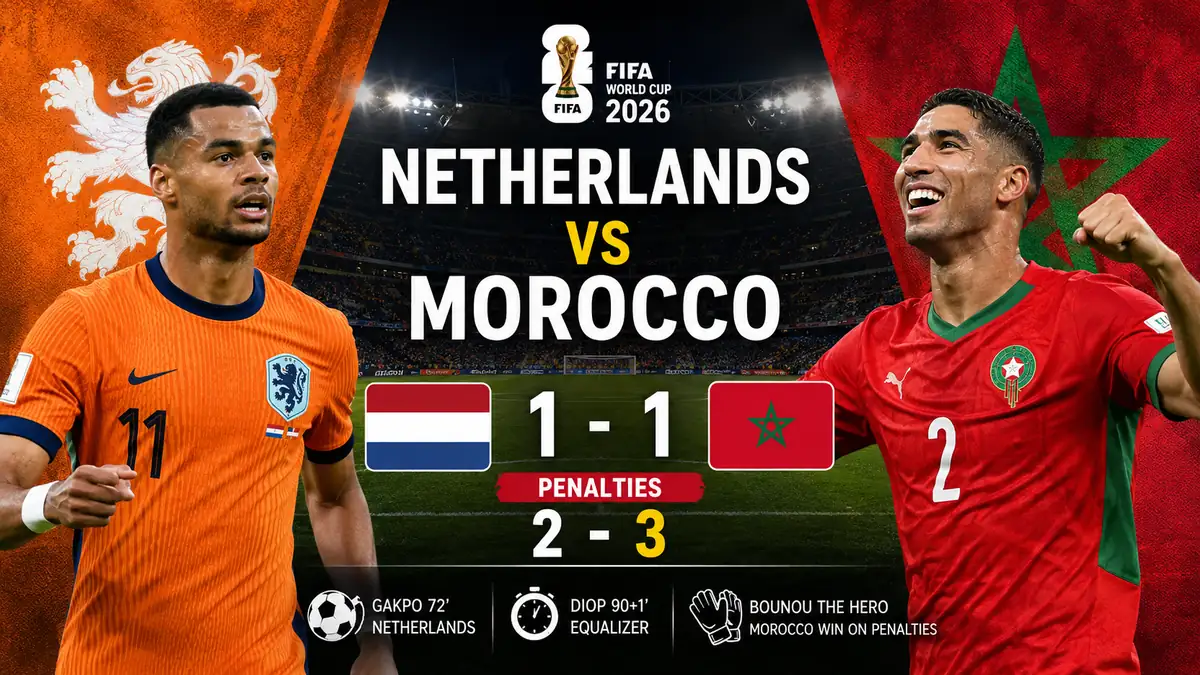
The netherlands vs morocco clash at the 2026 FIFA World Cup produced exactly the kind of knockout-stage drama that makes international football unforgettable. The Netherlands appeared to be heading into the last 16 after Cody Gakpo’s second-half goal, only for Morocco to equalize through Issa Diop in stoppage time.
The match finished 1-1 after extra time before Morocco won the penalty shootout 3-2. Goalkeeper Yassine Bounou played a decisive role as Morocco eliminated the Netherlands and advanced to face tournament co-host Canada in the round of 16.
Quick answer: Morocco defeated the Netherlands on penalties in the 2026 FIFA World Cup round of 32. The game ended 1-1 after extra time, with Cody Gakpo scoring for the Netherlands and Issa Diop equalizing in stoppage time. Morocco then won the shootout 3-2 at Estadio BBVA in Monterrey, Mexico.
netherlands vs morocco Match Overview
The Netherlands and Morocco met on June 29 local time in Mexico, with the match finishing in the early hours of June 30 UTC. It was played at Estadio BBVA in the Monterrey area as part of the FIFA World Cup round of 32.
Both teams had arrived in the knockout phase with reasons for confidence.
Ronald Koeman’s Netherlands won Group F after drawing 2-2 with Japan and beating Sweden 5-1 and Tunisia 3-1. Morocco came through Group C after a 1-1 draw against Brazil, a 1-0 win over Scotland and a 4-2 victory over Haiti.
| Match detail | Information |
|---|---|
| Competition | 2026 FIFA World Cup |
| Stage | Round of 32 |
| Match | Netherlands vs Morocco |
| Venue | Estadio BBVA, Monterrey area, Mexico |
| Score after 90 minutes | Netherlands 1-1 Morocco |
| Score after extra time | Netherlands 1-1 Morocco |
| Penalty shootout | Morocco won 3-2 |
| Netherlands scorer | Cody Gakpo, 72′ |
| Morocco scorer | Issa Diop, 90+1′ |
| Attendance | 51,243 |
The result meant Morocco moved into the last 16 while the Netherlands’ World Cup campaign ended in another painful penalty shootout.
How the Netherlands vs Morocco Match Unfolded
The final score alone does not tell the full story.
Morocco controlled much more of the ball and generated more attacking opportunities, while the Netherlands relied on a more direct and compact approach. The tactical contrast became one of the defining features of the match.
A Cautious Opening
The Netherlands did not approach the contest with the kind of possession-heavy structure often associated with Dutch football.
Instead, Koeman used a system that effectively included five defenders, with Virgil van Dijk at the heart of the back line and Denzel Dumfries providing width. Opta noted that it was the Netherlands’ first start with a back five since March 2024.
Morocco were far more comfortable keeping possession.
Achraf Hakimi, Noussair Mazraoui and the Moroccan midfield helped move the ball through different areas of the pitch, forcing the Netherlands to spend significant periods defending without possession.
Neither team found a breakthrough in the first half, leaving everything open after the interval.
Cody Gakpo Breaks the Deadlock
The Netherlands finally found their moment in the 72nd minute.
Crysencio Summerville helped create the opening, and Cody Gakpo finished to give the Dutch a 1-0 lead. It was another important tournament goal for a player who had become one of the Netherlands’ most reliable attacking threats.
Gakpo’s strike was particularly significant because the Netherlands had created relatively little. Opta recorded just 0.23 expected goals for the Dutch across the entire 120 minutes.
At that point, Morocco faced a simple problem: dominate possession all they wanted, but they needed a goal.
They eventually found one at almost the last possible moment.
Issa Diop Equalizes in Stoppage Time
Morocco continued pushing forward rather than allowing the Dutch defensive block to settle.
Their persistence was rewarded in the first minute of second-half stoppage time.
Issa Diop scored the equalizer, with Chemsdine Talbi involved in creating the goal, making it 1-1 and sending the contest into extra time.
For the Netherlands, it was a crushing moment. They had been minutes away from progressing despite having far less possession and fewer chances.
For Morocco, the goal completely changed the emotional direction of the match.
netherlands vs morocco Extra Time and Penalty Shootout
Neither side could score during the additional 30 minutes.
The Netherlands made changes, including Marten de Roon replacing Frenkie de Jong and Justin Kluivert coming on for Cody Gakpo. Morocco also relied on fresh legs as the physical demands of the contest increased.
After 120 minutes, the score remained 1-1.
A penalty shootout would decide which nation reached the round of 16.
Netherlands vs Morocco Penalty Results
The shootout became a battle of composure and goalkeeping.
Teun Koopmeiners converted for the Netherlands, but Neil El Aynaoui failed with Morocco’s first attempt.
Morocco recovered.
Soufiane Rahimi converted, while Justin Kluivert missed. Wout Weghorst then scored for the Netherlands and Chemsdine Talbi responded for Morocco.
Quinten Timber failed to convert the Netherlands’ fourth attempt. Achraf Hakimi also missed, keeping the shootout alive.
Then came the decisive sequence.
Yassine Bounou stopped Crysencio Summerville before Ismael Saibari converted Morocco’s final penalty.
Morocco won the shootout 3-2.
| Netherlands | Outcome | Morocco | Outcome |
|---|---|---|---|
| Teun Koopmeiners | Scored | Neil El Aynaoui | Missed |
| Justin Kluivert | Missed | Soufiane Rahimi | Scored |
| Wout Weghorst | Scored | Chemsdine Talbi | Scored |
| Quinten Timber | Missed | Achraf Hakimi | Missed |
| Crysencio Summerville | Missed | Ismael Saibari | Scored |
Quick Takeaway: The Netherlands initially held the advantage in the shootout, but Morocco recovered. Bounou’s intervention and Saibari’s decisive penalty ultimately completed the comeback.
Netherlands vs Morocco Match Stats
The statistics reveal why Morocco could reasonably feel that their persistence had been rewarded.
Sky Sports recorded Morocco with approximately 70.1% possession, compared with 29.9% for the Netherlands. Morocco also registered 11 shots to the Netherlands’ six and five shots on target compared with two.
| Statistic | Netherlands | Morocco |
|---|---|---|
| Possession | 29.9% | 70.1% |
| Shots | 6 | 11 |
| Shots on target | 2 | 5 |
| Corners | 5 | 8 |
| Chances created | 4 | 10 |
| Accurate passes | 292 | 801 |
| Pass accuracy | 78.7% | 91.1% |
| Duels won | 53 | 53 |
One number stands out immediately: 801 accurate passes for Morocco compared with 292 for the Netherlands.
Morocco’s 91.1% passing accuracy also reflected how successfully they circulated the ball.
Yet possession by itself did not make the game comfortable. The Netherlands remained dangerous because they could defend deep, compete physically and attack quickly when space became available.
That is exactly how knockout football can punish teams that dominate without finishing their opportunities.
Why Morocco Beat the Netherlands
Morocco’s victory was not built around one isolated moment.
Several factors came together.
Morocco Controlled the Ball
A 70% share of possession allowed Morocco to dictate much of the match’s rhythm.
Their midfielders consistently offered passing options, while players such as Hakimi helped stretch the Dutch defensive structure.
Morocco attempted 879 passes and completed 801. The Netherlands attempted only 371.
That difference demonstrates how contrasting the tactical approaches were.
Morocco Created More Chances
Possession is only valuable when it produces opportunities, and Morocco did turn their territorial control into chances.
They finished with more shots, more shots on target, more corners and more chances created.
The biggest criticism would be efficiency.
Morocco missed several opportunities and allowed the Netherlands to take the lead despite having controlled large parts of the contest.
Morocco Kept Believing
Issa Diop’s 90+1-minute equalizer mattered beyond the scoreline.
A late goal can completely change the psychological balance of a knockout game. The Netherlands went from protecting a lead to facing another 30 minutes against an opponent suddenly filled with confidence.
Morocco carried that resilience into the shootout.
Yassine Bounou Delivered Again
Bounou’s influence deserves special attention.
The Moroccan goalkeeper had already developed a reputation for performing under tournament pressure, most famously during Morocco’s 2022 World Cup run.
Against the Netherlands, he again became central to Morocco’s success.
His save from Summerville helped create the opportunity for Saibari to finish the shootout. Opta also highlighted that Morocco had now won both of their World Cup penalty shootouts, having previously eliminated Spain on penalties in the 2022 round of 16.
Netherlands Starting Lineup Against Morocco
The Dutch starting XI featured a mixture of established international stars and younger players.
Netherlands starting lineup:
- Bart Verbruggen
- Jan Paul van Hecke
- Virgil van Dijk
- Nathan Aké
- Denzel Dumfries
- Ryan Gravenberch
- Frenkie de Jong
- Micky van de Ven
- Crysencio Summerville
- Cody Gakpo
- Brian Brobbey
Virgil van Dijk captained the side, while Frenkie de Jong and Ryan Gravenberch operated in midfield.
The inclusion of Gakpo provided the Netherlands’ most important attacking moment, but the team struggled to consistently create chances around Morocco’s penalty area.
Morocco Starting Lineup Against Netherlands
Morocco’s starting team combined experienced World Cup performers with a newer generation of talent.
Morocco starting lineup:
- Yassine Bounou
- Achraf Hakimi
- Noussair Mazraoui
- Issa Diop
- Chadi Riad
- Ayyoub Bouaddi
- Azzedine Ounahi
- Ismael Saibari
- Bilal El Khannouss
- Neil El Aynaoui
- Brahim Díaz
The balance of the team helped explain Morocco’s control of possession.
Hakimi and Mazraoui offered experience and technical quality from defensive areas, while Ounahi, Saibari, El Khannouss and El Aynaoui gave Morocco multiple options through midfield.
Netherlands vs Morocco Head-to-Head Record
The two nations do not have an extensive senior international history against each other, which made their 2026 World Cup encounter especially interesting.
Before the 2026 meeting, they had faced each other in notable matches including the 1994 FIFA World Cup and international friendlies in 1999 and 2017.
Their previous World Cup meeting took place on June 29, 1994, when the Netherlands defeated Morocco 2-1 during the group stage.
Morocco later defeated the Netherlands 2-1 in a 1999 friendly.
The Netherlands answered with a 2-1 friendly victory in Morocco in 2017.
The 2026 match officially finished as a draw after extra time for standard match-record purposes, although Morocco advanced by winning the penalty shootout. Soccerbase lists the overall sequence of these meetings as two Netherlands wins, one Morocco win and the 2026 draw.
| Year | Competition | Result |
|---|---|---|
| 1994 | FIFA World Cup | Morocco 1-2 Netherlands |
| 1999 | International Friendly | Netherlands 1-2 Morocco |
| 2017 | International Friendly | Morocco 1-2 Netherlands |
| 2026 | FIFA World Cup | Netherlands 1-1 Morocco; Morocco won 3-2 on penalties |
This history also shows how unusual the matchup is. Unlike major European rivalries, there is not a large sample of competitive games between the Oranje and the Atlas Lions.
Key Players Who Shaped the Match
Cody Gakpo
Gakpo gave the Netherlands the lead and once again demonstrated his ability to deliver at major international tournaments.
His goal was especially valuable because Dutch attacking opportunities were limited.
Opta reported that Gakpo reached nine goals across World Cups and European Championships with his strike against Morocco.
Issa Diop
Diop produced arguably the biggest goal of the night.
Scoring in the 90+1st minute meant Morocco avoided elimination and forced extra time. Without that intervention, all of Morocco’s possession and chances would have meant very little.
Yassine Bounou
Bounou’s contribution became decisive when the match reached penalties.
Shootouts require more than simply guessing which direction a player will shoot. Goalkeepers study tendencies, watch body positioning and try to delay their movement long enough to react.
Bounou once again looked comfortable under that pressure.
Ismael Saibari
Someone still had to convert the decisive penalty.
Saibari did.
With Morocco one successful kick away from progressing, he finished the opportunity and confirmed his country’s place in the next round.
Bart Verbruggen
The Netherlands goalkeeper should not be overlooked simply because his team lost.
Verbruggen made five saves during the match and helped the Dutch survive long periods of Moroccan pressure.
What the Result Meant for Morocco
Beating the Netherlands was another major knockout achievement for Morocco.
The Atlas Lions had already changed expectations surrounding African teams at the World Cup with their historic semifinal appearance in Qatar in 2022.
Their 2026 squad was different, but the ability to compete with established international powers remained.
The victory sent Morocco into a round-of-16 meeting with co-host Canada. Morocco won that subsequent match 3-0 before eventually losing 2-0 to France in the quarterfinals.
That means the Netherlands victory was not an isolated high point. Morocco used it as the foundation for another run into the later stages of the tournament.
What Went Wrong for the Netherlands?
The Netherlands were extremely close to progressing, so describing their performance as simply poor would miss the tactical reality of the game.
Their defensive approach almost worked.
The bigger problem was that they produced too little attacking threat to give themselves a margin for error.
With just six shots and 0.23 xG across 120 minutes, the Dutch were heavily dependent on efficiency.
Once Diop equalized, the match entered a format where tactical control becomes less predictable.
Then came penalties.
For the Netherlands, the outcome continued an uncomfortable World Cup pattern. Opta noted that the Dutch were eliminated on penalties at consecutive World Cups following their shootout defeat against Argentina in the 2022 quarterfinals.
That is particularly painful because the Netherlands have one of international football’s richest histories without ever winning the men’s FIFA World Cup.
They finished runners-up in 1974, 1978 and 2010.
Tactical Lessons From Netherlands vs Morocco
This match offered a useful reminder that possession, chance creation and the final result are related—but never identical.
Morocco dominated the ball and created more opportunities, yet came within minutes of elimination.
The Netherlands showed the opposite side of knockout football. Their compact defensive structure and efficient finishing almost allowed them to advance despite spending much of the game without possession.
Three broader lessons stand out:
- Possession needs penetration. Morocco’s passing numbers were excellent, but converting territorial control into goals remained difficult.
- A one-goal lead is fragile. The Netherlands could not create enough additional attacking threat after Gakpo scored.
- Penalty preparation matters. When knockout matches remain level after 120 minutes, goalkeeper performance, penalty selection and composure can outweigh everything that happened beforehand.
That combination made the game much more competitive than the possession statistics might suggest.
Final Verdict on netherlands vs morocco
The netherlands vs morocco round-of-32 match became one of the dramatic knockout contests of the 2026 FIFA World Cup.
The Netherlands took the lead through Cody Gakpo in the 72nd minute and appeared close to advancing. Morocco refused to disappear, and Issa Diop’s 90+1-minute equalizer forced extra time.
After the score remained 1-1 through 120 minutes, penalties decided the contest.
Yassine Bounou helped turn the shootout in Morocco’s favor before Ismael Saibari converted the decisive kick, giving Morocco a 3-2 penalty shootout victory.
The statistics showed Morocco controlling possession and creating substantially more opportunities. The scoreline showed something equally important: the Netherlands remained dangerous enough to take the match all the way to penalties.
For Morocco, it was another demonstration of resilience on football’s biggest stage. For the Netherlands, it was a painfully narrow end to a World Cup campaign that had begun with them winning their group.
The lasting story of netherlands vs morocco is therefore bigger than the 1-1 score: Morocco survived a late knockout-stage battle, held their nerve under shootout pressure and earned their place among the final 16 teams at the 2026 World Cup.
