

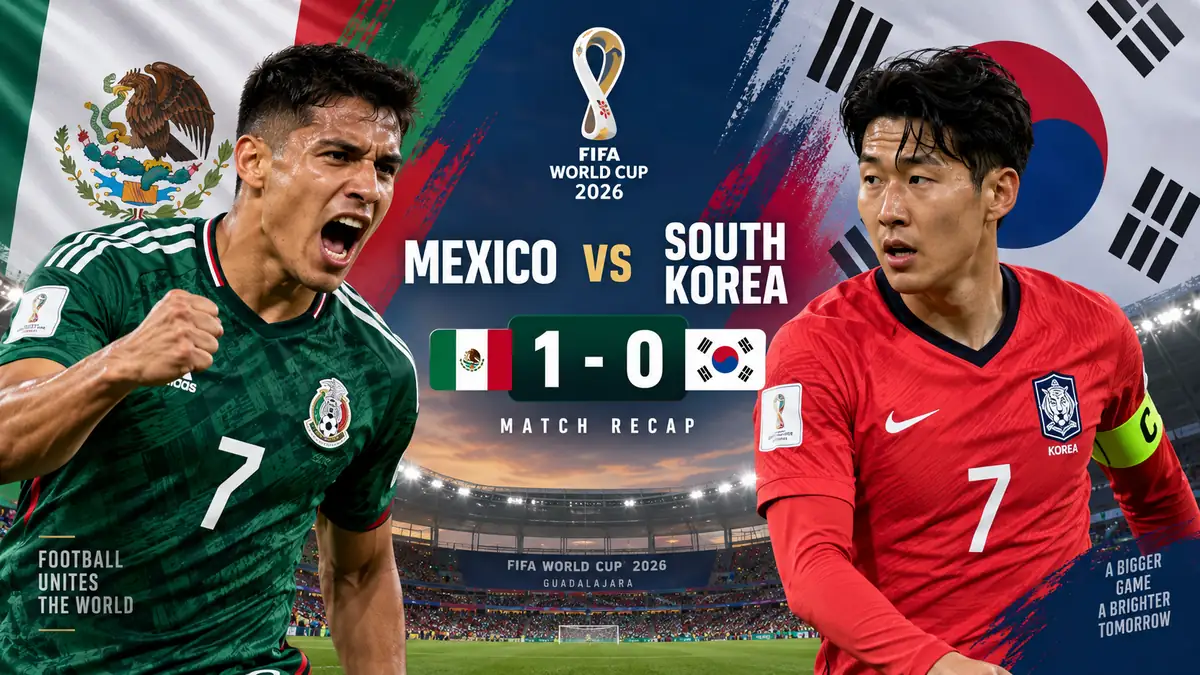
Mexico and South Korea met in one of the notable Group A fixtures of the 2026 FIFA World Cup, with Mexico earning a narrow but significant 1-0 victory in Guadalajara. Luis Romo scored the only goal shortly after halftime, while goalkeeper Raúl Rangel produced important late saves to protect Mexico’s lead.
Quick answer: The latest mexico vs south korea match ended Mexico 1-0 South Korea at the 2026 FIFA World Cup. Luis Romo scored in the 50th minute after goalkeeper Kim Seung-gyu failed to control the ball. The victory secured Mexico’s place in the Round of 32.
mexico vs south korea 2026 Match at a Glance
The match took place at Estadio Akron in the Guadalajara area on June 18 local time, with the fixture recorded internationally as June 19 because of time-zone differences. It was the teams’ second match in Group A of the expanded 2026 FIFA World Cup.
| Match detail | Information |
|---|---|
| Competition | FIFA World Cup 2026 |
| Stage | Group A |
| Result | Mexico 1-0 South Korea |
| Mexico scorer | Luis Romo, 50′ |
| Venue | Estadio Akron, Guadalajara area |
| Attendance | 45,522 |
| Referee | Gustavo Tejera |
| Halftime score | 0-0 |
The result carried particular importance for Mexico. It kept Javier Aguirre’s side at the top of Group A at that point and confirmed its qualification for the Round of 32.
South Korea, meanwhile, had opportunities to rescue the match but could not find an equalizer against an organized Mexican defense.
Who scored in Mexico vs South Korea?
Luis Romo scored the only goal in the 50th minute.
The decisive sequence began with Mexico attacking early in the second half. Raúl Jiménez met a Julián Quiñones delivery, and the resulting loose ball caused problems inside the Korean penalty area.
Goalkeeper Kim Seung-gyu attempted to collect it but lost control after contact in a crowded situation. Romo reacted quickly and finished into the exposed goal.
That moment separated two teams that otherwise produced a relatively tight contest.
How mexico vs south korea Unfolded
The final score suggests a straightforward Mexico victory, but the match was more competitive than 1-0 might imply.
A cautious first half
Neither side took complete control during the opening 45 minutes.
South Korea entered with attacking talent including Son Heung-min, Lee Kang-in and Lee Jae-sung, while Mexico had Raúl Jiménez, Julián Quiñones and Roberto Alvarado among its attacking options.
Lee Kang-in received an early yellow card in the fourth minute, but the game did not immediately develop into an end-to-end contest.
Mexico’s clearest early effort came through Quiñones, whose header was saved. Opta’s match analysis described the first half as quiet, with limited clear opportunities.
Mexico captain Edson Álvarez also played an important defensive role. With César Montes unavailable through suspension, Álvarez helped reorganize the back line and made a significant early intervention near goal.
The teams reached halftime at 0-0.
Romo breaks the deadlock
Mexico increased its attacking pressure immediately after the restart.
Jesús Gallardo threatened from a difficult angle before the breakthrough arrived in the 50th minute.
Kim Seung-gyu’s failure to secure the ball presented Romo with the opportunity, and the Mexican midfielder converted it.
Mexico 1-0 South Korea.
Rather than opening the match completely, the goal changed the tactical problem facing South Korea. The Koreans now needed to take greater risks while Mexico could protect central spaces and look for opportunities in transition.
South Korea turns to its bench
South Korea responded with attacking substitutions.
Hwang Hee-chan and Oh Hyeon-gyu were introduced around the 57th minute, replacing Son Heung-min and Lee Jae-sung. Further changes followed as South Korea searched for a way through Mexico’s defensive structure.
Cho Gue-sung, Yang Hyun-jun and Eom Ji-sung were among the additional options used during the second half.
Mexico also refreshed its team.
Orbelín Pineda and Obed Vargas entered in the 71st minute, while Santiago Giménez, Israel Reyes and César Huerta were subsequently introduced.
Those substitutions helped Mexico maintain energy as the match entered its decisive final phase.
Mexico vs South Korea Match Stats Explained
South Korea had more possession, but Mexico produced the more decisive moment.
One statistical record of the match gives South Korea 58% possession compared with Mexico’s 42%. Mexico nevertheless recorded four shots on target to South Korea’s two.
| Statistic | Mexico | South Korea |
|---|---|---|
| Goals | 1 | 0 |
| Possession | 42% | 58% |
| Shots on target | 4 | 2 |
| Shots off target | 3 | 4 |
| Blocked shots | 1 | 3 |
| Offsides | 3 | 6 |
| Fouls | 9 | 7 |
| Yellow cards | 0 | 2 |
These numbers help explain the match better than possession alone.
South Korea spent more time on the ball but struggled to turn that possession into high-quality attempts on target. Mexico was comfortable conceding periods of possession when its defensive structure remained intact.
The contrast highlights an important distinction between having the ball and creating dangerous chances.
Mexico did not need sustained possession to win. Its ability to capitalize on a goalkeeper error and then defend the advantage proved more valuable.
Why did Mexico beat South Korea?
Three factors were particularly important.
- Mexico reacted faster to the decisive mistake. Romo immediately recognized the opportunity created by Kim’s handling error.
- Mexico protected dangerous central areas. South Korea could circulate possession without consistently turning it into clear scoring opportunities.
- Raúl Rangel delivered when required. Mexico’s goalkeeper produced crucial late saves when South Korea finally increased the pressure.
Concacaf highlighted Rangel’s back-to-back saves in the 87th minute as a key part of Mexico preserving its clean sheet.
Quick Takeaway: South Korea’s possession advantage did not translate into enough shots on target. Mexico was more efficient in the decisive moments at both ends of the pitch.
Mexico Starting Lineup and Formation
Mexico lined up in a shape listed as a 4-1-2-3, with Rangel in goal and Álvarez captaining the team.
The starting XI was:
Goalkeeper: Raúl Rangel
Defenders: Jorge Sánchez, Edson Álvarez, Johan Vásquez, Jesús Gallardo
Midfielders: Erik Lira, Brian Gutiérrez, Luis Romo
Attackers: Roberto Alvarado, Raúl Jiménez, Julián Quiñones
The balance of the midfield was particularly important.
Lira provided protection, while Romo could contribute farther forward. Álvarez’s presence in central defense gave Mexico an experienced organizer in the absence of Montes.
Jiménez provided the central reference point in attack, with Quiñones and Alvarado operating around him.
Mexico substitutes
Javier Aguirre eventually used five replacements.
Orbelín Pineda and Obed Vargas came on for Brian Gutiérrez and Romo. Santiago Giménez replaced Jiménez, Israel Reyes replaced Alvarado, and César Huerta replaced Quiñones.
The changes allowed Mexico to preserve intensity without radically changing its approach.
South Korea Starting Lineup and Formation
South Korea used a three-man defensive structure, listed as a 3-4-3 in the match data.
Its starting lineup featured:
Goalkeeper: Kim Seung-gyu
Defense: Lee Han-beom, Kim Min-jae, Lee Gi-hyuk
Midfield/Wing areas: Hwang In-beom, Paik Seung-ho, Seol Young-woo, Kim Moon-hwan
Attack: Lee Kang-in, Lee Jae-sung, Son Heung-min
The setup was designed to provide width while allowing Korea’s technically skilled attackers to find space between Mexico’s defensive lines.
The challenge was turning territorial control into clear opportunities.
Mexico’s compact defensive organization frequently forced Korea away from the most dangerous central areas.
What happened to Son Heung-min?
Son Heung-min started the match as South Korea’s captain but was substituted during the second half as the coaching staff changed the attack.
Hwang Hee-chan entered as part of the reshuffle.
That substitution was notable because Son has long been one of the most recognizable figures in Korean football, but changing a high-profile attacker does not necessarily indicate an individual problem. In this match, it formed part of a broader tactical attempt to find an equalizer.
The Tactical Battle Behind the 1-0 Result
The mexico vs south korea matchup demonstrated why international tournament games cannot always be understood through possession percentages.
South Korea controlled more of the ball.
Mexico controlled enough of the important moments.
Mexico’s defensive organization
Without César Montes, Mexico needed its reconstructed defense to remain disciplined.
Álvarez’s positioning helped stabilize the central areas. Mexico generally avoided being stretched into uncontrolled transitions and forced South Korea to work for openings.
That mattered because Korea possessed several players capable of creating chances from technical combinations.
Lee Kang-in could operate between midfield and attack, while Hwang In-beom offered distribution from deeper positions. Son provided movement around the final defensive line.
Mexico’s priority was therefore not simply to win possession immediately. It was to prevent Korea’s possession from developing into clean opportunities near Rangel’s goal.
South Korea’s possession problem
Having 58% of the ball sounds impressive, but only two shots on target were recorded in the cited match statistics.
That is the central tactical lesson from the game.
Possession becomes dangerous when it moves defenders, creates overloads and produces high-quality shots. Mexico was largely successful in preventing those outcomes.
Korea eventually generated greater pressure late in the match, but by then Mexico was defending a one-goal advantage and could commit more players to protecting it.
Mexico’s efficiency
Mexico did not create a huge number of opportunities either.
The difference was execution.
When the Korean defense and goalkeeper made their biggest mistake, Romo punished it immediately. When Korea threatened late, Rangel responded.
Tournament football often turns on exactly those moments.
Raúl Rangel’s Role in Mexico’s Victory
Romo understandably received attention for scoring the winner, but Raúl Rangel was another major figure in the result.
South Korea pushed for an equalizer as the match approached full time. Rangel responded with consecutive late saves that protected Mexico’s 1-0 advantage.
Those interventions demonstrate why a clean sheet is rarely solely a defensive statistic.
Mexico’s back line restricted Korea for long periods, but when opponents finally broke through, the goalkeeper still had to finish the job.
For Mexico, that combination of defensive structure and goalkeeping was enough.
What the Result Meant for Mexico
The victory gave Mexico another three points in Group A and, more importantly, secured progression to the Round of 32.
That was particularly meaningful because Mexico entered the 2026 tournament as one of the three co-host nations alongside the United States and Canada.
Playing in Guadalajara also created a familiar environment for the Mexican team.
Rather than simply producing an entertaining performance, Mexico achieved the immediate tournament objective: collecting points and advancing.
A 1-0 win may appear modest, but knockout qualification is ultimately determined by results rather than style points.
What the Defeat Meant for South Korea
South Korea left the match without a point despite controlling more possession.
The performance showed both strengths and limitations.
Korea demonstrated an ability to maintain possession and move Mexico’s defensive block, but the lack of consistent end product became costly. The team also suffered from an individual mistake at the worst possible moment.
There was still a distinction between losing control of the match and losing the match itself.
South Korea was not overwhelmed. It remained within one goal and created late pressure. But against an opponent defending a narrow lead, opportunities become increasingly valuable.
Failing to convert those opportunities meant Korea could not recover from Romo’s goal.
Mexico vs South Korea Head-to-Head History
The rivalry extends well beyond the 2026 World Cup.
The teams have met in World Cups, international friendlies and other senior international fixtures. One head-to-head database lists 15 meetings, with Mexico recording 10 wins, South Korea two wins and three draws.
Their recent meetings include:
| Date | Competition | Result |
|---|---|---|
| June 2026 | FIFA World Cup | Mexico 1-0 South Korea |
| September 2025 | International Friendly | Mexico 2-2 South Korea |
| November 2020 | International Friendly | Mexico 3-2 South Korea |
| June 2018 | FIFA World Cup | South Korea 1-2 Mexico |
| January 2014 | International Friendly | Mexico 4-0 South Korea |
The September 2025 friendly was particularly dramatic.
Raúl Jiménez scored for Mexico before Son Heung-min and Oh Hyeon-gyu turned the match around for Korea. Santiago Giménez then scored in stoppage time to secure a 2-2 draw.
That match provided a much more open contrast to the controlled 1-0 contest at the 2026 World Cup.
Mexico vs South Korea at the FIFA World Cup
Mexico’s record against South Korea becomes even more striking when only World Cup meetings are considered.
The countries have now met three times at the men’s FIFA World Cup, and Mexico has won all three.
France 1998: Mexico 3-1 South Korea
Their first World Cup encounter came during the 1998 tournament in France.
South Korea went ahead, but Mexico responded strongly and completed a 3-1 comeback. Luis Hernández played a prominent role in Mexico’s second-half recovery.
Russia 2018: South Korea 1-2 Mexico
Twenty years later, they met again during the 2018 FIFA World Cup in Russia.
Mexico won 2-1, maintaining its perfect World Cup record against Korea. The match became part of an unusual tournament for South Korea, which later famously defeated defending champion Germany but still failed to advance from the group.
2026: Mexico 1-0 South Korea
The third World Cup meeting produced fewer goals but the same winner.
Romo’s 50th-minute finish gave Mexico a 1-0 victory and extended its perfect World Cup record in this matchup.
| World Cup | Result |
|---|---|
| 1998 | Mexico 3-1 South Korea |
| 2018 | South Korea 1-2 Mexico |
| 2026 | Mexico 1-0 South Korea |
Across those three matches, Mexico scored six goals and South Korea scored two.
More importantly, Mexico collected three victories from three World Cup meetings.
How the 2026 Match Compared With Their 2025 Friendly
The two teams had met less than a year before their World Cup encounter.
On September 10, 2025, they played a 2-2 international friendly in Nashville. Jiménez opened the scoring before goals from Son and Oh put Korea ahead. Santiago Giménez equalized in stoppage time.
The difference between the two matches is useful for understanding international football.
The friendly produced four goals and several momentum shifts.
The World Cup encounter produced only one.
Tournament circumstances encourage different decisions. Teams may become more cautious because one mistake can determine qualification, while coaches often prioritize defensive control over the risks they might accept in a friendly.
Mexico handled those conditions more effectively in Guadalajara.
Key Players From the Match
Luis Romo
Romo delivered the decisive contribution.
His 50th-minute goal was not built around an elaborate passing sequence. Instead, it rewarded awareness and quick reaction inside the penalty area.
Those qualities can be just as valuable as technical creativity.
Raúl Rangel
Rangel’s late saves protected the victory.
A goalkeeper can spend long periods relatively uninvolved and still determine the outcome through one sequence. That is effectively what happened here.
Edson Álvarez
Álvarez captained Mexico and helped organize a defense missing César Montes.
His early goal-line intervention also prevented South Korea from gaining an advantage before Mexico had settled fully into the game.
Kim Seung-gyu
For South Korea, Kim’s error became the defining negative moment.
Goalkeeping mistakes are particularly unforgiving because there is often no teammate behind the goalkeeper to correct them. Mexico capitalized immediately.
Lee Kang-in
Lee offered technical quality in Korea’s attack but also received an early yellow card.
Mexico’s compact positioning limited the amount of decisive space Korea’s creative players could exploit.
What Can Be Learned From mexico vs south korea?
The match offered several broader football lessons.
Possession does not automatically mean control. South Korea saw more of the ball but produced fewer shots on target.
Goalkeeper moments can decide tight games. Kim’s error created Mexico’s goal, while Rangel’s saves prevented Korea from scoring.
Tournament efficiency matters. Mexico did not need to dominate every statistical category. It needed to turn its best opportunity into a goal and protect the lead.
Squad depth becomes crucial. Both teams used all five substitutions as they attempted to manage energy and alter the tactical balance.
Historical records do not determine individual matches. Mexico entered with a strong history against South Korea, but the 2026 game was still decided by a single goal and remained competitive until the final whistle.
Final Takeaway
The latest mexico vs south korea meeting was decided by efficiency rather than overwhelming dominance. Mexico won 1-0 in the 2026 FIFA World Cup after Luis Romo capitalized on a second-half goalkeeping error, while Raúl Rangel’s late saves preserved the clean sheet.
South Korea controlled more possession but could not consistently convert it into dangerous attempts. Mexico, meanwhile, defended compactly, punished the game’s decisive mistake and managed the closing stages effectively.
The result secured Mexico’s passage to the Round of 32 and continued a remarkable pattern in this particular international matchup: Mexico has now defeated South Korea in each of their three men’s World Cup meetings.
