

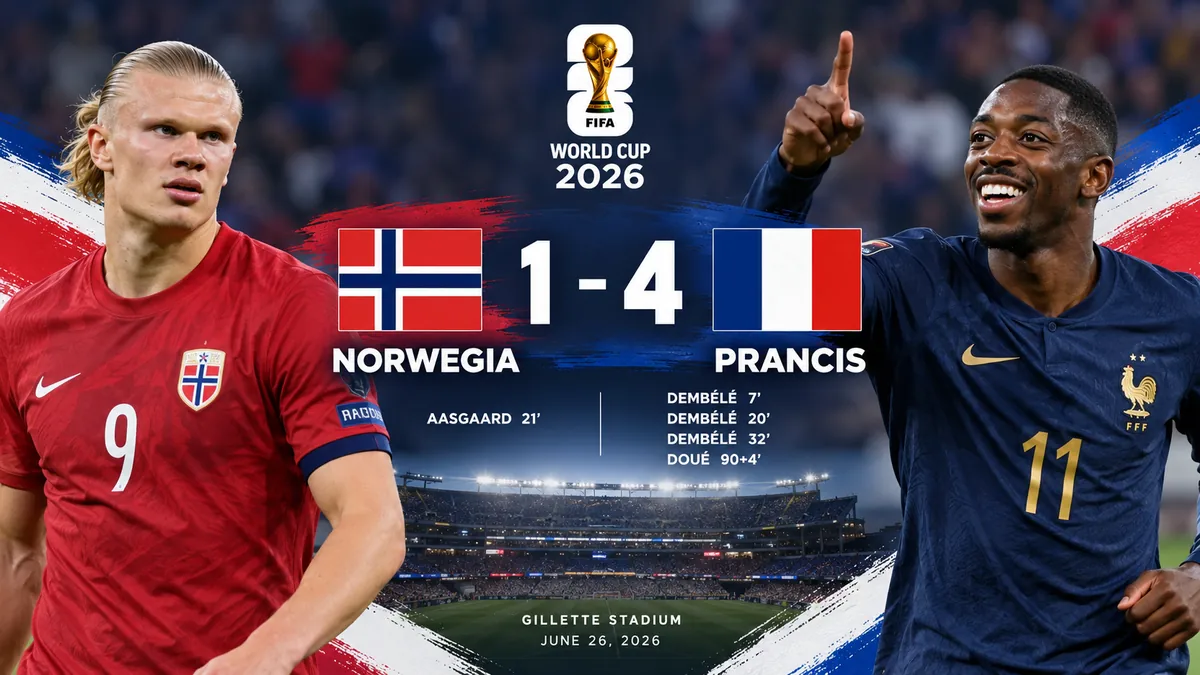
The norwegia vs prancis clash at the 2026 FIFA World Cup promised a fascinating contest between two European teams packed with attacking talent. Instead, France produced a devastating first-half display that effectively decided the game before halftime.
France defeated Norway 4-1 on June 26, 2026, at Gillette Stadium in Foxborough, Massachusetts. Ousmane Dembélé scored a first-half hat-trick, Thelo Aasgaard replied for Norway, and Désiré Doué completed the scoring in stoppage time. The victory gave France a perfect record and first place in Group I.
Quick answer: The decisive factor in norwegia vs prancis was France’s explosive start. Dembélé scored in the 7th, 20th and 32nd minutes, giving Les Bleus control despite Aasgaard’s 21st-minute response. France eventually won 4-1, with Doué adding the fourth goal in second-half stoppage time.
norwegia vs prancis Match Overview
The match was the third and final Group I fixture for both teams at the 2026 FIFA World Cup.
Norway entered the contest having already demonstrated its attacking potential during the tournament. France, meanwhile, arrived with one of the deepest squads in international football and an opportunity to secure first place in the group.
The setting was Gillette Stadium in Foxborough, with an announced attendance of 64,146.
| Match detail | Information |
|---|---|
| Competition | 2026 FIFA World Cup |
| Stage | Group I, Matchday 3 |
| Match | Norway vs France |
| Date | June 26, 2026 |
| Venue | Gillette Stadium, Foxborough, Massachusetts |
| Final score | Norway 1-4 France |
| Halftime score | Norway 1-3 France |
| Norway scorer | Thelo Aasgaard |
| France scorers | Ousmane Dembélé (3), Désiré Doué |
| Attendance | 64,146 |
France’s victory meant Les Bleus finished first in Group I with three wins from three matches.
norwegia vs prancis Goals and Key Moments
The final score tells only part of the story. The most important period came during the opening 32 minutes, when France repeatedly punished Norway before the Norwegian defense could settle.
7th minute: Dembélé opens the scoring
France started aggressively.
Kylian Mbappé had already threatened almost immediately after kickoff, striking the crossbar after only 22 seconds according to Opta’s match analysis. France maintained that pressure, and Ousmane Dembélé found the breakthrough in the seventh minute.
The early goal immediately changed the character of the match. Norway could no longer simply wait for opportunities on the counterattack.
20th minute: France doubles its lead
Dembélé struck again in the 20th minute.
Mbappé provided the assist as France’s movement and speed opened Norway’s defensive structure.
At 2-0, France appeared ready to run away with the match.
Norway, however, responded almost immediately.
21st minute: Aasgaard gives Norway hope
Just one minute after France’s second goal, Thelo Aasgaard pulled one back for Norway.
Andreas Schjelderup supplied the assist, and suddenly the score was 2-1.
It was exactly the response Norway needed. Instead of allowing France to establish complete control, Aasgaard’s goal briefly reopened the contest.
That hope did not last long.
32nd minute: Dembélé completes his hat-trick
Dembélé struck for the third time in the 32nd minute, with Aurélien Tchouaméni providing the assist.
France went into halftime leading 3-1.
The hat-trick was particularly significant. Paris Saint-Germain described it as Dembélé’s first hat-trick for the French national team and the second-fastest hat-trick in World Cup history.
By this point, Norway’s task had become extremely difficult.
Second half: Norway misses its biggest opportunity
Norway created opportunities after halftime and had a major chance to reduce the deficit.
Jørgen Strand Larsen stepped up for a penalty but failed to convert, preventing Norway from making it 3-2.
That moment mattered.
A successful penalty could have created a tense finish. Instead, France maintained its two-goal cushion and managed the remainder of the match more comfortably.
90+4: Doué makes it 4-1
France eventually added another goal deep into stoppage time.
Désiré Doué scored in the 94th minute after Bradley Barcola’s assist, producing the final 4-1 scoreline.
Norway vs France Match Statistics
France’s superiority was also visible in the underlying match numbers.
Sky Sports recorded France with 56.7% possession compared with Norway’s 43.3%. France attempted 18 shots to Norway’s 10 and registered nine shots on target compared with four for Norway.
| Statistic | Norway | France |
|---|---|---|
| Possession | 43.3% | 56.7% |
| Shots | 10 | 18 |
| Shots on target | 4 | 9 |
| Corners | 4 | 5 |
| Accurate passes | 343 | 480 |
| Passing accuracy | 81.5% | 86.5% |
| Yellow cards | 1 | 1 |
| Red cards | 0 | 0 |
France therefore did more than simply finish its chances efficiently. Les Bleus controlled more possession, completed more passes and generated significantly more shooting opportunities.
What the statistics reveal
The difference in passing accuracy—86.5% for France against 81.5% for Norway—may not initially look enormous. Combined with France’s higher possession and shot volume, however, it illustrates how effectively Didier Deschamps’ side controlled the ball while still attacking directly.
France did not dominate by endlessly circulating possession.
They moved forward quickly when spaces appeared.
That combination of control and acceleration made the French attack particularly difficult to contain.
Why France Won norwegia vs prancis
Several factors explain why the score became so one-sided.
1. France punished Norway immediately
Conceding early against an elite international side creates a tactical problem.
Norway fell behind after seven minutes and was 2-0 down after 20. That forced the team to take greater risks earlier than planned.
Those risks created more room for France.
Dembélé was particularly effective at exploiting those situations.
2. Dembélé produced an exceptional first half
Dembélé was the defining player of the match.
Three goals in 32 minutes effectively decided the contest. Sofascore gave him a perfect 10 rating after his hat-trick performance.
His impact was not simply about the number of goals. His positioning, acceleration and finishing repeatedly stretched Norway’s defense.
Norway could deal with one dangerous French attacker only to discover another moving into the space that had just opened.
3. France had enormous attacking depth
The starting French attack included players such as Dembélé, Mbappé, Michael Olise and Doué.
France could then introduce Bradley Barcola, Rayan Cherki and Jean-Philippe Mateta from the bench.
That depth matters during tournament football.
Opponents may survive the starting lineup’s intensity, only to face fresh elite attackers later in the game.
Doué’s stoppage-time goal illustrated that problem perfectly.
4. Norway heavily rotated its lineup
One of the most important pieces of context is that Norway made 10 changes to its starting XI.
Erling Haaland and Martin Ødegaard were unused substitutes, meaning Norway faced one of the strongest teams in the tournament without two of its most influential stars on the pitch.
That does not erase France’s performance, but it helps explain why this game should not automatically be interpreted as a definitive measure of the difference between the countries’ strongest possible teams.
5. Norway failed to capitalize on its comeback opportunities
Aasgaard’s goal made it 2-1 and gave Norway an immediate route back into the match.
France answered with another goal only 11 minutes later.
Norway then received another opportunity through Strand Larsen’s second-half penalty but could not convert it.
Against France, chances like those have to count.
Quick Takeaway: France combined ruthless finishing with superior possession, passing and attacking depth. Norway still created meaningful opportunities, but failing to convert the penalty and playing without several first-choice stars made a comeback much harder.
Norway and France Starting Lineups
Norway started with Egil Selvik in goal, with Fredrik Aursnes, Leo Østigård, Henrik Falchener and Fredrik André Bjørkan among the defensive players. Patrick Berg captained the team, while Kristian Thorstvedt, Thelo Aasgaard, Oscar Bobb, Andreas Schjelderup and Jørgen Strand Larsen formed the midfield and attacking group.
France started Mike Maignan in goal. Jules Koundé, Dayot Upamecano, Maxence Lacroix and Theo Hernández featured defensively, while Manu Koné and Aurélien Tchouaméni operated in midfield.
Further forward, France used Dembélé, Mbappé, Olise and Doué.
Norway starting XI
Egil Selvik; Fredrik Aursnes, Henrik Falchener, Leo Østigård, Fredrik André Bjørkan; Kristian Thorstvedt, Patrick Berg, Thelo Aasgaard; Oscar Bobb, Jørgen Strand Larsen, Andreas Schjelderup.
France starting XI
Mike Maignan; Jules Koundé, Dayot Upamecano, Maxence Lacroix, Theo Hernández; Manu Koné, Aurélien Tchouaméni; Ousmane Dembélé, Michael Olise, Désiré Doué; Kylian Mbappé.
The difference in squad management was striking. France fielded several established stars, while Norway’s extensive rotation left Haaland and Ødegaard outside the starting XI.
Ousmane Dembélé Was the Difference Maker
Any analysis of this match has to return to Dembélé.
Scoring a World Cup hat-trick is rare enough. Completing one before the 33rd minute puts a match almost entirely under one player’s influence.
His goals arrived in the 7th, 20th and 32nd minutes.
The timing was especially damaging.
The first prevented Norway from settling into the game. The second gave France breathing room. And when Norway responded through Aasgaard, Dembélé’s third quickly restored the two-goal advantage.
France could then approach the second half differently.
Instead of chasing another breakthrough, Les Bleus could control the match and choose when to accelerate.
That is exactly the type of situation tournament favorites want.
What Happened to Erling Haaland?
One obvious question surrounding Norway’s lineup was the absence of Erling Haaland from the field.
He was available but remained an unused substitute as Norway made extensive changes to the team. Martin Ødegaard was also left unused.
That was significant because the pre-match narrative had focused heavily on the possibility of Haaland and Mbappé going head-to-head.
Both had entered the match among the tournament’s prominent goalscorers, making the potential striker duel one of the game’s biggest storylines.
Instead, Dembélé became the headline performer.
Norway still generated 10 shots and four attempts on target without Haaland starting, but the absence of its leading attacking threat inevitably changed how the team could challenge France’s defense.
norwegia vs prancis Head-to-Head History
The 2026 World Cup encounter was not the first meeting between Norway and France.
Their history includes competitive games and international friendlies stretching back decades.
Soccerbase’s current head-to-head database records 17 meetings, with France winning eight, Norway winning five and four ending in draws.
Some recent meetings include:
| Date | Match | Result |
|---|---|---|
| June 26, 2026 | Norway vs France | 1-4 |
| May 27, 2014 | France vs Norway | 4-0 |
| August 11, 2010 | Norway vs France | 2-1 |
| February 25, 1998 | France vs Norway | 3-3 |
| July 22, 1995 | Norway vs France | 0-0 |
The historical record shows why a single result should not define the matchup.
Norway defeated France 2-1 in a 2010 friendly, while the countries played out draws in 1995 and 1998. France’s recent meetings, however, have been considerably more convincing: 4-0 in 2014 and 4-1 at the 2026 World Cup.
What the Result Meant for France
The victory completed a perfect Group I campaign for France.
Les Bleus won all three group matches and finished first, entering the knockout phase with significant momentum.
That mattered beyond the points.
Tournament football often tests whether a talented squad can translate individual quality into a functioning team. Against Norway, France demonstrated several qualities associated with a deep World Cup run: early intensity, clinical finishing, midfield control and options from the bench.
Dembélé’s form added another dimension.
Opponents already had to account for Mbappé. A Dembélé capable of producing this level of finishing made France’s attack even harder to plan against.
What the Result Said About Norway
A 4-1 defeat looks severe, but Norway’s performance requires context.
The team was heavily rotated, Haaland and Ødegaard did not play, and Norway nevertheless produced 10 attempts and created enough danger to score once and win a penalty.
Aasgaard’s goal also showed that France was not completely untouchable.
The bigger problem was defensive control.
Norway allowed France too much space during the opening half hour, and against attackers with the pace and technical quality of Dembélé and Mbappé, those openings became goals very quickly.
The missed penalty then removed Norway’s best opportunity to change the second-half momentum.
For future matches, the practical lesson is straightforward: Norway cannot afford extended periods of defensive instability against elite opponents, particularly when its strongest attacking players are absent.
Tactical Lessons From Norway vs France
The match provides a useful example of why international football cannot be judged purely by possession.
France had more of the ball, but the real damage came from what happened after the French attack found space.
France attacked before Norway could reset
Quick movement from Mbappé, Dembélé and the supporting attackers repeatedly forced Norway’s defenders to make decisions while moving backward.
That is an uncomfortable situation for any defense.
Rather than relying exclusively on patient buildup, France mixed controlled passing with sudden vertical attacks.
Norway’s response created additional space
Once Norway went behind, remaining compact became increasingly difficult.
Players had to move forward to support attacks.
That naturally created larger gaps behind midfield, giving France’s attackers more room.
This is one reason early goals are so valuable in tournament matches: they do not merely change the score. They change what the opponent is tactically required to do.
Squad depth changed the final phase
France could replace Dembélé with Barcola and Olise with Cherki before later introducing Mateta and Malo Gusto.
Norway also made substitutions, bringing on players including Morten Thorsby, Marcus Holmgren Pedersen, Sondre Langås, Jens Petter Hauge and Antonio Nusa.
France’s bench, however, allowed it to maintain significant attacking quality deep into the match.
That eventually contributed to Doué’s stoppage-time goal.
Final Assessment
The norwegia vs prancis match will primarily be remembered for Ousmane Dembélé’s remarkable first-half hat-trick.
France won 4-1 because it combined attacking speed with efficient finishing, greater possession, stronger passing numbers and extraordinary squad depth. Dembélé scored three times before the 33rd minute, while Doué added the final goal in stoppage time.
Norway’s Aasgaard briefly threatened a comeback at 2-1, and Strand Larsen later had a penalty opportunity, but neither moment changed the overall direction of the game.
The result also needs the right context. Norway made 10 changes and did not use Haaland or Ødegaard, while France fielded a powerful lineup and finished Group I with a perfect record.
For anyone reviewing norwegia vs prancis, the clearest takeaway is therefore not simply that France won. It is how quickly Les Bleus took control: three Dembélé goals in the opening 32 minutes turned a potentially difficult World Cup matchup into a convincing 4-1 victory.
