

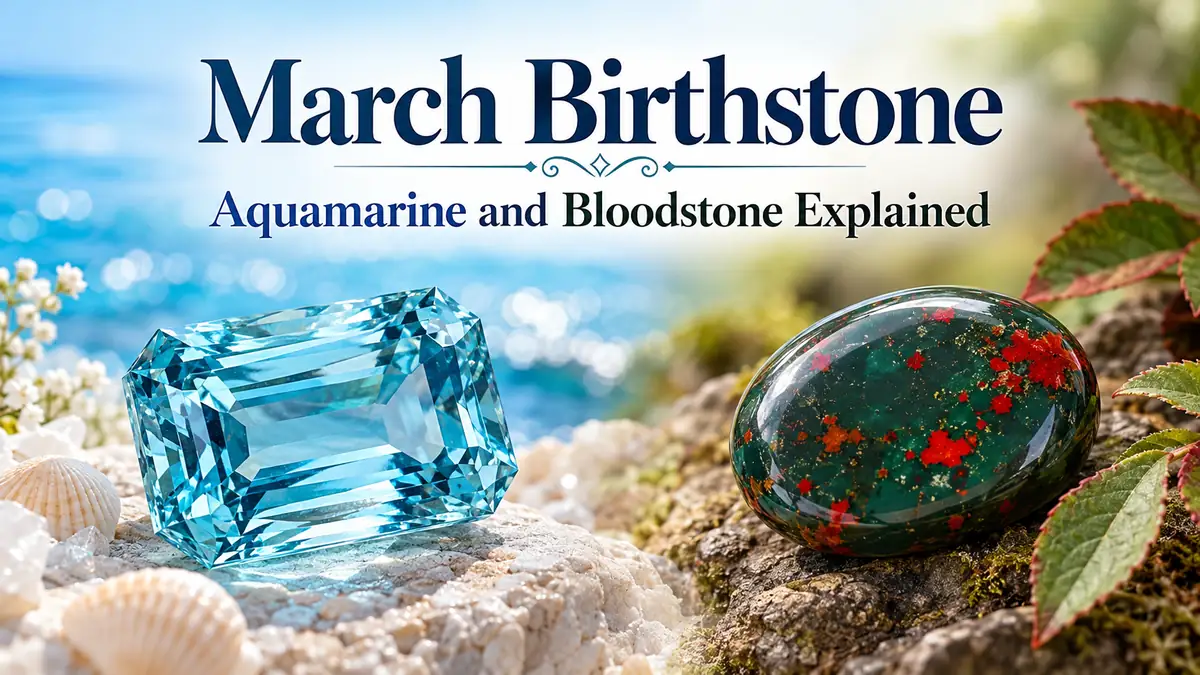
March has not one but two official birthstones, each with a distinctive appearance and centuries of history. One is celebrated for its clear, ocean-blue beauty, while the other is recognized for its deep green color and striking red markings.
The march birthstone is traditionally represented by two gemstones: aquamarine and bloodstone. Aquamarine is a blue to blue-green variety of beryl associated with tranquility, clarity, and the sea. Bloodstone is a dark green variety of chalcedony with red inclusions, historically connected with courage, strength, and protection.
Although these stones look completely different, both have fascinating geological origins and cultural significance. Understanding their colors, meanings, properties, and histories helps explain why they share the same birth month.
What Is the march birthstone?
The two recognized birthstones for March are aquamarine and bloodstone. Aquamarine is the modern birthstone most commonly associated with the month, while bloodstone is its traditional counterpart.
Both appear on recognized birthstone lists, including those maintained by the American Gem Society and the Gemological Institute of America (GIA).
| Feature | Aquamarine | Bloodstone |
|---|---|---|
| Birthstone association | Modern March birthstone | Traditional March birthstone |
| Mineral family | Beryl | Chalcedony, a form of quartz |
| Typical color | Light blue to blue-green | Dark green with red spots |
| Mohs hardness | 7.5–8 | Approximately 6.5–7 |
| Transparency | Transparent to translucent | Usually opaque |
| Symbolic meaning | Serenity, clarity, harmony | Courage, vitality, protection |
| Common appearance | Faceted transparent gemstone | Polished cabochon or carving |
| Historical association | Ancient maritime traditions | Ancient seals and protective amulets |
Neither gemstone is inherently more authentic than the other. Their different positions in birthstone traditions reflect how gemstone associations have developed over time.
Aquamarine: The Modern march birthstone


10
Aquamarine is best known for its soft blue hues, exceptional transparency, and association with the ocean.
Its name comes from the Latin words aqua, meaning water, and marina, meaning of the sea. Together, they describe the gemstone’s characteristic seawater appearance.
What color is aquamarine?
Aquamarine occurs in a range of blue shades, including pale sky blue, greenish blue, medium blue, and occasionally a more saturated deep blue.
The color comes primarily from trace amounts of iron within the beryl crystal structure.
While lighter aquamarine is common, strongly saturated blue specimens are generally more highly valued in gemological grading.
Some aquamarine is heat-treated to reduce greenish tones and produce a clearer blue appearance. This is an established gemstone treatment, although sellers should disclose treatments appropriately.
Physical and geological properties
Aquamarine belongs to the beryl mineral family, which also includes emerald and morganite.
Its chemical formula is Be₃Al₂Si₆O₁₈, and it forms mainly in geological environments such as granitic pegmatites.
Important characteristics include:
- Hardness: 7.5–8 on the Mohs scale.
- Crystal system: Hexagonal.
- Luster: Vitreous, or glass-like.
- Refractive index: Approximately 1.57–1.59.
- Cleavage: Poor to indistinct.
- Transparency: Frequently transparent in gem-quality material.
Aquamarine’s combination of hardness and transparency makes it suitable for many types of jewelry, although it can still chip or fracture under strong impact.
Where is aquamarine found?
Brazil is one of the most significant historical sources of gem-quality aquamarine, particularly the state of Minas Gerais.
Other notable sources include Pakistan, Nigeria, Madagascar, Mozambique, and Afghanistan.
Pakistan’s mountainous northern regions, including areas of Gilgit-Baltistan, are known for beautiful aquamarine crystals associated with pegmatite deposits.
The geology of each deposit influences crystal size, inclusions, and the quality of specimens recovered.
Aquamarine meaning and symbolism
Aquamarine has long been associated with the sea, calmness, and safe passage.
Ancient maritime folklore sometimes described the gemstone as a protective stone for sailors. It was believed to help travelers navigate dangerous waters and return safely.
Over time, aquamarine also became associated with:
- Emotional tranquility and peacefulness.
- Clear communication and understanding.
- Trust and harmony in relationships.
- Youthfulness, hope, and renewal.
These associations are cultural and symbolic rather than scientifically established effects.
Aquamarine does not have demonstrated medical or psychological healing powers, but its history and appearance can give it personal meaning.
Famous aquamarine gemstones
One of the most celebrated aquamarine specimens is the Dom Pedro Aquamarine, displayed at the Smithsonian National Museum of Natural History in Washington, D.C.
This large, sculpted gemstone was fashioned by gem artist Bernd Munsteiner from Brazilian aquamarine rough.
It weighs approximately 10,363 carats and is admired for its unusual obelisk-like shape and internal geometric carving.
Its remarkable size demonstrates how large aquamarine crystals can become under favorable geological conditions.
Bloodstone: The Traditional march birthstone


11
Bloodstone, also called heliotrope, has a dramatically different appearance from aquamarine.
Instead of transparent blue crystals, it typically appears as an opaque, dark green gemstone scattered with red markings.
The contrast between the green background and red inclusions gives bloodstone its recognizable appearance.
What is bloodstone made of?
Bloodstone is a variety of chalcedony, which consists of microscopic quartz crystals.
Its principal chemical composition is silicon dioxide (SiO₂).
The green color is associated with mineral inclusions, while the red markings generally result from iron oxide minerals such as hematite.
These red spots inspired the gemstone’s English name.
Unlike aquamarine, bloodstone is usually cut into rounded cabochons, beads, seals, or decorative carvings rather than transparent faceted stones.
Bloodstone colors and varieties
The classic bloodstone appearance is a deep green body with scattered red flecks or patches.
However, individual specimens may show differences in the intensity, distribution, and size of these markings.
Some stones contain relatively few red spots, while others have extensive red patterns.
Bloodstone may also display slightly bluish or grayish green tones depending on its mineral composition.
A related material called plasma is generally green chalcedony without the characteristic red spots.
Where is bloodstone found?
Bloodstone occurs in several parts of the world.
India has historically been an important source, particularly for material used in jewelry and carvings.
Other reported sources include Brazil, Australia, China, and the United States.
Bloodstone commonly forms in silica-rich geological environments where chalcedony develops alongside other minerals.
Its distinctive markings reflect the presence and distribution of iron-bearing material during formation.
Bloodstone meaning and symbolism
Bloodstone has a long association with bravery, vitality, endurance, and protection.
In ancient and medieval traditions, people carried bloodstone as an amulet or talisman.
Some cultures believed it could protect against injury, strengthen courage, or support physical health.
The gemstone also acquired religious symbolism in certain Christian traditions, where its red markings were connected with stories of Christ’s blood.
These stories are part of the gemstone’s cultural history, not evidence of supernatural or medical properties.
Today, bloodstone is often associated symbolically with determination, resilience, grounding, and personal strength.
Why is bloodstone called heliotrope?
The name heliotrope comes from Greek words associated with the sun and turning.
Ancient writers described beliefs that the stone could affect the appearance of sunlight or produce unusual optical effects when placed in water.
These accounts belong to historical gemstone lore rather than modern mineral science.
The name remains widely used in mineralogy, jewelry, and gemstone collecting.
Why Does March Have Two Birthstones?
The existence of two March birthstones reflects the evolution of gemstone traditions.
Historically, birthstones were connected with religious customs, astrology, cultural beliefs, and the twelve months of the calendar.
One frequently cited historical influence is the biblical breastplate of Aaron, which was described as containing twelve gemstones representing the tribes of Israel.
Over centuries, different cultures developed their own associations between gemstones and months.
Traditional versus modern birthstone lists
Bloodstone has a longstanding connection with March in traditional birthstone systems.
Aquamarine became more prominent as modern birthstone lists were standardized during the twentieth century.
In 1912, the American National Association of Jewelers adopted a standardized birthstone list that helped establish modern associations in the United States.
Subsequent revisions and jewelry-industry traditions reinforced aquamarine’s place as the principal modern March gemstone.
Today, the American Gem Society recognizes both aquamarine and bloodstone for March.

American Gem Society
+1
Is aquamarine or bloodstone the official March birthstone?
Both are recognized.
Aquamarine is commonly presented as the modern March birthstone, while bloodstone represents the traditional alternative.
There is no universal rule requiring someone born in March to use one instead of the other.
The distinction is primarily historical and cultural.
march birthstone Meaning, Spiritual Associations, and Zodiac Connections
The symbolism of March gemstones is influenced by ancient beliefs, seasonal changes, and astrological traditions.
Because March marks the transition from winter to spring in the Northern Hemisphere, both gemstones are sometimes interpreted as symbols of renewal.
Aquamarine represents calmness and clarity, while bloodstone is associated with courage and endurance.
Aquamarine and Pisces
Pisces traditionally covers approximately February 19 through March 20.
Aquamarine is frequently associated with Pisces because of its blue color and historical relationship with water.
In astrology, Pisces is a water sign, and aquamarine’s ocean imagery makes it a natural symbolic match.
People who follow gemstone astrology may connect aquamarine with emotional balance, intuition, and communication.
These are traditional interpretations, not scientifically demonstrated relationships between gemstones and personality.
Bloodstone and Aries
Aries generally begins around March 20 or 21 and continues into April.
Bloodstone is sometimes associated with Aries because its traditional symbolism emphasizes courage, determination, and strength.
Aries is classified as a fire sign in Western astrology.
The gemstone’s red markings and historical reputation as a protective talisman complement these symbolic themes.
However, zodiac signs do not determine a person’s official birthstone. Anyone born in March can identify with either gemstone.
Do March birthstones have healing properties?
Historical gemstone traditions attribute various healing powers to aquamarine and bloodstone.
Aquamarine has been associated with calming emotions and promoting peaceful communication. Bloodstone has been linked to circulation, physical vitality, and recovery.
These claims are not supported by reliable clinical evidence.
Wearing a gemstone may provide personal comfort or symbolic encouragement, but it should not be considered a medical treatment.
The cultural meanings of gemstones are best appreciated as folklore, history, and personal symbolism.
Aquamarine vs. Bloodstone: Which Is More Durable?
Durability is one of the most practical differences between March’s two birthstones.
Both can be used in jewelry, but their mineral structures and hardness levels affect how they respond to everyday wear.
Understanding the Mohs hardness scale
The Mohs scale measures a mineral’s resistance to scratching.
Aquamarine scores 7.5–8, while bloodstone generally scores 6.5–7.
This means aquamarine is more resistant to scratching than bloodstone.
However, hardness is not the same as toughness. A gemstone can resist scratches while remaining vulnerable to chips, fractures, or damage from impacts.
Neither gemstone is indestructible.
Which gemstone works better for everyday jewelry?
Aquamarine is suitable for rings, earrings, pendants, and bracelets when properly protected.
Its transparency makes it particularly attractive in faceted cuts such as oval, emerald, round, and pear shapes.
Bloodstone is frequently used in signet rings, pendants, beaded bracelets, and carved decorative objects.
Its opaque structure and attractive patterns make polished cabochons especially common.
For jewelry exposed to frequent knocks, protective settings and careful handling matter more than appearance alone.
How to Identify Genuine March Birthstones
Aquamarine and bloodstone have distinctive visual characteristics, but appearance alone cannot always establish authenticity.
Natural gemstones, treated stones, synthetic materials, and imitations can sometimes look similar.
Identifying aquamarine
Natural aquamarine commonly displays a transparent blue or slightly greenish-blue appearance.
Well-cut specimens often have excellent clarity, with few visible inclusions.
Gemologists may examine refractive index, optical behavior, internal inclusions, and other diagnostic characteristics to identify beryl.
Aquamarine can resemble blue topaz, blue glass, or other blue gemstones.
One common source of confusion is blue topaz, which may display a stronger blue color than many natural aquamarines.
A gemstone’s color alone is therefore not sufficient proof of identity.
Identifying bloodstone
Bloodstone is generally easier to recognize visually because of its dark green background and red iron-oxide markings.
However, other patterned stones and dyed materials can resemble it.
Natural bloodstone typically has irregular red spots or patches rather than perfectly uniform patterns.
A gemologist can distinguish bloodstone from imitations through mineralogical examination.
Can gemstones be identified with home tests?
Home tests may provide clues, but they rarely offer conclusive identification.
Scratching a gemstone to test hardness is especially unwise because it can permanently damage the surface.
Likewise, judging authenticity from weight, temperature, or appearance alone is unreliable.
For valuable or uncertain specimens, professional identification is the safer approach.
How to Clean and Care for March Birthstone Jewelry
Both March birthstones benefit from gentle cleaning and appropriate storage.
Their mineral compositions differ, but warm water and mild soap are generally suitable for routine cleaning.
Cleaning aquamarine safely
For most aquamarine jewelry:
- Prepare a bowl of lukewarm water with a small amount of mild dish soap.
- Soak the jewelry briefly if its setting and other materials permit.
- Gently remove dirt using a soft brush.
- Rinse thoroughly with clean water.
- Dry with a lint-free cloth.
Avoid sudden temperature changes, strong impacts, and harsh chemicals.
Ultrasonic and steam cleaners may be suitable for certain untreated, inclusion-free aquamarines, but they can be risky for stones containing fractures, liquid inclusions, or fracture fillings.
The GIA recommends warm soapy water as a dependable cleaning method.
gia
+1
Cleaning bloodstone safely
Bloodstone should also be cleaned using lukewarm soapy water and a soft cloth or brush.
Avoid abrasive cleaning products, strong chemicals, and excessive heat.
After cleaning, dry the stone carefully.
Because bloodstone is softer than aquamarine, separate storage is particularly helpful in preventing scratches.
A fabric-lined jewelry box or soft pouch works well.
Common gemstone care mistakes
One frequent mistake is storing multiple gemstones together without separating them.
Harder stones can scratch softer ones, especially when jewelry moves inside a drawer or travel case.
Another mistake is exposing gemstone jewelry to cleaning chemicals while doing household work.
It is also sensible to remove gemstone rings before heavy manual tasks, gardening, or activities involving repeated impacts.
These precautions help preserve the polish, appearance, and structural integrity of both stones.
March Birthstone Colors and Their Significance
Color is the most immediately recognizable difference between aquamarine and bloodstone.
Aquamarine’s blue tones evoke water, openness, and tranquility. Bloodstone’s dark green and red combination suggests nature, vitality, and resilience in traditional symbolism.
| Gemstone color | Appearance | Traditional symbolism |
|---|---|---|
| Pale blue aquamarine | Light, transparent blue | Peace and clarity |
| Blue-green aquamarine | Seawater-like color | Harmony and renewal |
| Saturated blue aquamarine | Richer blue appearance | Serenity and confidence |
| Dark green bloodstone | Opaque forest green | Stability and endurance |
| Red bloodstone markings | Irregular red spots | Courage and vitality |
These meanings are interpretations rather than fixed gemological classifications.
Is there a rare March birthstone color?
Deeply saturated, attractive blue aquamarine is generally less common than pale material.
In gemstone evaluation, stronger blue color combined with good clarity and an appealing cut can make an aquamarine particularly desirable.
Bloodstone rarity is evaluated differently.
Well-defined red markings, attractive contrast, suitable size, and good polish influence its visual appeal.
Because the two stones belong to different mineral families, their colors cannot be compared using one universal grading standard.
March Birthstones in Jewelry and Cultural History
Aquamarine and bloodstone have been used in decorative objects and personal adornment for centuries.
Their contrasting optical properties influenced the ways artisans worked with them.
Aquamarine in historical jewelry
Aquamarine has appeared in rings, necklaces, brooches, and royal jewelry collections.
Its transparency allows light to pass through the gemstone, making faceted cuts especially effective.
In 1936, the Brazilian government presented Eleanor Roosevelt with a remarkable 1,298-carat aquamarine.
The gemstone is now associated with the Franklin D. Roosevelt Presidential Library and Museum.
Aquamarine is also recognized as the gemstone traditionally associated with the 19th wedding anniversary.
GIA
+1
Bloodstone in ancient carvings
Bloodstone’s opaque appearance and fine-grained structure made it useful for carved objects.
Ancient artisans used the material for seals, engraved gems, amulets, and decorative pieces.
In some examples, the gemstone’s natural colors became part of the artistic design.
Bloodstone was particularly valued in traditions where carved gemstones served as personal symbols or protective objects.
Its connection with religious imagery and ancient medicine further contributed to its historical significance.
Why gemstone cutting styles differ
Aquamarine is commonly faceted because its transparency allows light to enter and reflect through the gemstone.
Bloodstone is more often polished into a smooth dome or carved because its appeal comes from surface patterns and contrasting colors.
This explains why aquamarine frequently appears as a sparkling transparent gem, while bloodstone is often presented as a smooth, patterned stone.
Interesting Facts About the march birthstone
Several details make March’s gemstones unusual among the twelve months’ birthstones.
Aquamarine belongs to the same mineral family as emerald, despite their different colors. Both are varieties of beryl, with their appearance influenced by trace elements within the crystal structure.
Aquamarine crystals can grow to impressive sizes. Some gem-quality specimens have been large enough to produce monumental cut gemstones and intricate sculptures.
Bloodstone is not related to actual blood. Its name describes the red iron-oxide markings visible against the green mineral background.
The name heliotrope preserves an ancient Greek connection to the sun, reflecting beliefs that existed long before modern gemology.
Both gemstones were historically associated with protection, although their traditions developed in different cultural settings.
Finally, March is one of several months with more than one recognized birthstone. June, August, October, November, and December also have multiple gemstones in commonly used modern birthstone lists.
Conclusion: Understanding the Two March Birthstones
The march birthstone represents two very different gemstones with equally interesting histories.
Aquamarine is admired for its transparent blue color, connection with the sea, and symbolism of peace and clarity. Bloodstone is recognized for its dark green appearance, red markings, and longstanding associations with courage and protection.
Both have established places in gemstone history, but they differ in mineral composition, hardness, appearance, and traditional uses.
For anyone exploring March birthstones, the most useful starting point is understanding these differences. Aquamarine offers the beauty of transparent beryl, while bloodstone preserves the distinctive patterns and ancient traditions of chalcedony.
Together, they illustrate how geology, history, and cultural symbolism shape the meanings we attach to gemstones.
