

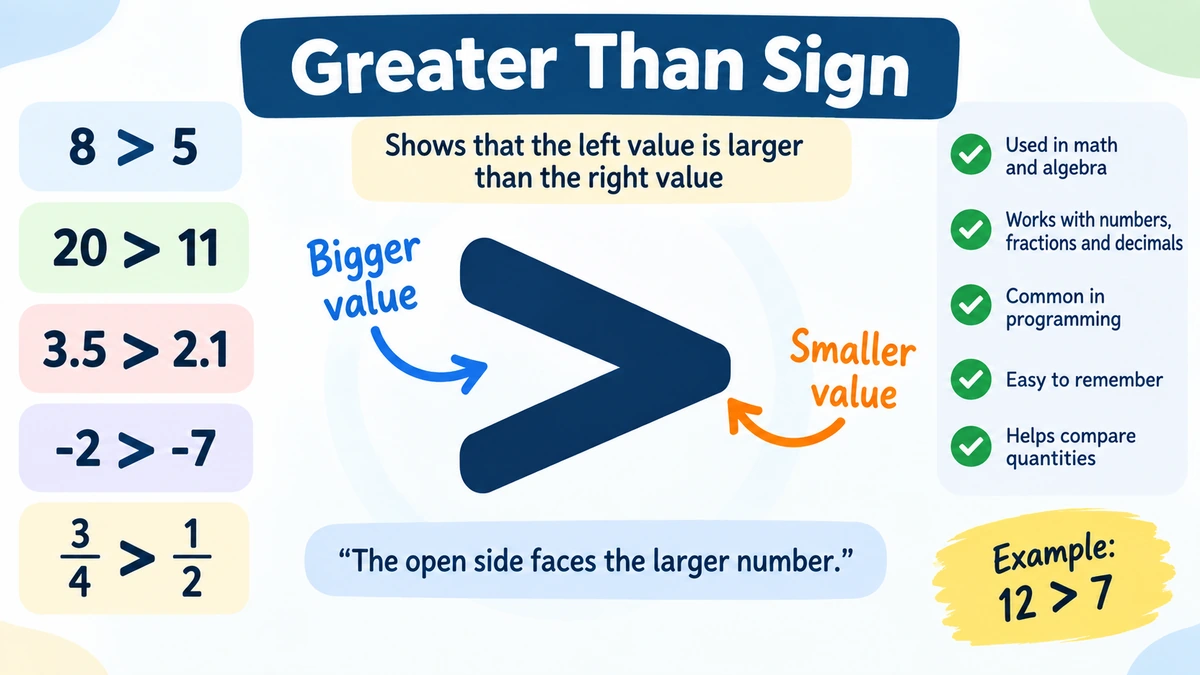
The greater than sign can look confusing at first because it closely resembles the less than sign. The easiest way to understand it is simple: the wide, open side faces the larger value, while the pointed end faces the smaller value.
The greater than sign (>) is a mathematical comparison symbol used to show that the value on the left is larger than the value on the right. For example, 8 > 5 means “8 is greater than 5.” It is commonly used with numbers, variables, inequalities, measurements, and computer programming.
What Is the greater than sign?
The greater than sign is written as:
>
It compares two numbers, quantities, or expressions and tells us that the item on the left has a greater value than the item on the right.
For example:
10 > 6
This is read as:
“10 is greater than 6.”
The statement is true because 10 has a larger numerical value than 6.
Another example is:
25 > 20
Since 25 is larger than 20, the symbol points toward 20 while its wider opening faces 25.
The greater than sign is one of the basic symbols used to express an inequality, meaning two values do not have the same relationship as values connected by an equals sign. Leading mathematics resources consistently describe > as the symbol used when the left-hand quantity exceeds the right-hand quantity.
Greater Than Symbol Copy and Paste
If you simply need the symbol, you can copy it here:
>
Its Unicode code point is U+003E, officially named GREATER-THAN SIGN.
How to Read the greater than sign
A greater than expression is normally read from left to right.
Consider:
9 > 4
Read it as:
“9 is greater than 4.”
Do not read it based only on which direction the symbol appears to point. Instead, look at the complete comparison.
Here are several examples:
| Expression | How to Read It |
|---|---|
| 7 > 3 | 7 is greater than 3 |
| 20 > 11 | 20 is greater than 11 |
| 100 > 99 | 100 is greater than 99 |
| 5.8 > 5.2 | 5.8 is greater than 5.2 |
| -2 > -7 | -2 is greater than -7 |
The final example is especially useful because negative numbers often cause mistakes. Although 7 is larger than 2 when both are positive, -2 is greater than -7 because -2 sits farther to the right on a number line.
Which Side Faces the Larger Number?
The open side of the symbol always faces the larger value.
For example:
12 > 5
The wide opening faces 12.
The pointed end faces 5.
You can think of it this way:
BIG > small
This visual rule is one of the simplest ways to distinguish greater than from less than.
greater than sign vs Less Than Sign
The symbols > and < are opposites.
| Symbol | Name | Meaning | Example |
|---|---|---|---|
| > | Greater than | Left value is larger | 8 > 3 |
| < | Less than | Left value is smaller | 3 < 8 |
| = | Equal to | Both values are equal | 8 = 8 |
| ≥ | Greater than or equal to | Left value is larger or equal | x ≥ 8 |
| ≤ | Less than or equal to | Left value is smaller or equal | x ≤ 8 |
| ≠ | Not equal to | Values are different | 8 ≠ 3 |
Notice that the same two numbers can be written in two equivalent ways:
9 > 2
and
2 < 9
Both statements describe exactly the same relationship.
The difference is simply which value appears first.
How to Remember Greater Than and Less Than
A common memory trick is to imagine the symbol as an open mouth.
The mouth wants the larger amount, so it opens toward the bigger number.
For example:
15 > 6
Imagine the symbol “eating” 15 because 15 is larger.
Another method is to ignore the mouth trick and focus on the point:
The pointed end always faces the smaller number.
So in:
40 > 12
the point faces 12.
And in:
12 < 40
the point still faces 12.
That rule works regardless of which direction you read the comparison.
How to Use the greater than sign Correctly
Using the symbol correctly takes only a few steps.
1. Compare the Two Values
Determine which number or expression has the larger value.
Suppose you are comparing:
17 and 9
17 is larger.
2. Put the Larger Value on the Left
Write:
17
first.
3. Place the Greater Than Symbol
Now write:
17 > 9
The result means:
17 is greater than 9.
This format is especially useful for beginners because it follows the natural left-to-right reading of the statement.
Greater Than Examples
Here are some straightforward comparisons:
6 > 1
50 > 20
1,000 > 999
7.5 > 6.9
3/4 > 1/2
-4 > -10
In each case, the value on the left is larger.
greater than sign With Positive and Negative Numbers
Positive numbers are usually easy to compare.
For example:
20 > 13
Things become less intuitive with negative numbers.
Consider:
-3 > -8
This is true.
A useful rule is:
Among negative numbers, the number closer to zero is greater.
Imagine a number line:
-10, -9, -8, -7, -6, -5, -4, -3, -2, -1, 0
Values increase as you move to the right.
Because -3 appears to the right of -8:
-3 > -8
Similarly:
-1 > -100
Even though 100 has a larger absolute value than 1, the negative number -1 is greater because it is closer to zero.
Comparing a Positive and Negative Number
Any positive number is greater than any negative number.
For example:
4 > -6
and:
0 > -2
Zero is also greater than every negative number.
Using Greater Than With Decimals
Decimals are compared according to place value.
Consider:
4.8 > 4.2
The whole-number part is the same, so compare the tenths:
8 tenths is greater than 2 tenths.
Now consider:
6.35 > 6.29
The whole numbers are equal, so move to the decimal places.
- Tenths: 3 = 2? No.
- Since 3 tenths is larger than 2 tenths, 6.35 is greater.
Another example:
7.50 > 7.49
The trailing zero does not make 7.50 smaller. In fact, 7.50 is the same as 7.5, which is greater than 7.49.
Using the Greater Than Symbol With Fractions
Fractions can be compared once you determine which represents the larger quantity.
For example:
3/4 > 1/2
One way to check is to rewrite the fractions using a common denominator:
3/4 = 6/8
1/2 = 4/8
Since:
6/8 > 4/8
we know:
3/4 > 1/2
You can also compare many fractions by converting them to decimals:
3/4 = 0.75
1/2 = 0.50
Therefore:
0.75 > 0.50
Fractions With the Same Denominator
When denominators are equal, compare the numerators.
For example:
7/10 > 4/10
because 7 is greater than 4.
Fractions With the Same Numerator
When two positive fractions have the same numerator, the fraction with the smaller denominator is larger.
For example:
1/3 > 1/5
Dividing something into three equal pieces produces larger pieces than dividing the same whole into five equal pieces.
Greater Than or Equal To vs Greater Than
One of the most common mistakes is confusing > with ≥.
They do not mean the same thing.
Greater Than: >
The symbol > means the left value must be strictly larger.
For example:
x > 5
Possible values include:
6, 7, 8, 10, 100, and 5.1.
But 5 itself does not satisfy the inequality.
This is sometimes described as strictly greater than.
Greater Than or Equal To: ≥
The symbol ≥ allows equality.
For example:
x ≥ 5
Possible values include:
5, 6, 7, 10, and so on.
The key difference is whether the boundary value is included.
| Expression | Is 5 Allowed? |
|---|---|
| x > 5 | No |
| x ≥ 5 | Yes |
This distinction matters in word problems.
For example:
“Age must be greater than 18”
means:
age > 18
But:
“Age must be at least 18”
normally means:
age ≥ 18
The phrase at least includes the stated value.
Greater Than in Algebra and Inequalities
The greater than symbol becomes especially useful in algebra because it can describe an entire range of possible values rather than one exact answer.
Consider:
x > 4
This means x can be any value greater than 4.
Examples include:
4.1, 5, 10, 100
but not:
4, 3, 0, -10
Solving a Simple Inequality
Suppose:
x + 3 > 9
Subtract 3 from both sides:
x > 6
So any number greater than 6 satisfies the original inequality.
Check with 7:
7 + 3 > 9
10 > 9
True.
What Happens When You Multiply or Divide by a Negative?
This is an important rule that beginners often miss.
When you multiply or divide both sides of an inequality by a negative number, reverse the inequality sign.
For example:
-2x > 8
Divide both sides by -2:
x < -4
The greater than symbol changes to less than.
Why?
Because multiplying by a negative reflects values across zero on the number line and reverses their order.
For instance:
5 > 3
Multiply both sides by -1:
-5 < -3
The relationship has reversed.
Greater Than in Word Problems
Many everyday phrases can signal that one value exceeds another.
Words that may indicate a greater-than relationship include:
- greater than
- more than
- higher than
- larger than
- exceeds
- above
Suppose a problem says:
“A roller coaster is available only to riders taller than 120 cm.”
If height is represented by h, you could write:
h > 120
However, pay attention to wording.
“Taller than 120 cm” excludes exactly 120 cm.
“At least 120 cm” would instead be:
h ≥ 120
Small wording differences can change the mathematical meaning.
Real-World Uses of the Greater Than Symbol
The symbol is not limited to worksheets and textbooks. It is useful whenever quantities must be compared.
Comparing Prices
If one item costs $70 and another costs $45:
70 > 45
Comparing Ages
If Alex is 22 and Sam is 19:
22 > 19
Comparing Temperatures
If today’s temperature is 30°C and yesterday’s was 26°C:
30°C > 26°C
Comparing Scores
If Team A scores 95 points and Team B scores 82:
95 > 82
Comparing Distance
If one route is 12 km and another is 8 km:
12 km > 8 km
These examples show that the symbol describes a relationship between quantities, not just abstract numbers.
Greater Than Sign in Programming
The symbol > is also widely used as a comparison operator in programming languages.
For example, in JavaScript:
5 > 3evaluates to:
truewhile:
2 > 7evaluates to:
falseMDN defines JavaScript’s > operator as returning true when the left operand is greater than the right operand and false otherwise.
A program might use the comparison inside a condition:
if (age > 18) {
  console.log("Age is greater than 18");
}
Similar comparison syntax appears in many programming and scripting languages, although the exact behavior can depend on data types and language rules.
Greater Than or Equal in Programming
Most programming languages represent greater than or equal to using:
>=For example:
age >= 18This returns true when age is either exactly 18 or greater than 18.
Do not confuse the programming notation >= with the single mathematical character ≥. They express the same basic relationship but are written differently in many coding environments.
Greater Than Sign in HTML
The greater than character has a special role in HTML because angle brackets are part of HTML tag syntax.
For example:
<p>Hello</p>The opening and closing tags use < and > characters.
When you specifically want to represent the greater-than character using an HTML character reference, you can use:
>which renders as:
>
You can also use the numeric character reference:
>MDN lists > as the named HTML character reference for the greater-than symbol.
How to Type the Greater Than Sign
On most standard computer keyboards, the greater than symbol shares a key with the period.
On many Windows and Mac keyboard layouts:
Shift + .
produces:
>
The exact key combination can vary with keyboard language and layout.
On smartphones and tablets, the symbol can usually be found by switching from the alphabet keyboard to the numbers or symbols screen.
You can also copy and paste it directly:
>
History of the Greater Than Symbol
The greater than and less than symbols have been used for centuries.
The earliest known printed use is commonly attributed to English mathematician Thomas Harriot, whose mathematical work Artis Analyticae Praxis was published posthumously in 1631.
The symbols eventually became standard mathematical notation because they provide a compact way to describe the relative size of two values.
Today, > appears not only in arithmetic and algebra but also in computer science, markup languages, data analysis, logic, and digital communication.
Common Mistakes When Using the Greater Than Sign
Most errors happen because people focus on the shape rather than the values being compared.
Mistake 1: Reversing the Symbol
Incorrect:
3 > 9
Correct:
9 > 3
Before choosing a symbol, identify the larger number first.
Mistake 2: Forgetting How Negative Numbers Work
Incorrect:
-10 > -2
Correct:
-2 > -10
Numbers farther right on the number line are greater.
Mistake 3: Confusing > With ≥
If a condition includes the boundary value, use ≥.
For example:
“5 or more”
means:
x ≥ 5
not:
x > 5
Mistake 4: Comparing Fractions by Denominator Alone
It is incorrect to assume a larger denominator always makes the fraction larger.
For example:
1/4 < 1/2
even though 4 is greater than 2.
Compare the value of the complete fractions, not just individual digits.
Mistake 5: Treating > Like an Arithmetic Operator
A greater than sign does not perform an operation like addition or multiplication.
For example:
9 > 5
is a statement about a relationship between two values. It tells us whether the comparison is true.
Quick Practice With the Greater Than Symbol
Try deciding whether each statement is true.
1. 14 > 9
True.
14 is larger than 9.
2. 5 > 12
False.
The correct comparison is:
5 < 12
3. -3 > -9
True.
-3 is closer to zero.
4. 0.8 > 0.75
True.
0.80 is greater than 0.75.
5. 2/3 > 1/2
True.
2/3 is approximately 0.667, while 1/2 is 0.5.
6. 10 > 10
False.
The values are equal, so:
10 = 10
If the expression were:
10 ≥ 10
it would be true.
Greater Than Symbol Cheat Sheet
| Concept | Symbol or Example |
|---|---|
| Greater than symbol | > |
| 8 is greater than 3 | 8 > 3 |
| Less than | < |
| Greater than or equal to | ≥ |
| Less than or equal to | ≤ |
| Equal to | = |
| Not equal to | ≠ |
| HTML reference | > |
| Unicode code point | U+003E |
| Programming comparison | x > y |
The easiest rule to remember is still the simplest:
The open side faces the larger value, and the pointed side faces the smaller value.
Once that rule becomes familiar, reading and writing comparisons becomes much easier.
Final Takeaway
The greater than sign (>) shows that the value on its left is larger than the value on its right. For example, 12 > 7 means “12 is greater than 7.” The wide end faces the greater number, while the pointed end faces the smaller one.
Understanding the greater than sign also makes it easier to work with less than (<), greater than or equal to (≥), negative numbers, fractions, decimals, algebraic inequalities, and programming comparisons. When you are unsure which direction the symbol should face, compare the values first and point the narrow end toward the smaller one.

Excellent way of describing, and fastidious piece of writing to get information about my presentation topic,
which i am going to deliver in institution of higher education.