

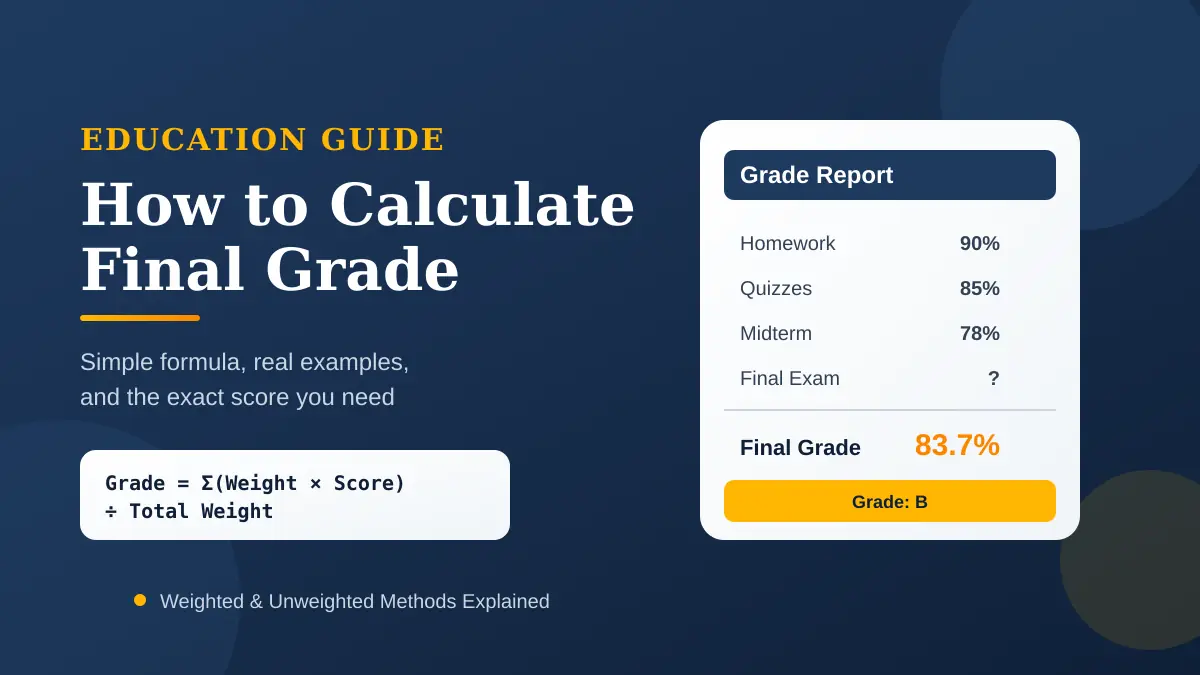
You’re staring at your syllabus, trying to figure out if that 62% on your last quiz just torched your semester. Or maybe finals are two weeks out and you need to know exactly what score keeps you above a B. Learning how to calculate final grade doesn’t require a math degree — the process is more approachable than it looks.
To calculate your final grade, multiply each grade category by its weight, add the results together, and divide by the total weight. For an unweighted class, just average all your scores. Once you know your current standing, you can work backward to find the score you need on any remaining assignment or exam.
To find out exactly what score you need on your final exam, try our final grade calculator.
The Basic Final Grade Formula
Most courses fall into one of two grading systems: unweighted, where every assignment counts the same, or weighted, where categories like homework, quizzes, and exams each carry a different percentage of your total grade.
The weighted formula looks like this:
Weighted Grade = (Weight₁ × Score₁ + Weight₂ × Score₂ + … + Weightₙ × Scoreₙ) ÷ Total Weight
That’s the entire concept. Everything else in this guide is just applying it to real numbers.
How to Calculate an Unweighted Final Grade
If your instructor treats every assignment equally — no separate categories, no exam bonus weighting — you’re looking at a simple average.
Add up every grade you’ve received, then divide by the number of grades. That’s it. There’s no trick here, which is exactly why so many intro-level courses use this system: it’s transparent and hard to argue with.
Step-by-Step Example
Say you have five test scores: 88, 92, 79, 95, and 84.
- Add them together: 88 + 92 + 79 + 95 + 84 = 438
- Divide by the number of scores: 438 ÷ 5 = 87.6
Your unweighted final grade is 87.6%, which typically lands as a B+ depending on your school’s scale.
How to Calculate a Weighted Final Grade
Weighted grading is more common in high school and college courses, especially once you get into science, math, or writing-heavy classes where a final exam or capstone project should logically count for more than a single homework set.
Here’s the process:
- Find each category’s weight from your syllabus (homework, quizzes, midterms, final exam, participation, etc.).
- Calculate the average score within each category.
- Convert each weight from a percentage to a decimal (divide by 100).
- Multiply each category average by its decimal weight.
- Add all the weighted results together.
- If your weights don’t total exactly 100%, divide by the sum of the weights instead of 100.
Step-by-Step Example
Suppose your syllabus breaks down like this:
| Category | Weight | Your Average |
|---|---|---|
| Homework | 20% | 90 |
| Quizzes | 15% | 85 |
| Midterm | 25% | 78 |
| Final Exam | 40% | Not yet taken |
If you want your current grade before the final:
- Homework: 0.20 × 90 = 18
- Quizzes: 0.15 × 85 = 12.75
- Midterm: 0.25 × 78 = 19.5
Total so far: 18 + 12.75 + 19.5 = 50.25, out of a possible 60 points (20 + 15 + 25). Divide 50.25 by 0.60 to scale it to 100%: 50.25 ÷ 0.60 = 83.75%.
That’s your grade going into the final, before that last 40% weight is factored in.
Quick Takeaway: Whenever some categories are still unscored, don’t divide by 100 — divide by the total weight of the categories you actually have grades for. Skipping this step is the single most common calculation error students make.
How to Figure Out What You Need on Your Final Exam
This is usually the real question behind “how do I calculate my final grade” — not just where you stand, but what score gets you where you want to be.
The formula:
Needed Score = (Goal Grade − Current Grade × (1 − Final Weight)) ÷ Final Weight
Worked Example
Using the numbers above: your current grade is 83.75%, the final is worth 40% (0.40), and you want to finish with a 90% overall.
- Multiply current grade by the non-final weight: 83.75 × (1 − 0.40) = 83.75 × 0.60 = 50.25
- Subtract that from your goal: 90 − 50.25 = 39.75
- Divide by the final’s weight: 39.75 ÷ 0.40 = 99.375
You’d need a 99.4% on the final to hit a 90% overall — a good sign that either your goal needs adjusting or your midterm needs to have gone better. This is exactly why checking your standing before finals week matters more than checking it after.
Common Mistakes That Throw Off Your Final Grade
Even simple math goes wrong under pressure. These are the errors that show up most often:
- Forgetting to convert percentages to decimals before multiplying (using 40 instead of 0.40).
- Averaging category averages equally instead of applying their actual weights.
- Dividing by 100 when the weights don’t add up to 100%, which skews the result.
- Using outdated weights from a syllabus that got revised mid-semester.
- Mixing raw points with percentages — always convert everything to the same unit first.
None of these are complicated once you know to watch for them, but they’re the reason two students with the same raw scores sometimes land on different final grades.
Converting Percentage Grades to Letter Grades
Letter grade cutoffs vary by school, but here’s the scale most U.S. institutions use as a baseline:
| Percentage | Letter Grade |
|---|---|
| 93–100 | A |
| 90–92 | A- |
| 87–89 | B+ |
| 83–86 | B |
| 80–82 | B- |
| 77–79 | C+ |
| 70–76 | C |
| 60–69 | D |
| Below 60 | F |
Always check your specific syllabus — some programs use a 10-point scale, others compress the ranges, and a few schools don’t use plus/minus grades at all.
Tools That Make This Easier
Doing this by hand is a useful skill, especially for verifying what a school portal tells you. But if you’re juggling several classes with different weight structures, a spreadsheet with the formula built in — or a dedicated grade calculator — saves time and cuts down on arithmetic mistakes. The formula stays the same either way; the tool just applies it faster.
Final Thoughts: How to Calculate Final Grade
Calculating your final grade comes down to one idea: multiply, add, divide by the total weight. Once you’ve done it manually a couple of times, checking where you stand becomes second nature — and knowing exactly what you need on that last exam takes the guesswork out of finals week. Pull up your syllabus, plug in your real numbers, and you’ll know precisely where you stand before your instructor posts anything.
For more free tools like this, visit GradeCalcs.com.
FAQ Section
How do you calculate your final grade with percentages?
Multiply each grade category’s percentage weight (as a decimal) by your average score in that category, then add the results together. If the weights don’t total 100%, divide the sum by the total weight used instead of by 100.
What is the formula for calculating a weighted grade?
Weighted Grade = (Weight × Score for each category, summed) ÷ Total Weight. Convert each weight to a decimal before multiplying, and make sure every category’s average reflects actual scores, not raw points.
How do I know what I need on my final exam?
Use: Needed Score = (Goal Grade − Current Grade × (1 − Final Weight)) ÷ Final Weight. Plug in your current grade, your target grade, and the final’s weight as a decimal to get the exact score required.
What is the difference between a weighted and unweighted grade?
An unweighted grade treats every assignment equally and is a simple average. A weighted grade assigns different importance to categories like homework, exams, or projects, so some scores affect your total more than others.
How do you calculate your grade if categories don’t add up to 100%?
Add up the weights you actually have grades for, calculate the weighted sum as usual, then divide by that total weight instead of 100. This scales your partial grade accurately.
Can I pass a class if I fail the final exam?
It depends on the final’s weight and your standing beforehand. Use the “needed score” formula in reverse — plug in a 0 or minimum passing score for the final and see what overall percentage results.
How do you convert a percentage grade to a letter grade?
Compare your percentage against your school’s grading scale, typically 93–100 for an A, 90–92 for an A-, and so on down to below 60 for an F. Scales vary, so always confirm with your syllabus.
How do teachers calculate final grades?
Most instructors follow the same weighted-average method: category weights are set in the syllabus, student averages are calculated within each category, and the weighted sum determines the course grade — often through a gradebook system that automates the math.
