

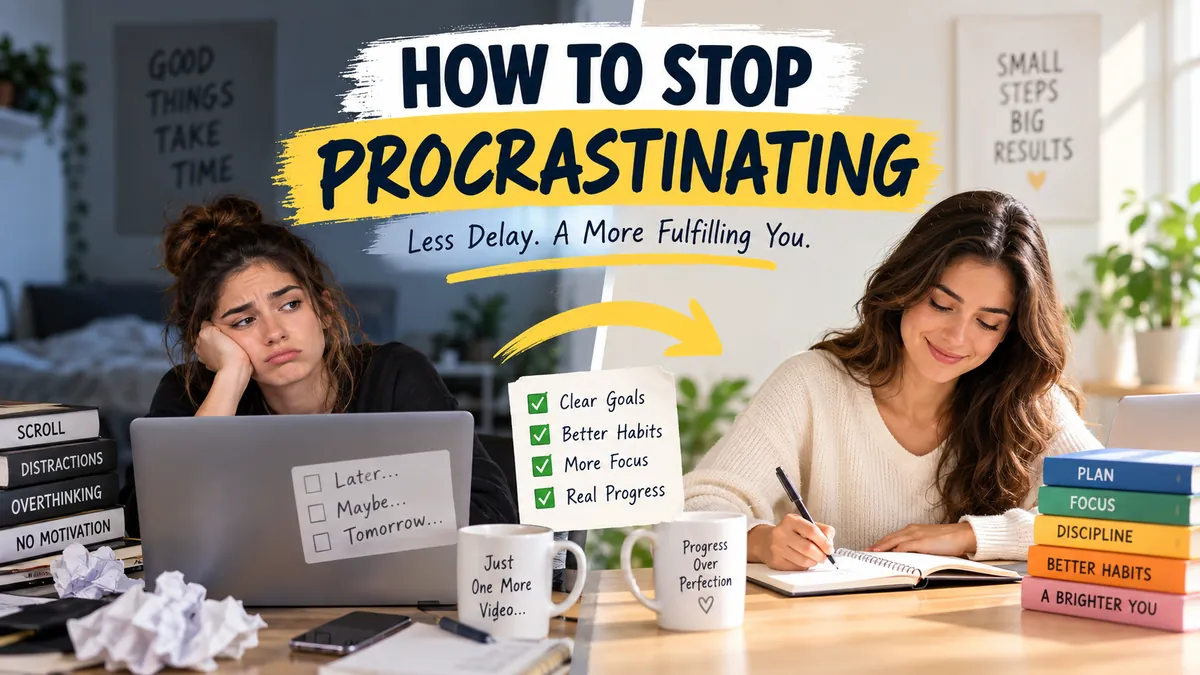
You know the task matters. You know delaying it will probably make tomorrow harder. Yet somehow you are checking messages, reorganizing your desk, watching another video, or telling yourself you will start when you “feel ready.”
Learning how to stop procrastinating starts with understanding that procrastination is often more than poor time management. Research increasingly describes it as a self-regulation problem in which people avoid tasks partly to escape uncomfortable emotions such as boredom, anxiety, frustration, uncertainty, or overwhelm.
The quickest way to stop procrastinating is to make the next action small and specific, begin before you feel motivated, remove obvious distractions, and work for a limited period. Then identify the emotion driving the avoidance and create a clear if-then plan for when and where you will continue.
That sounds simple. Making it work consistently requires understanding why your brain keeps choosing “later.”
Why Do We Procrastinate Even When We Know Better?
Procrastination is generally understood as unnecessarily delaying an intended action despite expecting that the delay may make things worse.
That distinction matters.
Deciding to postpone a report because an urgent customer problem appeared isn’t necessarily procrastination. Deliberately resting after an exhausting day isn’t automatically procrastination either.
Procrastination involves an intention-action gap: you intend to do something, have an opportunity to do it, but repeatedly avoid beginning or completing it.
Procrastination isn’t simply laziness
Calling yourself lazy may feel like an explanation, but it rarely identifies the actual problem.
A task can trigger:
- boredom
- anxiety
- frustration
- uncertainty
- fear of failure
- perfectionism
- overwhelm
- low confidence
- mental fatigue
- resentment
Avoiding the task removes some of that discomfort immediately.
Suppose you need to write a difficult report. Opening a social media app gives you instant relief from the uncertainty associated with writing. Your brain therefore receives a short-term reward for avoidance.
The report remains unfinished, however.
Now you have the original discomfort plus guilt, lost time, deadline pressure, and stress.
That creates a familiar cycle:
Difficult task → uncomfortable feeling → avoidance → temporary relief → guilt/stress → task feels worse → more avoidance
Research on procrastination and emotion regulation supports this idea of avoidance functioning as short-term mood repair.
Quick takeaway: Don’t ask only, “How can I become more disciplined?” Ask, “What am I trying not to feel when I avoid this task?”
The second question often reveals a much more useful solution.
How to Stop Procrastinating Right Now
If you are procrastinating at this moment, don’t spend the next hour designing the perfect productivity system.
Reduce the size of the decision.
1. Define the next physical action
“Work on my presentation” is vague.
Your brain still needs to determine what “work” means.
Replace it with something observable:
Open the presentation and write the titles of the first three slides.
Instead of:
Study chemistry.
Use:
Open Chapter 6 and answer question one.
Instead of:
Clean the house.
Use:
Put the clothes on the bedroom floor into the laundry basket.
The smaller and clearer the action, the less mental negotiation is required before starting.
2. Make starting ridiculously easy
When resistance is high, shrink the first action until refusing to do it almost feels silly.
James Clear popularized a version of this approach as the Two-Minute Rule: scale a new behavior down to something that takes less than two minutes to begin.
You don’t have to finish the project in two minutes.
You are simply reducing the activation energy required to start.
| Vague task | Better first action |
|---|---|
| Exercise | Put on workout clothes |
| Write essay | Create document and write one sentence |
| Study | Open notes to the correct page |
| Do taxes | Gather tax documents |
| Clean bedroom | Put away five items |
| Answer emails | Open the oldest important email |
| Prepare presentation | Create the first slide |
Once you begin, continuing often becomes easier because the task is no longer hypothetical.
3. Set a short timer
Tell yourself:
“I only need to work on this for 10 minutes.”
If 10 feels difficult, use five.
A defined endpoint makes an unpleasant task feel less threatening. After the timer ends, you can decide whether to continue.
For longer sessions, the Pomodoro Technique, developed by Francesco Cirillo, commonly uses 25 minutes of focused work followed by a short break. The Open University describes the standard study approach as 25 minutes of work, a five-minute break, and a longer break after four rounds.
Twenty-five minutes isn’t a magical number, though.
The best interval is one that gets you working and allows you to restart after the break.
4. Remove your easiest escape route
If you automatically grab your phone whenever work becomes uncomfortable, don’t depend on willpower to resist it 40 times an hour.
Put the phone somewhere inconvenient.
Close unnecessary browser tabs. Disable nonessential notifications. Sign out of distracting websites. Keep only the materials required for the current task visible.
Reducing competing distractions is also recommended in current clinical guidance on procrastination.
Then start the tiny action you identified earlier.
You now have a simple emergency formula:
One task + one tiny first step + one timer + fewer distractions.
How to Stop Procrastinating by Finding the Real Cause
The same technique doesn’t work for every form of procrastination.
A timer may help when a task feels boring. It won’t necessarily solve perfectionism. A detailed schedule may help when you’re disorganized but make little difference when you’re avoiding a frightening decision.
Before choosing a strategy, diagnose the resistance.
If the task feels overwhelming
Break the project into actions that can be completed independently.
Don’t write:
Finish website.
Write:
- Create homepage outline.
- Draft headline.
- Write introduction.
- Add images.
- Check mobile layout.
- Proofread.
- Publish.
You have transformed one intimidating project into seven visible actions.
Breaking larger responsibilities into manageable tasks is consistently recommended across current procrastination guidance.
If the task is unclear
Ask:
“What exactly would I physically do first?”
“Research competitors” is still broad.
“Search for five competitors and paste their URLs into a spreadsheet” is actionable.
Ambiguity creates friction because you must plan and execute simultaneously.
Separate those jobs.
If you’re afraid of doing badly
Perfectionism can disguise itself as procrastination.
You tell yourself:
I need more research first.
Or:
I’ll start when I have enough uninterrupted time.
Sometimes that’s legitimate. Sometimes it’s a safer alternative to producing something that could be judged.
Give yourself permission to produce a deliberately imperfect first version.
A rough paragraph can be edited.
A blank page cannot.
If the task is boring
Bring the reward closer.
You might work for 25 minutes and then have coffee, listen to a favorite song during repetitive work, or pair an unpleasant chore with something mildly enjoyable when doing so won’t interfere with concentration.
The objective isn’t to make every responsibility exciting.
It is to make starting less aversive.
If you’re exhausted
Be careful not to label genuine fatigue as procrastination.
Sleep deprivation, excessive workload, burnout and inadequate recovery can all make effortful work harder. Current clinical guidance explicitly recommends protecting sleep and scheduling breaks rather than treating rest as something that must always be earned.
If your concentration is deteriorating because you’ve been working continuously for hours, another productivity technique may not be the answer.
You may need recovery.
Use If-Then Plans to Turn Intentions Into Action
One of the biggest problems with procrastination is that intentions are usually too vague.
You say:
I’ll exercise tomorrow.
I’ll study tonight.
I’ll finish that report later.
But when “later” arrives, another decision is required.
This is where implementation intentions can help.
An implementation intention specifies the situation that should trigger an action:
If X happens, then I will do Y.
For example:
If it is 9:00 a.m., then I will sit at my desk and work on the report for 20 minutes.
Or:
After I finish breakfast, I will open my textbook and complete five practice questions.
Research has found that implementation intentions can help bridge the gap between wanting to act and actually acting. In one study involving 152 university students, participants who formed implementation intentions were substantially more likely to attend a later appointment.
More recent research has examined mental contrasting with implementation intentions (MCII). In a 2026 randomized study of 81 undergraduates, MCII reduced task aversiveness and increased willingness to initiate academic work compared with a positive-thinking condition, with effects still evident at a one-week follow-up.
Make your plan specific
Weak:
I’ll study tomorrow.
Better:
At 7:00 p.m., I’ll study biology.
Stronger:
At 7:00 p.m., I’ll sit at my desk, put my phone outside the room, open Chapter 8 and complete questions 1–5.
The stronger version removes several decisions from the moment when you’re most vulnerable to procrastination.
Stop Waiting for Motivation
One of procrastination’s most persistent traps is believing motivation must precede action:
Motivation → Action
In everyday life, the relationship often works in both directions:
Action → Progress → Motivation → More action
You may not feel motivated to exercise while sitting on the couch.
Changing clothes and walking outside changes the situation.
You may not feel ready to write while staring at a blank document.
Writing three imperfect sentences gives you something concrete to improve.
This is why task initiation deserves so much attention.
You don’t need enough motivation to finish.
You need enough momentum to perform the next action.
Replace “finish” with “start”
Notice the difference between these thoughts:
I need to write 2,000 words.
and:
I need to write for 10 minutes.
The first makes you mentally experience the entire workload before doing anything.
The second gives you a doorway into it.
Your goal when procrastination is strong isn’t necessarily maximum productivity.
It is successful initiation.
How to Stop Procrastinating With Better Time Management
Procrastination isn’t only a time-management issue, but good time management can remove unnecessary opportunities for avoidance.
The key is making your schedule concrete.
Use time blocking instead of endless to-do lists
A to-do list tells you what needs doing.
A calendar can tell you when you will do it.
Instead of maintaining a 23-item list and hoping you eventually feel motivated, assign important tasks actual periods of time.
For example:
| Time | Action |
|---|---|
| 8:30–9:00 | Email and admin |
| 9:00–10:00 | Important project |
| 10:00–10:15 | Break |
| 10:15–11:00 | Important project |
| 11:00–11:30 | Calls |
| 11:30–12:00 | Smaller tasks |
Don’t schedule every available minute.
Unexpected work happens, tasks take longer than predicted, and humans need breaks.
Leave breathing room.
Give yourself intermediate deadlines
A project due in three weeks creates a distant consequence.
Create closer checkpoints:
Monday: research complete
Wednesday: outline complete
Friday: first draft complete
Next Tuesday: editing complete
Thursday: final review
Now the project has multiple starting points rather than one frightening deadline.
Work with your energy, not only the clock
Notice when your concentration is strongest.
If your best mental energy occurs between 9 a.m. and noon, spending that period on routine email while saving difficult analytical work for late afternoon may make avoidance more likely.
Use higher-energy periods for cognitively demanding work when your schedule allows it.
Administrative tasks can occupy lower-energy periods.
Reduce Digital Distractions Before They Become Decisions
Modern procrastination has an unusually convenient escape hatch: a device containing almost unlimited novelty.
Your phone isn’t necessarily the cause of procrastination. But when a difficult task produces discomfort, digital entertainment gives you an immediate alternative.
That makes environmental design important.
Try increasing friction around distractions:
- Put your phone outside your workspace.
- Disable unnecessary notifications.
- Use full-screen mode when writing.
- Close unrelated tabs.
- Remove social media shortcuts.
- Use website or app limits during focus periods.
- Keep entertainment devices away from your desk.
- Create a dedicated work environment when possible.
Current guidance from both Understood and Cleveland Clinic recommends reducing competing distractions and adjusting the working environment rather than relying solely on self-control.
Don’t replace one form of procrastination with another
Productive procrastination is especially deceptive.
Instead of writing the report, you:
- organize folders
- clean your inbox
- redesign your task system
- read productivity articles
- research tools
- make increasingly detailed plans
These activities may genuinely need doing.
The question is:
“Would I be doing this right now if the difficult task didn’t exist?”
If the answer is no, you may simply have found a more respectable form of avoidance.
Deal With Perfectionism Before It Stops You Starting
Perfectionism often creates an impossible condition:
I should only begin when I can do this properly.
That increases the emotional cost of starting.
Try separating creation from evaluation.
First pass: produce
Write the rough paragraph.
Create the ugly spreadsheet.
Sketch the rough design.
Record the imperfect presentation.
Second pass: improve
Correct errors.
Strengthen arguments.
Improve formatting.
Check details.
Third pass: finish
Proofread.
Verify requirements.
Submit or publish.
Trying to create, judge and perfect something simultaneously makes every sentence or decision carry unnecessary weight.
Lower the standard for the first pass without lowering the standard for the finished work.
That’s an important distinction.
“Make a bad first draft” doesn’t mean “submit bad work.”
It means giving yourself something to improve.
Use Self-Compassion Instead of Shame
After procrastinating for several hours, many people try to motivate themselves with criticism:
I’m so lazy.
I’ve wasted another day.
Why can’t I just be disciplined?
The problem is that shame adds another unpleasant emotion to a task that already feels unpleasant.
That can strengthen avoidance rather than break it.
The American Psychological Association’s overview of psychologist Fuschia Sirois’s work emphasizes managing negative emotions and approaching procrastination with compassion rather than harsh self-judgment.
Self-compassion doesn’t mean pretending the missed deadline doesn’t matter.
A more useful response is:
I avoided this for two hours. I can’t recover those two hours, but I can spend the next 10 minutes starting.
That acknowledges reality without turning one delayed task into an argument about your character.
Focus on the future self
Procrastination often favors immediate emotional relief while leaving the cost for your future self.
Reverse the perspective.
Ask:
“What can I do for 15 minutes that will make tonight easier?”
Or:
“What would tomorrow morning’s version of me be relieved to find already finished?”
This moves attention from the discomfort of starting toward the consequences of action.
Build Accountability When Personal Deadlines Don’t Work
Some people can ignore a deadline they created themselves because they know there is no immediate consequence.
External accountability can make the commitment more concrete.
Tell a friend:
I’ll send you the completed outline by 4 p.m.
Study alongside someone.
Schedule a progress meeting.
Use a coworking session.
For some people, simply knowing that another person expects an update makes starting easier.
This doesn’t mean becoming dependent on other people for motivation.
Think of accountability as temporary scaffolding while you strengthen your own work routines.
How to Stop Procrastinating When Studying
Academic procrastination deserves special attention because students frequently work toward distant rewards.
An exam may be weeks away. An assignment might take dozens of hours. Meanwhile, entertainment provides immediate gratification.
A better study strategy makes progress visible and immediate.
Don’t schedule:
Study history for three hours.
Schedule:
7:00–7:25: review pages 40–48.
7:25–7:30: break.
7:30–7:55: answer 10 practice questions.
7:55–8:00: break.
8:00–8:25: review incorrect answers.
Now you know exactly what starting means.
Research on academic procrastination also supports addressing task aversiveness and emotional regulation rather than relying exclusively on positive thinking or willpower.
Don’t confuse studying with preparing to study
Finding the perfect playlist, rearranging notes, choosing highlighters and building an elaborate revision timetable can all become avoidance.
Ask yourself:
“Am I interacting with the material I actually need to learn?”
Reading, retrieval practice, solving problems, explaining concepts and completing practice questions move learning forward.
Preparing your desk for another 45 minutes doesn’t.
How to Break Chronic Procrastination
Occasional procrastination is common.
Chronic procrastination is different because the behavior becomes a repeated response to discomfort.
You may need to change the system surrounding your work rather than finding another motivational trick.
Track your procrastination triggers for one week
Whenever you catch yourself avoiding an important task, record four things:
| Question | Example |
|---|---|
| What was I supposed to do? | Write proposal |
| What did I feel? | Uncertain and anxious |
| What did I do instead? | Checked social media |
| What would have made starting easier? | Create outline first |
Patterns usually emerge.
Maybe you procrastinate when tasks are ambiguous.
Maybe perfectionism appears whenever your work will be evaluated.
Maybe your concentration collapses after lunch.
Maybe your phone is responsible for most derailments.
Once the trigger becomes visible, you can choose a targeted intervention instead of trying random productivity techniques.
Change one bottleneck at a time
If your biggest problem is your phone, redesign your digital environment.
If the problem is overwhelm, improve task breakdown.
If the problem is unclear work, define next actions.
If the problem is perfectionism, practice imperfect first drafts.
If the problem is exhaustion, examine workload and recovery.
If the problem is initiation, use implementation intentions.
You don’t need 20 productivity hacks.
You need the right intervention for the behavior that repeatedly stops you.
What Doesn’t Work Well Against Procrastination?
Some approaches feel productive but often leave the underlying pattern untouched.
Waiting until you feel inspired
Motivation fluctuates.
A reliable system should still allow you to begin when motivation is mediocre.
Creating enormous to-do lists
Long lists can increase overwhelm and make prioritization harder.
Identify a small number of meaningful priorities and convert them into specific actions.
Depending entirely on willpower
Your environment influences behavior.
Make desired actions easier and distractions harder.
Punishing yourself
Self-criticism can increase the emotional discomfort surrounding the task.
Correct the behavior without turning it into a judgment about your identity.
Planning endlessly
Planning has diminishing returns.
Eventually another hour of planning becomes avoidance.
Set a point where preparation ends and execution begins.
Trying to change everything overnight
An extreme routine may work for three days and collapse on the fourth.
A modest system you can repeat is more useful than an impressive system you cannot maintain.
Procrastination, Stress, Sleep, ADHD, Anxiety and Depression
Not every procrastination problem can be solved with a timer.
Persistent difficulty starting or completing tasks can sometimes occur alongside ADHD, anxiety, depression, burnout, sleep difficulties or other issues affecting attention, executive function, energy and emotion regulation.
That doesn’t mean procrastinating proves you have any particular condition.
For example, ADHD can affect executive functions involved in attention, planning, task initiation and follow-through, but procrastination alone isn’t enough to determine whether someone has ADHD.
Sleep deserves attention too. A 2026 longitudinal study involving 929 university students found associations among technostress, bedtime procrastination and poorer subsequent sleep quality.
Procrastination itself is also associated with stress and health. A 2026 meta-analysis covering 36 samples and 8,603 participants found that higher trait procrastination was associated with poorer self-rated health, with higher stress explaining part of that relationship. Because much of the analyzed evidence was cross-sectional, this association shouldn’t be interpreted as proving that procrastination directly causes poor health.
Consider professional support when procrastination is persistent and significantly interfering with school, work, finances, relationships, health responsibilities or everyday functioning, particularly when it occurs alongside substantial problems with attention, mood, anxiety or sleep.
A Simple Daily System for How to Stop Procrastinating
You don’t need a complicated productivity setup.
Try this for one week.
The night before
Choose your most important task.
Write down the first physical action required.
Not:
Work on proposal.
Instead:
Open proposal document and write the five section headings.
When your work period begins
Remove your phone and obvious distractions.
Use an implementation intention:
If it is 9:00 a.m., I will open the proposal and work for 10 minutes.
Then begin immediately.
When resistance appears
Don’t automatically obey it.
Name it:
I’m feeling bored.
I’m afraid this won’t be good enough.
I don’t know what comes next.
This feels too big.
Then choose the matching response.
| Problem | Response |
|---|---|
| Overwhelmed | Shrink the task |
| Unclear | Define the next physical action |
| Distracted | Change the environment |
| Perfectionism | Produce an imperfect first version |
| Bored | Use a short timed sprint |
| Low motivation | Commit only to starting |
| Fatigued | Rest and reassess workload |
| No urgency | Create an intermediate deadline |
| Weak follow-through | Add accountability |
| Repeated avoidance | Identify the emotion underneath it |
At the end of your work period, write down exactly where you will restart.
That last step matters.
Instead of returning tomorrow to the vague instruction “continue project,” you return to:
Open Section 3 and write the first example.
You’ve already made tomorrow’s first decision.
How Long Does It Take to Stop Procrastinating?
There isn’t a universal number of days.
Procrastination isn’t one behavior with one cause, so expecting it to disappear permanently after a particular challenge, app or productivity method is unrealistic.
Measure improvement differently.
Are you starting sooner?
Are you recovering more quickly after getting distracted?
Are fewer tasks reaching emergency-deadline status?
Can you work despite boredom or anxiety instead of waiting for those feelings to disappear?
Those are meaningful signs of progress.
The goal isn’t to become a person who never procrastinates.
The goal is to recognize avoidance earlier and have a reliable way to return to action.
How to Stop Procrastinating for Good
If you want to know how to stop procrastinating, don’t begin by demanding more motivation from yourself.
Begin by reducing the friction between intention and action.
Make the task concrete. Shrink the first step. Decide when and where you will start. Remove the easiest distraction. Work for a manageable period. Address the emotion behind repeated avoidance, and use accountability when your own deadlines aren’t enough.
Most importantly, practice starting before you feel completely ready.
The next time you catch yourself procrastinating, don’t promise that tomorrow will be different.
Choose the smallest useful action you can take now, and do that one thing.
