

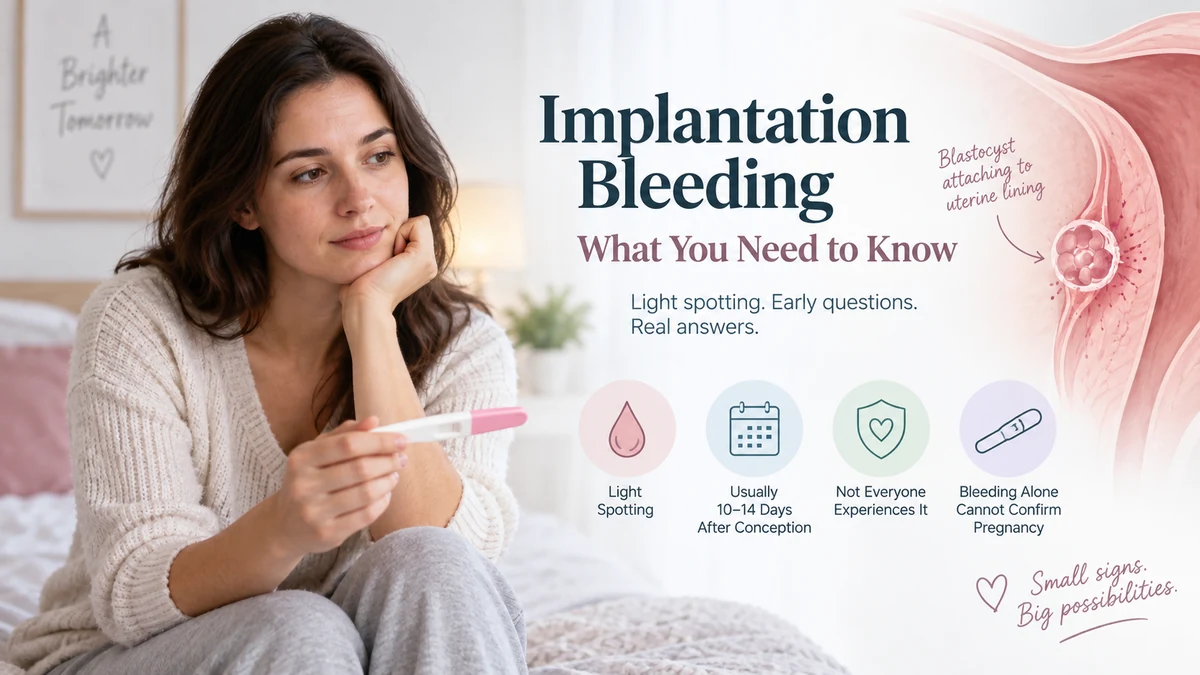
Seeing unexpected spotting when you are hoping—or wondering—if you might be pregnant can be confusing. The timing may be close to your expected period, and early pregnancy symptoms often overlap with premenstrual symptoms.
Implantation bleeding describes light spotting that may occur in very early pregnancy around the time a fertilized egg attaches to the uterine lining. It is typically much lighter than menstrual bleeding, may appear pink or brown, and usually lasts from a few hours to a couple of days.
Not everyone experiences this type of spotting, and bleeding alone cannot confirm pregnancy. In fact, the exact relationship between implantation itself and vaginal bleeding is less certain than the name suggests. A prospective study that precisely tracked ovulation and implantation found that early pregnancy bleeding rarely occurred on the actual day of implantation.
That distinction matters. Light spotting can occur in a healthy early pregnancy, but bleeding can also have other causes. Understanding the timing, amount, appearance, and accompanying symptoms can help you decide what to do next.
What Is Implantation Bleeding?
Implantation is an early stage of pregnancy. After an egg is fertilized by sperm, the developing cells travel through the fallopian tube toward the uterus. By the time the developing embryo reaches the uterus and begins attaching to the endometrium—the uterine lining—it has developed into a structure called a blastocyst.
The term implantation bleeding is commonly used for a small amount of vaginal spotting around this stage of early pregnancy.
The traditional explanation is that attachment to the vascular uterine lining can disturb tiny blood vessels and cause a small amount of bleeding. Major medical organizations, including the American College of Obstetricians and Gynecologists (ACOG), recognize that light spotting may occur roughly one to two weeks after fertilization.
There is an important scientific nuance, however. Spotting around this time doesn’t prove that implantation caused the bleeding. Research tracking implantation using hormone measurements has found little evidence that bleeding occurs specifically at the moment of implantation.
So, in everyday health information, “implantation bleeding” remains a useful descriptive term, but it should not be treated as a definitive diagnosis.
How common is implantation bleeding?
Estimates vary partly because studies define and measure early pregnancy bleeding differently.
ACOG reports that bleeding occurs during the first trimester in approximately 15 to 25 out of every 100 pregnancies. That figure covers early-pregnancy bleeding generally, however—not exclusively bleeding proven to result from implantation.
Many pregnant people never notice spotting around implantation at all. Its absence therefore tells you very little about whether conception occurred.
Quick takeaway: Implantation bleeding is usually described as brief, light spotting in very early pregnancy. Not having it is completely compatible with pregnancy, and having spotting does not by itself prove pregnancy.
When Does Implantation Bleeding Happen?
Timing is one reason implantation bleeding and menstruation are so easily confused.
Mayo Clinic describes implantation bleeding as typically occurring around 10 to 14 days after conception, which can place it close to the date an expected menstrual period would normally begin.
The exact timing varies because ovulation does not necessarily occur on the same cycle day every month.
A simplified sequence looks like this:
- Ovulation: An ovary releases an egg.
- Fertilization: If sperm fertilizes the egg, conception occurs.
- Early development: The fertilized egg divides as it travels toward the uterus.
- Blastocyst formation: The developing embryo reaches the blastocyst stage.
- Implantation: The blastocyst begins attaching to and embedding in the endometrium.
- hCG production: Human chorionic gonadotropin (hCG) begins rising after implantation, eventually reaching levels detectable by pregnancy tests.
Because menstrual cycles differ, calculating implantation from a calendar alone isn’t precise.
Can implantation bleeding happen after a missed period?
Spotting associated with very early pregnancy is usually discussed as occurring near the expected period, rather than well after a confirmed missed period.
If you have already missed your period and develop bleeding, don’t automatically label it implantation bleeding. There are several possible causes of bleeding during pregnancy, ranging from relatively harmless cervical bleeding to conditions requiring medical evaluation.
Taking a pregnancy test and paying attention to the amount of bleeding and other symptoms is more useful than trying to identify the cause from timing alone.
What Does Implantation Bleeding Look Like?
There is no single appearance that definitively identifies implantation bleeding.
The classic pattern is very light spotting rather than a true menstrual flow. Cleveland Clinic describes it as commonly pink or brown and light enough that it does not soak through a pad.
You might notice:
- A few spots on underwear
- Pinkish discharge
- Brown or dark-brown discharge
- Blood only when wiping
- A very light, intermittent flow
- Blood mixed with normal cervical mucus
Brown blood generally represents blood that has taken longer to leave the reproductive tract and has undergone oxidation. Color by itself, however, cannot tell you why you’re bleeding.
Is implantation bleeding red?
It can be difficult to diagnose the cause of bleeding from color alone.
Implantation spotting is commonly described as pink or brown, while a menstrual period is more likely to develop into a stronger red flow. But real-life bleeding doesn’t always follow textbook descriptions.
Bright-red bleeding—particularly if it becomes heavier—is less characteristic of what is normally called implantation bleeding and deserves closer attention.
Does implantation bleeding have clots?
Clots are not typical of implantation bleeding.
The small amount of blood normally associated with implantation spotting usually isn’t enough to produce the clotting seen with heavier menstrual bleeding.
Passing significant clots or tissue, especially when accompanied by increasing bleeding or cramping, should not simply be assumed to be implantation. Bleeding and cramping can occur with early pregnancy loss, and medical evaluation may be necessary.
Implantation Bleeding vs. Period: How Can You Tell the Difference?
This is usually the hardest question to answer because there is no home observation that can identify implantation bleeding with certainty.
Still, the overall bleeding pattern can provide clues.
| Feature | Implantation bleeding | Menstrual period |
|---|---|---|
| Amount | Usually very light spotting | Usually a more established flow |
| Typical color | Often pink or brown | Commonly red to dark red |
| Duration | Hours to roughly 1–2 days, sometimes a little longer | Often several days |
| Flow pattern | Light, sometimes intermittent | May become heavier before decreasing |
| Clots | Not typical | Small clots may occur |
| Cramping | None or mild | Can range from mild to strong |
| Timing | Around very early pregnancy/expected period | According to menstrual cycle |
| Pregnancy test | May become positive as hCG rises | Negative unless pregnancy is also present |
These are patterns, not diagnostic rules. Mayo Clinic specifically notes that implantation bleeding can be mistaken for a light period because it occurs around the expected time of menstruation.
Does implantation bleeding get heavier like a period?
Usually not.
A period often develops into a recognizable menstrual flow before gradually becoming lighter. Bleeding attributed to implantation should generally remain light.
If spotting progresses to bleeding similar to or heavier than your normal period, implantation becomes a less convincing explanation.
Heavy bleeding in early pregnancy needs particular attention because miscarriage and ectopic pregnancy are among the conditions healthcare professionals consider.
Can you fill a pad with implantation bleeding?
Typical implantation bleeding shouldn’t soak through pads.
If you’re filling pads, experiencing a rapidly increasing flow, or passing substantial clots or tissue, don’t rely on the assumption that the bleeding is implantation-related.
The amount of bleeding is more medically useful than trying to identify the exact shade of the blood.
Quick takeaway: Light, brief spotting fits the usual description of implantation bleeding better than a steady or increasing flow. Heavy bleeding, significant clots, or severe pain needs medical attention.
How Long Does Implantation Bleeding Last?
When implantation bleeding occurs, it is generally short-lived.
Cleveland Clinic states that it may occur for a few hours or a few days and should generally stop on its own after about two days. Mayo Clinic likewise characterizes it as light bleeding that resolves without treatment.
Some people may notice a single spot. Others may experience occasional pink or brown discharge over a day or two.
What is less typical is bleeding that:
- Becomes progressively heavier
- Continues like a normal menstrual period
- Requires frequent pad changes
- Contains significant clots
- Is accompanied by worsening pelvic pain
- Stops and then repeatedly returns with significant pain
These patterns don’t automatically mean something is wrong, but they make it more important to determine the actual cause rather than assuming implantation.
Implantation Bleeding Symptoms and Early Pregnancy Signs
Implantation itself often produces no noticeable symptoms.
People who notice spotting may also report symptoms commonly associated with either early pregnancy or the premenstrual phase, such as:
- Mild abdominal or pelvic cramping
- Breast tenderness
- Fatigue
- Bloating
- Headache
- Changes in vaginal discharge
- Nausea
The problem is that none of these symptoms reliably confirms implantation.
Progesterone rises after ovulation regardless of whether conception occurred, and many premenstrual symptoms overlap with early pregnancy symptoms. Breast tenderness, bloating, fatigue, mood changes, and mild cramping can therefore occur in both situations.
What do implantation cramps feel like?
If cramping accompanies light early-pregnancy spotting, it is generally described as mild.
Strong, persistent, worsening, or one-sided pain is different. Severe abdominal or pelvic pain—especially together with bleeding—can occur with an ectopic pregnancy and warrants prompt medical evaluation. ACOG notes that ectopic pregnancy may cause abdominal, pelvic, or shoulder pain and can become life-threatening if a fallopian tube ruptures.
Symptoms should therefore be judged as a whole rather than by whether they resemble an online description of “implantation cramps.”
Implantation Bleeding and Pregnancy Tests
A pregnancy test is far more useful for establishing pregnancy than the appearance of spotting.
Home pregnancy tests detect human chorionic gonadotropin (hCG) in urine. This hormone begins increasing after implantation, but it takes time for concentrations to become high enough for a urine test to detect reliably.
That creates a frustrating situation: you can potentially experience spotting at a time when a home pregnancy test is still negative.
Can you take a pregnancy test during implantation bleeding?
Yes, but an early negative result may not settle the question.
If hCG has not yet risen above the test’s detection threshold, the result can be negative despite an early pregnancy. Cleveland Clinic advises that testing too soon may produce a negative result because insufficient hCG has accumulated.
For a more reliable home result:
- Check the pregnancy test’s instructions carefully.
- Test on or after the expected date of your period when possible.
- Consider first-morning urine if you’re testing very early because it is often more concentrated.
- If the result is negative but your period doesn’t arrive, repeat the test after a few days.
- Contact a healthcare professional if results remain unclear or bleeding or pain is concerning.
A healthcare professional can also use a blood test to measure serum beta-hCG (β-hCG). When medically necessary, serial hCG measurements and ultrasound can help evaluate an early pregnancy. ACOG notes that ultrasound and serum β-hCG testing can be used when assessing early pregnancy complications.
Does implantation bleeding guarantee a positive pregnancy?
No.
Bleeding cannot establish that implantation has successfully occurred, and many unrelated conditions cause spotting.
A positive pregnancy test indicates that hCG has been detected. It still does not tell you why you’re bleeding or confirm by itself that the pregnancy is developing normally or located inside the uterus.
Other Causes of Spotting Around the Time of a Period
One of the biggest mistakes people make is treating any spotting before a period as implantation bleeding.
Vaginal bleeding has many possible explanations.
Hormonal changes
Normal fluctuations in estrogen and progesterone can produce changes in menstrual timing and flow. Irregular spotting can also occur with hormonal contraception.
Birth control pills, hormonal intrauterine devices (IUDs), contraceptive implants, injections, and vaginal rings can all alter bleeding patterns. ACOG notes that breakthrough bleeding is particularly common with some hormonal birth-control methods.
Cervical bleeding
Pregnancy increases blood flow and vascular changes around the cervix, which can make it easier for the cervix to bleed.
Spotting can therefore occur after penetrative sex, a Pap test, or a pelvic examination. ACOG specifically notes that light spotting after intercourse can occur during pregnancy.
Infection
Some vaginal, cervical, urinary, or sexually transmitted infections can cause spotting or unusual discharge.
The NHS includes infection among the possible causes of bleeding during pregnancy.
Bleeding accompanied by fever, pelvic discomfort, pain during urination, or unusual or foul-smelling discharge deserves medical assessment.
Cervical polyps and other growths
Benign growths such as cervical polyps can bleed, particularly when irritated.
Fibroids and other gynecologic conditions can also alter menstrual bleeding patterns. These possibilities are another reason that spotting should not automatically be interpreted as proof of conception.
Implantation Bleeding, Miscarriage, and Ectopic Pregnancy
Most light spotting in early pregnancy does not automatically mean pregnancy loss. At the same time, appearance alone cannot safely distinguish all causes of bleeding.
Miscarriage
Vaginal bleeding is one possible symptom of early pregnancy loss, but bleeding doesn’t mean a miscarriage has definitely occurred.
ACOG estimates early pregnancy loss occurs in about 10% of clinically recognized pregnancies and states that bleeding is its most common sign. Cramping and passage of fluid or tissue may also occur.
The distinction sometimes requires ultrasound and hCG testing rather than symptoms alone.
Ectopic pregnancy
An ectopic pregnancy occurs when a pregnancy implants outside the uterine cavity, most commonly in a fallopian tube.
This condition requires medical care because a growing ectopic pregnancy can rupture and cause dangerous internal bleeding.
Possible warning signs include:
- Vaginal bleeding
- Significant abdominal or pelvic pain
- Pain concentrated on one side
- Shoulder pain
- Weakness
- Dizziness
- Fainting
ACOG advises contacting an ob-gyn promptly when symptoms suggest an ectopic pregnancy.
Molar pregnancy
A molar pregnancy is a much less common abnormal pregnancy in which unusual placental tissue develops. Vaginal bleeding can be one symptom.
Mayo Clinic and the NHS include molar pregnancy among potential causes healthcare professionals may consider when evaluating bleeding during pregnancy.
The key lesson is simple: “implantation bleeding” should never become a catch-all explanation for significant bleeding during pregnancy.
When Should You Contact a Healthcare Professional?
If you know you’re pregnant, reporting vaginal bleeding to your pregnancy-care provider is sensible even when the amount is small. ACOG recommends contacting your ob-gyn about bleeding during pregnancy because causes range from harmless to serious.
Seek urgent medical attention for bleeding accompanied by symptoms such as:
- Heavy or rapidly increasing bleeding
- Severe abdominal or pelvic pain
- Significant one-sided pain
- Shoulder pain
- Fainting or severe dizziness
- Marked weakness
- Passage of substantial tissue
- Severe or persistent cramping
- Fever or feeling seriously unwell
These symptoms can occur with conditions such as ectopic pregnancy or pregnancy loss and should not be self-diagnosed as implantation bleeding.
If you’re unsure how much blood you’re losing, using a pad rather than a tampon can make the amount easier to monitor. Note when the bleeding began, whether it’s increasing or decreasing, its approximate amount, and whether you’re experiencing pain or other symptoms. Those details can help a healthcare professional evaluate what is happening.
How Is Early Pregnancy Bleeding Evaluated?
There isn’t a specific test that proves a small amount of blood was caused by implantation.
Instead, healthcare professionals assess the pregnancy and rule out other explanations.
Depending on your pregnancy stage, symptoms, and medical history, evaluation may involve:
Pregnancy testing
Urine or blood testing can establish whether hCG is detectable.
A quantitative blood test measures the concentration of beta-hCG. Sometimes the measurement is repeated to evaluate how levels change over time.
Ultrasound
An ultrasound may be used to determine whether a pregnancy is located within the uterus and assess its development.
In very early pregnancy, however, an ultrasound may simply be too early to provide a definitive answer. Follow-up imaging or serial hCG testing may therefore be needed. ACOG emphasizes that more than one ultrasound or hCG measurement can sometimes be necessary before an early pregnancy loss can be confirmed.
Medical history and examination
A clinician may ask about:
- The first day of your last menstrual period
- Usual cycle length
- When spotting began
- Bleeding amount and duration
- Pregnancy test results
- Pelvic or abdominal pain
- Previous pregnancies
- Previous ectopic pregnancy or miscarriage
- Contraceptive use
- Recent sexual activity
- Other medical conditions
A pelvic examination may sometimes be appropriate to look for cervical or vaginal sources of bleeding.
The goal isn’t simply to decide whether spotting “looks like implantation.” It is to establish whether you’re pregnant and, when necessary, whether that pregnancy appears to be developing appropriately.
Common Myths About Implantation Bleeding
Implantation bleeding attracts a lot of certainty online that the medical evidence doesn’t always support.
Myth: Everyone gets implantation bleeding
They don’t.
Many pregnancies begin without noticeable spotting. Absence of bleeding is not evidence that implantation failed.
Myth: You can confirm pregnancy from the color of spotting
You cannot.
Pink or brown spotting may fit the commonly described appearance of implantation bleeding, but color alone cannot identify its cause.
Myth: Heavy implantation bleeding is normal
Heavy bleeding does not fit the usual clinical description.
Typical implantation bleeding is light. If you’re soaking pads, passing significant clots, or experiencing substantial pain, another explanation needs to be considered.
Myth: Implantation bleeding happens exactly on implantation day
This isn’t established.
Although the term implies a direct connection, prospective research tracking hormone-defined implantation found that early bleeding rarely coincided with the day implantation occurred.
Myth: Implantation bleeding confirms a healthy pregnancy
No.
Spotting cannot tell you whether a pregnancy is viable. Likewise, bleeding doesn’t automatically mean the pregnancy is unhealthy.
Pregnancy tests, clinical assessment, hCG measurements, and ultrasound provide much more meaningful information when confirmation is needed.
What to Do If You Think You Have Implantation Bleeding
If you’re experiencing only a tiny amount of spotting around the time your period is expected and otherwise feel well, monitor what happens rather than trying to diagnose pregnancy from the blood itself.
Keep track of the amount, duration, color, and any accompanying pain. If your period does not begin normally, take a home pregnancy test at an appropriate time according to its instructions.
If the test is negative but your period still doesn’t arrive, repeating it after a few days can help account for testing too early.
If the test is positive and you are bleeding, contact your pregnancy-care provider for guidance, particularly if the bleeding persists or becomes heavier.
And if bleeding occurs with severe pain, fainting, marked dizziness, shoulder pain, or other concerning symptoms, seek urgent medical care rather than waiting for another pregnancy test.
The Bottom Line on Implantation Bleeding
Implantation bleeding is the term commonly used for light spotting around the earliest stage of pregnancy. It is typically described as pink or brown, much lighter than a menstrual period, and brief—often lasting hours to a couple of days.
But spotting isn’t a reliable pregnancy test, and the evidence does not allow someone to identify implantation simply by looking at blood. Early pregnancy bleeding can also come from the cervix, infection, pregnancy loss, ectopic pregnancy, or other causes.
If pregnancy is possible, the most useful next step is a properly timed pregnancy test. If you’re already pregnant, or the bleeding is heavy, persistent, painful, or accompanied by dizziness, fainting, or significant one-sided pain, get medical advice promptly.
