

You know the word you want to write, but suddenly you’re unsure which letters come next. Maybe you’ve heard it spoken but never seen it written, or perhaps two different spellings both look correct.
The question “how do you spell” is one of the simplest ways to ask for help with written English, yet finding the correct spelling sometimes requires more than sounding out a word.
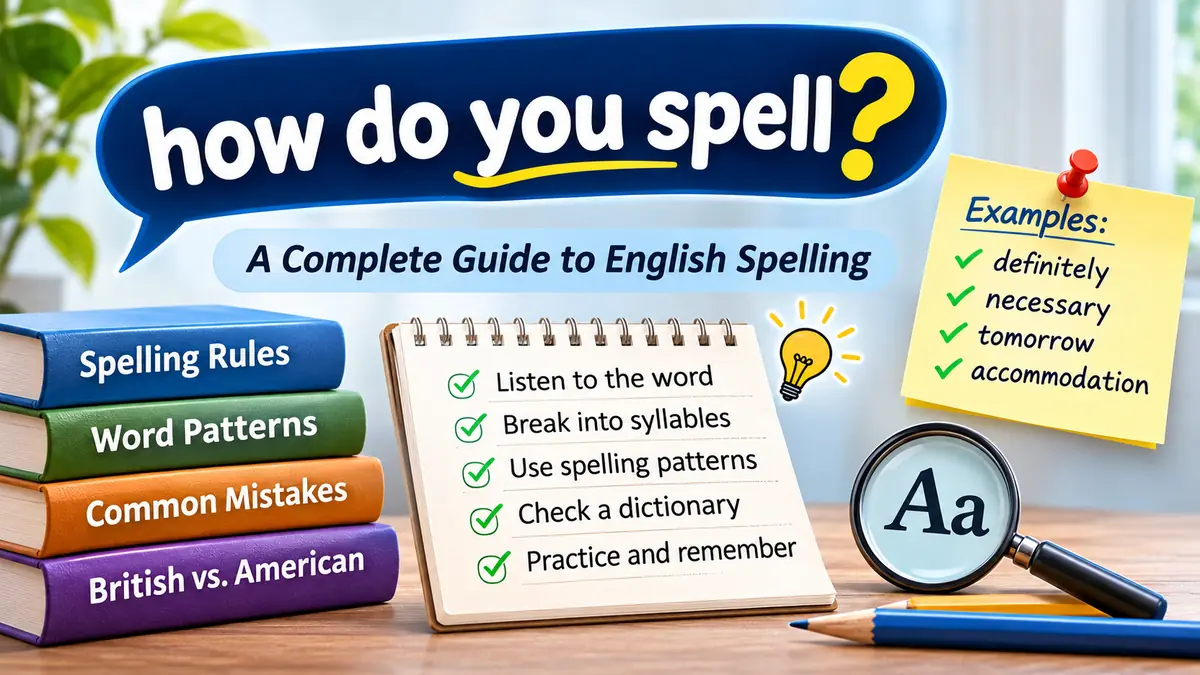
To spell a word correctly, identify its pronunciation, break it into syllables, recognize common letter patterns, and verify the spelling in a reliable dictionary. English spelling is not always phonetic, so understanding silent letters, vowel combinations, word origins, and differences between British and American English can help you avoid mistakes.
What Does “how do you spell” Mean?
“How do you spell” is a common English question used to ask which letters make up a particular word and in what order they appear.
For example:
- How do you spell beautiful? B-E-A-U-T-I-F-U-L.
- How do you spell necessary? N-E-C-E-S-S-A-R-Y.
- How do you spell restaurant? R-E-S-T-A-U-R-A-N-T.
- How do you spell definitely? D-E-F-I-N-I-T-E-L-Y.
- How do you spell tomorrow? T-O-M-O-R-R-O-W.
The phrase is especially useful when learning English, writing unfamiliar vocabulary, or checking a word that sounds different from how it is written.
Is “How Do You Spell” Grammatically Correct?
Yes. “How do you spell” is grammatically correct when followed by the word or expression you want someone to spell.
For example:
“How do you spell accommodation?”
The question uses the auxiliary verb do, the subject you, and the base verb spell.
You can also ask:
- “How is accommodation spelled?”
- “Can you spell accommodation for me?”
- “What’s the correct spelling of accommodation?”
All three are natural expressions, although the first is more passive and the second is a polite request.
How Do You Spell a Word Correctly?
When you’re uncertain about a word, follow a straightforward process rather than guessing repeatedly.
1. Listen to the Word Carefully
Start by identifying the sounds you hear.
For example, the word elephant can be separated into three spoken syllables: el-e-phant.
Breaking a word into smaller sound units makes it easier to remember and write.
However, English letters do not always correspond directly to individual sounds. The word phone, for instance, begins with the letters “ph” even though its first sound is /f/.
2. Break the Word Into Syllables
A syllable is a unit of pronunciation that contains a vowel sound.
Consider these examples:
| Word | Syllable breakdown |
|---|---|
| Banana | ba-na-na |
| Computer | com-pu-ter |
| Important | im-por-tant |
| Remember | re-mem-ber |
| Education | ed-u-ca-tion |
| Wonderful | won-der-ful |
Syllable division can make long words more manageable, but it does not guarantee the correct spelling. Some sounds can be represented by several different letter combinations.
3. Recognize Familiar Letter Patterns
English contains recurring spelling patterns that can help you predict how unfamiliar words are written.
For example, the letters “tion” commonly appear at the end of nouns such as action, education, and information.
Other patterns include:
- “ight” in light, night, and bright
- “ough” in though, through, and thought
- “ck” in back, duck, and clock
- “sh” in ship, fish, and brush
- “ch” in chair, cheese, and lunch
Recognizing these patterns improves spelling accuracy, although their pronunciation can vary.
4. Check a Reliable Dictionary
If you’re still uncertain, look up the word in a trusted dictionary.
Resources such as Cambridge Dictionary, Merriam-Webster, and Oxford Learner’s Dictionaries provide standard spellings, pronunciations, definitions, and usage examples.
A dictionary is particularly helpful when two spellings look similar or when a word has regional variations.
5. Write the Word and Check It
Once you’ve found the correct spelling, write the word without looking at the reference.
Compare your version with the dictionary entry and identify any missing, extra, or misplaced letters.
Repeating this process helps reinforce your memory.
Common English Words People Struggle to Spell
Some words cause frequent spelling problems because they contain silent letters, repeated consonants, unexpected vowel combinations, or misleading pronunciations.
| Correct spelling | Common misspelling | Helpful reminder |
|---|---|---|
| Definitely | Definately | Contains “finite” |
| Separate | Seperate | “par” appears in the middle |
| Necessary | Neccessary | One c, two s’s |
| Accommodation | Accomodation | Two c’s and two m’s |
| Receive | Recieve | “ei” follows c |
| Believe | Beleive | “ie” appears after l |
| Tomorrow | Tommorow | One m, two r’s |
| Embarrass | Embarass | Two r’s and two s’s |
| Occurrence | Occurence | Two c’s and two r’s |
| Maintenance | Maintainance | The noun contains “ten” |
| Privilege | Privelege | No second e before “lege” |
| Calendar | Calender | Ends with “dar” |
The most effective way to learn difficult words is to focus on the particular letter combination that causes confusion.
For example, rather than memorizing every letter in necessary individually, remember that the word contains one “c” and two “s” letters.
Why Is English Spelling So Difficult?
English spelling can feel unpredictable because the language developed through centuries of contact with other languages.
Its vocabulary includes words originating from Old English, French, Latin, Greek, and numerous other linguistic traditions.
Pronunciation has also changed over time, while many traditional spellings have remained.
Silent Letters
Some English words contain letters that are written but not pronounced.
Examples include:
| Word | Silent letter |
|---|---|
| Knife | k |
| Write | w |
| Honest | h |
| Doubt | b |
| Island | s |
| Psychology | p |
| Autumn | n |
| Comb | b |
Silent letters are one reason that spelling a word purely by sound can produce an incorrect result.
Different Spellings for the Same Sound
English often uses multiple letter combinations to represent similar sounds.
Consider the long “ee” sound in these words:
- See
- Sea
- Receive
- Key
- Machine
Although the relevant vowel sound is similar, the spelling varies.
This is why phonics is helpful but cannot explain every spelling choice.
Words That Sound Alike
Homophones are words that have the same pronunciation but different spellings or meanings.
Common examples include:
| Words | Difference |
|---|---|
| Their / There / They’re | Possession / place / they are |
| Your / You’re | Possession / you are |
| To / Too / Two | Direction or infinitive / also or excessive / number |
| Hear / Here | Listening / location |
| Right / Write | Correct or direction / forming written words |
| Peace / Piece | Harmony / portion |
| Weather / Whether | Atmospheric conditions / expressing alternatives |
Spell-checking software may not catch these errors because both words are correctly spelled.
Understanding their meanings is essential.
Basic English Spelling Rules You Should Know
Although English has exceptions, many words follow recognizable spelling conventions.
Learning these rules can help you spell unfamiliar words more confidently.
The “I Before E” Rule
A familiar spelling reminder says “i before e, except after c.”
Examples include:
- Believe
- Field
- Chief
- Receive
- Ceiling
- Deceive
However, this rule has many exceptions, including weird, science, their, and seize.
It works as a memory aid for certain words rather than a universal spelling rule.
Dropping the Final E
When a word ends in a silent “e,” that letter is often removed before adding a suffix beginning with a vowel.
| Original word | New word |
|---|---|
| Make | Making |
| Write | Writing |
| Hope | Hoping |
| Dance | Dancing |
| Create | Creating |
There are exceptions. For example, agree becomes agreeing, while dye becomes dyeing.
The suffix and the structure of the original word determine whether the final letter changes.
Changing Y to I
When a word ends in a consonant followed by “y,” the “y” often changes to “i” before certain suffixes.
Examples:
- Happy → Happiness
- Carry → Carried
- Easy → Easier
- Cry → Cried
When a vowel appears before “y,” the letter usually remains unchanged.
For example, play becomes played, and enjoy becomes enjoyment.
An important exception is the suffix “-ing”: carry becomes carrying.
Doubling the Final Consonant
Some words double their final consonant before adding a suffix.
Examples include:
- Run → Running
- Stop → Stopped
- Begin → Beginning
- Sit → Sitting
- Plan → Planned
This often happens when a stressed syllable ends in a single vowel followed by a single consonant.
However, words such as open and visit generally do not double their final consonants because their final syllables are unstressed.
These patterns are described in the Cambridge Dictionary’s English spelling guide. Cambridge Dictionary+1
British vs. American English Spelling
Sometimes two different spellings are both correct.
This is particularly common when comparing British English and American English.
| British English | American English |
|---|---|
| Colour | Color |
| Favourite | Favorite |
| Centre | Center |
| Theatre | Theater |
| Organise | Organize |
| Analyse | Analyze |
| Travelling | Traveling |
| Defence | Defense |
| Neighbour | Neighbor |
| Catalogue | Catalog |
For example, someone in the United Kingdom may write “My favourite colour is blue,” while someone in the United States may write “My favorite color is blue.”
Neither version is inherently incorrect.
Some British publishers also accept or prefer “-ize” endings, so organize is not exclusively American. UOC+1
Which Spelling Should You Use?
Your choice depends on your audience, school requirements, workplace style guide, or publication standards.
For American readers, American spelling is generally appropriate. For British readers, British spelling is usually preferable.
The most useful principle is consistency. Avoid switching between color and colour throughout the same document unless there is a specific reason.
How Do You Spell a Word You Can Only Pronounce?
One of the hardest spelling situations occurs when you know how a word sounds but have never seen it written.
You might hear a word during a conversation, lecture, podcast, or video and struggle to identify its letters.
Use Pronunciation to Find the Word
Begin by saying the word slowly and separating its sounds.
For example, imagine hearing a word that sounds like “kuh-NEK-shun.”
You might recognize its syllables and search for the word connection.
The spelling contains the letter combination “tion,” which represents the final /ʃən/ sound.
This illustrates why pronunciation and spelling patterns work best together.
Try Voice Search or Speech Recognition
Voice typing can help identify words you recognize by sound.
You can pronounce the word into a speech-recognition tool and examine the suggested spelling.
However, speech recognition can misinterpret accents, background noise, unfamiliar names, and homophones.
Always confirm the result against its meaning and context.
Use the International Phonetic Alphabet
The International Phonetic Alphabet (IPA) represents speech sounds using standardized symbols.
For example:
| Word | IPA pronunciation |
|---|---|
| Cat | /kæt/ |
| Dog | /dɒɡ/ (British) |
| Book | /bʊk/ |
| Fish | /fɪʃ/ |
| School | /skuːl/ |
IPA symbols are particularly useful for language learners who want to understand how pronunciation differs from written spelling.
Learning every symbol is unnecessary for casual spelling checks, but recognizing common vowel and consonant symbols can be helpful.
How to Spell Names, Addresses, and Unfamiliar Terms
Spelling ordinary vocabulary is different from spelling a person’s name, company name, or geographical location.
Proper nouns may use uncommon letter combinations, and multiple spellings can represent similar pronunciations.
For example, the names Sara and Sarah are both established spellings.
Similarly, Steven and Stephen may be pronounced alike.
Ask for the Exact Letters
When accuracy matters, ask the person to spell the name letter by letter.
You can say:
“Could you spell your surname for me?”
For additional clarity, repeat the letters back to confirm them.
This is particularly helpful when recording email addresses, legal names, street names, or official information.
Use the NATO Phonetic Alphabet
The NATO phonetic alphabet assigns distinctive words to letters to make spoken communication clearer.
| Letter | Code word |
|---|---|
| A | Alfa |
| B | Bravo |
| C | Charlie |
| D | Delta |
| E | Echo |
| F | Foxtrot |
| G | Golf |
| H | Hotel |
| I | India |
| J | Juliett |
| K | Kilo |
| L | Lima |
| M | Mike |
| N | November |
| O | Oscar |
| P | Papa |
| Q | Quebec |
| R | Romeo |
| S | Sierra |
| T | Tango |
| U | Uniform |
| V | Victor |
| W | Whiskey |
| X | X-ray |
| Y | Yankee |
| Z | Zulu |
For instance, the name “Sam” can be communicated as “Sierra, Alfa, Mike.”
This reduces confusion between similar-sounding letters, especially during telephone conversations.
Best Ways to Check Spelling Online
Digital tools can identify many spelling mistakes quickly, but each method has strengths and limitations.
Online Dictionaries
A dictionary is generally the most dependable starting point when you need to verify a particular word.
Useful resources include:
- Cambridge Dictionary — definitions, pronunciation recordings, and British and American usage.
- Merriam-Webster — American English spelling, definitions, and usage.
- Oxford Learner’s Dictionaries — vocabulary explanations and pronunciation support.
Dictionary entries can also clarify whether a spelling is a regional variant, an inflected form, or a completely different word.
Spell Checkers and Writing Assistants
Writing software such as Microsoft Word, Google Docs, and Grammarly can identify suspected spelling mistakes and suggest corrections.
These tools are useful for checking longer documents because they examine many words at once.
However, automatic corrections can introduce errors when the software misunderstands the intended meaning.
For example:
“Their going to the store.”
A basic spelling checker might accept every word because their is correctly spelled, even though they’re is required in this sentence.
Grammar-aware tools may identify the problem, but human review remains valuable.
Search Engines
Search engines can help identify a word when you know only an approximate spelling.
Typing an unfamiliar word may produce a corrected search suggestion.
However, search suggestions are not authoritative dictionary entries. They can reflect popular searches, names, brands, or informal spellings.
Use a dictionary to confirm the final result.
How to Remember Difficult Spellings
Memorizing words becomes easier when you combine visual recognition, writing practice, and meaningful associations.
Use the Look, Cover, Write, Check Method
The British Council recommends a simple spelling practice technique:
- Look carefully at the correctly spelled word.
- Cover the word so you cannot see it.
- Write it from memory.
- Uncover the original and compare the spellings.
- Repeat the process for any letters you missed.
This technique encourages active recall rather than passive reading. LearnEnglish Teens
Create Mnemonics
A mnemonic is a memory aid that connects unfamiliar information with something easier to remember.
For example:
Necessary: Remember that it contains one “c” and two “s” letters.
Separate: Remember that “a rat” appears inside sep-a-rat-e.
Rhythm: The sentence “Rhythm Helps Your Two Hips Move” provides the letters R-H-Y-T-H-M.
Mnemonics do not explain why a word is spelled a particular way, but they can help you recall difficult letter sequences.
Keep a Personal Spelling List
Record words that you repeatedly misspell.
A simple notebook or digital document can contain three columns:
| Word | Common mistake | Memory tip |
|---|---|---|
| Definitely | Definately | Remember “finite” |
| Necessary | Neccessary | One c, two s’s |
| Separate | Seperate | Contains “a rat” |
| Tomorrow | Tommorow | One m, two r’s |
Reviewing your own mistakes is often more useful than studying a random list of difficult words.
Learn Word Families
Words that share a common root often contain similar spelling patterns.
For example:
- Act, action, active, activity
- Sign, signal, signature
- Decide, decision, decisive
- Educate, education, educational
Recognizing relationships between words can make unfamiliar vocabulary easier to spell and understand.
How to Improve Your English Spelling Over Time
Spelling improvement depends on regular exposure and practice rather than memorizing hundreds of isolated rules.
Reading helps you become familiar with how words look in context.
Writing helps you retrieve those spellings from memory.
Checking mistakes helps you identify which patterns need additional attention.
A Simple Daily Spelling Routine
Five-minute spelling practice
0 of 5 completeChoose five words you often misspell.Read each word and identify its difficult letters.Write each word without looking.Check your answers and correct mistakes.Use each word in a meaningful sentence.
Reset checklist
Revisit the same words after a day or two, then again later in the week. Spacing out practice helps you check whether you can still recall a spelling after time has passed.
Practice Spelling in Context
Instead of writing a difficult word ten times without context, use it in several sentences.
For example, with the word necessary:
“It is necessary to check your work.”
“Bring only the necessary documents.”
“Regular practice is necessary for improvement.”
Using words in meaningful sentences connects their spelling with their definitions and grammatical functions.
How Do You Spell Words Correctly Without Spell Check?
You can become less dependent on automatic correction by developing a repeatable proofreading habit.
First, read your writing slowly and focus on one sentence at a time.
Next, look for the mistakes you commonly make, such as repeated consonants, missing silent letters, and confused homophones.
Pay particular attention to words that spell checkers might accept despite being wrong in context.
Finally, consult a dictionary whenever you are uncertain.
For important documents, reading the text aloud can also help reveal missing words and awkward sentences, although it will not reliably expose every spelling error.
The goal is not to eliminate dictionaries or digital tools. It is to develop enough spelling awareness to recognize when a suggestion may be incorrect.
Final Thoughts on how do you spell
Learning how to spell English words correctly becomes easier when you understand pronunciation, syllables, spelling patterns, and common exceptions.
Start by listening carefully to the word, break it into manageable parts, and check its spelling in a reliable dictionary. For difficult words, use memory aids and regular writing practice.
Remember that English spelling is not always predictable. Silent letters, homophones, historical word origins, and regional variations can all affect how words are written.
The next time you wonder “how do you spell” a particular word, use its pronunciation and context to identify it, verify the letters, and practise writing it from memory.
