

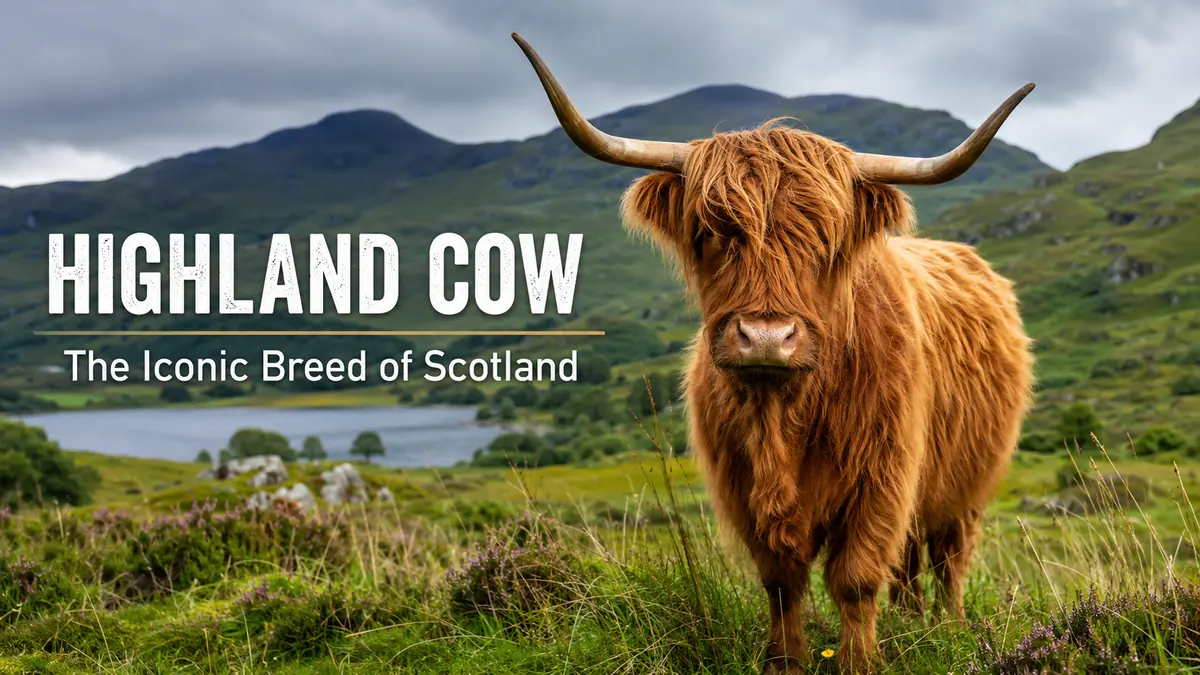
Few cattle breeds are as instantly recognizable as the highland cow. Long sweeping horns, a thick shaggy coat, and hair falling across the eyes give these Scottish cattle an appearance that is difficult to confuse with any other breed.
But the famous “fluffy cow” is much more than a photogenic symbol of Scotland. Highland cattle developed under demanding conditions in the Scottish Highlands and western islands, producing a breed valued for hardiness, efficient foraging, longevity, maternal ability, and beef production. The Highland Cattle Society describes it as one of Britain’s oldest and most distinctive cattle breeds.
A highland cow is a female Highland, a traditional Scottish cattle breed known for its long horns and distinctive double coat. Highland cattle originated in western Scotland and the islands, tolerate harsh weather remarkably well, forage efficiently on marginal land, and occur in red, black, yellow, dun, brindle, white, and silver colors.
highland cow Quick Facts
| Characteristic | Highland Cattle |
|---|---|
| Origin | Scotland |
| Breed | Highland cattle |
| Traditional regions | Scottish Highlands and western islands |
| Primary modern use | Beef |
| Mature cow weight | Roughly 900–1,300 lb (408–590 kg) |
| Mature bull weight | Roughly 1,500–2,000 lb (680–907 kg) |
| Coat | Long outer hair with soft undercoat |
| Traditional colors | Red, yellow, black, dun, silver, white and brindle |
| Horns | Naturally horned |
| Temperament | Generally docile when properly managed |
| Lifespan | Known for longevity |
| Climate adaptation | Particularly strong cold-weather tolerance |
| Group name | Traditionally called a “fold” |
Exact weight and size vary with genetics, sex, nutrition, environment, and management. The Livestock Conservancy gives an adult-weight range of approximately 900–2,000 pounds across the breed, while the American Highland Cattle Association reports mature cows averaging about 900–1,200 pounds and bulls about 1,500–1,800 pounds under typical conditions.
What Is a highland cow?
A highland cow is technically an adult female of the Highland cattle breed. In everyday conversation, however, people frequently use “Highland cow” for the breed generally, including bulls and young cattle.
The Highland is a Bos taurus cattle breed native to Scotland. Its historical home lies in the western Highlands and islands, where generations of cattle had to cope with rain, wind, cold temperatures, rugged ground, and relatively sparse vegetation.
That environment helped shape several characteristics that remain valuable today:
- A dense double coat
- Strong foraging ability
- Hardiness in exposed conditions
- Relatively moderate body size
- Good maternal qualities
- Reproductive efficiency
- Longevity
- Ability to utilize rougher pasture
The Livestock Conservancy classifies Highlands as a beef breed and highlights their docile temperament, hardiness, maternal instincts, reproductive efficiency, and ability to forage on diverse vegetation.
Is it Highland cow or Highland cattle?
Both expressions are correct, but they don’t mean exactly the same thing.
Highland cattle refers to the breed collectively. A Highland cow is an adult female. An adult male is a Highland bull, while a young animal is a calf.
You may also encounter names such as Scottish Highland cattle and the Scots expression “Heilan coo.” The breed’s Scottish Gaelic name is Bò Ghàidhealach.
The Scottish History of Highland Cattle
The distinctive appearance of Highlands isn’t a modern breeding trend. Their history reaches deep into Scotland’s agricultural past.
The Highland Cattle Society states that written records extend back to the 18th century, while historical references to Highland cows go considerably further back. The organization itself was established in 1884, and its first Herd Book appeared in 1885.
That Herd Book was particularly significant because it formalized pedigree recording for the breed.
Kyloe and mainland cattle
Historically, Highland cattle weren’t always regarded as one completely uniform type.
There were two broad classes.
The Kyloe was the somewhat smaller animal associated with Scotland’s western islands and was often black. Its name is traditionally associated with cattle being moved across narrow channels of water.
The mainland Highland type tended to be larger and was commonly reddish in color.
Eventually, the two became recognized as a single Highland breed.
Highland cattle and the old droving trade
Cattle were economically important to Highland communities.
Historical accounts describe large-scale droving in which cattle were moved from the Highlands and islands toward markets farther south. Scottish Genetics notes records of Highland cattle droving as early as 1359, with the trade becoming especially significant between roughly 1760 and 1820.
Animals could travel considerable distances before eventually reaching richer grazing land and markets.
The traits that made these cattle useful centuries ago—soundness, hardiness, efficient grazing, and adaptability—remain central to the breed today.
Why Does a highland cow Have So Much Hair?
The shaggy coat is probably the Highland’s most famous characteristic after its horns, but it serves a practical purpose.
Highland cattle have a double hair coat.
Long outer coat
The exterior consists of long, coarse hair designed to provide protection from difficult weather.
This outer layer helps shield the animal from:
- Rain
- Snow
- Wind
- Mud
- Cold conditions
Breed standards favor abundant, long, gracefully wavy hair rather than a tightly curled coat.
Soft undercoat
Beneath the long outer hair is a softer, insulating undercoat.
Think of the two layers as performing different jobs: the exterior provides weather protection while the softer layer traps insulating air close to the body.
That combination helps explain why Highlands are so closely associated with exposed Scottish landscapes.
The Australian Highland Cattle Society similarly describes two separately renewed coats: a long, strong outer layer and a soft, fluffy undercoat that helps keep the animal warm.
Do Highland cows get hot in summer?
They can tolerate climates beyond Scotland, but their cold-weather adaptations mean heat management deserves attention in warm regions.
Highlands naturally shed much of their winter hair as temperatures rise. The American Highland Cattle Association’s breed standard specifically identifies the ability to shed the winter coat during hot summer months as advantageous.
In hotter climates, sensible cattle management includes reliable drinking water, shade, good airflow, and watching animals for signs of heat stress.
Their reputation for toughness shouldn’t be interpreted as immunity to environmental extremes.
Quick Takeaway: The famous Highland “fluff” isn’t primarily decorative. It is a functional two-layer coat that helped cattle survive the cold, wet and windy conditions of western Scotland.
highland cow Colors: They’re Not All Ginger
Ask someone to picture a Highland and they’ll probably imagine a ginger or reddish-brown animal.
Red Highlands are certainly common, but Highland cattle occur naturally in a surprisingly broad range of colors.
Recognized traditional colors include:
- Red
- Yellow
- Black
- Dun
- Silver
- White
- Brindle
The Highland Cattle Society notes that black was historically the breed’s original color, despite red becoming the image most people now associate with Highlands.
The American Highland Cattle Association likewise recognizes red, yellow, white, brindle, black, dun, and silver in its breed standard.
Why are ginger Highland cows so famous?
Visibility is part of the explanation.
The rich reddish coat contrasts dramatically with Scotland’s green hills, misty mountains, and darker winter landscapes. Over time, photography, tourism imagery, souvenirs, and popular culture reinforced the ginger Highland as the stereotypical version.
Color alone, however, doesn’t determine whether an animal represents the breed well. Structure, soundness, hair, head, horns, body, and overall breed character matter too.
Highland Cow Horns: Females and Males Look Different
Another unmistakable feature is the pair of large horns.
Both male and female Highland cattle are naturally horned, but experienced observers can often distinguish cows from bulls partly by the shape and orientation of those horns.
According to breed standards, a bull’s horns should emerge strongly from the head, extending relatively level before inclining slightly forward and upward.
A cow’s horns are generally longer and can rise earlier, often creating the elegant upward and outward sweep associated with classic Highland females. Another accepted female configuration has a wider sweep with a noticeable backward-set curve.
| Feature | Highland Cow | Highland Bull |
|---|---|---|
| Typical horn impression | Longer, sweeping and often upward | Stronger, heavier and more forward |
| Body build | Feminine, broad-bodied | Heavier and more muscular |
| Neck | Cleaner profile | More pronounced crest |
| Average weight | Lower | Considerably higher |
Horn shape varies among individuals, so it shouldn’t be used as the only method of determining sex.
Are Highland cow horns dangerous?
Any horned bovine deserves respectful handling.
A calm Highland doesn’t automatically make its horns harmless. An animal can accidentally injure a person simply by turning its head, reacting to another animal, or moving suddenly.
Visitors should therefore avoid touching, feeding, surrounding, or approaching unfamiliar cattle unless the owner explicitly permits it.
Highland Cow Size and Weight
Those horns and all that hair can make Highlands look enormous in photographs. Underneath the coat, however, they are generally considered a moderate-framed beef breed.
The American Highland Cattle Association reports:
- Mature cows: approximately 900–1,200 lb
- Mature bulls: approximately 1,500–1,800 lb
The Livestock Conservancy gives a broader typical range, with cows around 900–1,300 lb and bulls around 1,500–2,000 lb.
An individual’s final weight depends heavily on forage availability, bloodline, age, sex, health, and management.
This moderate frame has practical advantages. Highlands can fit both smaller farms and larger grazing systems, and lighter animals may place less pressure on some marginal landscapes than substantially heavier cattle.
Highland Cow Temperament: Are They Friendly?
Highland cattle have a reputation for being relatively calm and manageable.
The Livestock Conservancy describes the breed’s temperament as docile and places the typical experience level for keeping them at novice to intermediate.
Still, “docile” and “pet” are very different concepts.
Individual temperament depends on:
- Genetics
- Previous handling
- Human contact
- Age
- Sex
- Maternal behavior
- Environment
- Stress level
A regularly and calmly handled cow may become very comfortable around familiar people. A poorly socialized animal may remain wary.
Bulls require particular caution regardless of breed.
Can you pet a Highland cow?
Only when the animal’s owner or handler says it is safe.
Tourists often see Highlands beside roads or walking trails and assume their fluffy appearance makes them approachable. That is a mistake.
They are large livestock with substantial horns. Never put yourself between a cow and her calf, enter a field without permission, or approach an unfamiliar bull.
Admire roadside cattle from a sensible distance.
What Do Highland Cows Eat?
Highlands are ruminants, so their digestive system is designed to turn fibrous plant material into usable energy.
Their diet is primarily based on forage such as:
- Pasture grasses
- Hay
- Other suitable herbaceous plants
- Browse and rough vegetation where appropriate
One of the breed’s strongest practical characteristics is its ability to utilize varied forage.
The Livestock Conservancy notes that Highlands consume grass as well as a variety of plants that may be undesirable in pasture, which has contributed to their use in pasture improvement and land management.
Do Highland cows need grain?
Not automatically.
A forage-based ration may meet the needs of many animals when pasture or conserved forage has adequate nutritional quality. Supplementation depends on body condition, forage testing, age, pregnancy, lactation, growth targets, weather, and other management factors.
Cattle should also have constant access to clean water and appropriate minerals.
The key principle is simple: hardy does not mean maintenance-free.
Why Highland Cattle Are Exceptional Foragers
Highlands evolved where lush, uniform pasture couldn’t always be guaranteed.
As a result, they developed a reputation for making effective use of rougher vegetation and marginal grazing areas.
That ability now has applications beyond ordinary beef farming.
Conservation grazing
Highland cattle are used in some conservation grazing projects because their grazing and browsing behavior can influence vegetation structure.
They can consume a varied selection of plants while their movement through landscapes can create different habitat conditions.
At Pollok Country Park in Glasgow, for example, Highland cattle have historically been used on natural pasture and are associated with conservation and biodiversity management.
This doesn’t mean simply placing Highlands on any unmanaged land will automatically improve biodiversity. Stocking density, timing, soil conditions, sensitive habitats, and conservation objectives all matter.
When professionally managed, however, cattle can become active landscape-management tools.
How Long Does a highland cow Live?
Longevity is one of the breed’s recognized strengths.
Highland cattle can remain productive for many years, and lifespans approaching 20 years are reported for the breed.
That doesn’t mean every Highland will reach that age.
Lifespan depends on factors such as:
- Genetics
- Nutrition
- Dental condition
- Parasite management
- Reproductive health
- Injury
- Climate
- Disease prevention
- Overall husbandry
From an agricultural perspective, longevity is particularly useful when breeding cows remain fertile and successfully raise calves over many seasons.
Highland Cows as Mothers and Calving Cattle
Highlands have traditionally been valued for maternal ability.
The Livestock Conservancy specifically identifies good maternal instincts and reproductive efficiency among the breed’s notable characteristics.
Strong mothering behavior can help protect and support calves, especially in extensive outdoor systems.
That same maternal instinct is another reason visitors should never approach a calf without understanding where its mother is.
A normally calm cow may behave differently when she believes her calf is threatened.
How long is a Highland cow pregnant?
Like other cattle, Highlands have a gestation period of roughly nine months, though the exact duration varies.
Usually one calf is born.
Good calving outcomes depend on far more than breed reputation. Breeding decisions, bull selection, cow condition, nutrition, observation, and access to veterinary assistance remain important.
What Are Highland Cattle Used For?
Modern Highlands are primarily classified as a beef breed.
Their ability to convert pasture and varied forage into beef is particularly useful in systems where farmers want hardy cattle capable of functioning under relatively extensive conditions.
But beef isn’t their only modern role.
1. Beef production
Highlands are raised commercially and on smaller farms for beef.
Their moderate size, forage efficiency, longevity, and ability to cope with challenging environments can suit grass-based production systems.
2. Conservation grazing
Their ability to consume varied vegetation has made them useful in certain habitat-management programs.
3. Small farms and homesteads
Their moderate frame and distinctive appearance have increased their popularity with smaller cattle operations.
Keeping one still requires proper cattle infrastructure, though. Secure fencing, handling facilities, water, forage, mineral supplementation, veterinary care, and sufficient land remain essential.
4. Agritourism
Few cattle breeds attract attention quite like Highlands.
Their extraordinary appearance makes them popular on visitor farms and agritourism properties. The Livestock Conservancy specifically notes their value as a conversation starter for agritourism operations.
5. Heritage breed preservation
Maintaining pedigree Highlands also protects a distinctive part of Scottish agricultural history.
Highland Cow Beef and Milk
Highlands historically provided both meat and milk to rural households, although modern registered populations are predominantly associated with beef.
Wild Scotland notes that small farmers traditionally kept Highlands as household cows for milk as well as meat.
Highland beef
Highland cattle have become established as beef animals in many countries.
The breed’s economic appeal is tied less to rapid industrial growth and more to characteristics such as hardiness, grazing efficiency, adaptability, and ability to produce on landscapes that may be challenging for some larger cattle.
Can you milk a Highland cow?
Yes. A Highland cow is biologically capable of producing milk for her calf and can be milked.
However, Highlands aren’t specialized modern dairy cattle comparable with high-output dairy breeds. Their primary contemporary agricultural classification is beef.
Historically, milk production was simply one part of the animal’s usefulness to Highland households.
Why Highland Cows Handle Cold Weather So Well
The answer comes down to centuries of adaptation combined with physical characteristics.
Scotland’s western Highlands and islands exposed cattle to:
- Strong winds
- Heavy rainfall
- Low temperatures
- Wet ground
- Rough terrain
- Seasonal forage limitations
Animals poorly suited to those conditions were less likely to thrive and reproduce.
Over generations, this environmental pressure favored resilient cattle.
The resulting combination of a weather-resistant outer coat, insulating undercoat, strong legs, useful feet, efficient grazing behavior, and moderate body structure made the breed exceptionally well suited to its traditional environment.
Does that mean Highlands need no shelter?
No.
Their hardiness should never be used as an excuse for poor husbandry.
Local livestock-welfare requirements still apply, and animals need appropriate protection from environmental extremes. Conditions involving prolonged mud, flooding, dangerous wind exposure, intense heat, inadequate water, or poor-quality forage require active management.
Quick Takeaway: Highland cattle can tolerate weather that challenges many other cattle, but “hardy” describes their adaptation—not permission to neglect basic animal care.
Keeping Highland Cattle: What Good Care Actually Requires
Their rustic reputation sometimes creates the misleading impression that Highlands can simply be placed in a field and forgotten.
Successful management is much more deliberate.
Secure fencing
Long horns and a thick coat change how animals interact with fences, gates, feeders, and handling equipment.
Facilities should accommodate horn width without creating unnecessary trapping or injury risks.
Adequate pasture
Highlands are efficient foragers, but a field still has a finite carrying capacity.
Overstocking can degrade vegetation and soil regardless of breed.
Winter forage
When grass stops growing or becomes nutritionally inadequate, good-quality conserved forage such as hay may be necessary.
Clean drinking water
Cold-tolerant cattle still need dependable access to fresh, clean water every day.
Mineral nutrition
Mineral requirements vary by location because soil and forage mineral content differ considerably.
A locally appropriate cattle mineral program is preferable to assuming one formula works everywhere.
Veterinary and parasite management
Hardiness doesn’t eliminate disease.
Owners still need an appropriate vaccination, parasite-control, hoof, reproductive, and general health program developed for their region and management system.
Handling facilities
This is an area first-time owners can underestimate.
Highland horns are wide, so facilities designed around polled cattle may not always work comfortably. Chutes, gates, alleys, trailers, and feeding spaces need enough clearance.
Good design makes routine handling safer for both livestock and people.
Highland Cattle Breed Standard and Appearance
A genuine Highland is defined by much more than long hair.
Breed standards describe an animal that combines recognizable Highland character with functional cattle structure.
The American Highland Cattle Association standard emphasizes characteristics including:
- Broad, proportionate head
- Strong muzzle
- Bright eyes
- Characteristic horns
- Clear neck
- Muscular shoulders
- Broad, straight back
- Deep, rounded ribs
- Strong hindquarters
- Short, powerful legs
- Sound hoof structure
- Abundant, long, wavy hair
The overall objective isn’t simply producing the fluffiest animal possible.
Functional structure matters because cattle must walk, graze, breed, calve, and remain productive.
What is the “dossan”?
One characteristic Highland term is dossan, referring to the prominent forelock or fringe of hair across the forehead.
It contributes heavily to the breed’s famous shaggy-faced appearance.
While people often find the hair covering their eyes amusing, Highland cattle are remarkably adapted to carrying this heavy coat.
Highland Cow vs Other Cattle Breeds
The easiest way to understand the Highland is to compare its defining characteristics with those of more conventional cattle.
| Trait | Highland Cattle | Many Conventional Beef Breeds |
|---|---|---|
| Coat | Very long double coat | Usually much shorter |
| Horns | Naturally prominent | Depends on breed/genetics |
| Frame | Moderate | Small to very large |
| Cold adaptation | Exceptional | Varies widely |
| Foraging | Strong on varied vegetation | Varies by breed |
| Traditional environment | Rugged Scottish landscapes | Breed-dependent |
| Primary use | Beef | Usually beef or dairy |
| Visual appearance | Highly distinctive | Highly variable |
| Conservation grazing | Frequently suitable | Depends on system |
| Heat management | Needs attention in warm climates | Breed-dependent |
No cattle breed is universally “better.”
Highlands make particular sense where their hardiness, grazing characteristics, longevity, moderate frame, and environmental adaptability match the farming system.
A specialized dairy operation, feedlot, tropical ranch, conservation reserve, and Scottish hill farm all demand different traits.
Highland Cattle Around the World
Although Highland cattle are Scottish, they haven’t remained confined to Scotland.
The breed is now internationally established.
Historical exports took Highlands to countries including the United States, Canada, Australia, Argentina, and parts of continental Europe.
The American Highland Cattle Association says the first recorded importation into the United States occurred in the late 1890s, when cattlemen were interested in adding hardiness to their herds.
Australia has an even earlier connection. The Australian Highland Cattle Society records Highland cattle arriving there in 1829, although the early population eventually disappeared and the breed was later re-established.
Today, Highlands can be found far beyond their ancestral Scottish landscape.
Their international success demonstrates that their practical characteristics—not simply their unusual appearance—have helped sustain the breed.
Are Highland Cattle Rare?
The answer depends on location and how “rare” is defined.
In the United States, the Livestock Conservancy reports that Highland cattle graduated from its Conservation Priority List in 2019 after their population increased sufficiently. Its current breed profile lists their conservation status as “Graduated.”
That is encouraging because maintaining genetically viable populations of traditional livestock breeds helps preserve agricultural biodiversity.
Breed organizations remain important for pedigree registration, genetic management, breed standards, and connecting responsible breeders.
The Highland Cattle Society, founded in 1884, continues maintaining breed records and representing pedigree breeders in the UK and internationally.
Why Is a Group of Highland Cows Called a Fold?
Here’s one of the more unusual pieces of Highland terminology.
While groups of cattle are ordinarily called herds, a group of Highland cattle is traditionally known as a fold.
The terminology is associated with the stone shelters or enclosures historically used to protect cattle during difficult Highland weather.
You’ll still see both words in practice.
Breed enthusiasts frequently use “fold,” while “herd” remains perfectly understandable in ordinary agricultural conversation.
Highland Cows and Scotland’s Cultural Identity
Highland cattle occupy an unusual position: they are working livestock and cultural symbols at the same time.
Their appearance captures many qualities people associate with the Scottish Highlands—ruggedness, tradition, independence, and adaptation to a dramatic landscape.
Royal connections have strengthened that association.
The Highland Cattle Society records that the late Queen Elizabeth II maintained an award-winning Highland fold at Balmoral, helping reinforce the breed’s high-profile connection with Scotland and its agricultural heritage.


7
Tourism has amplified their popularity further.
Visitors now actively seek opportunities to photograph Highland cattle, and the animals appear everywhere from Scottish tourism campaigns to artwork and home décor.
Yet reducing them to a cute “fluffy cow” misses the point.
The characteristics tourists love photographing—the huge coat, sweeping horns, compact build, and rugged appearance—are closely connected to centuries of livestock adaptation.
Common Misconceptions About Highland Cows
Popularity has produced a few persistent misunderstandings.
“All Highland cows are ginger”
False. Red is iconic, but black, yellow, dun, white, silver, and brindle Highlands also occur.
“The hair is bred only for appearance”
False. The double coat is a major environmental adaptation.
“Highland cows are tiny”
Not really. They are moderate-framed cattle, but mature females can still weigh around half a tonne and bulls considerably more.
“They’re basically giant pets”
No. A well-handled Highland can be docile, but it remains powerful livestock equipped with substantial horns.
“They can survive entirely without care”
Hardiness reduces some environmental challenges; it doesn’t eliminate nutritional, veterinary, fencing, water, or welfare requirements.
“Only bulls have horns”
False. Both sexes naturally have horns, although typical horn shape differs between cows and bulls.
“Highlands only live in Scotland”
Not anymore. Established populations now exist across numerous countries.
What Makes the Highland Cow So Special?
The Highland’s appeal comes from an unusually successful combination of appearance, history, and practical function.
Its long shaggy coat provides weather protection. Its sweeping horns contribute to one of the most recognizable profiles in domestic livestock. Its foraging ability makes it useful on varied landscapes. Its maternal ability and longevity support productive breeding systems, while its moderate frame works well in many extensive farming environments.
Most importantly, these traits developed together.
The Highland wasn’t created simply to look unusual. Its physical characteristics reflect the landscape that shaped it.
That is why a highland cow represents much more than the fluffy, ginger animal seen on Scottish postcards. It is an old and functional cattle breed whose hardiness helped sustain farming communities for generations—and whose combination of resilience, grazing ability, distinctive genetics, and unmistakable character continues to keep Highland cattle relevant around the world today.
