

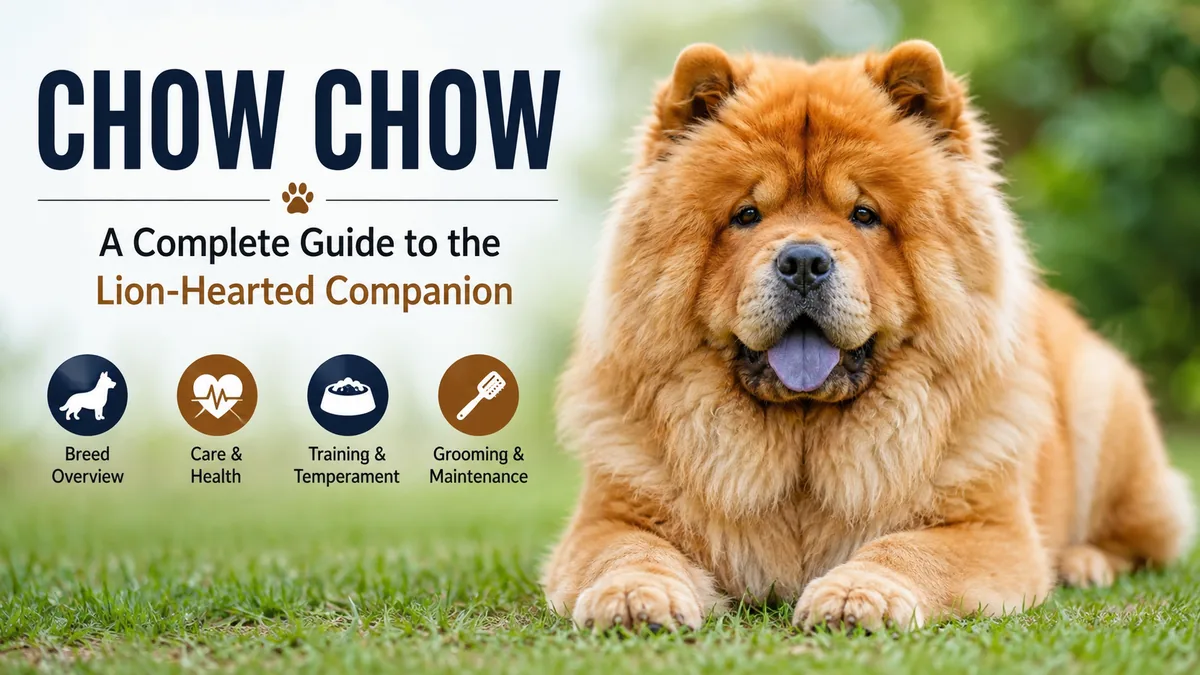
Few dogs are as instantly recognizable as the chow chow. Its lion-like mane, compact build, deep-set eyes, curled tail, and famous blue-black tongue give the breed an appearance unlike almost any other dog.
But appearance tells only half the story. Behind all that fur is an intelligent, dignified, remarkably independent dog that often forms strong bonds with family while remaining reserved around strangers. A Chow can be an excellent companion in the right home, but its grooming, socialization, training, and heat-management needs deserve serious attention.
The chow chow is an ancient Chinese dog breed known for its dense double coat, blue-black tongue, lion-like ruff, independent temperament, and loyalty to family. Adults generally stand 17–20 inches tall and weigh about 45–70 pounds. They need regular grooming, moderate daily exercise, patient training, and careful early socialization.
Chow Chow Breed Overview
The Chow is a sturdy, medium-sized dog rather than the enormous breed its thick coat sometimes makes it appear to be.
| Trait | Typical Chow Chow |
|---|---|
| Origin | China |
| Height | 17–20 inches |
| Weight | 45–70 pounds |
| Lifespan | Roughly 8–12 years |
| Coat | Rough or smooth double coat |
| Common colors | Red, black, blue, cinnamon, cream |
| Temperament | Loyal, independent, dignified, reserved |
| Exercise | Moderate |
| Grooming | High |
| Shedding | Moderate to heavy |
| Hypoallergenic | No |
| Distinctive feature | Blue-black tongue |
| AKC group | Non-Sporting Group |
Individual dogs naturally vary, so these characteristics should be treated as a breed-level guide rather than a guarantee about every Chow.
Where Does the Chow Chow Come From?
The Chow Chow has a remarkably long association with China. Historical evidence places Chow-like dogs as far back as China’s Han Dynasty, which lasted from 206 BCE to 220 CE. The breed has served humans in several capacities over its history, including hunting, guarding, pulling carts, and companionship.
Its overall construction also connects it with the ancient spitz-type breeds.
Dogs in the spitz family commonly share features such as thick coats, upright ears, and tails carried over the back. The Chow’s combination of these characteristics with its broad skull, distinctive expression, and unusually straight rear-leg structure produces its unmistakable silhouette.
Over time, Chow Chows spread beyond China and became established in Europe and the United States.
Today, the American Kennel Club places the Chow Chow in its Non-Sporting Group.
Why is it called a Chow Chow?
The breed’s modern English name does not clearly explain its original Chinese identity. Historical accounts commonly connect “chow chow” with terminology once used for miscellaneous goods transported from East Asia.
Whatever the exact path of the name, the dog behind it has a history extending much further back than its modern Western label.
What Does a Chow Chow Look Like?
A Chow Chow looks powerful without being particularly tall. The body is compact and muscular, while the enormous visual volume of the coat—particularly around the neck and shoulders—creates the characteristic lion-like appearance.
Several features distinguish the breed.
Blue-black tongue
The blue-black tongue is perhaps the Chow’s best-known physical characteristic.
Interestingly, Chow puppies aren’t necessarily born with the mature dark tongue. Puppies begin with pink tongues, with the blue-black pigmentation developing as they grow. The Chinese Shar-Pei is another AKC-registered breed famous for similar tongue pigmentation.
A naturally pigmented blue-black tongue should not be confused with a sudden change in a normally pink dog’s tongue color, which can indicate a medical emergency.
Lion-like mane
Rough-coated Chows develop particularly heavy hair around the head and shoulders, producing the breed’s famous mane or ruff.
The visual effect can make the head appear substantially larger than it actually is.
Small upright ears
The ears are relatively small, triangular, and erect. Combined with deep-set eyes and the broad head, they contribute heavily to the breed’s serious expression.
Curled tail
The heavily coated tail is carried over the back, another feature associated with spitz-type dogs.
Stilted gait
One of the breed’s less obvious characteristics is its unusual movement.
The Chow’s straighter rear construction creates a short, distinctive gait commonly described as stilted. This shouldn’t automatically be mistaken for stiffness caused by illness, although any new change in an individual dog’s movement should still be evaluated.
Chow Chow Size and Growth
A full-grown Chow Chow generally stands around 17–20 inches at the shoulder and weighs approximately 45–70 pounds.
Its dense coat can make the dog look substantially larger.
Actual adult weight varies with sex, genetics, skeletal structure, diet, and general conditioning. Rather than trying to make a Chow reach a particular number on the scale, owners should work with their veterinarian to maintain an appropriate body condition.
That’s particularly important beneath such a dense coat because gradual weight gain isn’t always visually obvious.
When is a Chow Chow fully grown?
Most of the dog’s structural growth occurs during puppyhood and adolescence, but physical filling-out and coat development can continue after height growth slows.
Don’t accelerate growth by overfeeding a puppy. Healthy, controlled development matters more than trying to produce a large adult dog quickly.
Chow Chow Colors and Coat Types
Not every Chow has the same giant fluffy appearance.
There are two coat varieties: rough and smooth.
Rough coat
The rough coat is the version most people picture when they hear “Chow Chow.”
It has abundant hair, a dense undercoat, and a pronounced ruff around the neck and shoulders. Feathering around the tail and legs contributes further to the plush appearance.
Smooth coat
Smooth-coated Chows retain the dense double coat but have shorter outer hair and lack the dramatic feathering associated with the rough variety.
They are still unmistakably Chows.
Chow Chow colors
Recognized colors include:
- Red
- Black
- Blue
- Cinnamon
- Cream
Red can occur in different shades, which explains why photographs of two red Chows can look surprisingly different. AKC information identifies these colors across rough and smooth coats.
Coat color should never be considered more important than health, stable temperament, and responsible breeding.
Chow Chow Temperament and Personality
Understanding the chow chow temperament is far more important than simply admiring its appearance.
This breed is commonly described as independent, intelligent, loyal, calm, dignified, and reserved.
A well-adjusted Chow doesn’t need to enthusiastically greet every person it meets.
Many are naturally selective about affection. They can become deeply attached to their household while remaining uninterested in attention from unfamiliar people.
That independence sometimes surprises owners expecting the personality of an extremely social retriever wrapped inside a fluffy body.
It isn’t.
Are Chow Chows affectionate?
Yes, but affection may look different with a Chow.
Some dogs want constant physical attention. Many Chows prefer simply being near their people without continually climbing onto them, demanding petting, or interacting.
They may also develop a particularly strong relationship with one family member.
PetMD describes the breed as loyal but independently minded and notes that Chows generally appreciate having their personal space respected.
This makes learning an individual dog’s body language particularly valuable.
Are Chow Chows aggressive?
Reserved and aggressive are not synonymous.
The breed standard describes the Chow as naturally reserved and discerning with strangers, while aggression and excessive timidity are undesirable.
Problems can develop when natural wariness is combined with inadequate socialization, inconsistent handling, fear, poor breeding, or inappropriate training.
That is why early socialization matters so much.
A responsible goal isn’t to force a Chow to love everyone. It is to teach the dog to remain calm and manageable around unfamiliar people, dogs, environments, sounds, surfaces, handling, and everyday situations.
Quick Takeaway: A Chow doesn’t need to behave like an outgoing social butterfly. Calm neutrality around unfamiliar people is a far more realistic goal for this naturally reserved breed.
Are Chow Chows Good Family Dogs?
They can be excellent companions for an appropriate household.
Chows are often loyal to the people they know and enjoy predictable home environments. Their relatively moderate exercise requirements can also suit households that don’t want an extremely high-energy working dog.
The bigger question is whether the family’s expectations match the breed.
A Chow generally fits best with people who appreciate an independent dog and are willing to invest time in socialization, training, grooming, and respectful handling.
Are Chow Chows good with children?
Chow Chows can live successfully with children, particularly when appropriately socialized and when both dog and children understand boundaries.
However, the breed isn’t generally known for endless tolerance of chaotic handling.
AKC guidance suggests Chows may be better suited to households with older children rather than very young, boisterous children.
Children should never be encouraged to climb on a dog, pull its fur, disturb it while sleeping or eating, or corner it for affection.
Supervision matters with every breed.
Can Chow Chows live with other dogs?
Possibly, but compatibility shouldn’t be assumed.
Some Chows prefer being the only pet. Others can live comfortably with animals they have been properly introduced to, especially when socialization begins early.
Individual temperament, sex, previous experiences, socialization, and introductions all influence the outcome.
What about cats?
A Chow raised appropriately around a cat may learn to live peacefully with it.
Again, the individual dog matters. Introductions should be controlled rather than simply placing two unfamiliar animals together and hoping they sort things out themselves.
How to Train a Chow Chow
Training a Chow requires patience more than force.
The breed is intelligent enough to learn quickly but independent enough to question why a particular exercise needs repeating.
Harsh corrections can damage trust and make training harder.
Positive reinforcement—using food, toys, praise, access to desired activities, and other rewards—is a more productive approach.
Start immediately
Training begins the day the puppy arrives home.
Priorities should include:
- Responding to its name.
- Comfortable handling.
- Toilet training.
- Loose-leash walking.
- Recall foundations.
- Settling calmly.
- Waiting at doors.
- Grooming tolerance.
- Appropriate interaction with visitors.
- Calm exposure to unfamiliar environments.
Keep sessions short.
Several focused minutes can accomplish more than a long repetitive session with a bored puppy.
Socialization is not optional
The early developmental period is especially valuable for exposing puppies safely to normal life.
PetMD identifies roughly 3–12 weeks as an important early socialization period and recommends controlled exposure to people, sounds, travel, and other everyday experiences.
Good socialization isn’t about overwhelming a puppy.
It means creating positive or neutral experiences with things the adult dog will encounter later: people of different appearances, veterinarians, grooming equipment, traffic, household sounds, car journeys, surfaces, friendly animals, and appropriate handling.
Don’t neglect recall training
Independent dogs can be unreliable when allowed to make their own decisions outdoors.
The Chow Chow Club’s AKC-hosted guidance specifically warns about recall and recommends against allowing Chows to roam off leash outside secure areas.
A fenced space and leash management therefore remain important even after substantial training.
How Much Exercise Does a Chow Chow Need?
Despite its sturdy appearance, the Chow isn’t typically an extreme endurance athlete.
Most healthy adults do well with moderate daily activity.
PetMD suggests that a couple of approximately 20-minute walks per day may be sufficient for many Chows, alongside mental enrichment.
That number isn’t a prescription for every dog.
Age, health, temperature, conditioning, weight, and personality affect exercise requirements.
Suitable activities
Useful options include:
- Daily walks
- Short training sessions
- Food puzzles
- Scent-based games
- Hide-and-seek activities
- Gentle fetch
- Obedience exercises
- Controlled exploration
Mental stimulation matters because intelligent dogs can become bored even when their basic physical exercise needs have been met.
Be careful in hot weather
Heat deserves special attention.
The breed combines a very dense coat with physical characteristics that can make warm-weather activity uncomfortable. AKC and veterinary guidance both highlight heat tolerance as a consideration for Chows.
During hot weather, exercise during cooler parts of the day, provide constant access to fresh water and shade, and avoid intense activity.
Heavy panting, weakness, confusion, excessive drooling, collapse, or difficulty breathing require immediate attention.
Chow Chow Grooming and Shedding
Anyone considering this breed should understand that the spectacular coat comes with work.
The Chow has a dense double coat consisting of an undercoat protected by outer hair.
Regular brushing removes loose coat, helps prevent tangles and mats, and provides an opportunity to inspect the skin.
How often should you brush a Chow Chow?
At minimum, expect thorough grooming several times per week, with additional work during periods of heavy seasonal shedding.
AKC guidance recommends brushing at least twice weekly, while veterinary guidance may suggest brushing as often as every other day. Breed-club material estimates owners may spend roughly one to two hours each week thoroughly brushing the coat.
The important part isn’t simply brushing the visible surface.
You need to work carefully through the coat so hidden tangles aren’t forming close to the skin.
Common trouble spots include:
- Behind the ears
- Around the neck
- Under the legs
- Around the tail
- Dense areas of undercoat
Do Chow Chows shed?
Yes.
Chows aren’t low-shedding dogs. Their double coats shed throughout the year and can shed much more heavily during seasonal coat changes.
Expect more loose undercoat during these periods.
Frequent brushing removes much of that hair before it ends up around the home.
Are Chow Chows hypoallergenic?
No.
Because the breed sheds and produces normal canine allergens, a Chow shouldn’t be considered a hypoallergenic dog.
People with dog allergies should spend meaningful time around the breed before making a long-term commitment.
Bathing
Bathing frequency depends on lifestyle, skin condition, coat condition, and veterinary or grooming advice.
Use products formulated specifically for dogs rather than human shampoo. Thorough rinsing and drying are especially important with a dense coat because trapped moisture can contribute to skin problems.
Professional grooming can be extremely useful for owners who struggle to maintain the coat correctly.
Eyes, ears, nails and teeth
Coat maintenance is only part of grooming.
Check the eyes regularly for redness, discharge, excessive watering, swelling, or squinting. Keep the ears clean and dry as advised by your veterinarian, trim nails before they become overgrown, and make dental care part of the normal routine.
Teaching these procedures during puppyhood can make lifelong care considerably easier.
Quick Takeaway: Don’t choose a Chow solely because you love its fluffy appearance. Maintaining that appearance—and the healthy skin beneath it—requires consistent work every week.
Chow Chow Health Problems Owners Should Know
No individual Chow is guaranteed to develop a particular disease, but several conditions deserve attention when discussing breed health.
Regular veterinary examinations and responsible health screening can identify or reduce some risks.
Hip dysplasia
Hip dysplasia occurs when the hip joint doesn’t develop normally.
Over time, abnormal joint mechanics can cause pain, reduced mobility, and arthritis.
Possible signs include difficulty rising, reluctance to jump, abnormal gait, stiffness, or reduced enthusiasm for exercise.
Elbow dysplasia
Elbow dysplasia is another developmental orthopedic disorder.
It can cause lameness and eventually contribute to arthritis. Veterinary assessment is needed when a young or adult dog develops persistent front-leg lameness or unexplained discomfort.
Entropion
Eye health is particularly important in this breed.
Entropion occurs when the eyelid rolls inward, allowing eyelashes or skin to rub against the eye. Persistent irritation can damage the cornea and, in severe untreated cases, threaten vision.
Redness, squinting, excessive tearing, discharge, or obvious discomfort should not be dismissed as a normal characteristic of the breed.
Other screening considerations
PetMD recommends asking about health testing involving the hips, thyroid, knees, and eyes, with results potentially recorded through organizations and systems such as the Orthopedic Foundation for Animals (OFA), PennHIP, and eye-health registries.
Health screening doesn’t guarantee that a dog will never become ill. It helps identify known risks and allows better-informed breeding decisions.
How Long Do Chow Chows Live?
A commonly cited chow chow lifespan is around 8–12 years, although individual dogs may live shorter or longer lives.
Genetics play a role, but everyday care matters too.
A strong long-term care routine includes:
- Appropriate nutrition
- Healthy body weight
- Regular exercise
- Dental care
- Parasite prevention
- Vaccination according to veterinary guidance
- Routine veterinary examinations
- Early investigation of unusual symptoms
- Consistent mental stimulation
One practical habit makes a significant difference: learn what is normal for your own dog.
Changes in appetite, thirst, weight, breathing, movement, eyes, skin, behavior, or energy are easier to recognize when you already understand the dog’s normal baseline.
Feeding and Weight Management
There is no universal amount of food that suits every Chow.
Daily energy requirements change with age, body size, activity, reproductive status, health, environment, and the calorie density of the food.
Start with an appropriate nutritionally complete diet and adjust portions according to body condition and veterinary guidance.
Watch the body, not just the bowl
A fluffy dog can hide excess body fat remarkably well.
Use hands as well as eyes when evaluating body condition. Your veterinarian can demonstrate how to assess the ribs, waist, and overall body condition beneath the coat.
Keeping the dog lean is particularly valuable when orthopedic conditions such as hip or elbow dysplasia are a concern.
Treats should also count toward daily calorie intake.
Training rewards may be individually tiny, but dozens of them can add substantial calories over a day.
Is a Chow Chow Good for First-Time Owners?
It isn’t usually the easiest first breed.
That doesn’t mean a responsible first-time owner can never succeed with one. It means the learning curve can be steeper than with breeds that are naturally more socially outgoing and highly motivated to follow human direction.
A Chow owner needs to manage several things simultaneously:
Independent temperament. The dog may understand a command without feeling particularly motivated to repeat it endlessly.
Early socialization. Natural reservation means positive exposure to normal life needs to start early.
Regular grooming. Coat care can’t be postponed indefinitely without consequences.
Visitor management. Owners should understand canine body language and avoid forcing interaction.
Heat management. Exercise plans may need adjustment in warm climates.
Consistent boundaries. Rules should remain predictable from puppyhood onward.
Experienced owners often find the Chow’s independence appealing rather than frustrating. Success largely depends on expectations.
Can a Chow Chow Live in an Apartment?
Potentially, yes.
A huge yard isn’t automatically required for a dog to have a good life. Chows can adapt to different living environments when their exercise, enrichment, toileting, training, and temperature-control needs are met. AKC describes the breed as relatively adaptable.
Apartment living creates a few additional responsibilities.
The dog needs reliable leash manners and controlled exposure to elevators, corridors, neighbors, visitors, other dogs, and communal areas.
Climate control can also be especially important in hot regions.
A large house doesn’t compensate for neglect, just as an apartment doesn’t prevent responsible ownership.
What Living With a Chow Chow Is Actually Like
The day-to-day experience can be quite different from what social-media photos suggest.
You are living with a substantial, intelligent dog under an enormous coat—not a teddy bear.
Many Chows enjoy routine. They can be calm around the home, observant of their surroundings, and strongly connected to their household without constantly demanding interaction.
AKC breed material describes Chows as clean, quiet, intelligent dogs that often enjoy being incorporated into ordinary family activities.
That calmness is appealing.
But it shouldn’t become an excuse to skip training.
An independent puppy that is easy to physically control can become a 45–70-pound adult with very different opinions. Teaching leash manners, grooming tolerance, handling, boundaries, and calm responses to unfamiliar situations while the dog is young is considerably easier.
Common mistakes Chow owners make
Several preventable problems appear repeatedly in difficult ownership situations.
Skipping early socialization: A naturally reserved breed still needs controlled exposure to normal life.
Forcing affection: Allow the dog appropriate personal space instead of expecting constant physical contact.
Using harsh training: Cooperation built through consistency and rewards is more useful than creating conflict.
Ignoring grooming until mats appear: Preventing mats is much easier than removing severe ones.
Underestimating heat: Thick-coated dogs need careful management during hot weather.
Assuming a quiet puppy doesn’t need training: Adolescence can expose weaknesses in previously neglected boundaries.
Allowing uncontrolled off-leash freedom: Independent decision-making and imperfect recall can create unnecessary risk.
Most of these problems are easier to prevent than correct.
Chow Chow vs Other Fluffy Spitz-Type Dogs
The Chow is sometimes visually grouped with breeds such as the Samoyed, Siberian Husky, Keeshond, or Pomeranian because of the thick coat and spitz characteristics.
Their personalities, however, can differ considerably.
| Feature | Chow Chow | Typical Social Spitz-Type Companion |
|---|---|---|
| Stranger attitude | Often reserved | Frequently more outgoing |
| Independence | High | Moderate to high |
| Coat | Dense double coat | Usually double coat |
| Grooming | High | Moderate to high |
| Exercise | Moderate | Often moderate to high |
| Distinctive tongue | Blue-black | Usually pink |
| Training style | Patient, consistent | Varies by breed |
| Family attachment | Strong but often understated | Often more visibly social |
Breed groups shouldn’t be treated as personality clones.
The Chow’s particularly dignified, reserved nature is one reason people who enjoy living with the breed often become devoted to it.
How to Decide Whether a Chow Chow Fits Your Lifestyle
Before bringing home a puppy or adult Chow, think beyond appearance.
A good match usually involves someone who:
- Appreciates an independent dog
- Can provide structured early socialization
- Uses patient, reward-based training
- Has time for substantial coat maintenance
- Understands canine boundaries and body language
- Can supervise interactions with children
- Can manage introductions to other animals
- Will provide moderate daily activity
- Can keep the dog comfortable during hot weather
- Is prepared for routine and unexpected veterinary expenses
A poor match is more likely when someone wants an automatically friendly dog that enthusiastically greets every stranger, requires almost no grooming, reliably follows commands without consistent training, or tolerates unlimited physical handling.
Choosing a breed should ultimately be about compatibility rather than appearance.
Final Thoughts on the Chow Chow
The chow chow combines one of the dog world’s most memorable appearances with an equally distinctive personality. Its ancient Chinese heritage, blue-black tongue, lion-like ruff, compact physique, and stilted gait make it physically unusual, while its intelligence, loyalty, independence, and natural reservation define life with the breed.
Its biggest requirements aren’t endless exercise. They are responsible socialization, patient training, consistent grooming, thoughtful handling, health awareness, and respect for the dog’s temperament.
For people who understand those needs, the Chow can be a calm and deeply loyal companion. Before bringing one home, spend time around adult Chows as well as puppies, learn how their temperament differs from more outgoing breeds, and make sure you’re prepared for the grooming and management that continue throughout the dog’s life.
