

You check the syllabus, see your test is worth 40% and your homework is worth 10%, and suddenly a 90% on one assignment doesn’t mean what you thought it meant. That’s the moment most students realize their course grade isn’t a simple average — it’s a weighted one.
A weighted average grade is calculated by multiplying each grade by its assigned weight (as a decimal or percentage), adding those results together, and dividing by the total weight. Unlike a simple average, it accounts for the fact that some assignments — like final exams — count more toward your final grade than others, like homework.
Since most courses grade categories differently, our weighted grade calculator gives you an accurate final result.
Weighted Average Grade vs. Simple Average — What’s the Difference?
A simple average treats every score the same. Three grades of 80, 90, and 100 average out to 90%, no matter what those grades represent.
A weighted average doesn’t work that way. If the 100% came from a quiz worth only 5% of your grade, and the 80% came from a final exam worth 50%, your actual course grade will land much closer to 80% than 90%.
This is the part students underestimate most: weighting can shift your grade by several percentage points, and in a close-to-the-cutoff situation, that shift decides whether you get a B+ or an A-.
Quick takeaway: Simple average = every score counts equally. Weighted average = some scores count more than others, based on syllabus weights.
The Weighted Average Grade Formula
There are two versions of the formula, depending on how your weights are expressed.
The Formula When Weights Are Percentages
When your syllabus lists weights that already total 100%:
Weighted Grade = (w₁ × g₁) + (w₂ × g₂) + (w₃ × g₃) + …
Where w is the weight in decimal form (30% = 0.30) and g is the grade received.
The Formula When Weights Are Points or Credits
When weights are given as points, hours, or credits rather than percentages, you divide by the sum of the weights:
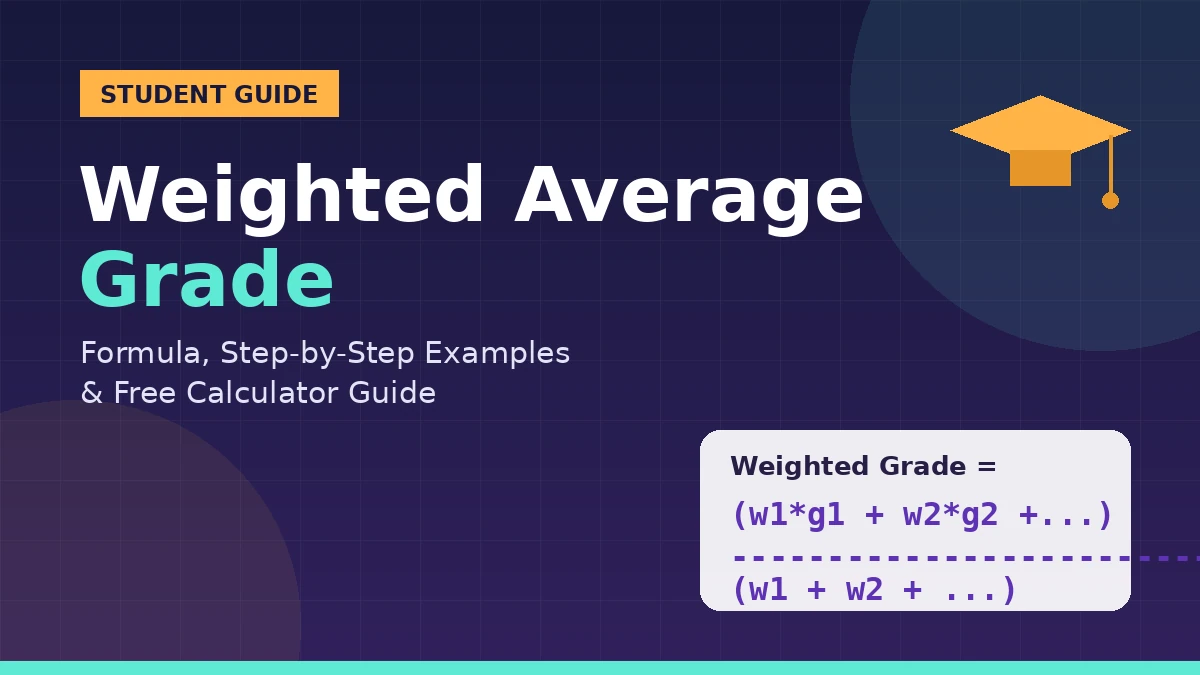
Weighted Grade = (w₁×g₁ + w₂×g₂ + w₃×g₃ + …) / (w₁ + w₂ + w₃ + …)
This version matters for college GPA calculations, where course credit hours act as the weight.
How to Calculate Your Weighted Average Grade, Step by Step
- List every graded component — tests, quizzes, homework, projects, final exam.
- Convert each weight to a decimal. Divide the percentage by 100 (30% becomes 0.30).
- Multiply each grade by its decimal weight.
- Add up all the weighted values.
- Divide by the total weight (skip this step if your weights already sum to 1, or 100%).
That’s the entire process. The math itself is basic multiplication and addition — the part people get wrong is usually step 2, forgetting to convert percentages to decimals before multiplying.
Worked Example: Calculating a Real Course Grade
Say you’re taking a course with this breakdown:
| Component | Grade | Weight |
|---|---|---|
| Homework | 85% | 15% |
| Midterm Exam | 78% | 25% |
| Quizzes | 90% | 10% |
| Final Exam | 82% | 50% |
Here’s the calculation:
- Homework: 85 × 0.15 = 12.75
- Midterm: 78 × 0.25 = 19.5
- Quizzes: 90 × 0.10 = 9.0
- Final: 82 × 0.50 = 41.0
Add them: 12.75 + 19.5 + 9.0 + 41.0 = 82.25%
Notice this is close to the final exam score (82%) alone — that’s expected, since the final carries half the total weight. This is exactly why a strong final exam performance matters more than a strong quiz performance in most courses.
What If Your Weights Don’t Add Up to 100%?
This happens more often than people expect — a professor drops the lowest quiz, or you’re calculating your grade mid-semester before all assignments are in.
In that case, don’t assume the missing weight is zero. Instead, divide your weighted sum by the total weight you do have, using the credit/points version of the formula above. This gives you your current grade based only on work completed so far — which is also how most professors track in-progress grades.
Common Mistakes Students Make (And How to Avoid Them)
- Forgetting to convert percentages to decimals. Multiplying by 30 instead of 0.30 throws off the entire calculation.
- Assuming all assignments in a category share one weight. If “homework” is 20% total but there are 8 assignments, each one is worth 2.5%, not 20%.
- Ignoring weight changes announced mid-semester. Some instructors adjust weighting if an assignment is dropped or added — always recalculate from the updated syllabus.
- Confusing weighted GPA with weighted course grade. They use the same underlying math but apply to different scopes (one course vs. an entire transcript).
How to Calculate the Score You Need on a Final Exam
This is one of the most searched-for uses of the weighted average formula. If you know your current grade and the final’s weight, you can reverse the formula to find your required score:
Required Final Score = (Grade Goal − Current Grade × (1 − Weight of Final)) / Weight of Final
Example: your current grade is 85%, the final is worth 30%, and you want an overall 90%.
Required Score = (90 − 85 × 0.70) / 0.30 = (90 − 59.5) / 0.30 = 101.7%
In this case, hitting 90% overall isn’t realistically achievable — which is useful information well before exam day, not after.
Weighted Average Grade Table Example
| Assignment Type | Weight | Score | Weighted Contribution |
|---|---|---|---|
| Homework | 15% | 88% | 13.2 |
| Quizzes | 10% | 92% | 9.2 |
| Midterm | 25% | 80% | 20.0 |
| Final Exam | 50% | 85% | 42.5 |
| Total | 100% | — | 84.9% |
Whether it’s GPA or final grades, our site has a calculator for every situation.
Frequently Asked Questions
What is a weighted average grade?
A weighted average grade is a course grade calculated by multiplying each assignment’s score by its assigned weight, then summing those results. It reflects that some assignments — like finals — count more toward your final grade than others, unlike a simple average.
How do you calculate a weighted grade by hand?
Convert each weight to a decimal, multiply it by the corresponding grade, add all the weighted values together, then divide by the total weight if it doesn’t already equal 1 (or 100%).
What’s the difference between weighted and unweighted grades?
An unweighted grade averages all scores equally. A weighted grade gives more influence to higher-weighted assignments, like a final exam, so your overall grade reflects the syllabus’s actual grading structure.
How much does the final exam affect my grade?
It depends entirely on its assigned weight. A final worth 50% can shift your grade far more than a quiz worth 5%, even if both scores differ by the same number of points.
What score do I need on my final to get a specific grade?
Use the reverse formula: (Grade Goal − Current Grade × (1 − Final’s Weight)) ÷ Final’s Weight. This tells you the minimum score needed on the remaining component.
Can weights add up to more than 100%?
No — properly structured grading weights should total exactly 100%. If they don’t (often mid-semester), calculate your current grade using only the weights of completed assignments.
Is weighted GPA the same as weighted course grade?
They use the same mathematical principle but different scopes: weighted course grade applies within a single class, while weighted GPA applies across multiple courses using credit hours as weights.
Why is my weighted grade different from my simple average?
Because weighting shifts influence toward higher-weight assignments. If your best scores carry less weight than your weaker ones, your weighted grade will be lower than your simple average, and vice versa.
