

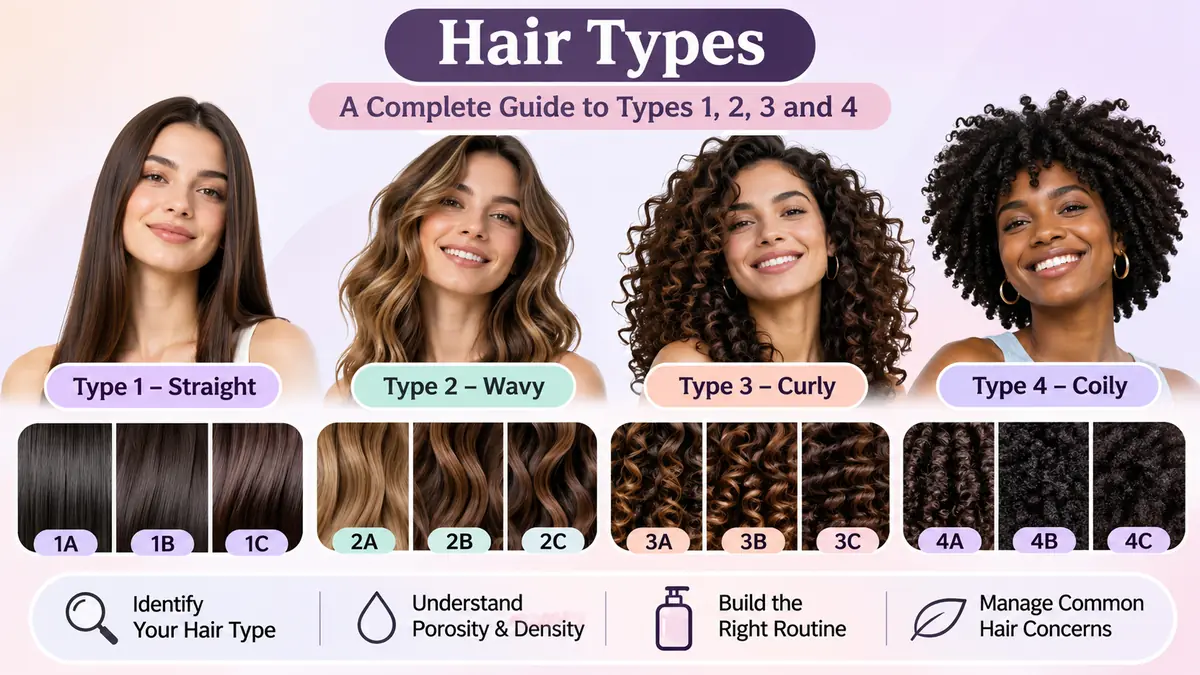
Your hair may look straight when wet, develop waves as it dries, or form tight curls that shrink to a fraction of their stretched length. Understanding why these differences occur can make everyday hair care much easier.
Hair texture is only part of the picture. Strand thickness, density, porosity, scalp condition, and even the weather influence how your hair looks and behaves.
There are four main hair types: Type 1 (straight), Type 2 (wavy), Type 3 (curly), and Type 4 (coily). These are commonly divided into 12 subtypes, from 1A to 4C, according to the appearance of the hair’s natural pattern. Knowing your type can help guide washing, conditioning, styling, and detangling, although no classification captures every characteristic of your hair.
What Are the Four Main hair types?
The widely used hair typing system describes hair according to its natural shape, ranging from straight strands to tightly coiled patterns.
It is commonly associated with hairstylist Andre Walker, although other curl classification systems also exist. The familiar numbered and lettered categories are useful descriptions, not scientific diagnoses or universal standards.
| Hair type | Natural pattern | Common characteristics |
|---|---|---|
| Type 1 | Straight | Little to no visible wave |
| Type 2 | Wavy | Loose to defined S-shaped waves |
| Type 3 | Curly | Spirals, ringlets, or corkscrew curls |
| Type 4 | Coily | Tight curls, coils, or zigzag patterns |
Each category has three commonly used subtypes: A, B, and C. These describe differences in the appearance and tightness of the pattern.
Importantly, one person can have several patterns across their scalp. For example, hair near the crown might form loose waves while the hair around the temples develops tighter curls.
Why Does Hair Texture Vary?
Natural hair shape is influenced strongly by genetics and the structure of the hair follicle.
Hair follicles produce strands made primarily of keratin, a structural protein. Differences in follicle shape, strand structure, and the arrangement of bonds within the hair contribute to straight, wavy, curly, and coily patterns.
The shape of the follicle is not the only factor. Hair growth, hormones, aging, chemical treatments, and physical damage can also affect the visible pattern.
Humidity can temporarily change the way hair behaves because water interacts with hydrogen bonds in the hair shaft. This helps explain why a smooth hairstyle may become wavy or frizzy on a humid day.
Type 1 Hair: Straight Hair
Type 1 hair grows without a noticeable natural wave or curl. It often reflects light evenly, which can give it a smooth, shiny appearance.
Scalp sebum can move relatively easily along straight strands, although this does not mean everyone with straight hair has an oily scalp.
Type 1A: Very Straight Hair
Type 1A hair appears extremely straight and often has fine strands with little natural volume.
It can lie close to the scalp and may struggle to hold curls created with styling tools.
A lightweight shampoo and conditioner can help maintain movement without making the hair feel weighed down.
Type 1B: Straight Hair With Some Body
Type 1B hair is predominantly straight but usually has more visible volume or body than 1A.
Individual strands may be fine, medium, or coarse. The subtype describes the pattern, not the thickness of each strand.
Lightweight conditioning and gentle styling can help maintain softness without flattening the roots.
Type 1C: Straight Hair With More Body
Type 1C hair remains mostly straight but may have subtle bends, especially toward the ends.
It can appear fuller and may be more resistant to certain heat-styled shapes.
Using a heat protectant when blow-drying or straightening and avoiding unnecessary high temperatures helps reduce damage.
Quick takeaway: Straight hair benefits from care based on scalp oiliness and strand thickness rather than curl pattern alone.
Type 2 Hair: Wavy Hair
Type 2 hair falls between straight and curly textures. Its defining characteristic is an S-shaped pattern that can range from barely visible bends to pronounced waves.
Wavy hair may look straighter when wet or when weighed down by heavy styling products.
Type 2A: Loose, Subtle Waves
Type 2A hair has gentle waves that often become more noticeable toward the middle or ends of the strands.
It may be easily flattened by heavy creams, oils, and butters.
Lightweight mousse or gel can help encourage wave definition without excessive buildup.
Type 2B: Defined S-Shaped Waves
Type 2B hair has more visible S-shaped waves, often beginning closer to the roots.
It may experience frizz when brushed dry or exposed to humid conditions.
Applying a lightweight styling product to damp hair and gently scrunching can help preserve the natural pattern.
Type 2C: Strong Waves With Occasional Curls
Type 2C hair has pronounced waves and may form loose spirals in some sections.
It often needs more conditioning than looser wave patterns, especially when the strands are dry or damaged.
A leave-in conditioner and flexible-hold gel can help manage frizz while maintaining definition.
How Should You Care for Wavy Hair?
Wavy hair generally responds well to a balance between moisture and lightweight styling.
- Cleanse according to scalp oiliness and product buildup.
- Apply conditioner primarily to the lengths and ends.
- Detangle gently while the hair has enough slip.
- Apply mousse or gel to damp hair.
- Scrunch upward to encourage wave formation.
- Air-dry or use a diffuser at a moderate or low heat setting.
Avoid assuming that every wavy texture needs a complicated curly hair routine. Some people achieve better results with fewer products.
Type 3 Hair: Curly Hair
Type 3 hair forms visible spirals, ringlets, or corkscrew-shaped curls.
Because the strands curve, they can be more susceptible to tangling and mechanical damage, particularly when handled roughly.
Curly hair also commonly experiences shrinkage, meaning the dry curls appear shorter than the strands when stretched.
Type 3A: Large, Loose Curls
Type 3A hair forms relatively large spirals with a loose curl pattern.
Its curls may become stretched by heavy products or prolonged brushing.
Lightweight curl creams, mousse, or gel can help maintain bounce and definition.
Type 3B: Springy Ringlets
Type 3B hair forms smaller, springier curls than 3A.
The curls often create noticeable volume and may become frizzy when moisture levels or styling techniques change.
Conditioning, section-by-section styling, and gentle drying can help maintain curl shape.
Type 3C: Tight Corkscrew Curls
Type 3C hair forms densely packed, relatively small corkscrew curls.
It may experience considerable shrinkage and can become tangled if not detangled carefully.
A moisturizing conditioner, leave-in product, and styling gel can help reduce friction and maintain definition.
How to Maintain Healthy Curly Hair
Curly hair care should focus on minimizing damage while maintaining adequate cleansing and conditioning.
- Use a shampoo appropriate for your scalp rather than avoiding shampoo entirely.
- Condition thoroughly, especially along the ends.
- Detangle in sections with fingers or a suitable wide-tooth comb.
- Avoid repeatedly brushing dry curls if doing so causes breakage.
- Protect the hair from excessive heat and tight hairstyles.
- Consider a satin bonnet or smooth pillowcase to reduce nighttime friction.
Curly hair does not automatically require large quantities of oil. The right amount depends on the individual strand and the product formulation.
Type 4 Hair: Coily and Kinky Hair
Type 4 hair includes tightly curled, coiled, and zigzag-shaped patterns.
These textures may show substantial shrinkage and can be vulnerable to breakage from excessive manipulation, particularly at bends along the hair shaft.
Coily hair is not inherently unhealthy, unmanageable, or unable to grow long. Its visible length can be affected considerably by shrinkage.
Type 4A: Small, Defined Coils
Type 4A hair generally forms small, visible S-shaped coils.
The pattern can often be seen when the hair is wet or conditioned.
Moisturizing conditioners, gentle detangling, and styling products that provide slip can help maintain the coils.
Type 4B: Tight, Less Uniform Bends
Type 4B hair often has a less uniform pattern with tight bends or zigzag-like sections.
The hair may appear densely packed and can experience substantial shrinkage.
Working in sections and using conditioner during detangling can reduce unnecessary pulling.
Type 4C: Very Tight, Compact Coils
Type 4C hair typically has a very tight pattern that may not form obvious, uniform ringlets without styling.
It can shrink dramatically compared with its stretched length.
Because tightly coiled strands can be vulnerable to mechanical damage, low-tension styling and careful handling are especially useful.
Best Practices for Coily Hair
A practical routine prioritizes cleansing, conditioning, detangling, and protecting the strands from unnecessary stress.
Wash when needed to remove scalp oils, sweat, and buildup. Apply a conditioner with sufficient slip, and detangle gradually from the ends toward the roots.
Protective styles such as twists, braids, and buns may reduce daily manipulation, but they should never pull tightly on the scalp or hairline.
Persistent tenderness, bumps, or thinning around the edges may indicate excessive tension.
Quick takeaway: Type 4 hair often benefits from gentle handling and reduced friction. Curl tightness alone does not determine how frequently hair should be washed or how much moisture it needs.
How to Determine Your Natural Hair Type
Identifying your hair type is easiest when your hair is clean, free from heavy styling products, and allowed to dry in its natural state.
A simple observation process can help you distinguish between straight, wavy, curly, and coily patterns.
Step 1: Wash Your Hair
Cleanse your scalp with a suitable shampoo and rinse thoroughly.
Apply conditioner if needed to detangle, then rinse according to the product instructions. Avoid using straightening treatments or heavy styling products during this assessment.
Step 2: Let Your Hair Dry Naturally
Gently remove excess water with a microfiber towel or soft cotton T-shirt.
Avoid aggressive towel rubbing, which can disturb the pattern and increase friction.
Allow the hair to air-dry without brushing it into a different shape.
Step 3: Examine the Natural Pattern
Once dry, observe several sections, including the crown, sides, back, and hairline.
- Straight strands: Likely Type 1.
- S-shaped bends: Likely Type 2.
- Visible spirals or ringlets: Likely Type 3.
- Small, tightly packed coils or bends: Likely Type 4.
Compare the pattern with the A, B, and C descriptions to estimate your subtype.
Step 4: Check for Multiple Textures
Do not force every section into one category.
Mixed curl patterns are common. You might have 2C waves near the front and 3A curls around the back, for example.
The most useful classification is the one that helps you understand how different sections respond to care.
Step 5: Consider Previous Hair Treatments
Chemical straightening, bleaching, permanent waving, and repeated heat exposure can change how the hair appears.
If your lengths have been chemically altered, the newer growth near your scalp may provide a better indication of your natural pattern.
However, even untreated hair can change over time.
Hair Texture vs. Hair Density, Thickness, and Porosity
One of the biggest misconceptions about hair types is that curl pattern tells you everything about hair care.
In reality, several characteristics work together to determine how hair feels, absorbs products, and responds to styling.
Hair Texture and Strand Thickness
In everyday language, texture often means curl pattern. In hair science and professional styling, it can also refer to the physical characteristics of individual strands.
Strand thickness describes the diameter of a single hair.
| Strand thickness | Description | Typical care consideration |
|---|---|---|
| Fine | Small individual strand diameter | May become weighed down by heavy products |
| Medium | Intermediate strand diameter | Often tolerates a range of formulations |
| Coarse | Larger individual strand diameter | May benefit from richer conditioning, depending on condition |
Fine hair is not necessarily thin hair.
A person can have fine individual strands but a large number of them, creating a full appearance.
Likewise, someone with coarse strands may have relatively low overall density.
What Is Hair Density?
Hair density refers to the number of hair strands growing within a particular area of the scalp.
It is different from the thickness of each strand.
People often describe their density as low, medium, or high, although these informal labels are not precise measurements.
Low-density hair may expose more scalp when parted, while high-density hair can look fuller and take longer to wash or dry.
Density affects styling choices. For example, thick creams may make low-density hair appear flatter, while high-density hair may require sectioning for even product application.
What Is Hair Porosity?
Hair porosity describes how readily hair takes up and releases water. It is influenced by the condition of the hair cuticle, the outer protective layer of the strand.
Porosity is often described using three informal categories.
| Porosity | General characteristics | Practical approach |
|---|---|---|
| Low | Water may penetrate relatively slowly | Use suitable lightweight conditioning and rinse thoroughly |
| Medium | Moderate water uptake and retention | Maintain consistent cleansing and conditioning |
| High | Water may enter and leave readily, particularly in damaged hair | Reduce damage and use conditioning products to improve manageability |
Porosity can vary along the same strand. For instance, older, bleached ends may be more porous than untreated roots.
Does the Hair Float Test Work?
A popular home method involves dropping a strand into a glass of water and judging porosity by whether it floats or sinks.
This test is unreliable.
Surface oils, product residue, trapped air, and other factors can influence floating behavior. It cannot accurately establish porosity on its own.
Instead, observe how your hair behaves over several wash cycles. If breakage, roughness, or unusual dryness is persistent, a professional assessment may be more useful than a home porosity label.
Hair Elasticity and Shrinkage
Elasticity describes a strand’s ability to stretch and return toward its original length.
Healthy hair has some flexibility, but excessive stretching, snapping, or a gummy feeling when wet may indicate damage.
Shrinkage is different. It describes how curly or coily hair contracts into its natural shape.
Substantial shrinkage does not automatically mean the hair is damaged or unhealthy.
How to Build a Hair Care Routine for Different hair types
An effective routine should reflect your natural pattern, scalp condition, strand characteristics, and daily activities.
The American Academy of Dermatology recommends choosing washing and conditioning practices based on how oily, dirty, dry, or textured the hair is, rather than following a universal schedule. American Academy of Dermatology+1
Choosing the Right Shampoo
Shampoo primarily cleanses the scalp and removes oil, sweat, dead skin, and product buildup.
People with straight hair and oily scalps may need frequent washing, sometimes daily.
People with dry, curly, or coily hair may benefit from washing less frequently, provided the scalp remains clean and comfortable.
A gentle shampoo can be useful for regular cleansing, while a clarifying shampoo may help when styling products accumulate.
Sulfate-containing shampoos are not inherently harmful, and sulfate-free formulas are not automatically better. The overall formulation and individual response matter.
Conditioning According to Hair Needs
Conditioners reduce friction, improve detangling, and make the hair easier to manage.
Fine, straight hair may respond best to a small amount of lightweight conditioner concentrated on the ends.
Curly, coily, dry, or chemically treated hair may benefit from richer conditioning along the full length.
Useful conditioning ingredients include glycerin, fatty alcohols such as cetyl alcohol, and conditioning agents that help smooth the hair surface.
Leave-in conditioners provide additional lubrication and manageability, but using too much can create buildup.
Choosing Styling Products
Different product textures can produce different results.
| Product | Common purpose | Often useful for |
|---|---|---|
| Mousse | Lightweight volume and hold | Fine, straight, or wavy hair |
| Gel | Definition and hold | Wavy, curly, and coily hair |
| Curl cream | Softness and curl definition | Curly or coily hair |
| Leave-in conditioner | Detangling and manageability | Dry, damaged, or textured hair |
| Hair oil | Lubrication and shine | Dry lengths and ends |
| Heat protectant | Helps reduce heat-related damage | Hair exposed to heated tools |
These are starting points, not strict rules.
A person with fine 3A curls may prefer mousse, while someone with coarse 2C waves may find a small amount of cream helpful.
How Often Should You Wash Your Hair?
There is no ideal wash frequency that applies to everyone.
Scalp oil production, exercise, climate, hair length, product buildup, and skin conditions all influence washing needs.
A practical rule is to cleanse when the scalp becomes oily, uncomfortable, or noticeably dirty.
For thick, curly, or coily hair, dermatologists commonly advise avoiding excessive washing while maintaining regular scalp hygiene. The American Academy of Dermatology advises washing at least every two to three weeks as needed, with individual routines adjusted accordingly. American Academy of Dermatology+1
Persistent itching, scaling, or inflammation should not simply be treated by washing less often.
Common Hair Problems Across Different Textures
Although curl pattern influences how hair behaves, most common hair concerns can affect any hair type.
Why Does Hair Become Frizzy?
Frizz occurs when strands separate from their intended alignment, creating an uneven appearance.
Humidity, mechanical damage, static electricity, and natural variation in strand shape can contribute.
To reduce frizz, try applying conditioner consistently, limiting rough towel drying, and using styling products that provide appropriate hold.
Frizz is not always a sign of unhealthy hair. Some natural textures have a less uniform appearance even when well cared for.
Why Does Hair Become Dry?
Dryness can result from inadequate lubrication, environmental exposure, frequent washing with harsh products, chemical treatments, or heat damage.
Curly and coily hair may feel drier because scalp oils do not distribute as easily along the curved strands.
Conditioners and leave-in products can improve softness and reduce friction. Oils can help lubricate the hair surface, but they do not replace water or repair severely damaged structures.
How Can You Prevent Hair Breakage?
Hair breakage occurs when the shaft fractures rather than shedding naturally from the follicle.
Common contributors include excessive heat, chemical processing, aggressive detangling, and repeated tension.
Reduce breakage by handling wet hair gently, using suitable conditioning products, and limiting damaging styling practices.
Tightly pulled braids, ponytails, and extensions can also contribute to traction alopecia, a form of hair loss caused by repeated tension. American Academy of Dermatology
Can Your Hair Type Change Over Time?
Yes. Natural hair patterns can change with age, hormonal changes, and certain health conditions.
Pregnancy, puberty, and menopause may coincide with changes in hair characteristics.
Chemical treatments can alter the appearance of existing strands, while new growth may retain a different pattern.
If hair texture changes suddenly alongside significant shedding, scalp inflammation, or other symptoms, consult a dermatologist.
Common Myths About Hair Types
Several popular hair care claims oversimplify how hair works.
Myth: Type 4 Hair Cannot Grow Long
Coily hair grows from follicles just like other hair textures.
Its visible length can be reduced by shrinkage, and breakage can make length retention difficult.
Gentle handling and reducing damaging practices can help preserve the length already grown.
Myth: Straight Hair Never Needs Conditioner
Straight hair can still experience dryness, tangling, chemical damage, and split ends.
The amount and formulation of conditioner should reflect strand condition rather than curl pattern alone.
Myth: Curly Hair Should Never Be Shampooed
Curly hair requires scalp cleansing, even when washing frequency is lower than for oilier hair types.
Avoiding shampoo indefinitely can allow sweat, oils, and product residue to accumulate.
Myth: Natural Oils Permanently Repair Split Ends
Hair oils may temporarily smooth the surface and reduce friction, but they cannot permanently reconnect a split hair shaft.
Trimming damaged ends is the most reliable way to remove existing splits.
Myth: Everyone Has Exactly One Hair Type
Multiple patterns can grow on the same head.
The classification system is a convenient descriptive tool, not a requirement that every strand fit into a single category.
Final Thoughts on hair types
Understanding hair types provides a useful starting point for building a routine that supports healthy, manageable hair.
Type 1 hair is straight, Type 2 is wavy, Type 3 is curly, and Type 4 is coily. The familiar A, B, and C subtypes offer additional descriptions of the natural pattern.
However, curl classification alone cannot determine your ideal shampoo, conditioner, styling products, or wash schedule.
Pay attention to strand thickness, density, porosity, scalp health, and how your hair responds to different techniques.
Start by observing your clean, naturally dried hair. Then establish a simple routine built around gentle cleansing, appropriate conditioning, careful detangling, and protection from excessive heat and tension.
The most effective hair care routine is not necessarily the most complicated one. It is the routine that keeps your scalp comfortable and your hair manageable while minimizing avoidable damage.
