

A curling stone has already left the player’s hand, yet teammates can still change where it finishes. That unusual feature is one of the reasons sweeping is so important in elite curling.
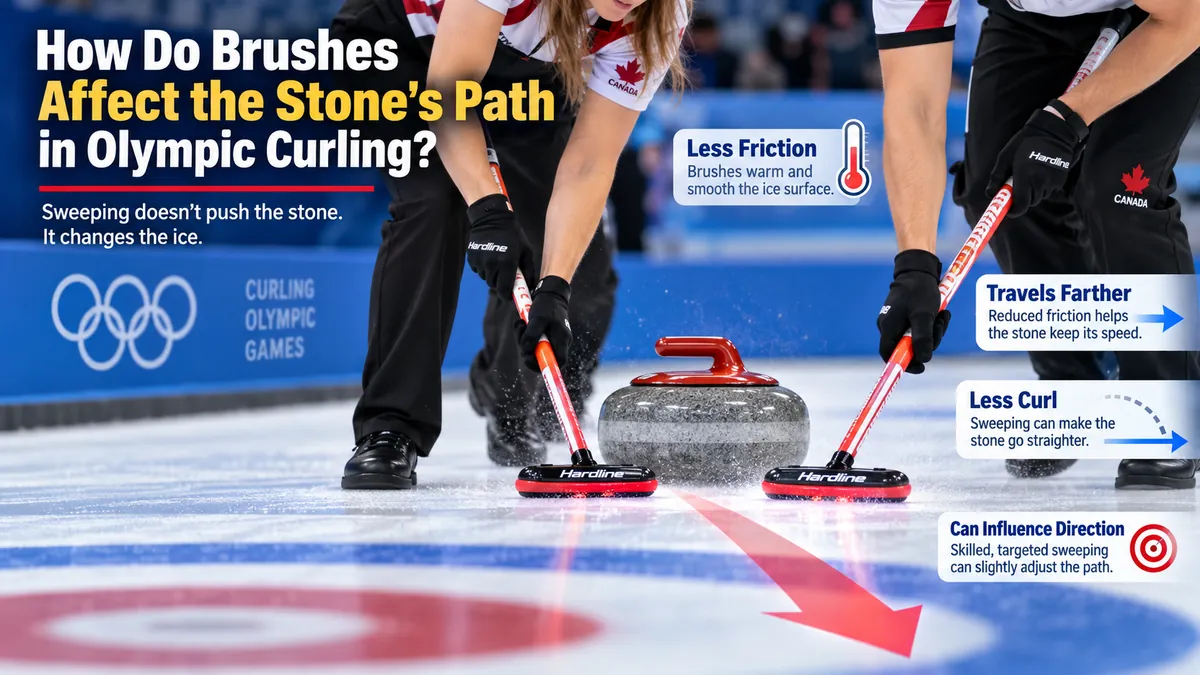
So, how do brushes affect the stone’s path in olympic curling? Sweeping modifies the interaction between the stone and the pebbled ice. Effective brushing reduces friction, helping the stone retain speed, travel farther, and generally curl less. Skilled sweepers can also influence its lateral path through carefully controlled sweeping techniques.
The brush does not physically touch or push the stone. Instead, sweepers alter the ice immediately in front of it. The effect may look small on television, but over the length of a curling sheet it can make the difference between a perfectly placed stone and a missed shot.
How Do Brushes Affect the Stone’s Path in Olympic Curling?
The simplest way to understand sweeping is to separate its effects into distance, curl, and directional control.
| Effect of sweeping | What happens to the stone |
|---|---|
| Reduced friction | Stone loses speed more slowly |
| More effective sweeping | Stone can travel farther |
| Sweeping in front of the stone | Usually reduces curl and holds a straighter line |
| No sweeping | Stone slows naturally and can develop more of its intended curl |
| Controlled asymmetric sweeping | Can influence the stone’s lateral trajectory |
| Greater pressure and brush speed | Generally produce a stronger sweeping effect |
World Curling describes the basic purpose clearly: sweeping gently warms the ice surface and can extend the stone’s path by approximately two or three metres, while also reducing curl and making its trajectory straighter.
That means sweepers are effectively making fine adjustments to a shot after delivery.
They cannot rescue every bad throw. A stone delivered dramatically too fast, too slow, or on the wrong line still has physical limits. But when the initial shot is reasonably close, good sweeping can substantially improve the result.
Why Curling Stones Curve in the First Place
Understanding the brush requires understanding the surface beneath the stone.
Curling is not played on perfectly smooth ice. Before play, water droplets are sprayed onto the sheet and freeze into thousands of tiny bumps called pebbles. The stone therefore travels across a textured surface rather than sliding across a flat sheet.
The curling stone itself is made from granite and has a narrow running band underneath. This ring-shaped portion of the stone contacts the pebbled ice.
During delivery, the player gives the handle a controlled clockwise or counterclockwise rotation. As the rotating running band interacts with the ice, the stone gradually moves sideways, producing the curved trajectory that gives curling its name. World Curling notes that players deliberately apply this rotation to control where the stone ultimately comes to rest.
The Physics Behind the Curl
The exact microscopic explanation for why curling stones curl has been studied for decades, and the detailed mechanism is more complicated than the simple friction explanations often given to television viewers.
Research has examined mechanisms involving ice scratches, asymmetric friction, contact between the running band and individual pebbles, and the changing behavior of the stone as its translational and rotational speeds decrease.
One proposed explanation is often called scratch guiding. As parts of the running band move across ice pebbles, microscopic scratches can form. Subsequent interactions between the stone and these scratches may contribute to the characteristic sideways movement. Battelle describes scratch guiding as an important explanation for curling behavior, while scientific research continues to investigate the precise mechanisms involved.
For understanding sweeping, however, the key point is simpler: the trajectory depends heavily on the stone-ice interaction, and sweeping changes that interaction.
How Sweeping Changes Friction on the Ice
When athletes rapidly move a curling brush across the ice while applying downward pressure, friction between the brush head and ice changes the surface conditions.
The temperature at the surface rises slightly. Scientific modeling and experiments have reported measurable temperature increases from vigorous sweeping and associate those increases with reductions in the effective friction coefficient.
Less friction means less resistance against the moving stone.
Imagine sliding two identical objects across surfaces with different resistance. The object experiencing less resistance keeps moving longer. The same broad principle applies to a curling stone, although real curling physics is considerably more complicated because the stone is simultaneously translating and rotating over pebbled ice.
This is why sweeping immediately in front of the stone can have such a noticeable effect.
Does Sweeping Actually Melt the Ice?
You may hear the explanation that curling brushes simply “melt the ice” and create a layer of water.
That description is too simplistic.
Sweeping does generate heat and raises the temperature of the ice surface, but the resulting stone behavior involves changes to friction, the pebble surface, and microscopic stone-ice interactions. Battelle notes that sweeping can raise the ice closer to its melting boundary without necessarily requiring the simplistic picture of sweepers producing an obvious lubricating water layer.
For spectators, “sweeping reduces effective friction” is the more useful explanation.
Sweeping Makes the Curling Stone Travel Farther
The most obvious effect of brushing is additional distance.
Every curling stone gradually loses kinetic energy as it travels down the sheet. Without intervention, friction eventually slows it until it stops.
Sweeping reduces that resistance. The stone consequently loses speed more slowly and continues traveling.
World Curling states that good sweeping can add roughly two to three metres to a stone’s travel.
That is a huge adjustment in a precision sport.
Suppose a player releases a draw that appears destined to stop short of the house. The sweepers immediately judge its speed—often called its weight—and begin sweeping hard. If the delivery is within a recoverable range, they may carry the stone significantly farther toward the intended target.
Why Players Shout “Hurry!” and “Hard!”
The shouting heard during Olympic curling is part of the team’s real-time communication.
The player directing the shot watches the stone’s line while the sweepers assess its speed. Calls such as “Hurry!” or “Hard!” tell the sweepers that aggressive sweeping is needed.
Other calls tell them to stop.
This communication happens continuously because the situation changes as the stone slows. A team may sweep aggressively for several metres, stop to allow more curl, then resume sweeping when additional distance or line control is required.
The decision is not random. Elite teams develop highly refined estimates of stone speed, expected stopping distance, and ice conditions.
How Brushes Make a Curling Stone Go Straighter
Distance is only half the story.
Sweeping also generally causes a stone to curl less, allowing it to hold a straighter trajectory for longer.
This matters because curl becomes especially important as the stone slows. If a team sees that its stone is beginning to move sideways too soon, sweeping can help maintain the intended line.
World Curling specifically identifies making a stone go farther and holding it straighter as acceptable effects of sweeping under its current competition policy. The federation also recognizes that sweeping can produce some enhancement of the curling trajectory.
Consider a stone intended to pass through a narrow gap between two guards.
Without sweeping, it might begin curling early and collide with one of them. Effective sweeping can help hold the stone on a straighter line long enough to clear the obstruction.
Once the sweepers stop, the stone resumes responding to the unswept ice conditions and can continue developing its curl.
That creates one of curling’s most interesting tactical possibilities: athletes can decide when to encourage a straighter path and when to let the stone finish naturally.
Quick takeaway: Sweeping usually gives a team two major controls at once: it preserves the stone’s speed so it travels farther, and it can reduce its curl so it stays straighter.
Can Curling Sweepers Actually Steer the Stone?
To a limited degree, yes—but “steering” needs qualification.
Sweepers cannot turn a curling stone like a driver turns a car. They work within the trajectory established by the delivery, rotation, stone speed, ice conditions, and friction.
Modern research nevertheless indicates that asymmetric or directional sweeping can influence lateral movement.
A 2024 study published in Sports Engineering investigated left-right asymmetric sweeping. Its experimental results found statistically supported effects from sweeping one side of the stone’s path, including an effect that assisted curling when the opposite half-side was swept. The authors also emphasized that the detailed physical mechanism of curl control is not completely understood.
Earlier sports-science literature likewise reported that sweeping on different sides can help a stone stay straighter or curl more depending on its rotation.
This ability is one reason modern sweeping is much more sophisticated than simply scrubbing as hard as possible.
Rotation Changes the Sweeping Decision
A stone can be released with clockwise or counterclockwise rotation.
Because the direction of curl depends on that rotation, the useful side for directional sweeping also changes.
Elite sweepers therefore need to know:
- which direction the stone is rotating;
- its current speed;
- how quickly it is beginning to curl;
- the desired final line;
- the condition of the pebble;
- where guards and other stones are positioned.
They make those judgments while moving rapidly beside a roughly 20-kilogram granite stone.
What Makes Sweeping More Effective?
Not all sweeping produces the same result.
Two important variables are downward force and brush-head speed. Sports-science research has identified their combination as central to effective sweeping, with the appropriate technique also depending on the velocity of the moving stone.
Downward Pressure
A sweeper who applies more effective downward force creates stronger contact between the brush head and ice.
Elite curlers therefore do much more than wave a broom across the surface. They lean their body weight into the brush while maintaining balance and moving alongside the stone.
That is physically demanding.
Brush-Head Speed
The brush must also move rapidly across the ice.
Fast strokes combined with effective pressure increase the brush’s ability to modify the surface conditions ahead of the stone.
This is why sweeping technique requires strength, cardiovascular fitness, coordination, and repetition.
Stone Speed
The stone’s speed matters too.
A fast-moving takeout and a slow draw do not present the same sweeping problem. Sweepers have less time to work on the ice ahead of a rapidly moving stone, while a slower stone gives them a different combination of time, friction, and developing curl to manage.
Ice Conditions
Curling ice changes throughout competition.
Temperature, humidity, pebble condition, wear from previous stones, and preparation of the sheet can influence speed and curl. Teams therefore learn the ice throughout a game rather than assuming every stone will behave identically.
Why Curling Ice Has Pebbles
The small bumps covering the ice are essential to modern curling.
Without pebble, the interaction between a granite stone and a completely flat ice surface would be very different. Pebbling limits the contact area and creates the surface over which the running band travels.
As stones repeatedly pass over the sheet, those pebbles can change. Ice technicians therefore play a major role in producing consistent competition conditions.
Sweeping acts primarily on the path immediately ahead of the moving stone, which is why timing matters so much. Altering ice well behind the stone obviously cannot help its current trajectory.
The sweepers need to work exactly where the stone is about to travel.
Why Olympic Curling Brushes Are Highly Regulated
If sweeping can alter a stone’s trajectory, brush technology can potentially provide a significant competitive advantage.
That became especially clear during the controversy sometimes called “Broomgate.” Highly effective brush constructions raised concerns that equipment was allowing athletes to manipulate stones beyond what curling authorities considered acceptable.
World Curling introduced specifications for brushes used in elite competition in 2016 and continues to regulate competition equipment.
The regulations have continued evolving.
For the 2025–26 Olympic season, World Curling changed compliance requirements for component-style brushes after concerns about the effectiveness of certain brush-head constructions. The federation published lists identifying approved and no-longer-approved combinations involving manufacturers and products such as BalancePlus, Goldline Impact, Hardline Ice Pad, SmartBroom by Curling Tools, and End Game Icon.
These rules matter because equipment should reward athletic sweeping skill without allowing brush technology to dominate the sport.
The 2026 Sweeping Technique Rules
Equipment is not the only thing regulated. How athletes use the brush matters as well.
In January 2026, World Curling introduced a Sweeping Technique Policy developed in consultation with the World Curling Athlete Commission.
The policy defines acceptable sweeping effects as making the stone travel farther and holding it straighter while permitting some enhancement of its curling trajectory. It prohibits specified techniques when they are used with the intent of increasing a stone’s deceleration.
Under Rule R8, permitted sweeping must also follow requirements governing how the brush is used around the moving stone. Among other provisions, the brush cannot deposit debris in front of the stone and sweeping must finish to either side.
This is an important distinction for Olympic viewers.
The objective of legal sweeping is not simply “make the stone do anything possible.” Competitive curling establishes limits on the ways athletes may influence a stone after release.
What Sweepers Are Calculating During an Olympic Shot
Watch an elite curling team and the sweeping can appear frantic. In reality, several calculations are happening simultaneously.
Immediately after release, sweepers assess the stone’s weight, meaning the speed and expected distance of the shot. The skip or player directing the house evaluates the line.
From there, the team continually updates the decision.
A simplified sequence looks like this:
- The stone is released with a chosen rotation and speed.
- Sweepers judge its weight and estimate where it will stop.
- The skip monitors the line and developing curl.
- Sweeping begins if more distance or a straighter trajectory is required.
- Pressure, stroke speed, position, and duration are adjusted according to the shot.
- Sweeping stops or changes when the team wants the stone to slow or develop more of its natural trajectory.
- The stone enters the house or contact zone, where fractions of a stone’s width can determine the outcome.
The remarkable part is how quickly those decisions occur.
How Sweeping Changes Different Curling Shots
The value of the brush depends on the shot being played.
Draw Shots
A draw is intended to stop at a particular location rather than remove another stone.
Weight control is crucial. Sweepers can extend an under-thrown draw, sometimes carrying it substantially farther than it would have traveled without sweeping.
They also manage the line so the stone reaches the intended part of the house.
Guards
A guard is deliberately placed in front of the house to protect another stone or complicate the opponent’s access.
Because placement must be precise, excessive sweeping can be costly. Carrying a guard too far may leave an opening that the team intended to block.
Takeouts
A takeout is thrown with the goal of removing another stone.
These shots are usually faster than draws. Sweeping may be used to hold the line and help the attacking stone reach the intended point of contact.
Raises and Runbacks
More complex shots involve hitting one stone into another.
Here, directional accuracy can be extraordinarily important. A small difference in contact angle may determine whether the intended combination works.
The sweepers’ role is therefore tied directly to strategy rather than merely distance.
What Happens When Sweepers Stop Brushing?
Stopping does not suddenly apply a brake to the stone.
Instead, the stone simply encounters ice that has not just been modified by active sweeping. Friction continues slowing it, and the stone can develop more of its expected curl as its speed decreases.
This explains the rapid start-stop behavior seen in competition.
A skip might initially want heavy sweeping to keep a stone moving. Seconds later, the stone may have enough distance, so the sweepers are told to stop. If its speed then falls faster than expected, sweeping can resume.
The team is continuously balancing weight and line.
Can Sweeping Fix a Bad Curling Shot?
Only within limits.
A well-swept stone can travel farther and follow a somewhat different lateral trajectory than the same stone would without sweeping. But sweepers cannot completely erase the physics of a poor delivery.
If a stone is thrown far too hard, sweeping cannot normally make legal sweeping function as a powerful brake. If it is dramatically off line, the brush cannot simply drag it sideways across the sheet.
Similarly, sweepers cannot add rotational energy that was never present in the delivery.
This is why elite curling still begins with excellent delivery mechanics. Sweeping is a powerful fine-control system, not a substitute for the throw itself.
Why Two Sweepers Are Often Used
Traditional team sweeping often places two athletes around the moving stone.
Having two sweepers can provide substantial brushing capacity and lets the team coordinate the stone’s speed and line while traveling down the sheet.
Modern strategy can also involve more specialized sweeping decisions depending on the desired trajectory and competition rules.
The physical demands should not be underestimated. A review of curling sports science describes hard sweeping as highly demanding and identifies effective technique as a combination of pressure and brush speed.
Over an Olympic-length game, repeatedly producing high-quality sweeping requires considerable endurance.
Does More Sweeping Always Mean a Better Shot?
No.
Sweeping is useful only when its effects match the intended result.
If a draw already has enough speed, continuing to sweep could carry it beyond its ideal position. If the team wants the stone to develop more curl, holding it straighter for too long may produce the wrong angle.
Good sweepers therefore need to know when not to sweep.
This is one of the subtle skills new viewers can watch for. Sometimes a player urgently shouts for sweeping; seconds later, everyone suddenly stops.
Nothing has gone wrong. The team is changing the balance between distance and trajectory in real time.
The Difference Between Sweeping and Physically Steering
The easiest misconception to avoid is imagining an invisible steering wheel attached to the brush.
The stone’s basic path is established at delivery through:
- initial direction;
- release speed;
- clockwise or counterclockwise rotation;
- the stone’s running band;
- ice and pebble conditions.
Sweeping then modifies the stone-ice interaction along that existing journey.
A useful analogy is fine-tuning rather than steering.
The thrower creates the shot. The sweepers continuously adjust how that shot develops.
That distinction explains both the remarkable effectiveness and the limitations of Olympic sweeping.
Why Sweeping Is So Important to Olympic Curling Strategy
Curling is often described as a precision and strategy sport, and sweeping connects those two elements.
A skip may design a shot that needs to pass extremely close to a guard before curling into the house. The thrower must deliver the correct speed, line, and rotation, but the exact behavior of the stone cannot be perfectly known at release.
Sweeping provides a limited form of post-release correction.
Teams can preserve speed when a stone appears light, hold a straighter line when it starts curling early, and use sophisticated sweeping techniques to influence lateral movement within the rules.
That is why communication among the thrower, sweepers, and skip is so intense. The brush is not an accessory—it is part of the team’s control system.
How Do Brushes Affect the Stone’s Path in Olympic Curling? The Bottom Line
So, how do brushes affect the stone’s path in olympic curling? They change the conditions of the pebbled ice immediately ahead of the moving granite stone. Vigorous sweeping raises the ice surface temperature slightly and alters friction, allowing the stone to retain speed, travel farther, and generally follow a straighter trajectory.
Advanced sweeping can also influence lateral movement, although the physics of directional sweeping and curling remain an active area of study. Modern Olympic-level brushes and sweeping techniques are consequently regulated by World Curling to limit how equipment and technique can affect play.
The next time you watch Olympic curling, focus on when the sweepers start and stop. Their movements reveal what the team is trying to change: more distance, less curl, a different line—or simply letting the stone finish naturally.
