

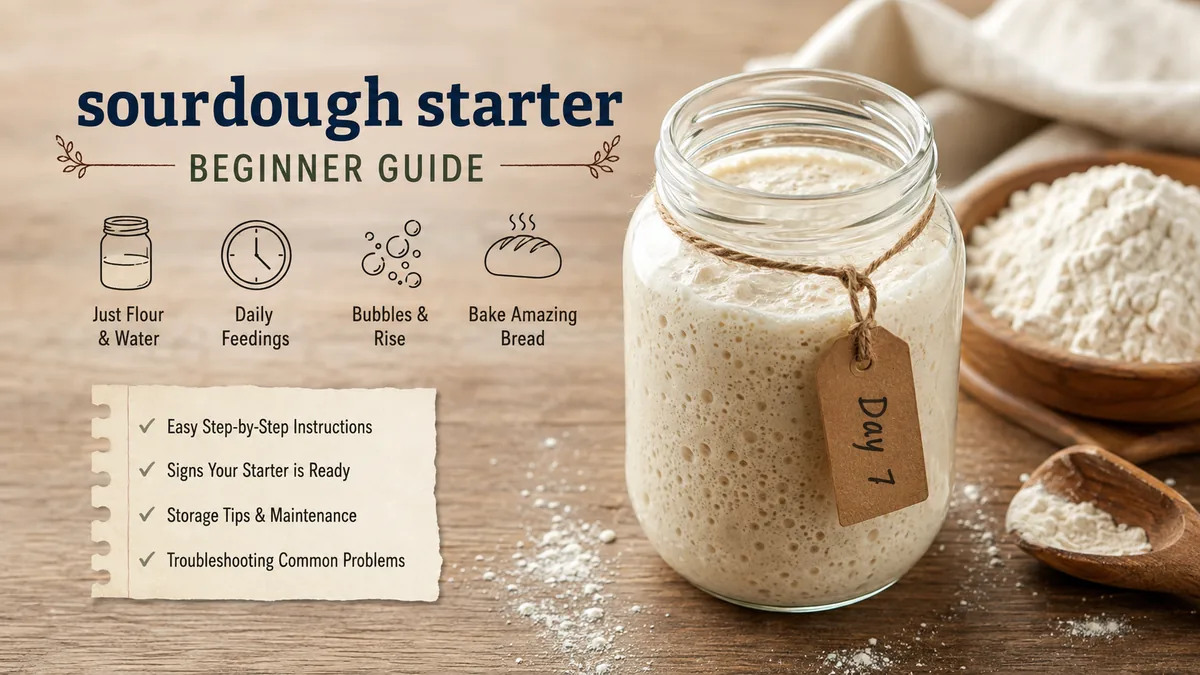
A jar of flour and water can look completely lifeless on day one. Give it several days of regular feeding, though, and that same mixture can become bubbly, aromatic, and strong enough to raise a loaf of bread without commercial yeast.
A sourdough starter is a fermented culture of flour and water populated by wild yeasts and lactic acid bacteria. These microorganisms consume carbohydrates in flour and produce carbon dioxide and organic acids. A healthy starter expands after feeding, develops bubbles throughout, smells pleasantly acidic, and can naturally leaven sourdough bread.
The process isn’t difficult, but it rewards consistency more than strict adherence to a calendar. Some starters become dependable within five or six days; others need a week or two before they consistently rise after feeding. King Arthur Baking, for example, recommends watching for reliable doubling rather than assuming a starter is ready simply because a certain number of days has passed.
What Is a sourdough starter?
A sourdough starter is essentially a small, continuously maintained fermentation ecosystem.
Flour supplies carbohydrates and microorganisms. Water hydrates the flour and creates conditions in which yeasts and bacteria can multiply. With repeated feedings, a relatively stable microbial community develops.
Wild yeasts produce carbon dioxide as they ferment sugars. That gas becomes trapped in bread dough and helps it rise. Lactic acid bacteria produce acids and other compounds responsible for much of sourdough’s characteristic aroma, flavor, and acidity.
This is why a traditional starter does not require a packet of commercial baker’s yeast.
You may see several related terms in sourdough recipes:
Starter is the ongoing culture you maintain.
Active or ripe starter usually means recently fed starter that has risen substantially and is ready for baking.
Discard is the portion removed before feeding.
Levain is generally a portion of starter that is separately fed and prepared specifically for a batch of bread.
The terms sometimes overlap between bakers, so the recipe you’re following should always be your final guide.
What You Need to Make a sourdough starter
The basic ingredients really are just flour and water. King Arthur Baking’s current starter method begins with whole wheat or pumpernickel flour before switching to unbleached all-purpose flour for regular feedings, while other successful methods use rye, bread flour, or all-purpose flour.
For an easy beginner method, use:
| Item | Recommended choice | Why it helps |
|---|---|---|
| Flour | Whole wheat or rye initially | Whole-grain flour often encourages vigorous early fermentation |
| Feeding flour | Unbleached all-purpose flour | Affordable, predictable, and easy to maintain |
| Water | Tap or filtered water | Either generally works unless tap water is strongly treated |
| Container | Clean glass jar or food-safe container | Makes expansion and bubbles easy to observe |
| Scale | Digital kitchen scale | Gives much more consistent feeding ratios |
| Cover | Loose lid | Prevents contamination without sealing fermentation gases inside |
A kitchen scale deserves special emphasis. Starter changes volume dramatically depending on how aerated or stirred down it is, making cups far less precise than grams. King Arthur specifically recommends weighing starter ingredients for consistency.
Which flour is best?
Whole wheat and rye flour are excellent choices when establishing a new culture. They contain more of the grain than refined white flour and commonly produce energetic fermentation.
Once activity begins, unbleached all-purpose flour is perfectly suitable for maintenance.
Bread flour also works.
You do not need an expensive specialty flour, and constantly changing flour types can make it harder to understand your starter’s normal behavior.
What water should you use?
Ordinary tap water is often fine.
King Arthur notes that bottled water is generally unnecessary unless tap water is so heavily treated that the chemicals are noticeable. Food Network suggests filtered water as an alternative when chlorine is a concern.
Temperature matters more than many beginners realize. Cool conditions slow fermentation, while warmer conditions speed it up.
Aim for comfortably warm room conditions rather than trying to make the mixture hot.
How to Make a sourdough starter From Scratch
There are many legitimate starter schedules. Some use larger quantities, some use smaller ones, and feeding ratios vary.
For home baking, there is little benefit in maintaining hundreds of grams while establishing your culture. A small starter reduces wasted flour and is easier to manage.
The following method uses a straightforward 1:1:1 feeding ratio by weight once regular feeding begins: equal weights of retained starter, flour, and water.
- Day 1: Mix 50 g whole wheat or rye flour with 50 g water in a clean jar. Stir until no dry flour remains. Scrape down the sides, cover loosely, and leave at approximately 70–75°F (21–24°C) for 24 hours.
- Day 2: Keep 50 g of the mixture and remove the rest. Add 50 g water and 50 g unbleached all-purpose flour. Stir thoroughly, mark the starter’s level on the jar, cover loosely, and leave for another 24 hours.
- Day 3: Look for bubbles, expansion, or a fresh fermented aroma. Keep 50 g starter and feed it 50 g water plus 50 g flour again. If activity is becoming strong and the starter rises and falls within about 12 hours, begin feeding approximately every 12 hours.
- Days 4–6: Continue retaining 50 g starter and feeding 50 g water plus 50 g flour. Watch its behavior rather than expecting identical results every day.
- Day 7 and beyond: Continue feeding until the culture reliably rises to about twice its original volume within several hours after feeding and shows bubbles throughout. Once that pattern becomes predictable, your starter is approaching baking strength.
This general progression closely reflects established starter methods that begin with approximately equal weights of flour and water and transition into regular discard-and-feed cycles.
Do not panic if yours needs longer.
King Arthur notes that starter development can take roughly five to 14 days depending on conditions, and its current recipe explicitly recommends continuing beyond day five when the culture hasn’t yet become vigorous.
Why Do You Have to Discard sourdough starter?
Discarding seems wasteful at first, but there is a practical reason for it.
Imagine keeping 50 g starter and adding 50 g each of flour and water. You now have 150 g.
If you kept all 150 g at the next 1:1:1 feeding, you would need 150 g water and 150 g flour, producing 450 g.
One more equivalent feeding would produce 1,350 g.
The quantity grows exponentially.
Removing part of the culture keeps the starter manageable while ensuring the microorganisms receive enough fresh food relative to the amount of old starter present.
Discard also does not always have to go in the trash.
Once your culture is established and healthy, excess starter can be incorporated into recipes such as pancakes, waffles, crackers, muffins, flatbreads, pizza dough, and certain cakes. Discard generally should not be relied upon as the primary leavener unless it is active enough for that particular recipe.
With a brand-new culture, waiting until it has stabilized before cooking with discard is the more sensible approach.
What Should a New Starter Look and Smell Like?
The first week can be confusing because starter development is rarely a smooth upward progression.
You may see significant bubbles early on and assume you’ve created a powerful culture overnight.
Then it appears to stop.
That slowdown is common.
Early microbial activity does not necessarily mean the stable yeast-and-bacteria community needed for bread has developed. Keep following your feeding schedule unless you see genuine signs of spoilage.
A developing starter may smell:
- floury or grain-like
- fruity
- yogurt-like
- mildly yeasty
- tangy
- sharply acidic
- somewhat alcoholic when hungry
Its texture can also change dramatically between feeding and peak fermentation.
Immediately after feeding, a 100% hydration starter made with equal weights of flour and water is usually thick and paste-like. As fermentation progresses, bubbles develop and the mixture becomes lighter and more aerated. Eventually it peaks, begins losing structure, and falls.
That rise-and-fall cycle is one of the most useful things to learn.
How Do You Know When a sourdough starter Is Ready?
Don’t judge readiness by age alone.
A seven-day-old culture can be weaker than a 12-day-old culture kept under different conditions. The most useful indication is repeatable fermentation performance after feeding.
King Arthur’s current recipe considers a starter ready when it becomes vigorous, develops abundant bubbles, smells pleasantly tangy, and roughly doubles within about six to eight hours. Food Network similarly emphasizes growth, bubbles, and a pleasant acidic aroma.
Mark the starter’s height immediately after feeding using a rubber band, marker, or piece of tape. Then observe it.
A mature starter should follow a reasonably predictable pattern:
Feed → rise → peak → fall.
If it occasionally produces a few bubbles but never expands significantly, it probably needs more time.
What about the float test?
The float test involves dropping a small spoonful of starter into water. Gas-filled starter may float, and the method is commonly used as one indication that a culture is active.
But don’t make a floating spoonful your only readiness criterion.
Starter can behave differently depending on flour, hydration, how gently it was scooped, and where it is in its fermentation cycle.
Consistent rise after feeding tells you considerably more about its strength.
How to Feed a sourdough starter
A feeding ratio describes starter, flour, and water by weight.
For example:
1:1:1 = 50 g starter + 50 g flour + 50 g water
A ratio such as 1:2:2 would mean:
50 g starter + 100 g flour + 100 g water.
Higher feeding ratios give the existing culture more fresh food and often extend the time before it peaks.
For a new starter, consistency matters more than chasing complicated ratios. Use the same flour, approximate temperature, quantities, and feeding interval long enough to understand how the culture behaves.
If your starter peaks rapidly and then collapses long before its next scheduled feeding, increasing the feeding ratio can give it more food.
If it remains nearly inactive, repeatedly throwing increasingly large feedings at it may simply dilute an immature culture. Keep conditions warm and stable and allow fermentation time to do its job.
How Temperature Changes Your Starter
Fermentation schedules are temperature-dependent.
That’s why one person’s starter can double in four hours while another person’s needs eight or ten.
King Arthur recommends approximately 70°F (21°C) while creating its starter and notes that colder environments slow development. Food Network’s beginner method targets a somewhat warmer 75–80°F environment.
You don’t need to obsess over one exact number.
Think in terms of direction:
Cooler starter = slower fermentation.
Warmer starter = faster fermentation.
If your kitchen is cool, use slightly warmer water and choose a naturally warmer location.
A turned-off oven with its light on is sometimes suggested, but check the actual temperature first. Some oven lights generate enough heat to make the environment warmer than intended, and someone accidentally preheating the oven can obviously end badly for the starter.
Never place the culture somewhere genuinely hot just because you want faster fermentation.
How to Store a sourdough starter
Once your culture has matured, storage depends mainly on how often you bake.
Room-temperature storage
Keeping starter on the counter makes sense for frequent baking because the culture remains active.
It also requires regular feeding.
King Arthur’s maintenance guidance recommends feeding a room-temperature culture roughly every 12 hours under its standard method.
Exact timing can still change with temperature and feeding ratio.
Refrigerator storage
Refrigeration dramatically slows fermentation and is usually more convenient for someone who bakes occasionally.
A common maintenance routine is to feed the culture, allow fermentation to begin, and refrigerate it. King Arthur recommends feeding refrigerated starter approximately weekly under its maintenance system.
Before making bread, remove the starter and refresh it at room temperature until it once again rises strongly and predictably after feeding.
A sluggish refrigerated starter isn’t necessarily dead. It may simply need multiple refreshments.
Common sourdough starter Problems and What Actually Helps
My starter isn’t bubbling
First consider temperature.
A cold culture develops slowly. Move it somewhere moderately warmer and continue feeding consistently.
Also consider the flour. Replacing some white flour with whole wheat or rye can sometimes stimulate activity.
Most importantly, don’t restart every time nothing happens for 24 hours. New cultures frequently need patience.
My starter bubbled on day two and then stopped
This is one of the most confusing stages for first-time bakers.
Early activity isn’t proof that your starter is mature. Continue the feeding process and wait for a repeatable rise-and-fall cycle to develop.
My starter smells like alcohol
A solvent-like or alcoholic aroma often appears when starter is hungry.
Feed it.
If this repeatedly happens long before the next planned feeding, adjust the ratio or feeding frequency.
There’s liquid on top
A neglected refrigerated starter can develop liquid on its surface. King Arthur’s troubleshooting guidance notes that sluggish refrigerated starter can develop a liquid layer and can often be revived through repeated feedings.
Different-colored liquid is not automatically mold, but inspect the culture carefully before deciding what to do.
My starter doesn’t double
Check the jar shape before assuming fermentation has failed.
A wide container can make volume increases harder to judge than a relatively straight-sided jar.
Mark its starting height after every feeding.
Then consider temperature, flour quality, feeding ratio, and time. A starter that produces bubbles but rises poorly may simply be immature and need several more days of regular feeding.
My starter rises and immediately falls
That’s usually useful information: fermentation is occurring.
If it peaks much earlier than your next feeding, either feed more frequently or use a larger refreshment ratio such as 1:2:2.
The goal isn’t to prevent falling forever. Falling is part of the fermentation cycle. You simply want to understand when your culture reaches its peak.
When Should You Throw a Starter Away?
A neglected starter is often more resilient than people expect.
Grayish liquid, strong acidity, or an alcoholic aroma can occur when a culture has gone too long without food, especially after refrigeration. Those signs alone do not necessarily mean it is ruined.
Visible mold is different.
Pink or orange discoloration is also a warning sign. King Arthur recommends discarding starter that develops mold, abnormal pink or orange coloring, or an odor outside the expected clean sour/alcoholic range.
Do not try to rescue obviously moldy starter by scraping off the surface.
Throw it away, thoroughly clean the container, and start again.
Active Starter vs. Discard vs. Levain
These three terms cause unnecessary confusion.
| Term | What it means | Typical use |
|---|---|---|
| Active starter | Fed culture near its vigorous stage | Naturally leavened bread |
| Discard | Portion removed during maintenance | Pancakes, crackers, cakes and other discard recipes |
| Levain | Starter portion built specifically for a bread formula | Added to a particular dough |
A bread recipe asking for active starter generally expects substantial fermentation power.
A discard recipe often uses starter primarily for flavor, hydration, or acidity and may rely on baking powder, baking soda, commercial yeast, eggs, or another mechanism for lift.
A levain gives the baker greater control because its flour type, hydration, amount, and fermentation schedule can be tailored to a particular loaf.
Does an Older sourdough starter Make Better Bread?
Not necessarily.
Stories about starters maintained for decades or even centuries are fascinating, but age alone does not guarantee stronger fermentation or better bread.
For practical home baking, the starter’s current health and activity matter more.
A relatively young but mature culture that predictably expands after feeding can make excellent bread. An old starter neglected for months may require several feedings before it performs well.
Your local environment, feeding schedule, flour, hydration, temperature, and bread-making process all affect the culture and its performance.
Does sourdough starter Make Bread Sour?
Yes, but the relationship isn’t as simple as “more sour starter equals more sour bread.”
The microorganisms in the culture create acids and fermentation compounds, but the final flavor is also shaped by flour choice, inoculation level, dough hydration, temperature, fermentation length, and proofing schedule.
King Arthur specifically notes that sourness depends heavily on the bread recipe rather than simply the starter itself.
A starter’s main job in naturally leavened bread is therefore broader than creating acidity. It supplies the microbial culture responsible for fermentation and contributes to aroma, structure, flavor, and leavening.
A Simple Routine for Keeping Your Starter Healthy
Once you understand the pattern, starter maintenance becomes surprisingly repetitive.
For a counter culture, feed it at predictable intervals and adjust the ratio when it begins consuming its food too quickly.
For a refrigerated culture, refresh it periodically and give it additional room-temperature feedings before an important bake.
Keep your process simple enough that changes are meaningful.
If you simultaneously switch flour, change hydration, increase the feeding ratio, move the jar somewhere warmer, and alter the schedule, you won’t know which change affected the starter.
The most useful habit is recording three things: feeding time, peak time, and approximate temperature.
Within several feedings, you’ll begin recognizing your culture’s normal rhythm.
Final Takeaway
Making a sourdough starter is less about following a perfect seven-day timetable and more about creating consistent conditions for fermentation.
Start with flour and water, use a scale when possible, discard and feed regularly, keep the culture at a comfortable temperature, and watch its behavior. Strong bubbles are encouraging, but reliable expansion after feeding is the better benchmark.
When your starter repeatedly rises to roughly twice its original volume within several hours, develops a pleasantly acidic aroma, and follows a predictable rise-and-fall cycle, you have something far more useful than a jar that has simply existed for a week: you have an active culture capable of naturally leavening bread.
