

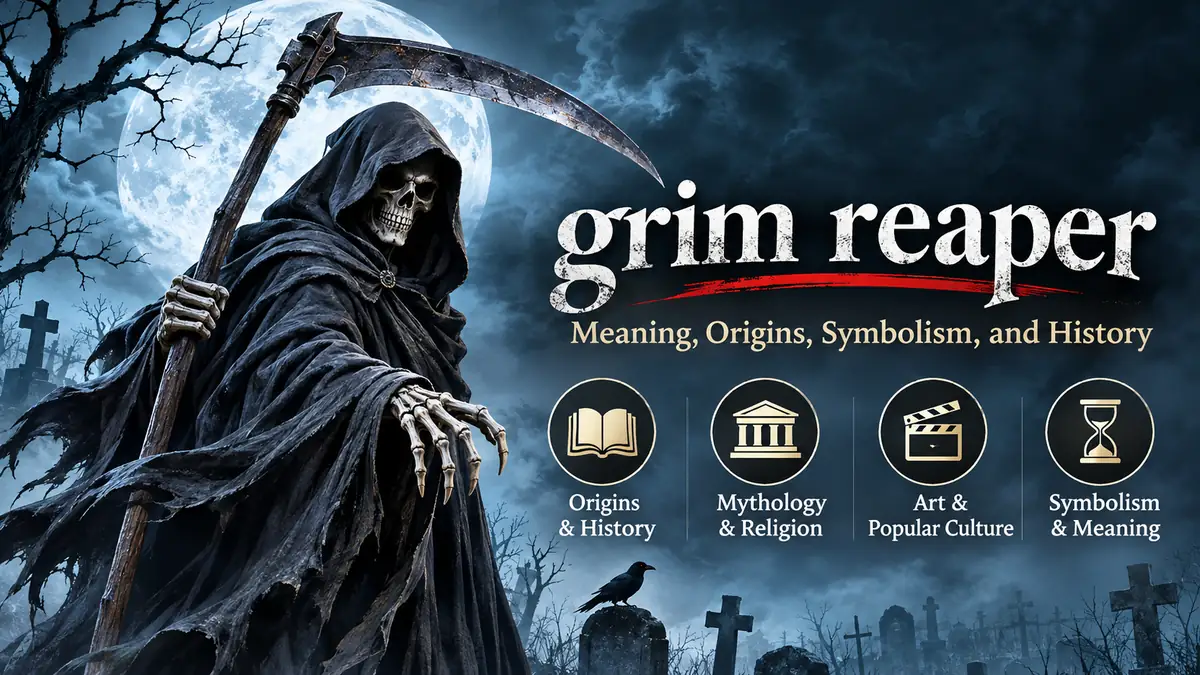
A mysterious figure dressed in a black cloak, carrying a scythe, and appearing when someone’s life is about to end—the grim reaper is one of the world’s most recognizable symbols of death. But where did this frightening character come from, and why has it remained so influential for centuries?
The grim reaper is a personification of death, traditionally depicted as a hooded skeleton carrying a scythe. The figure became especially prominent in European imagery during the late Middle Ages, when plague, warfare, and religious beliefs shaped how people understood mortality. Today, it symbolizes death’s inevitability rather than an actual supernatural being.
Although its appearance seems straightforward, the character has a complicated history involving medieval art, ancient mythology, religious traditions, and modern entertainment.
What Is the grim reaper?
The grim reaper is a symbolic representation of death in human form. Rather than portraying death as an abstract event, artists and storytellers imagine it as a figure that arrives when a person’s life ends.
Its traditional appearance includes several distinctive features:
- Skeleton: Represents the physical remains of the human body after death.
- Black hooded robe: Suggests mourning, mystery, and the unknown.
- Scythe: Symbolizes the harvesting of human lives, much as farmers harvest crops.
- Hidden or skeletal face: Emphasizes death’s frightening and impersonal nature.
- Silent presence: Reflects the idea that death arrives regardless of wealth, age, or social status.
The figure is frequently described as a collector of souls. However, its exact role changes between religious traditions, folklore, literature, and fictional stories.
Some portrayals depict it as a terrifying supernatural force. Others present it as a neutral guide responsible for escorting the deceased into the afterlife.
Is the grim reaper real?
There is no scientific evidence that the grim reaper exists as a physical or supernatural being.
The character is primarily a cultural and artistic representation of mortality. Its significance comes from the way societies have used recognizable imagery to explain and confront the uncertainty surrounding death.
Belief in spirits, death messengers, or supernatural guides exists in many cultures, but those beliefs should not be confused with evidence for the existence of a hooded skeleton carrying a scythe.
The Origins and History of the grim reaper
The familiar image of the grim reaper developed gradually. It was not invented by one person or introduced in a single story.
Its appearance emerged from several centuries of European religious imagery, medieval social conditions, and older traditions that personified death.
The Black Death and medieval Europe
14th century
One of the most important historical influences was the Black Death, the devastating plague pandemic that spread across Europe between 1347 and 1351.
The pandemic killed an enormous proportion of Europe’s population. Estimates vary, but its consequences profoundly affected medieval society, religion, art, and attitudes toward mortality.
Death became a prominent subject in paintings, manuscripts, church decorations, and public storytelling.
Artists increasingly represented death through skeletal figures and decaying bodies. These images reminded viewers that human life was temporary, regardless of social position.
The plague did not single-handedly create the grim reaper. However, the widespread experience of mortality helped popularize the visual traditions from which the modern figure developed.
The Dance of Death tradition
Late medieval Europe
The Danse Macabre, also known as the Dance of Death, became an influential artistic and literary tradition during the late Middle Ages.
These works typically showed skeletal figures leading people from different social classes toward death.
Kings, merchants, clergy, peasants, and children could all appear in the same procession.
The message was simple: no person could escape mortality.
One notable example was the medieval Dance of Death mural at the Cemetery of the Holy Innocents in Paris, created in the 1420s.
The tradition spread through paintings, woodcuts, manuscripts, and church art.
It helped establish the skeleton as a recognizable personification of death, although not every skeletal figure in these works resembled the modern hooded reaper.
How the hooded skeleton became familiar
During the late medieval and early modern periods, European artists increasingly combined skeletal imagery with objects associated with mortality.
These included hourglasses, coffins, grave-digging tools, and agricultural implements.
The long robe and hood eventually became familiar elements of the character’s appearance, reinforcing its mysterious identity.
The exact combination of black cloak, skeleton, and scythe developed through artistic convention rather than a single documented invention.
The English expression Grim Reaper became established much later than the medieval imagery that inspired it.
Why Does the grim reaper Carry a Scythe?
The scythe is arguably the most recognizable object associated with the grim reaper.
A scythe is a traditional agricultural tool with a long, curved blade used to cut grass or harvest crops.
Its symbolism comes from comparing human life to a growing field.
Just as a farmer cuts mature crops, death metaphorically harvests lives when their time has come.
The symbolism of harvesting souls
Agricultural imagery was familiar to medieval European audiences because farming was central to everyday life.
Harvesting also provided a powerful metaphor for the natural cycle of existence.
Seeds are planted, crops grow, and eventually they are cut down.
Similarly, human life begins, develops, and ultimately ends.
The reaper’s scythe therefore represents mortality, the passage of time, and the inevitability of death.
It does not necessarily imply violence or punishment. In many interpretations, the harvesting metaphor emphasizes that death is part of the natural order.
The connection to Father Time
The grim reaper is sometimes confused with Father Time, another symbolic figure traditionally associated with a scythe.
Father Time commonly appears as an elderly, bearded man carrying an hourglass or scythe.
His imagery has historical connections with classical representations of time, particularly Chronos, and with later artistic interpretations that also drew on the Greek Titan Cronus.
Although their symbols overlap, the two figures represent different concepts.
| Feature | grim reaper | Father Time |
|---|---|---|
| Main meaning | Death and mortality | Passage of time |
| Typical appearance | Hooded skeleton | Elderly bearded man |
| Common objects | Scythe | Hourglass and scythe |
| Central symbolism | End of life | Aging and passing years |
| Cultural role | Personification of death | Personification of time |
Their shared agricultural imagery reflects a deeper connection: the passage of time eventually leads every living being toward death.
What Does the grim reaper Symbolize?
The grim reaper has several meanings beyond fear and dying.
Its symbolism changes depending on the historical period, religious tradition, artistic context, or individual interpretation.
Mortality and the inevitability of death
The character’s central meaning is that death is universal.
It does not distinguish between rich and poor, powerful and powerless, or famous and unknown.
This idea connects closely with memento mori, a Latin expression meaning “remember that you must die.”
Memento mori imagery encourages people to recognize life’s temporary nature.
Rather than promoting despair, it can inspire reflection on how limited time should be spent.
Equality in the face of death
Medieval Dance of Death artwork frequently depicted individuals from every level of society.
The purpose was to remind audiences that worldly power offered no permanent protection against mortality.
The reaper consequently became a symbol of death’s impartiality.
This theme remains common in modern stories, where even powerful fictional characters cannot necessarily escape the figure.
Fear of the unknown
The black hood and concealed face contribute to the character’s unsettling appearance.
People often fear what they cannot understand or predict.
Death represents one of humanity’s greatest uncertainties, especially concerning what happens after life ends.
The reaper gives this uncertainty a visible form.
Transition rather than punishment
Not every portrayal presents the reaper as evil.
Some interpretations treat the figure as a psychopomp—a being that guides souls from the world of the living to the realm of the dead.
In these versions, death is a transition rather than an act of cruelty.
The character may appear solemn, compassionate, or simply committed to fulfilling a necessary duty.
The meaning of the grim reaper’s clothing and objects
| Symbol | Common interpretation |
|---|---|
| Black cloak | Mourning, darkness, mystery |
| Skeleton | Mortality and bodily decay |
| Scythe | Harvesting of lives |
| Hourglass | Limited time remaining |
| Hood | Anonymity and the unknown |
| Empty eye sockets | Absence of ordinary human life |
| Dark surroundings | Fear, grief, and uncertainty |
These meanings are artistic conventions, not universal rules. A particular artwork may use the same object to communicate a different idea.
The grim reaper in Mythology and Religion
Although the familiar hooded skeleton developed primarily within European culture, many civilizations have imagined death as a deity, spirit, messenger, or supernatural force.
These figures share certain functions with the grim reaper, but they are not identical.
Thanatos in Greek mythology
In ancient Greek mythology, Thanatos personified death, particularly peaceful or nonviolent death.
According to traditional accounts, Thanatos was the son of Nyx, the goddess of night, and the twin brother of Hypnos, the personification of sleep.
Ancient Greek art sometimes depicted Thanatos as a winged young man rather than a skeleton.
He could be shown carrying the dead, including in representations of the Trojan warrior Sarpedon.
Unlike the grim reaper, Thanatos was not traditionally identified by a black hood and agricultural scythe.
The resemblance lies mainly in their shared function as personifications of death.
Hades and the Greek underworld
Hades is frequently mistaken for the Greek equivalent of the grim reaper.
However, Hades ruled the underworld and was not simply the embodiment of death itself.
Greek mythology distinguished between the ruler of the dead, the personification of death, and the beings responsible for transporting souls.
For example, Charon was the ferryman who transported deceased souls across a river associated with the underworld, traditionally the Acheron or Styx depending on the source.
These different roles help explain why modern fictional portrayals of death sometimes combine several mythological functions into one character.
Yama in Hindu and Buddhist traditions
Yama is associated with death, judgment, and the afterlife in several South and East Asian religious traditions.
In Hindu mythology, Yama is often described as the lord of the dead and a judge of departed souls.
He may be depicted riding a buffalo and carrying a noose or staff.
Buddhist traditions also feature Yama, although his interpretation varies across schools and cultures.
Yama and the grim reaper share associations with mortality, but their theological and mythological roles differ significantly.
The Angel of Death in Abrahamic religions
Judaism, Christianity, and Islam contain traditions involving angels or divine agents associated with death.
In Islamic tradition, the Angel of Death is commonly called Malak al-Mawt. The name Azrael is widely used in later religious tradition, although it does not appear in the Quran.
The Quran describes an Angel of Death entrusted with taking souls.
In Jewish traditions, Malakh ha-Mavet refers to the Angel of Death, whose depiction and role vary across texts.
Christian scripture contains several angelic and apocalyptic images connected with mortality and divine judgment.
However, the grim reaper is not a standardized biblical figure. Its familiar skeleton-and-scythe appearance developed through artistic traditions rather than a direct description in scripture.
Shinigami in Japanese culture
The Japanese term shinigami generally refers to death spirits or supernatural beings associated with death.
Their portrayal varies considerably across folklore, literature, anime, and manga.
Unlike the Western grim reaper, shinigami do not have one universally established appearance.
Modern entertainment frequently depicts them as supernatural beings with individual personalities, powers, and responsibilities.
How different cultures personify death
| Tradition | Figure | Main association |
|---|---|---|
| Western European folklore | grim reaper | Personification of death |
| Ancient Greek mythology | Thanatos | Death |
| Ancient Greek mythology | Hades | Ruler of the underworld |
| Hindu traditions | Yama | Death and judgment |
| Japanese traditions | Shinigami | Death-associated spirits |
| Jewish traditions | Angel of Death | Death under divine authority |
| Islamic tradition | Malak al-Mawt | Taking souls by divine command |
| Norse mythology | Hel | Ruler of a realm of the dead |
These comparisons illustrate a recurring human tendency to give death a recognizable identity while also showing how differently cultures understand the afterlife.
Is the grim reaper Evil or a Guide to the Afterlife?
The grim reaper is not inherently evil.
Its moral identity depends on the story, artwork, or tradition in which it appears.
In some portrayals, the figure actively causes death. In others, it merely arrives after death has occurred.
This distinction changes the character’s meaning.
Death as an unavoidable force
In horror stories, the reaper may appear threatening because it represents an event no living person can permanently escape.
Its frightening nature does not necessarily mean it enjoys suffering.
Sometimes, the character simply follows rules beyond human control.
A fictional reaper might be unable to decide who lives or dies, acting instead as the messenger of a predetermined fate.
Death as a psychopomp
A psychopomp is a mythological or spiritual being responsible for guiding souls between the worlds of the living and the dead.
Examples of psychopomp-like figures include Hermes in Greek mythology and certain interpretations of Charon.
When the grim reaper performs this role, its responsibility is transportation rather than punishment.
This portrayal can transform a frightening skeleton into a compassionate guide.
Does the grim reaper kill people?
There is no single answer within fiction.
Some stories describe the reaper as directly ending human lives with its scythe. Others suggest that it only collects souls after death.
Traditional symbolism does not establish a universal set of supernatural powers.
The difference matters because the grim reaper is a flexible literary character, not a figure governed by one authoritative mythology.
Can anyone escape the grim reaper?
In traditional mortality symbolism, nobody permanently escapes death.
However, folklore and fictional narratives frequently explore characters who attempt to bargain with, trick, or defeat Death.
These stories often use the encounter to examine courage, greed, love, fate, or the consequences of trying to avoid the natural order.
A temporary escape may be possible within a particular story, but the larger theme usually remains the inevitability of mortality.
The grim reaper in Art, Literature, and Popular Culture
The character has changed dramatically over the centuries.
Medieval artists used skeletal imagery to remind viewers of mortality, while modern writers and filmmakers often turn Death into a complex personality.
Famous historical artwork
The Dance of Death — Hans Holbein the Younger
Published in 1538, this influential series of woodcuts depicts death confronting people from different social classes. Its detailed scenes emphasize mortality’s universal reach.
The Triumph of Death — Pieter Bruegel the Elder
Painted around 1562, this dramatic artwork depicts armies of skeletons overwhelming the living. It illustrates death’s overwhelming and indiscriminate power.
Knight, Death and Devil by Albrecht Dürer
Knight, Death and the Devil — Albrecht Dürer
This 1513 engraving presents Death as a disturbing, corpse-like rider carrying an hourglass. It explores mortality, temptation, and moral perseverance.
These artworks demonstrate that the familiar modern reaper emerged from a much broader tradition of death imagery.
The grim reaper in movies
The Seventh Seal (1957)
One of cinema’s most famous representations of Death appears in Ingmar Bergman’s film, where a medieval knight plays chess against a mysterious figure representing mortality.
The film explores faith, uncertainty, and the human desire to find meaning before death.
Other films have portrayed Death as an intelligent supernatural character rather than a silent skeleton.
In Meet Joe Black (1998), Death takes human form and experiences aspects of ordinary life.
The Final Destination franchise presents death as an invisible force whose apparent design the characters attempt to escape.
These portrayals preserve the reaper’s underlying theme even when the traditional costume disappears.
The grim reaper in television and animation
Animated series often reinterpret the figure through comedy, fantasy, or supernatural storytelling.
In The Grim Adventures of Billy & Mandy, Grim is a supernatural character forced into an unusual friendship with two children.
His appearance retains the skeleton, black robe, and scythe, but his personality is frequently humorous rather than terrifying.
Other television stories depict Death as a bureaucratic official, reluctant worker, or emotionally complicated individual.
These interpretations make an abstract concept easier to explore through character-driven storytelling.
The grim reaper in video games
Video games frequently use reaper imagery to represent dangerous enemies, supernatural powers, or the boundary between life and death.
Examples include:
- Castlevania — Features Death as a recurring supernatural antagonist.
- Darksiders II — Features Death as one of the Four Horsemen of the Apocalypse.
- The Sims — Includes a Grim Reaper character who appears when Sims die.
- Persona 3 — Uses the Reaper as a powerful enemy associated with danger and mortality.
These games demonstrate the flexibility of the character’s design and role.
The grim reaper in books and comics
Literature has also explored the possibility that Death might possess emotions, responsibilities, and a personal identity.
In Mort, Terry Pratchett presents Death as a character who performs a necessary cosmic duty while interacting with human concerns.
Neil Gaiman’s The Sandman includes Death of the Endless, a compassionate character who looks very different from the conventional hooded skeleton.
These works challenge the assumption that a personification of death must always be cruel or frightening.
The Meaning of the grim reaper in Dreams, Tattoos, and Modern Symbols
Beyond traditional mythology and entertainment, the grim reaper appears in personal artwork, dreams, clothing, and contemporary symbolism.
Its meaning is not fixed.
Context and individual interpretation are essential.
What does dreaming about the grim reaper mean?
Dreams involving the grim reaper can feel unsettling, but they do not predict death.
There is no reliable scientific basis for interpreting such dreams as supernatural warnings or forecasts of future events.
Possible psychological interpretations include anxiety about loss, awareness of aging, major life transitions, or exposure to frightening imagery.
For example, someone experiencing a significant personal change might dream about death as a metaphor for an ending.
However, dream interpretation is subjective, and no single symbol has a scientifically established universal meaning.
What does a grim reaper tattoo symbolize?
A grim reaper tattoo can express different personal ideas.
Common interpretations include mortality, fearlessness, remembrance, resilience, and acceptance of life’s uncertainty.
Some people choose the image as a form of memento mori, reminding themselves to use their limited time meaningfully.
Others appreciate its association with Gothic art, horror, or traditional tattoo design.
A tattoo featuring an hourglass may emphasize time passing, while one incorporating roses may suggest the contrast between life and death.
Its meaning ultimately depends on the person wearing it.
Why is the grim reaper associated with Halloween?
Halloween imagery frequently includes skeletons, ghosts, graveyards, and supernatural beings.
The grim reaper fits naturally into this visual tradition because it combines several recognizable symbols of mortality.
Modern Halloween costumes often simplify the figure to a black hooded robe, skeletal mask, and plastic scythe.
Although Halloween has historical connections with traditions surrounding the dead, the grim reaper’s medieval European artistic development should not be mistaken for the origin of Halloween itself.
What does the grim reaper emoji mean?
The Unicode standard does not provide a dedicated grim reaper emoji.
People commonly combine existing symbols, such as:
- 💀 Skull — Death, danger, or dark humor.
- ☠️ Skull and crossbones — Mortality, poison, or danger.
- ⚰️ Coffin — Death or funerals.
- ⏳ Hourglass — Time running out.
In online conversations, these symbols may be used humorously rather than literally.
Their meaning depends heavily on context.
Common Misconceptions About the grim reaper
Several popular assumptions about the character are historically inaccurate or overly simplified.
The grim reaper was invented during the Black Death
The Black Death strongly influenced European death imagery, but personifications of death existed long before the plague.
Ancient mythologies already included death deities and supernatural guides.
Medieval European skeletal imagery also has roots predating the pandemic. The familiar modern figure developed from several traditions over time. PBS+1
The grim reaper is always male
The figure is frequently portrayed as male in English-speaking culture, but personifications of death have varied across regions and historical periods.
Some European artistic traditions depict death as female.
For example, French, Italian, and Spanish works have included feminine representations of death, demonstrating that its gender is culturally variable rather than universal. Cambridge Assets+1
The grim reaper is the devil
The grim reaper and the devil represent different concepts.
The devil is generally associated with temptation, evil, or opposition to divine authority in Christian traditions.
The reaper personifies mortality.
Although fictional stories sometimes merge these ideas, there is no universal religious or historical basis for treating them as the same being.
The grim reaper always carries an hourglass
The hourglass is a common accessory, but it is not essential to every depiction.
It symbolizes the passage of time and the limited duration of human life.
Some artworks feature a scythe alone, while others include clocks, coffins, or additional symbols.
Every culture has the same grim reaper
Different cultures have developed distinct representations of death.
A Greek personification, a Japanese shinigami, and the European hooded skeleton may share thematic similarities without being interchangeable.
Understanding their differences helps preserve the historical and religious contexts in which they developed.
Why the grim reaper Remains a Powerful Symbol
The grim reaper has survived centuries of cultural change because it transforms an abstract, universal experience into a recognizable character.
Death itself cannot be seen as a person. A hooded skeleton, however, gives artists and storytellers something visible through which to explore fear, loss, time, and human vulnerability.
The character’s meaning has also evolved.
In medieval art, skeletal figures frequently served as moral reminders about mortality and the temporary nature of earthly power.
In Gothic literature and horror, the reaper became a frightening presence.
In modern fantasy, comedy, and animation, Death can be compassionate, humorous, frustrated, or surprisingly human.
These changes reflect how people continue to reinterpret mortality through the values and concerns of their own times.
The symbol also appears in discussions of mortality awareness and the psychology of death.
Human beings understand that life is finite, yet everyday experience often encourages them to ignore that knowledge.
A visible representation of death interrupts that avoidance.
It can provoke fear, but it can also encourage reflection on priorities, relationships, and the value of time.
This explains why the reaper remains meaningful even to people who do not believe in supernatural beings.
Its influence comes from the questions it represents rather than from any claim that the figure physically exists.
Final Thoughts on the grim reaper
The grim reaper is far more than a frightening skeleton holding a scythe. It is a centuries-old symbol shaped by medieval European art, ancient mythological traditions, religious imagery, and humanity’s ongoing effort to understand death.
Its hood represents mystery, its skeleton recalls mortality, and its scythe connects the end of life with the natural cycle of harvesting.
Although often portrayed as terrifying, the figure can also represent equality, transition, acceptance, and the importance of living meaningfully.
Understanding the grim reaper’s history reveals something deeper about human culture: across generations, people have created stories and symbols to make the uncertainty of death easier to imagine, discuss, and understand.
