

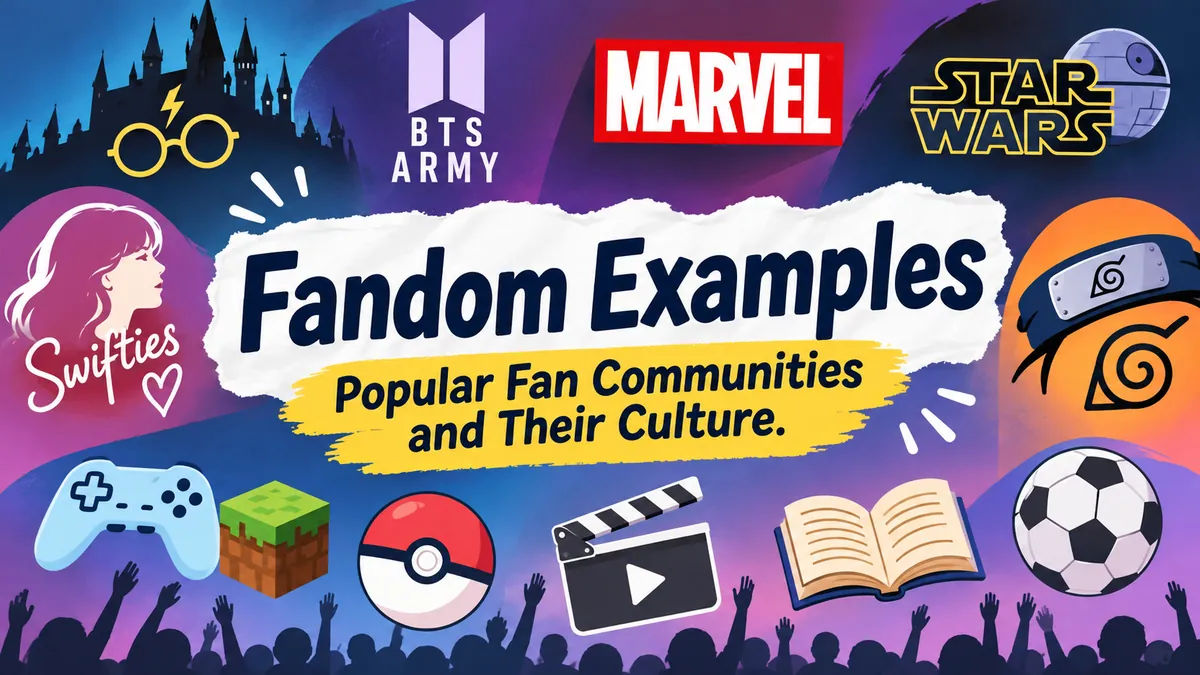
Watching a television series is entertainment. Spending hours discussing its characters, developing theories, and connecting with other viewers is part of something bigger: fandom culture.
From Taylor Swift supporters to Minecraft players, the most recognizable fandom examples demonstrate how shared interests can develop into entire communities with distinct identities, traditions, and creative activities.
A fandom is a community of people connected by enthusiasm for a particular artist, fictional universe, sports team, game, or hobby. Popular examples include Swifties, BTS ARMY, Potterheads, Trekkies, Marvel fans, and anime enthusiasts. These communities express their interests through discussions, fan art, conventions, and collaborative projects.
What Is a Fandom?
A fandom is a social and cultural community formed around a shared interest. Its members often develop a sense of belonging through collective experiences and participation.
Unlike a casual audience, a fandom frequently creates its own traditions, vocabulary, artwork, and social spaces.
The American Library Association identifies fandom as a growing cultural phenomenon supported by digital platforms, online communities, fan conventions, and creative expression. Center for the Future of Libraries
Common characteristics of fandoms include:
- Shared interests and collective identities.
- Community-specific language and inside jokes.
- Online and offline social interactions.
- Creative contributions such as fan fiction and artwork.
- Emotional connections with characters, artists, or franchises.
- Participation in events and community projects.
Fandoms existed long before social media. Sherlock Holmes enthusiasts, Beatles supporters, science fiction readers, and sports fan clubs established communities before digital communication became widespread.
Fan vs. Fandom: What Is the Difference?
| Characteristic | Fan | Fandom |
|---|---|---|
| Meaning | Individual enthusiast | Community of enthusiasts |
| Participation | Personal interest | Shared participation |
| Social interaction | Optional | Common |
| Creative activities | Individual | Often collaborative |
| Identity | Personal preference | Collective belonging |
| Example | A Taylor Swift listener | Swifties |
Someone can enjoy a movie without participating in its fandom. Joining discussions, sharing interpretations, or connecting with other viewers represents a more community-oriented experience.
25 Popular fandom examples Across Different Categories
Fandoms exist throughout entertainment, literature, gaming, sports, and creative hobbies. The following examples illustrate their diversity rather than rank them by popularity.
Music Fandom Examples
Music fandoms frequently develop around artists whose songs, personalities, and performances create strong emotional connections.
| Fandom | Associated artist | Common activities |
|---|---|---|
| Swifties | Taylor Swift | Lyric analysis and friendship bracelets |
| ARMY | BTS | Streaming and charity projects |
| BLINK | BLACKPINK | Fan edits and concert participation |
| Beliebers | Justin Bieber | Artist support and fan updates |
| Directioners | One Direction | Fan fiction and nostalgia |
| BeyHive | Beyoncé | Performance discussions and album celebrations |
| Little Monsters | Lady Gaga | Creative expression and community support |
1. Swifties
Swifties are fans of Taylor Swift. Their community is particularly recognizable for interpreting song lyrics, discovering hidden clues, exchanging friendship bracelets, and discussing different musical eras.
Their activities demonstrate how music fandom can extend beyond listening to songs and become a shared cultural experience.
2. BTS ARMY
ARMY is the global fandom of South Korean music group BTS. Its name stands for Adorable Representative M.C. for Youth.
Fans participate in music discussions, translations, charitable initiatives, and coordinated streaming activities. International fan networks also help make Korean-language content more accessible.
3. BLINK
BLINK is the fandom associated with BLACKPINK. Its community participates in dance challenges, music video discussions, concerts, and online celebrations.
The fandom illustrates how K-pop communities connect audiences across different countries and languages.
4. Beliebers
Beliebers are supporters of Justin Bieber. The name combines Bieber with the word believer.
The community expanded alongside Bieber’s early online success, illustrating how digital media can transform an emerging performer into an internationally recognized musical figure.
5. Directioners
Directioners support the British-Irish boy band One Direction.
Although the group entered an extended hiatus, fans have continued sharing music, preserving memorable performances, and supporting members’ individual careers.
6. BeyHive
Beyoncé’s fandom is known as the BeyHive. Members celebrate her albums, choreography, performances, and artistic development.
Fashion discussions and performance analysis are also recognizable aspects of the community.
7. Little Monsters
Little Monsters are fans of Lady Gaga. Their community frequently emphasizes individuality, artistic experimentation, self-expression, and acceptance.
Fan costumes, music interpretations, and concert experiences help maintain its collective identity.
Movie and Television Fandoms
Film and television fandoms often form around fictional worlds that allow audiences to explore characters and stories beyond the original material.
8. Marvel Fandom
The Marvel fandom includes readers of Marvel Comics and viewers of the Marvel Cinematic Universe (MCU).
Its members commonly discuss superhero abilities, interconnected timelines, character development, and possible future storylines.
Popular fan activities include analyzing post-credit scenes, collecting memorabilia, and creating superhero costumes.
9. Star Wars Fandom
The Star Wars community spans multiple generations and includes fans of movies, television series, novels, comics, and video games.
Discussions frequently explore Jedi philosophy, Sith mythology, fictional history, and differences between official canon and Legends stories.
Its longevity makes it a notable example of a multigenerational entertainment community.
10. Trekkies
Trekkies are enthusiasts of Star Trek, which originally premiered in 1966.
Early Star Trek supporters organized fan publications, conventions, and campaigns supporting the television series. These activities helped shape modern media fandom long before internet communities became available. Center for the Future of Libraries
The community remains associated with science fiction, space exploration, technology, and philosophical discussions.
11. Whovians
Whovians are fans of Doctor Who, the British science fiction television series that began in 1963.
The show’s regeneration concept allows different actors to portray its central character, creating opportunities for ongoing discussion about favorite Doctors, companions, timelines, and episodes.
12. Game of Thrones Fandom
This community developed around George R. R. Martin’s A Song of Ice and Fire novels and their television adaptation.
Fans analyze fictional politics, character relationships, symbolism, and differences between the novels and television series.
Its popularity also demonstrates how serialized storytelling encourages speculation between releases.
Book and Literary Fandom Examples
Literary fandoms develop when readers begin sharing interpretations, expanding fictional worlds, and discussing characters beyond the pages of a book.
13. Potterheads
Potterheads are fans of the Harry Potter series and its wider Wizarding World.
Members frequently explore Hogwarts houses, magical creatures, fictional character relationships, spells, and alternative storylines.
The community also produces fan fiction, themed artwork, quizzes, and costumes.
14. Twihards
Twihards are enthusiasts of Stephenie Meyer’s Twilight series.
The rivalry between Team Edward and Team Jacob became one of the community’s recognizable traditions, demonstrating how fictional relationships can influence collective identity.
15. Tolkien Fandom
Tolkien enthusiasts celebrate J. R. R. Tolkien’s literary works, particularly The Hobbit and The Lord of the Rings.
Unlike communities focused primarily on individual characters, Tolkien fans often explore constructed languages, fictional geography, mythology, and the extensive history of Middle-earth.
This makes Tolkien fandom particularly relevant to readers interested in world-building.
16. Percy Jackson Fandom
Fans of Rick Riordan’s Percy Jackson books combine enthusiasm for fantasy storytelling with an interest in Greek mythology.
Common activities include imaginary Camp Half-Blood cabin assignments, character illustrations, mythology discussions, and comparisons between books and screen adaptations.
Anime and Manga Fandom Examples
Anime and manga communities connect fans of Japanese animation and comics through illustrations, character discussions, cosplay, and storytelling analysis.
17. Naruto Fandom
Naruto fans explore ninja abilities, fictional clans, character rivalries, friendship, and personal growth.
Its recognizable characters and visual symbols make Naruto a popular source of cosplay inspiration and fan artwork.
18. One Piece Fandom
The One Piece community follows the adventures of Monkey D. Luffy and the Straw Hat Pirates.
Its extensive fictional universe encourages theories about hidden treasures, historical mysteries, character abilities, and unresolved storylines.
Long-term speculation is a particularly important part of this fandom.
19. Dragon Ball Fandom
Dragon Ball fans celebrate martial arts-inspired storytelling, transformations, powerful fictional characters, and memorable battles.
The community frequently engages in power-scaling discussions, comparing characters’ fictional strengths and abilities.
20. Attack on Titan Fandom
Attack on Titan enthusiasts examine the series’ mysteries, political themes, character motivations, and moral conflicts.
Its complicated narrative encourages detailed interpretations and discussions about how earlier events connect with later revelations.
Anime fandoms demonstrate how audiences can engage with entertainment through both creative participation and serious narrative analysis.
Gaming Fandom Examples
Gaming communities are distinctive because fans can directly participate in the fictional or competitive environments they enjoy.
Fandom’s twentieth-anniversary research identifies gaming as its largest wiki category, with long-established franchises and newer user-generated games attracting substantial community activity. about.fandom.com
21. Minecraft Fandom
Minecraft enthusiasts share building designs, survival strategies, modifications, adventure maps, and technical creations.
The game’s sandbox environment allows players to create original experiences rather than follow a single predetermined storyline.
Community participation is an essential part of its appeal.
22. Pokémon Fandom
The Pokémon community includes video game players, anime viewers, trading card collectors, and competitive participants.
Members discuss Pokémon types, battle strategies, collection goals, regional creatures, and favorite characters.
Its range of activities makes Pokémon an effective example of a fandom operating across multiple entertainment formats.
23. Fortnite Fandom
Fortnite fans participate in competitive matches, virtual events, creative game modes, and discussions about character designs and seasonal changes.
The game’s collaborations with musicians, superheroes, and other entertainment franchises also bring different fandom communities together.
Sports and Creative Fandom Communities
Fandom is not limited to fictional stories or celebrity culture. It also develops around real-world competitions, creative practices, and shared hobbies.
24. Sports Fandom
Sports fans often build identities around teams, athletes, national representation, and regional traditions.
Recognizable communities include Manchester United supporters, Real Madrid fans, Formula 1 enthusiasts, and cricket supporters.
Their traditions may involve team colors, chants, match-day gatherings, memorabilia, and discussions about competitive performance.
Sports fandom frequently connects personal interests with family traditions and local identities.
25. Furry Fandom
The furry fandom revolves around fictional animal characters with human-like characteristics.
Members may create personalized characters called fursonas, produce illustrations, write stories, attend conventions, or design costumes known as fursuits.
Unlike many entertainment fandoms, this community does not depend on a single movie, artist, or fictional franchise. Its primary connection is a shared creative interest. Wikipedia
Quick takeaway: Fandoms can develop around almost anything that encourages sustained interest, social interaction, and a sense of community.
How Different Types of Fandoms Compare
Although fandoms share common social characteristics, their activities often reflect the interests around which they develop.
| Fandom type | Primary interest | Typical participation |
|---|---|---|
| Music | Artists and bands | Concerts, lyric analysis, streaming |
| Film | Movies and franchises | Theories, collections, cosplay |
| Television | Series and characters | Episode discussions and fan edits |
| Literature | Books and fictional worlds | Fan fiction and literary analysis |
| Anime | Japanese animation and manga | Artwork, cosplay, conventions |
| Gaming | Video games | Multiplayer sessions, mods, tutorials |
| Sports | Teams and athletes | Match attendance, chants, analysis |
| Creative | Art, characters, hobbies | Original designs and collaboration |
These categories frequently overlap. A Pokémon enthusiast, for example, may simultaneously participate in gaming, anime, and trading card communities.
Someone belonging to several fan communities is sometimes described as multifandom.
What Do People Do in Fandoms?
Fandom participation ranges from occasionally reading discussions to organizing large community events.
Media scholar Henry Jenkins helped popularize the concept of participatory culture, which describes environments where audiences contribute to cultural production instead of simply consuming existing material.
Fan Fiction
Fan fiction involves writing original stories inspired by established characters, fictional settings, or existing narratives.
Writers may imagine alternative endings, unexplored relationships, or entirely different fictional circumstances.
Archive of Our Own (AO3), FanFiction.net, and Wattpad are recognizable platforms associated with fan-created writing.
Fan Art and Fan Edits
Fan artists reinterpret existing characters and fictional worlds through illustrations, digital paintings, animation, and video editing.
These creations allow community members to express individual interpretations while contributing to collective cultural experiences.
Cosplay
Cosplay combines costume design and character portrayal.
Participants dress as characters from anime, movies, television series, comics, and video games. Some create costumes from scratch, while others adapt existing clothing and accessories.
Events such as San Diego Comic-Con provide opportunities for enthusiasts to display their creations and connect with other fans.
Fan Theories
Fan theories attempt to explain unanswered questions, predict future developments, or reinterpret existing stories.
They are especially common in communities built around mysteries, interconnected narratives, and serialized entertainment.
Collaborative Wikis
Fans frequently maintain community encyclopedias that document fictional characters, locations, timelines, objects, and storylines.
Fandom.com is one recognizable platform hosting such collaborative resources.
These wikis help newcomers understand complex fictional universes and allow experienced enthusiasts to contribute detailed knowledge.
Fan Activism
Some communities organize charitable campaigns, awareness initiatives, and fundraising projects.
This demonstrates how collective enthusiasm can extend beyond entertainment and support wider social objectives.
Common Fandom Terms and Their Meanings
Online fan communities use specialized vocabulary that can initially confuse newcomers.
| Term | Meaning |
|---|---|
| Canon | Information officially established within a fictional work |
| Fanon | Ideas widely accepted by fans without official confirmation |
| Headcanon | An individual’s interpretation of a fictional detail |
| Shipping | Supporting a romantic relationship between characters |
| OTP | One true pairing, or a preferred fictional couple |
| AU | Alternate universe |
| OC | Original character created by a fan |
| Stan | A highly enthusiastic supporter |
| Bias | A favorite member of a music group, especially in K-pop |
| Lore | Background history and mythology of a fictional universe |
| Fanfic | Unofficial fan-created fiction |
| Multifandom | Participation in multiple fan communities |
| Fanzine | A fan-produced magazine or publication |
| Fandom war | Conflict between groups of fans |
| Gatekeeping | Unfairly restricting who qualifies as a genuine fan |
These expressions help members communicate efficiently and develop shared cultural identities.
However, their meanings can vary slightly between communities.
How Fandom Culture Has Evolved
Organized fandom existed well before smartphones, social media, and streaming services.
| Period | Major developments |
|---|---|
| Late 19th century | Literary communities and enthusiast clubs |
| 1930s–1950s | Science fiction clubs and fan publications |
| 1960s–1970s | Music fandoms and organized television fan communities |
| 1980s–1990s | Expanded conventions and early internet discussions |
| 2000s | Fan forums, blogs, wikis, and fiction archives |
| 2010s | Global social media communities |
| 2020s onward | Short-form videos, livestreams, Discord communities, and collaborative digital experiences |
The internet reduced geographic barriers, allowing people with highly specific interests to communicate regardless of where they lived.
Platforms such as Reddit, Tumblr, TikTok, YouTube, Discord, Instagram, and X now support different forms of fandom participation.
Traditional activities have not disappeared, however. Printed fanzines, conventions, physical collections, and fan clubs continue alongside digital communities.
What Is the Biggest Fandom in the World?
BTS ARMY, Swifties, Marvel enthusiasts, Star Wars supporters, and Potterheads are frequently mentioned among the world’s most recognizable entertainment fandoms.
However, there is no universally accepted measurement that establishes one community as the largest.
Different indicators measure different forms of participation:
- Social media followers measure potential online reach.
- Streaming figures represent content consumption.
- Convention attendance measures participation in physical events.
- Fan fiction archives reflect creative activity.
- Merchandise sales reveal purchasing behavior.
- Online community membership indicates organized participation.
None of these measurements independently establishes the complete population of a fandom. Many individuals participate in multiple communities, and others never register on public platforms. Kpop Ora
Claims that a particular fandom has an exact global membership should therefore be treated cautiously unless supported by a transparent measurement method.
Benefits and Challenges of Fandom Culture
Participating in a fandom can provide meaningful social and creative opportunities. However, the quality of those experiences depends partly on community behavior.
| Benefits | Potential challenges |
|---|---|
| Social belonging | Pressure to conform |
| Creative development | Excessive comparison |
| International friendships | Online harassment |
| Shared learning | Misinformation |
| Emotional enjoyment | Unhealthy attachment |
| Community collaboration | Rivalry and exclusion |
| Cultural awareness | Excessive spending |
Why Do People Join Fandoms?
Many people join fandoms because they want to share an interest with others who understand their enthusiasm.
Communities can offer friendship, entertainment, creative inspiration, and opportunities to develop skills such as writing, video editing, illustration, translation, and costume design.
For individuals with uncommon interests, online fandoms can make finding like-minded people considerably easier.
What Makes a Fandom Toxic?
Toxic fandom behavior occurs when enthusiasm develops into harassment, intimidation, hostility, or attempts to control other people’s participation.
Examples include attacking someone for criticizing an artist, targeting individuals who prefer different characters, spreading rumors, and demanding that members prove their loyalty.
A large or enthusiastic fandom is not automatically toxic. Individual behavior and community moderation matter more than generalizations about the entire group.
Fandom and Parasocial Relationships
A parasocial relationship is a one-sided emotional connection with a public figure, fictional character, or media personality.
Such connections can be enjoyable and meaningful, but they should not be confused with reciprocal personal relationships.
Healthy participation involves respecting privacy, recognizing personal boundaries, and maintaining a balanced relationship with entertainment.
How to Participate in a Fandom
There is no official membership requirement for most fan communities. Newcomers can participate at a level that suits their interests and comfort.
A healthy approach involves:
- Choosing a community based on genuine personal interest.
- Exploring discussions and learning community terminology.
- Reading community guidelines before participating.
- Respecting differing opinions and interpretations.
- Giving appropriate credit to fan artists and writers.
- Avoiding unnecessary arguments and personal attacks.
- Maintaining reasonable spending and screen-time habits.
You do not need to purchase merchandise, attend conventions, or know every detail about a fictional universe to qualify as a fan.
Enjoyment matters more than demonstrating loyalty.
Final Thoughts
The variety of fandom examples across music, literature, gaming, television, anime, sports, and creative hobbies reveals how shared interests can develop into lasting cultural communities.
Swifties interpret lyrics, Potterheads explore fictional worlds, Minecraft players build collaborative experiences, and sports supporters preserve collective traditions. Each community expresses enthusiasm differently.
What connects them is the human desire to share meaningful experiences, develop relationships, and contribute creatively.
The healthiest fandoms welcome newcomers, encourage respectful disagreement, and allow individuals to enjoy their interests without pressure. Whether participation involves creating artwork, attending events, or simply discussing a favorite story, fandom offers a way to transform personal enjoyment into a shared experience.
