

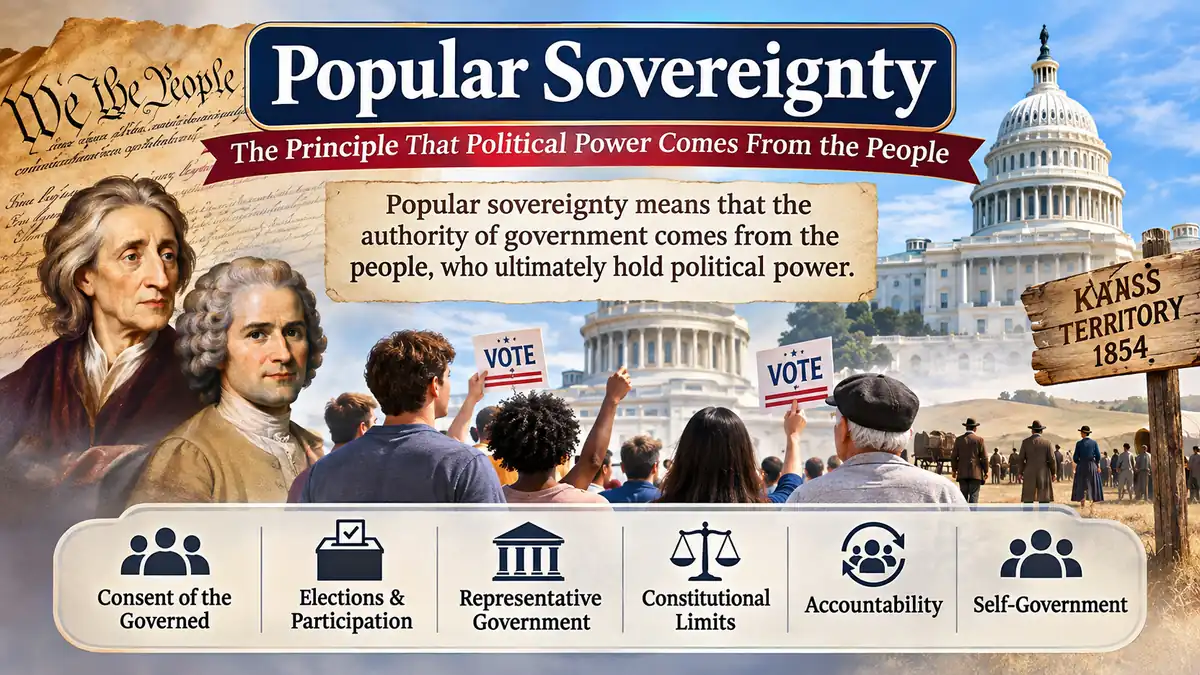
Who holds the ultimate power in a democracy: the government or the people who elect it? This question lies at the heart of popular sovereignty, a foundational principle of democratic government and American constitutional history.
Popular sovereignty is the principle that the authority of government comes from the people. Citizens are the ultimate source of political power and exercise that authority through elections, representation, constitutional processes, and public participation. In the United States, this principle helped shape the Constitution and became central to nineteenth-century debates over slavery.
The concept has two especially important meanings in American history. One concerns the people’s authority to establish and control their government. The other describes a controversial proposal to let residents of federal territories decide whether slavery would be permitted.
Understanding both meanings helps explain the development of American democracy, the causes of the Civil War, and the continuing relationship between citizens and government.
What Is popular sovereignty?
Popular sovereignty means that political authority ultimately belongs to the people rather than a monarch, hereditary ruler, or government claiming power independently of public consent.
The word popular refers to the people, while sovereignty means supreme political authority.
Together, the terms express a fundamental democratic idea: governments derive their legitimate power from those they govern.
Under this principle, public officials do not possess unlimited authority. Their powers are established and constrained through constitutional arrangements and political institutions that ultimately depend on the people’s consent.
The basic principles of popular sovereignty
Several interconnected ideas support this concept:
- Consent of the governed: Legitimate government rests on the authority of the people.
- Political participation: Citizens can influence government through voting, civic engagement, and other lawful activities.
- Representative government: Elected officials exercise public authority on behalf of the people.
- Constitutional government: Government institutions operate within established legal limits.
- Accountability: Public officials can be questioned, challenged, and replaced through political processes.
- Self-government: A political community has the authority to participate in determining its governing arrangements.
Popular sovereignty does not necessarily require citizens to vote directly on every law. In representative democracies, the people delegate decision-making authority to elected institutions.
A simple example of popular sovereignty
Imagine a country where citizens elect representatives to create laws, approve public spending, and oversee government institutions.
Those representatives exercise authority because the constitutional system gives them power derived from the people.
If citizens disagree with their decisions, they may organize politically, petition officials, and vote for different representatives in subsequent elections.
This illustrates popular sovereignty in practice: the government exercises political power, but the people remain its ultimate source of legitimacy.
The Historical Origins of popular sovereignty
Although popular sovereignty became especially influential during the eighteenth century, its intellectual foundations developed over centuries.
Political thinkers questioned whether rulers possessed authority by divine right, inheritance, military strength, or the consent of the governed.
Ancient Greek democracy
Ancient Athens developed one of the best-known early examples of direct citizen participation in government.
Eligible male citizens could participate in the Assembly, debate public matters, and vote on decisions.
However, Athenian democracy excluded women, enslaved people, and many foreign residents from political participation.
It therefore demonstrated an early form of citizen self-government without establishing the inclusive political rights associated with modern democratic ideals.
John Locke and the consent of the governed
John Locke – Free to download EPUB, Kobo, Kindle – Public Domain
The English philosopher John Locke significantly influenced modern ideas about legitimate government.
In his Two Treatises of Government, published in 1689, Locke argued that political authority rests on consent and that government exists to protect people’s rights.
His ideas about natural rights, limited government, and resistance to tyranny influenced American revolutionary political thought.
Locke maintained that people possess rights that governments should protect, rather than rights granted solely at the discretion of rulers.
Jean-Jacques Rousseau and the general will
Portrait of Jean-Jacques Rousseau 1712-1778
French-speaking philosopher Jean-Jacques Rousseau developed another influential interpretation of popular sovereignty.
In The Social Contract, published in 1762, Rousseau argued that sovereignty belongs collectively to the people and is expressed through the general will.
His account emphasized collective self-government and distinguished the sovereign people from the officials who administer government.
Locke and Rousseau approached political authority differently, but both challenged the idea that rulers possess legitimate power independently of the people.
The Enlightenment and democratic government
During the Enlightenment, political thinkers increasingly challenged absolute monarchy and hereditary authority.
Ideas about natural rights, social contracts, constitutional limitations, and representative government influenced political movements in Europe and North America.
These developments helped establish the intellectual foundations for the American Revolution and later democratic reforms.
popular sovereignty in the United States Constitution
The United States Constitution reflects popular sovereignty through its opening words:
We the People of the United States
This phrase identifies the people as the source of the Constitution’s authority.
Rather than presenting the federal government as a creation of a king, the Constitution establishes a system of government grounded in the authority of the people.
How the Constitution establishes popular sovereignty
The principle appears through several constitutional features.
1. The Preamble
The Preamble presents the Constitution as an act of the people establishing a national government.
2. Representative institutions
Members of the House of Representatives are elected by voters in their respective districts.
The Senate was originally selected by state legislatures, but the Seventeenth Amendment, ratified in 1913, established direct popular election of senators.
3. Constitutional amendments
Article V provides procedures for changing the Constitution through federal and state institutions.
The amendment process reflects constitutionally structured popular authority, although amendments are not ordinarily adopted through a nationwide popular vote.
4. Federalism
The Constitution divides authority between the federal government and state governments.
This arrangement creates multiple levels of political representation while limiting the powers of each government.
5. Republican government
Article IV guarantees every state a republican form of government.
This commitment supports representative institutions rather than hereditary rule.
The Declaration of Independence and popular sovereignty
The United States Declaration of Independence of 1776 expressed the idea that governments derive their just powers from the consent of the governed.
It also asserted that people may alter or abolish a government that becomes destructive of the purposes for which it was established.
These ideas provided a philosophical justification for independence from British rule.
However, the Declaration of Independence and the Constitution are different documents. The Declaration announced political principles and independence, while the Constitution established the legal structure of the federal government.
Did everyone originally have equal political power?
No.
Despite the Constitution’s foundation in popular authority, political participation was highly restricted during the early republic.
Voting qualifications varied among states, and many people were excluded from the electorate.
Enslaved people lacked political freedom, women were generally denied voting rights, and property requirements restricted participation in some jurisdictions.
Over time, constitutional amendments, legislation, and political movements expanded voting rights.
The Fifteenth Amendment prohibited voting discrimination based on race, color, or previous condition of servitude. The Nineteenth Amendment prohibited voting discrimination based on sex, and the Twenty-Sixth Amendment lowered the voting age to eighteen.
The Voting Rights Act of 1965 also became a major federal protection against racial discrimination in voting.
These developments illustrate the difference between proclaiming popular sovereignty as a principle and ensuring broad, meaningful political participation.
popular sovereignty and Slavery in American History
During the nineteenth century, popular sovereignty acquired a more specific and controversial meaning in the United States.
As the country expanded westward, Americans fiercely debated whether slavery should be allowed in newly organized federal territories.
Some political leaders proposed allowing territorial settlers to decide the issue rather than having Congress impose a uniform national rule.
This approach became known as popular sovereignty in the slavery debate.
Its supporters presented it as a form of local self-government. Its critics argued that fundamental human rights should not depend on the preferences of a local electorate.
Why did popular sovereignty become controversial?
The controversy grew from the expansion of the United States and the political conflict between free and slave states.
Every new state potentially affected the balance of power in Congress.
Southern slaveholding interests feared that restricting slavery in western territories would eventually weaken their political influence.
Many Northern opponents of slavery’s expansion believed the federal government should prevent the institution from spreading into new territories.
Popular sovereignty was proposed as a compromise between these opposing positions.
However, leaving the decision to territorial residents did not eliminate the underlying moral, constitutional, or political conflict.
The Missouri Compromise of 1820
The Missouri Compromise attempted to address sectional tensions over slavery.
Under this arrangement:
- Missouri entered the Union as a slave state.
- Maine entered as a free state.
- Slavery was prohibited in most of the remaining Louisiana Purchase territory north of latitude 36°30′.
The arrangement temporarily preserved the political balance between free and slave states.
However, it did not resolve the fundamental disagreement over slavery or determine how future territorial expansion would be handled.
The Compromise of 1850
The Compromise of 1850 introduced popular sovereignty into the political arrangements governing territories acquired after the Mexican-American War.
The compromise included measures concerning California, Utah, New Mexico, Texas, the District of Columbia, and fugitive slaves.
California entered as a free state, while Utah and New Mexico were organized without a congressional prohibition on slavery. Their future status was left to constitutional and political processes.
The compromise also strengthened federal enforcement of the return of people escaping slavery through the Fugitive Slave Act.
Although intended to reduce sectional tensions, the settlement left major disagreements unresolved. National Archives+1
The Kansas-Nebraska Act and popular sovereignty
The Kansas-Nebraska Act of 1854 became one of the most consequential applications of popular sovereignty in American history.
Senator Stephen A. Douglas of Illinois promoted legislation organizing the territories of Kansas and Nebraska.
Douglas supported the idea that territorial settlers should determine whether slavery would be permitted.
President Franklin Pierce signed the Kansas-Nebraska Act into law on May 30, 1854.
The legislation effectively repealed the Missouri Compromise restriction on slavery north of the 36°30′ line within the Louisiana Purchase territory.
This reopened an issue that many Americans believed had already been settled by the 1820 agreement. National Archives+1
How did the Kansas-Nebraska Act work?
The legislation established territorial governments for Kansas and Nebraska and allowed decisions concerning slavery to be addressed through their political and constitutional arrangements.
Supporters believed this would remove the slavery question from national congressional debates.
In practice, the policy encouraged competing political groups to influence settlement, elections, and territorial government.
The Kansas-Nebraska Act did not simply create an ordinary democratic disagreement. It made the legal future of slavery a direct political struggle within the territories.
What was Bleeding Kansas?
File:McConnell’s historical map Kansas-Nebraska Act, 1854.jpg – Wikimedia Commons
It wasn’t called Bleeding Kansas for nothing
7
Bleeding Kansas describes the violent conflict between pro-slavery and anti-slavery groups in Kansas Territory during the years preceding the Civil War.
After the Kansas-Nebraska Act, settlers and political activists entered Kansas hoping to influence whether the territory would permit slavery.
The conflict involved:
- Election fraud and intimidation.
- Competing territorial governments.
- Armed attacks on communities.
- Violence between pro-slavery and anti-slavery groups.
- Disputes over the legitimacy of territorial laws.
In 1856, pro-slavery forces attacked Lawrence, an important center of the free-state movement.
That same year, abolitionist John Brown and his followers killed five pro-slavery men near Pottawatomie Creek.
The violence exposed the failure of popular sovereignty as a peaceful solution to the territorial slavery dispute.
Kansas eventually entered the Union as a free state on January 29, 1861. National Park Service+1
Why did popular sovereignty fail over slavery?
The policy failed to produce a stable compromise for several reasons.
First, the issue concerned human freedom rather than an ordinary matter of local administration.
Second, pro-slavery and anti-slavery groups disputed who had legitimate authority to determine the territory’s future.
Third, fraudulent elections and political intimidation undermined confidence in the results.
Finally, the national disagreement over slavery remained unresolved regardless of territorial decisions.
The experience demonstrated that voting procedures alone cannot guarantee legitimate government when political rights, participation, and fundamental freedoms are deeply contested.
The Dred Scott Decision and the Lincoln-Douglas Debates
Two major events further weakened the political compromise associated with popular sovereignty.
The Dred Scott decision of 1857
In Dred Scott v. Sandford, the United States Supreme Court ruled that Congress lacked constitutional authority to prohibit slavery in federal territories.
Chief Justice Roger B. Taney wrote the majority opinion.
The decision also denied federal citizenship to people of African descent under the Court’s interpretation of the Constitution at that time.
This ruling severely undermined the possibility that territorial governments could freely prohibit slavery.
The decision intensified sectional conflict and was later overturned in its central constitutional premises by the Reconstruction Amendments, particularly the Thirteenth and Fourteenth Amendments.
The Lincoln-Douglas debates of 1858
The Lincoln-Douglas debates occurred during the 1858 Illinois Senate election.
Abraham Lincoln, the Republican candidate, challenged Democratic Senator Stephen Douglas over the expansion of slavery.
Douglas defended popular sovereignty and argued that local political institutions could determine whether slavery became established.
Lincoln opposed slavery’s expansion into federal territories while distinguishing that position from immediate federal abolition within existing slave states.
At Freeport, Douglas argued that slavery could not effectively exist in a territory without local laws supporting it, even after the Dred Scott ruling.
This position became known as the Freeport Doctrine.
Douglas retained his Senate seat in 1858, but the debates elevated Lincoln’s national political profile.
Lincoln later won the presidential election of 1860, and the sectional crisis escalated into secession and the American Civil War.
Examples of popular sovereignty in Government
Popular sovereignty is not limited to nineteenth-century American history.
It continues to influence constitutional design, representative institutions, and democratic participation.
The following examples illustrate different ways the principle can operate.
| Example | How it reflects popular sovereignty |
|---|---|
| National elections | Citizens choose representatives who exercise government authority. |
| Constitutional referendums | Eligible voters directly approve or reject proposed constitutional changes. |
| Local elections | Residents select officials responsible for local government decisions. |
| Constitutional conventions | Representatives develop or revise governing arrangements under an established authorization process. |
| Citizen initiatives | Voters in some jurisdictions propose or approve laws through direct voting. |
| Peaceful transfers of power | Election outcomes determine who holds public office under constitutional rules. |
Elections in the United States
American citizens exercise political influence through elections at federal, state, and local levels.
However, the United States does not use direct national popular voting for every government decision.
For example, the president is chosen through the Electoral College system rather than by a single nationwide popular vote.
This distinction illustrates how popular sovereignty can operate through constitutional institutions instead of unrestricted direct majority voting.
Constitutional referendums
In some countries, voters participate directly in decisions about constitutional amendments.
For example, constitutional changes in Ireland generally require approval through a referendum.
This gives eligible voters a direct role in determining fundamental constitutional rules.
The details vary among countries because popular sovereignty does not require one universal electoral system.
Citizen initiatives and ballot measures
Some American states allow voters to participate directly in lawmaking through ballot initiatives or referendums.
Depending on state law, citizens may propose legislation, approve constitutional amendments, or vote on certain government decisions.
These mechanisms complement representative government by allowing more direct public participation.
popular sovereignty vs. Other Political Principles
Popular sovereignty is closely related to democracy, republicanism, national sovereignty, and federalism.
However, these concepts are not interchangeable.
| Political concept | Main meaning | Relationship to popular sovereignty |
|---|---|---|
| Popular sovereignty | The people are the ultimate source of legitimate political authority. | Establishes the source of government legitimacy. |
| Democracy | Political decision-making is organized around public participation and political equality. | Provides institutions through which popular authority may operate. |
| Republicanism | Government is conducted through public institutions rather than hereditary monarchy. | Often expresses popular authority through representation. |
| Federalism | Government powers are divided between national and regional authorities. | Distributes powers exercised within a constitutional system. |
| National sovereignty | A state possesses supreme authority within its jurisdiction and independence externally. | Concerns state authority rather than necessarily identifying the people as its source. |
Is popular sovereignty the same as democracy?
Not exactly.
Popular sovereignty explains where legitimate political authority originates.
Democracy describes how people participate in political decision-making and government.
A representative democracy may express popular sovereignty through elections, constitutional institutions, and political accountability.
The two principles are closely connected, but popular sovereignty alone does not establish all the protections associated with a functioning democracy.
Popular sovereignty vs. limited government
Popular sovereignty and limited government address different questions.
Popular sovereignty identifies the people as the source of legitimate authority.
Limited government restricts how public institutions may exercise that authority.
In constitutional democracies, these principles often work together.
For example, an elected legislature may possess democratic legitimacy but still be prohibited from violating constitutional protections.
Popular sovereignty vs. states’ rights
States’ rights refers to the powers reserved to or exercised by individual states within a federal system.
Popular sovereignty concerns the ultimate source of political authority.
The concepts can overlap in debates about federalism, but they are not equivalent.
A state government’s claim to authority does not automatically establish that every action it takes reflects the consent or rights of its people.
Why Is popular sovereignty Important?
Popular sovereignty provides a foundational explanation for why governments should answer to the people they govern.
Its significance extends beyond elections.
1. It supports government legitimacy
Government legitimacy depends partly on whether political authority is exercised through institutions accepted as lawful and representative.
Popular sovereignty rejects the assumption that rulers possess unlimited authority simply because of inheritance or personal power.
2. It encourages political accountability
If public authority comes from the people, government officials must remain answerable through appropriate democratic and legal mechanisms.
Competitive elections, legislative oversight, public scrutiny, and constitutional review help make accountability possible.
3. It supports civic participation
The principle gives political meaning to voting, petitioning, public debate, community organizing, and participation in political institutions.
Citizens are not merely subjects governed by others. They are participants in the political community from which legitimate authority derives.
4. It provides a foundation for constitutional government
Constitutions establish institutions, distribute powers, and define political procedures.
Popular sovereignty helps explain why those arrangements can claim legitimacy when established through recognized processes of public authorization.
5. It creates a standard for evaluating political systems
A government may claim to represent the people while restricting political competition, suppressing dissent, or excluding groups from participation.
Popular sovereignty provides a basis for questioning whether such a government genuinely reflects public authority.
The principle therefore matters not only in constitutional theory but also in evaluating how political systems function.
Limitations and Criticisms of popular sovereignty
Although popular sovereignty is central to democratic political thought, its application raises difficult questions.
Majority rule and minority rights
One major concern is whether a political majority should have unlimited power over minorities.
Modern constitutional democracies generally address this problem by combining public authority with legal protections for individual rights.
Freedom of expression, equal protection, due process, and other constitutional guarantees can limit what elected majorities may lawfully impose.
The nineteenth-century slavery debate provides an especially stark example of why majority preference alone cannot establish moral legitimacy.
Who counts as the people?
Popular sovereignty assumes that political authority comes from the people, but defining the political community has historically been contested.
Questions about citizenship, voting eligibility, residency, and political equality determine who can participate.
The early United States illustrates this problem: the principle of popular authority coexisted with slavery and widespread restrictions on voting.
Representation and unequal influence
Even when elections are competitive, citizens may have unequal opportunities to influence political decisions.
Economic resources, access to information, electoral rules, and political institutions can affect representation.
Popular sovereignty therefore requires more than simply declaring that the people hold ultimate authority.
Meaningful participation and accountability depend on how political institutions actually operate.
Can popular sovereignty exist without direct democracy?
Yes.
Direct democracy allows eligible citizens to vote on certain policies themselves.
Representative democracy allows elected officials to make decisions within constitutional limits.
Both can express popular sovereignty, although they use different institutional arrangements.
The central question is whether government authority ultimately rests on the people and remains subject to legitimate political and constitutional processes.
How popular sovereignty Works in Modern Democracies
Modern constitutional democracies use different arrangements to translate popular authority into government decisions.
Although their institutions vary, several common processes help connect citizens with political power.
Step 1: Establish constitutional authority
A constitution or comparable legal framework defines government institutions and the procedures through which political authority is exercised.
It may also establish rights that government institutions must respect.
Step 2: Select representatives
Citizens participate in elections to choose public officials.
Electoral systems differ, including proportional representation, single-member districts, and mixed arrangements.
Each system affects how votes translate into political representation.
Step 3: Exercise public authority
Elected representatives and authorized institutions develop policies, enact laws, and administer government.
Their authority operates within the applicable constitutional and legal framework.
Step 4: Maintain public accountability
Elections, independent courts, legislative oversight, a free press, and civic organizations can help hold government institutions accountable.
These mechanisms provide opportunities to challenge abuses of power and demand political change.
Step 5: Renew or revise political authority
Citizens may replace elected officials, support legal reforms, or participate in constitutional change.
The procedures differ among political systems, but the underlying idea remains that political authority is not permanently owned by individual officeholders.
Does popular sovereignty mean people can ignore laws?
No.
Popular sovereignty does not mean each individual can independently decide which laws apply to them.
In constitutional government, public authority operates through established institutions and legal procedures.
Citizens may challenge laws through elections, litigation, political advocacy, and lawful reform processes.
The principle concerns the ultimate legitimacy of political authority, not an unlimited personal exemption from government rules.
The Lasting Legacy of popular sovereignty
Popular sovereignty has shaped political thought from Enlightenment philosophy to modern constitutional democracy.
In the United States, it helped justify independence, informed the establishment of republican government, and supported the expansion of democratic participation.
Yet its history also contains a profound contradiction.
During the 1850s, politicians invoked local self-government to justify allowing territorial settlers to decide whether slavery could exist. The resulting conflict showed how appeals to democratic choice can become deeply problematic when fundamental human rights are at stake.
The Kansas-Nebraska Act, Bleeding Kansas, the Dred Scott decision, and the Lincoln-Douglas debates demonstrate why popular sovereignty cannot be understood solely as a voting procedure.
Its broader meaning concerns the relationship between legitimate authority, political participation, constitutional institutions, and human rights.
The central lesson is that popular sovereignty places the people at the foundation of government, but meaningful self-government also depends on fair representation, accountable institutions, and protections against abuses of power.
That distinction remains essential for understanding both American history and the operation of modern democratic systems.
