

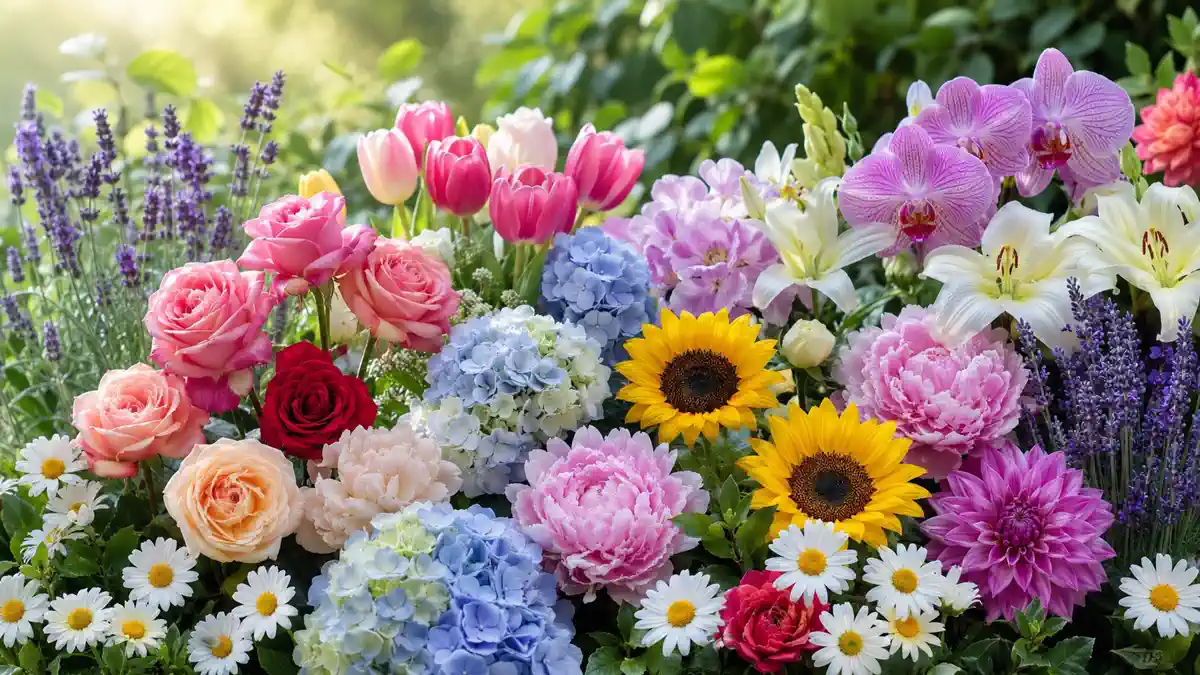
Flowers can be surprisingly difficult to identify. A daisy-like bloom might be a true daisy, an aster, a coneflower, or one flower head composed of dozens of tiny florets.
Types of flowers can be grouped by lifespan, plant structure, growing habitat, bloom season, and botanical features. Popular examples include roses, tulips, lilies, orchids, sunflowers, daisies, peonies, hydrangeas, carnations, and chrysanthemums. Each has distinct light, soil, climate, and care requirements.
This guide introduces 40 familiar flowers while explaining the classifications gardeners use to understand them. You will learn what each plant looks like, when it generally blooms, and where it is most likely to thrive.
How Are Different Types of Flowers Classified?
A flower is the reproductive structure of an angiosperm, or flowering plant. Botanists identify plants through characteristics such as their petals, sepals, stamens, pistils, leaves, fruit, and seed structure.
Gardeners use more practical categories, including lifespan, growth habit, climate tolerance, and bloom time.
Classification by life cycle
| Plant type | Life cycle | Common examples | Practical advantage |
|---|---|---|---|
| Annual | Completes its life cycle in one growing season | Zinnia, cosmos, marigold | Fast growth and extended color |
| Biennial | Usually grows leaves in year one and flowers in year two | Foxglove, hollyhock, sweet William | Tall, dramatic seasonal displays |
| Perennial | Lives for more than two years | Peony, daylily, coneflower | Returns in suitable conditions |
| Tender perennial | Perennial in warm regions but damaged by frost | Geranium, begonia, dahlia | Can be overwintered or treated as an annual |
An annual grows, flowers, produces seeds, and dies within one growing season. A biennial normally completes this process across two seasons, while a perennial survives for multiple years. The Oregon State University Extension Service notes that weather stress can cause some biennials to flower early, a response known as bolting.
These labels are influenced by climate. A snapdragon may behave as a short-lived perennial in a mild region but be grown as an annual where winters are severe.
Classification by growing structure
Flowering plants may also be described as:
- Herbaceous plants: Their non-woody stems usually die back at the end of the season.
- Woody plants: Flowering shrubs, trees, and vines retain permanent woody growth.
- Geophytes: They survive unfavorable seasons through underground storage organs.
- Aquatic plants: They grow in or beside water.
- Climbers: Their stems climb, twine, or scramble over supports.
- Succulents: Their leaves or stems store water.
The word bulb is frequently applied to several different structures. True bulbs include tulips and daffodils, but crocuses grow from corms, dahlias from tuberous roots, and irises may grow from rhizomes. Collectively, these underground-storage plants are called geophytes, as explained by the University of Florida IFAS Extension.
Botanical flower classifications
A complete flower has all four principal structures: sepals, petals, stamens, and one or more carpels. An incomplete flower lacks at least one of them.
A perfect flower contains both male and female reproductive structures. An imperfect flower has stamens or carpels, but not both. “Complete” and “perfect” therefore do not mean exactly the same thing.
Flowering plants are also commonly discussed as monocots and eudicots:
- Monocots usually have one seed leaf, parallel leaf veins, and flower parts in multiples of three. Lilies, orchids, and tulips are familiar examples.
- Eudicots generally have two seed leaves, branching veins, and flower parts in multiples of four or five. Roses, sunflowers, and peonies belong to this broad group.
Popular Types of Flowers and Their Characteristics
The following flower names cover classic garden plants, wildflowers, flowering shrubs, climbers, and popular cut flowers. Bloom periods are approximate because climate and cultivar can shift flowering by several weeks.
1. Rose
Roses (Rosa species and hybrids) may grow as compact shrubs, climbers, ramblers, or ground covers. Their flowers range from simple five-petaled forms to densely layered blooms.
Most garden roses prefer full sun, fertile well-drained soil, and good airflow. Hybrid tea roses are valued for long cutting stems, while floribundas produce clusters. Shrub and landscape roses are often easier to maintain.
Typical bloom time: Late spring through fall
Plant type: Deciduous or semi-evergreen perennial shrub
2. Tulip
Tulips are spring-flowering geophytes with upright, cup-shaped blooms. They are botanically perennial, although many modern hybrids decline after their first or second display.
Plant bulbs in fall where winters provide sufficient chilling. They perform best in sun and freely draining soil because prolonged moisture can rot dormant bulbs.
Typical bloom time: Early to late spring
Plant type: Bulbous perennial
3. Lily
True lilies belong to the genus Lilium. They grow from scaly bulbs and carry prominent, often fragrant flowers with six tepals.
Asiatic lilies generally bloom earlier and have little fragrance. Oriental lilies flower later and are known for their perfume. Daylilies and calla lilies are not true members of Lilium, despite their common names.
Typical bloom time: Early to late summer
Plant type: Bulbous perennial
4. Sunflower
The familiar sunflower is Helianthus annuus. What appears to be one large flower is a composite head containing numerous disc and ray florets.
Sunflowers need direct sunlight and generally tolerate heat once established. Varieties range from dwarf container plants to towering, seed-producing forms.
Typical bloom time: Summer to early fall
Plant type: Usually annual
5. Daisy
“Daisy” describes many plants in the Asteraceae family rather than a single species. The common daisy, Shasta daisy, gerbera, and African daisy are related but have different growing requirements.
Their recognizable flower heads combine a central disc with petal-like ray florets. Many varieties provide open landing areas for pollinating insects.
Typical bloom time: Spring through fall, depending on species
Plant type: Annual or perennial
6. Orchid
Orchidaceae is one of the largest flowering-plant families. Orchid flowers have bilateral symmetry and a specialized petal called the lip or labellum.
Popular houseplant genera include Phalaenopsis, Cattleya, Dendrobium, and Oncidium. Many tropical orchids are epiphytes that grow on trees without parasitizing them. They usually need airflow around their roots rather than ordinary garden soil.
Typical bloom time: Varies by genus
Plant type: Mostly perennial
7. Peony
Peonies develop large, bowl-shaped flowers that may be single, semi-double, or fully double. Herbaceous peonies die back each year, tree peonies retain woody stems, and intersectional hybrids combine traits of both.
They prefer sun, cold winter dormancy, and a planting site that will remain undisturbed. Planting herbaceous peony crowns too deeply is a common reason for poor flowering.
Typical bloom time: Late spring to early summer
Plant type: Long-lived perennial or shrub
8. Hydrangea
Hydrangeas are flowering shrubs known for rounded mophead, flattened lacecap, conical, or snowball-like clusters.
Some bigleaf hydrangeas can produce pinker flowers in less acidic soil and bluer flowers when acidic conditions make aluminum available. This effect does not apply equally to every species or flower color.
Typical bloom time: Late spring through fall
Plant type: Deciduous or evergreen shrub
9. Carnation
Carnations (Dianthus caryophyllus) have ruffled petals and a light, spicy fragrance. Florists value them because their sturdy flowers usually last well after cutting.
Garden pinks, sweet William, and carnations belong to the same genus. They prefer good drainage and benefit from removing spent blooms.
Typical bloom time: Late spring through summer
Plant type: Short-lived perennial, often grown as an annual
10. Chrysanthemum
Chrysanthemums, commonly called mums, are classic autumn flowers. Their cultivated forms include decorative, pompon, spider, anemone, and single-flowered types.
Hardy garden mums can survive winter in suitable climates when established early enough to develop strong roots. Florist mums sold indoors may be less reliable outdoors.
Typical bloom time: Late summer through fall
Plant type: Perennial
11. Daffodil
Daffodils belong to the genus Narcissus. Their flowers feature six tepals around a central trumpet or cup called the corona.
They are among the most dependable spring bulbs because many varieties naturalize and return for years. Allow the foliage to yellow naturally after blooming so it can replenish the bulb.
Typical bloom time: Late winter to spring
Plant type: Bulbous perennial
12. Iris
Irises have three upright petals known as standards and three descending sepals called falls. Bearded irises grow from rhizomes, while several other groups grow from bulbs or fibrous roots.
Different species tolerate very different conditions. Bearded iris needs drainage, whereas Japanese and Louisiana irises accept considerably more moisture.
Typical bloom time: Spring to early summer
Plant type: Perennial
13. Dahlia
Dahlias produce composite flower heads in forms ranging from neat pompons to broad “dinner plate” blooms. They grow from tuberous roots rather than true bulbs.
Dahlias need sun, rich soil, regular water, and protection from hard frost. In cold regions, gardeners often lift and store the tuberous roots over winter.
Typical bloom time: Midsummer until frost
Plant type: Tender perennial
14. Marigold
Marigolds are cheerful annuals in the genus Tagetes. French marigolds are compact, African marigolds are taller with larger heads, and signet marigolds bear smaller edible flowers.
They germinate readily from seed and tolerate heat. Removing faded flowers encourages continued blooming.
Typical bloom time: Late spring until frost
Plant type: Annual
15. Lavender
Lavender combines aromatic foliage with purple, pink, or white flower spikes. English lavender generally tolerates cold better, while Spanish and French types favor milder conditions.
The plant needs strong sun and sharp drainage. Rich, constantly damp soil often causes weak growth or root disease.
Typical bloom time: Late spring through summer
Plant type: Evergreen or semi-evergreen perennial shrub
16. Poppy
Poppies have delicate, tissue-like petals surrounding conspicuous stamens. Familiar types include Oriental poppy, Iceland poppy, California poppy, and annual corn poppy.
Their cultural needs vary. Oriental poppies are herbaceous perennials, California poppies are short-lived plants suited to dry ground, and corn poppies commonly grow as annuals.
Typical bloom time: Spring to early summer
Plant type: Annual, biennial, or perennial
17. Hibiscus
Hibiscus flowers are recognizable by their prominent central staminal column. Tropical hibiscus has glossy foliage and cannot tolerate frost, while hardy hibiscus can return after severe winter dormancy.
Both groups perform best with ample sunlight and moisture during active growth.
Typical bloom time: Summer through fall
Plant type: Shrub or herbaceous perennial
18. Jasmine
Jasmine plants are shrubs or vines with small, often intensely fragrant flowers. Common jasmine and Arabian jasmine are especially valued for scent.
Not every plant called jasmine belongs to Jasminum. Star jasmine, for example, belongs to a different botanical family.
Typical bloom time: Spring through summer, depending on species
Plant type: Perennial shrub or climber
19. Gardenia
Gardenias bear waxy white flowers against glossy evergreen foliage. Their rich fragrance makes them popular near entrances and patios.
They prefer acidic soil, warmth, humidity, and consistent moisture without waterlogging. Sudden environmental changes can trigger yellow leaves or bud drop.
Typical bloom time: Late spring through summer
Plant type: Evergreen shrub
20. Magnolia
Magnolias include deciduous and evergreen trees and shrubs. Their large flowers may appear before the leaves in spring or among the foliage during warmer months.
Saucer magnolia has early pink-and-white flowers, while southern magnolia produces creamy, fragrant summer blooms.
Typical bloom time: Spring or summer
Plant type: Tree or shrub
21. Camellia
Camellias offer rose-like flowers during seasons when relatively few shrubs are blooming. Camellia japonica and Camellia sasanqua are two widely cultivated species.
They favor acidic, organic soil and shelter from harsh afternoon sun. Their shallow roots benefit from mulch but should not be buried too deeply.
Typical bloom time: Fall through spring
Plant type: Evergreen shrub
22. Azalea
Azaleas belong to the genus Rhododendron. They produce dense spring displays in white, pink, red, purple, orange, or yellow.
Most need acidic, well-drained soil and filtered light. Deciduous azaleas and evergreen azaleas differ in cold tolerance, flower form, and seasonal appearance.
Typical bloom time: Primarily spring
Plant type: Shrub
23. Begonia
Begonias are grown for flowers, decorative foliage, or both. Major groups include wax, tuberous, cane, and rex begonias.
Most appreciate bright shade and protection from intense midday sun. Tuberous begonias produce especially showy flowers but require a dormant period.
Typical bloom time: Late spring through fall
Plant type: Tender perennial, commonly grown as an annual
24. Geranium
The name geranium creates frequent confusion. Plants sold as bedding geraniums are usually Pelargonium, while hardy cranesbills belong to the genus Geranium.
Pelargoniums prefer sun and warmth. Hardy geraniums tolerate colder winters and work well as border or ground-cover plants.
Typical bloom time: Spring through fall
Plant type: Annual, tender perennial, or hardy perennial
25. Petunia
Petunias produce funnel-shaped flowers in nearly every color except true green. Grandiflora types have large blooms, multifloras resist weather better, and spreading forms spill from baskets and containers.
They flower most heavily in sun with regular feeding and moisture. Modern cultivars may not require frequent deadheading.
Typical bloom time: Spring until frost
Plant type: Tender perennial grown as an annual
26. Zinnia
Zinnias are heat-loving annuals available in single, semi-double, cactus-flowered, and rounded forms. Their colors range from soft pastels to vivid red, orange, and purple.
Sow them in sun after frost danger has passed. Watering near the soil rather than over the foliage helps reduce leaf disease.
Typical bloom time: Early summer until frost
Plant type: Annual
27. Cosmos
Cosmos have finely divided foliage and open, daisy-like flowers. Cosmos bipinnatus produces white, pink, and crimson flowers, while sulphur cosmos offers warmer yellow and orange shades.
Excess fertilizer can create abundant leaves but relatively few blooms. Average soil and full sun usually produce better-balanced plants.
Typical bloom time: Summer through fall
Plant type: Annual
28. Snapdragon
Snapdragons carry vertical spikes of two-lipped flowers. They thrive in cool weather and may pause during intense summer heat before blooming again in fall.
Although technically short-lived perennials in some climates, they are commonly treated as annual bedding plants.
Typical bloom time: Spring and fall
Plant type: Short-lived or tender perennial
29. Foxglove
Foxgloves bear tall spires of tubular, spotted blooms. Traditional common foxglove generally forms a leaf rosette during its first year and flowers during its second.
They perform well in woodland-style borders with filtered light and moisture-retentive soil. Every part of the plant is poisonous if ingested.
Typical bloom time: Late spring to early summer
Plant type: Biennial or short-lived perennial
30. Hollyhock
Hollyhocks send up tall stems lined with open, saucer-shaped flowers. They suit cottage gardens and positions beside fences or walls.
Many behave as biennials or short-lived perennials. Good air circulation helps limit hollyhock rust, a common fungal disease.
Typical bloom time: Summer
Plant type: Biennial or short-lived perennial
31. Sweet Pea
Sweet peas are cool-season climbing flowers prized for their perfume and pastel colors. They require support and should not be confused with edible garden peas.
In cool climates, seeds are generally planted for spring or early-summer flowers. Hot weather shortens their display.
Typical bloom time: Spring to early summer
Plant type: Annual
32. Wisteria
Wisteria is a vigorous woody vine that produces hanging clusters of pea-like flowers. Chinese and Japanese wisterias can grow aggressively, whereas native American species are generally less overwhelming in North American gardens.
A mature plant needs a strong support. Thoughtful pruning controls its size and improves flower production.
Typical bloom time: Spring to early summer
Plant type: Deciduous perennial vine
33. Clematis
Clematis vines produce flowers in many shapes, from large open stars to small nodding bells. Cultivars are assigned to pruning groups according to when and where they form flower buds.
Most grow best with sunlight on their upper growth and a cool, mulched root zone.
Typical bloom time: Spring through fall, depending on variety
Plant type: Primarily perennial vine
34. Coneflower
Coneflowers, especially Echinacea purpurea, have raised central cones surrounded by drooping ray florets. Modern cultivars include white, yellow, orange, red, and double forms.
Established plants handle heat and periods of drought. Leaving some seed heads standing provides winter structure and food for birds.
Typical bloom time: Summer through fall
Plant type: Herbaceous perennial
35. Black-Eyed Susan
Black-eyed Susans have golden ray florets surrounding dark centers. The name most commonly refers to Rudbeckia hirta, though several related species share the same appearance.
They are dependable in sunny beds and naturalistic plantings. Depending on the species and local conditions, they may be annual, biennial, or perennial.
Typical bloom time: Summer through fall
Plant type: Variable
36. Aster
Asters provide daisy-like flowers late in the growing season. Many North American plants formerly classified as Aster now belong to genera such as Symphyotrichum and Eurybia.
Their late nectar and pollen make them useful to bees and other insects when fewer flowers are available.
Typical bloom time: Late summer through fall
Plant type: Perennial
37. Ranunculus
Florists’ ranunculus produces densely layered, rose-like flowers on slender stems. It grows from claw-shaped tuberous structures.
These plants prefer cool conditions, bright light, and well-drained soil. They are normally planted in fall in mild climates and in late winter or spring in colder regions.
Typical bloom time: Spring to early summer
Plant type: Tender perennial
38. Anemone
Anemones include low spring woodland flowers and taller fall-blooming Japanese anemones. Florists’ anemones are known for colorful petals surrounding dark centers.
Because the genus is diverse, there is no single correct growing position for every species. Some favor shade and woodland soil; others perform best in sun.
Typical bloom time: Spring or fall, depending on species
Plant type: Primarily perennial
39. Lotus
Lotus (Nelumbo) is an aquatic perennial with leaves and flowers held above the water. This separates it visually from many water lilies, whose leaves float on the surface.
Lotus grows from rhizomes in underwater soil and requires warmth and strong sunlight to bloom well.
Typical bloom time: Summer
Plant type: Aquatic perennial
40. Water Lily
Water lilies belong mainly to the genus Nymphaea. Their rounded leaves float on the water, while the flowers open at or slightly above the surface.
Hardy water lilies tolerate cold dormancy, but tropical varieties need warm water and frost protection. Neither group is botanically a true lily.
Typical bloom time: Late spring through early fall
Plant type: Aquatic perennial
Types of Flowers by Bloom Season
Combining plants with different flowering periods creates a more continuous display and gives pollinators a steadier supply of food.
| Season | Common flowers |
|---|---|
| Late winter | Crocus, snowdrop, hellebore, early daffodil |
| Spring | Tulip, iris, peony, azalea, magnolia |
| Summer | Rose, lily, lavender, hibiscus, zinnia, dahlia |
| Fall | Chrysanthemum, aster, Japanese anemone, goldenrod |
| Winter in mild climates | Camellia, pansy, cyclamen, winter jasmine |
Bloom time depends on temperature, rainfall, elevation, latitude, and the particular cultivar. A calendar created for one region should therefore be treated as a starting point rather than a universal schedule.
Quick takeaway: Select at least two plants for each part of the growing season. This reduces empty periods if one variety blooms early, flowers poorly, or suffers weather damage.
Choosing Types of Flowers for Your Garden
Appearance matters, but matching a flower to its environment matters more. A healthy, appropriately placed common plant will usually outperform an exotic variety struggling in unsuitable conditions.
Check sunlight accurately
“Full sun” generally means at least six hours of direct light, but the intensity also matters. Six hours of gentle morning sun is not equivalent to six hours of severe afternoon heat.
Observe the planting area at several times during the day. Then choose among:
- Full-sun flowers: Sunflower, zinnia, lavender, coneflower, dahlia
- Part-shade flowers: Begonia, foxglove, hydrangea, some geraniums
- Shade-tolerant flowers: Hellebore, impatiens, woodland anemone, certain begonias
Match the plant to the soil
Lavender and bearded iris resent persistently wet soil. Japanese iris, on the other hand, tolerates much more moisture. Gardenias, azaleas, and camellias commonly need acidic conditions, while many annuals accept a broader soil range.
Before changing the soil, test it. Adding amendments without knowing the existing pH or nutrient levels can create new problems.
Consider mature size
A small nursery plant may eventually become a wide shrub or vigorous climber. Check mature height and spread before positioning wisteria, climbing roses, hydrangeas, magnolias, or tall hollyhocks.
Correct spacing improves air circulation and lowers competition for light, moisture, and nutrients.
Use climate-appropriate plants
Hardiness describes whether a perennial can survive local winter temperatures. Heat tolerance measures a different challenge. A plant may survive winter but struggle through a hot, humid summer.
Local extension services, botanic gardens, and reputable regional nurseries are better guides than a generalized plant label. The NC State Extension Gardener Handbook, for example, distinguishes hardy, tender, and half-hardy perennials because winter survival varies with both plant and location.
Decide how much maintenance is realistic
Annuals can provide quick, prolonged color, but they require replacement. Perennials return, yet some need division, staking, pruning, or winter protection.
For a lower-maintenance bed, combine durable shrubs with adapted perennials and a limited number of annuals. Mulch appropriately and group plants with similar water needs.
Best Types of Flowers for Specific Uses
Different flowers solve different gardening and decorating needs. Choosing by purpose makes a long list of varieties easier to narrow down.
Flowers for containers
Petunias, begonias, geraniums, marigolds, dwarf dahlias, and compact roses work well in pots. Containers must have drainage holes, and their soil usually dries faster than ground soil.
Use plants with similar light and water requirements in a mixed arrangement. Combining a drought-tolerant lavender with a moisture-loving begonia makes care unnecessarily difficult.
Flowers for cutting
Roses, dahlias, zinnias, lilies, peonies, carnations, cosmos, ranunculus, and sweet peas are widely grown for arrangements.
Cut during the cool part of the day with clean tools. The best harvest stage varies: peonies can be cut as soft buds, while zinnias should have firm stems that do not wobble when gently moved.
Fragrant flowers
Jasmine, gardenia, lavender, sweet pea, rose, lily, hyacinth, and certain peonies are notable for fragrance.
Scent strength varies among cultivars, even within the same species. Place fragrant plants near paths, doors, seating areas, or open windows where their perfume can be appreciated.
Pollinator-friendly flowers
Open or accessible blooms such as asters, coneflowers, sunflowers, cosmos, lavender, and black-eyed Susans can supply nectar or pollen. Native species are particularly valuable because they may support local insects with specialized relationships.
A pollinator garden works best when it:
- Includes several flower shapes and colors.
- Blooms from early spring through fall.
- Uses groups of the same plant rather than isolated specimens.
- Avoids unnecessary pesticide applications.
- Provides water, shelter, and undisturbed nesting areas.
Highly doubled flowers sometimes offer less accessible pollen or nectar than simpler forms. Mixing ornamental cultivars with suitable native plants improves both beauty and ecological value.
Flowers for shade
Shade does not mean a garden must lack color. Begonias, impatiens, hellebores, foxgloves, woodland anemones, and some hydrangeas can flower with limited direct sunlight.
Distinguish bright shade from deep shade beneath dense evergreen trees. Root competition and dry soil can be more restrictive than the absence of sunlight itself.
Common Flower-Selection Mistakes
The most expensive plant is rarely the one that fails. It is the plant repeatedly replaced because the underlying problem was never corrected.
Treating every perennial as maintenance-free
Perennial means the plant can live for several years; it does not mean it needs no care. Some perennials require division, deadheading, staking, or protection from pests and extreme temperatures.
Assuming every “bulb” receives identical care
Tulips, daffodils, crocuses, dahlias, and canna lilies use different storage organs and have different tolerances. A dahlia tuber that survives winter in one climate may freeze in another, while a daffodil bulb may remain outdoors and multiply.
Choosing flowers from photographs alone
Images rarely communicate mature size, scent, bloom duration, disease susceptibility, or behavior outside the photographer’s climate. Read the botanical name and cultivar information rather than relying solely on a common name.
Ignoring toxicity
Several familiar flowers can harm people or animals if eaten. Lilies are particularly dangerous to cats; oleander, foxglove, autumn crocus, lily of the valley, and castor bean also contain potent toxins.
“Toxic” does not always mean the same level or route of danger. Verify a plant through a veterinarian, poison-control authority, or reliable botanical resource before placing it where children or pets may chew it.
Buying invasive plants
A beautiful non-native flower can spread beyond cultivation and displace local vegetation. Invasive status is regional, so check official local lists before planting vigorous species such as certain wisterias, honeysuckles, or loosestrifes.
Understanding Common and Botanical Flower Names
Common names are convenient but imprecise. “Bluebell,” “jasmine,” and “lily” may refer to unrelated plants in different countries.
A botanical name contains a genus and species, such as Helianthus annuus for the common sunflower. Cultivated varieties may add a cultivar name in quotation marks. This system helps gardeners obtain the intended plant and accurate care information.
It also prevents misleading assumptions:
- Calla lily is Zantedeschia, not a true Lilium.
- Daylily belongs to Hemerocallis.
- Star jasmine is Trachelospermum jasminoides.
- Bedding geraniums are generally Pelargonium.
- Water lilies belong primarily to Nymphaea.
You do not need to memorize Latin names for every plant. Check them when purchasing, diagnosing a problem, determining toxicity, or comparing care instructions.
Building a Balanced Flower Collection
The most useful way to explore types of flowers is not to collect the largest possible number. It is to build a compatible mix suited to the site.
Begin with light, soil drainage, climate, and available space. Add dependable structural plants, choose flowers for successive bloom periods, and include a few annuals for flexible seasonal color. If wildlife value matters, incorporate locally native species and favor accessible flower forms.
A rose may provide fragrance, an aster can extend the season, a tulip brings spring color, and a sunflower supplies summer height. When each plant has a clear role and suitable growing conditions, the garden becomes easier to care for—and far more rewarding.
