

Why do some arguments persuade us almost instantly while others fail, even when they contain accurate information? The answer often lies in how a message establishes trust, appeals to emotions, and presents logical reasons.
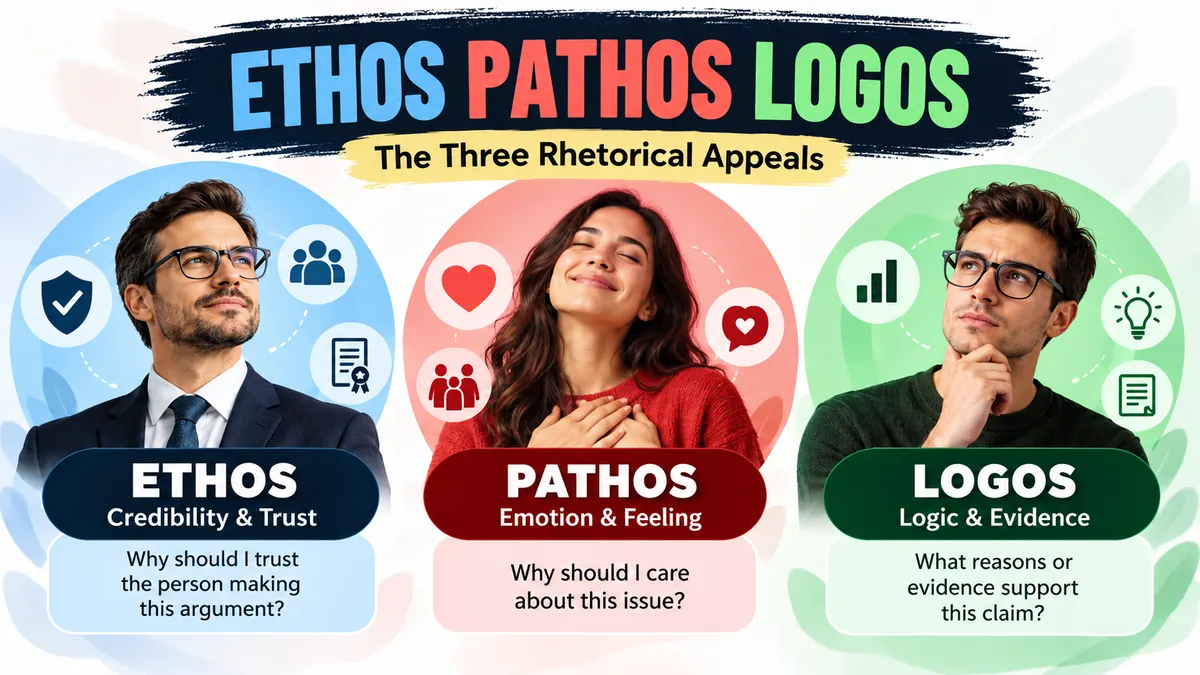
ethos pathos logos are three rhetorical appeals associated with the ancient Greek philosopher Aristotle. Ethos establishes credibility and trust, pathos engages an audience’s emotions, and logos uses evidence and reasoning. Together, these appeals help speakers and writers create persuasive arguments in speeches, essays, advertisements, debates, and everyday conversations.
Understanding these techniques also makes you a more critical reader. Instead of accepting an argument simply because it sounds convincing, you can examine why it works and whether its claims deserve your trust.
What Are ethos pathos logos?
Ethos, pathos, and logos are three fundamental methods of persuasion studied in rhetoric, the art of communicating effectively.
Aristotle explored these appeals in his work Rhetoric, explaining how speakers can persuade audiences through their character, their listeners’ emotional responses, and the reasoning presented in an argument.
Each appeal answers a different question:
- Ethos: Why should I trust the person making this argument?
- Pathos: Why should I care about this issue?
- Logos: What reasons or evidence support this claim?
Consider a school principal encouraging students to participate in a recycling program.
An ethos-based argument might highlight the school’s environmental expertise and previous achievements. A pathos-based message could describe how pollution affects wildlife. A logos-based argument might present data showing how recycling reduces landfill waste.
All three messages promote the same action, but each uses a different persuasive strategy.
Ethos vs. Pathos vs. Logos: Quick Comparison
| Appeal | Meaning | Main focus | Common techniques |
|---|---|---|---|
| Ethos | Credibility and character | Trust | Expertise, reputation, fairness |
| Pathos | Emotional appeal | Feelings | Stories, imagery, emotional language |
| Logos | Logical appeal | Reason | Facts, statistics, examples, reasoning |
These categories are useful for analysis, but persuasive messages rarely fit into only one. A personal story told by a qualified expert may establish credibility and evoke emotion while also supporting a logical argument.
Ethos: The Appeal to Credibility and Trust
Ethos is a rhetorical appeal that persuades an audience by establishing the speaker’s credibility, character, or trustworthiness.
The Greek word ethos is associated with character. In rhetoric, it concerns how an audience judges the person presenting an argument.
People are often more willing to consider advice when they believe the source is knowledgeable, honest, and responsible.
Examples of Ethos
Imagine a physician speaking about preventive healthcare:
As a practicing physician who has worked with patients for fifteen years, I recommend discussing regular health screenings with your healthcare provider.
The statement appeals to ethos by emphasizing professional experience.
Another example appears in academic writing:
According to research published by a recognized scientific institution, the findings support further investigation.
Here, the writer draws on the credibility of a research source, although readers should still evaluate the actual study.
A third example comes from leadership:
Our organization has published its financial reports openly for the past decade, and we will continue to explain how every donation is used.
This establishes trust through transparency and accountability rather than professional qualifications alone.
Common Ethos Techniques
Writers and speakers establish ethos through several methods:
- Expertise: Demonstrating relevant knowledge, training, or experience.
- Credible sources: Citing reliable research, institutions, or specialists.
- Fairness: Acknowledging opposing arguments without misrepresenting them.
- Honesty: Recognizing limitations, uncertainty, or mistakes.
- Shared values: Showing an understanding of the audience’s concerns.
- Consistent character: Communicating responsibly and respectfully.
Ethos is not limited to famous individuals or people with advanced degrees. A student can establish credibility by researching a topic carefully, citing dependable sources, and representing evidence accurately.
When Is Ethos Most Effective?
Ethos is particularly useful when an audience needs reassurance about the reliability of a speaker or message.
It often plays a central role in scientific communication, professional presentations, public policy discussions, academic arguments, and leadership speeches.
However, credibility does not guarantee correctness. An expert may be mistaken, and a respected institution can publish findings that later require revision.
This creates an important distinction between legitimate credibility and the appeal to authority fallacy, in which a claim is treated as true merely because an authority figure supports it.
Strong ethos encourages trust while leaving room for independent evaluation.
Pathos: The Appeal to Emotion
Pathos is a persuasive technique that influences an audience by engaging emotions, values, hopes, fears, or personal experiences.
The term comes from Greek and is associated with feelings and experiences.
Unlike logos, which emphasizes reasoning, pathos focuses on the emotional significance of an argument.
An effective emotional appeal helps readers understand not only what is happening but also why it matters to people.
Examples of Pathos
Consider a nonprofit organization raising awareness about homelessness:
Tonight, thousands of families will face uncertainty about where they can safely sleep. Every child deserves a place to feel secure.
The language encourages empathy and concern.
A graduation speech might use a different emotion:
Remember the challenges you overcame, the friendships you built, and the dreams that brought you here. Your next chapter begins today.
This appeals to pride, nostalgia, and hope.
Advertising frequently uses pathos as well. A commercial showing a family celebrating a meaningful reunion may connect a product with feelings of belonging and happiness.
The emotional association can influence how viewers perceive the message, even when it provides little factual information about the product itself.
Emotional Techniques Used in Pathos
Pathos can involve positive or negative emotions, including:
- Empathy and compassion
- Happiness and excitement
- Fear and anxiety
- Pride and patriotism
- Hope and inspiration
- Anger and frustration
- Sadness and nostalgia
- A sense of belonging
Common techniques include storytelling, vivid imagery, personal anecdotes, emotionally charged words, repetition, and descriptions that appeal to the senses.
For example, compare these two statements:
Neutral: The community library may close because of reduced funding.
Emotional: For generations, the community library has been a place where children discover stories, students find opportunities, and neighbors connect. Now its future is uncertain.
Both communicate a funding problem, but the second makes the potential loss feel more personal.
Is Pathos Always Manipulative?
No. Emotional appeals can help audiences recognize the human consequences of important issues.
A survivor sharing a personal experience, for example, may provide valuable insight that statistics alone cannot communicate.
Pathos becomes problematic when a message exploits fear, guilt, or anger to discourage critical thinking.
A misleading advertisement might use frightening images to imply a danger without providing reliable evidence.
The ethical use of pathos requires emotional honesty. The feelings a message encourages should be connected to real circumstances rather than fabricated threats or exaggerated claims.
Logos: The Appeal to Logic and Evidence
Logos persuades through reasoning, evidence, and the structure of an argument.
The Greek term logos can refer to speech, reason, or an account. In rhetoric, it describes the persuasive power of the argument itself.
A logos-based message encourages audiences to examine the connection between a claim and the reasons supporting it.
Examples of Logos
Consider a student arguing that a school should install energy-efficient lighting:
If the school replaces 100 traditional 60-watt bulbs with 10-watt LED bulbs, and each operates for five hours daily, electricity consumption for those bulbs would decrease by 25 kilowatt-hours per day.
This example uses a measurable comparison.
The calculation is:
\[ 100 \times (60-10)\times 5 \div 1000 = 25\text{ kWh} \]
The result follows logically from the stated assumptions. Actual cost savings would depend on electricity prices, usage patterns, and installation costs.
Another example uses deductive reasoning:
All mammals are warm-blooded animals. Dolphins are mammals. Therefore, dolphins are warm-blooded animals.
If the premises are true, the conclusion necessarily follows.
A third example involves everyday decision-making:
The first route is 12 miles long, while the second is 18 miles long. If traffic conditions and average speeds are comparable, the shorter route will generally require less travel time.
This argument connects evidence with a qualified conclusion rather than making an unconditional claim.
Types of Evidence Used in Logos
Logos commonly includes facts, statistics, comparisons, definitions, research findings, and logical explanations.
Two important reasoning methods are:
Deductive reasoning: Moving from general premises to a conclusion that follows necessarily when the argument is valid.
Inductive reasoning: Using observations or examples to support a broader conclusion that is probable rather than guaranteed.
Writers may also use causal reasoning to explain why something happens, or analogical reasoning to compare similar situations.
Common Logical Fallacies to Avoid
An argument can appear logical while relying on flawed reasoning.
| Logical fallacy | What goes wrong | Example |
|---|---|---|
| Hasty generalization | Drawing a broad conclusion from insufficient evidence | Two customers complained, so everyone dislikes the service |
| False dilemma | Presenting only two options when others exist | Either support this plan or oppose progress |
| False cause | Assuming one event caused another without sufficient evidence | Sales increased after a logo change, so the logo caused the increase |
| Straw man | Misrepresenting an opposing position | Someone wants less homework, so they must oppose education |
| Circular reasoning | Using the conclusion as its own support | This rule is correct because it is the right rule |
| Slippery slope | Predicting a chain of consequences without adequate justification | One small change will inevitably destroy the entire system |
Using numbers does not automatically make an argument logical or accurate. Statistics may be outdated, selectively presented, or interpreted incorrectly.
Effective logos depends on relevant evidence, sound reasoning, and conclusions that do not exceed what the evidence supports.
The Rhetorical Triangle: How the Three Appeals Work Together
The rhetorical triangle is a visual model showing the relationship between ethos, pathos, and logos in persuasive communication.
The three rhetorical appeals support persuasive communication through credibility, emotion, and reasoning.
The three appeals complement one another.
Ethos gives an audience reasons to trust the communicator. Pathos connects the subject to human experiences and concerns. Logos provides the reasoning needed to evaluate the claim.
Consider a community campaign encouraging people to conserve water.
Ethos: A qualified environmental researcher explains the issue using reliable scientific findings.
Pathos: A resident describes how water shortages have affected daily life.
Logos: The campaign presents measured water consumption figures and calculates the potential savings from conservation measures.
Together, these approaches establish credibility, demonstrate human consequences, and provide evidence for a practical recommendation.
However, balance does not necessarily mean using equal amounts of each appeal. Academic research may emphasize logos, while a commemorative speech may rely more heavily on pathos.
The appropriate combination depends on the audience, purpose, and rhetorical situation. University writing resources similarly emphasize choosing appeals according to context rather than applying a fixed formula.

Professional Writing
+1
Real-World ethos pathos logos Examples
Rhetorical appeals appear in communication far beyond classroom essays. They influence how people interpret news, advertisements, speeches, public messages, and social media content.
Examples in Advertising
Imagine an advertisement for a bicycle helmet.
| Appeal | Example | Persuasive purpose |
|---|---|---|
| Ethos | A qualified safety engineer explains the helmet’s testing process | Establish confidence |
| Pathos | A parent discusses the importance of protecting children during cycling | Encourage concern and care |
| Logos | The advertisement explains its safety certification and documented test results | Provide supporting evidence |
A single advertisement may combine all three.
A trustworthy expert can establish ethos, a family story can create pathos, and independently verified safety data can supply logos.
The presence of these techniques does not establish whether the product is genuinely effective. That requires evaluating the evidence behind its claims.
Examples in Famous Speeches
Historical speeches provide useful examples of persuasive language.
Martin Luther King Jr.’s I Have a Dream speech (1963)
King drew upon moral authority and the American tradition of equality to establish ethos. His vivid descriptions of injustice and hopes for the future created pathos.
His argument also drew on the contradiction between the nation’s stated principles and the unequal treatment experienced by Black Americans, contributing to its logos.
Abraham Lincoln’s Gettysburg Address (1863)
Lincoln invoked the founding principles of the United States, connecting his message to a shared national history.
The speech’s references to sacrifice, remembrance, and responsibility generated emotional resonance. Its reasoning linked the nation’s founding ideals to the continuing struggle over its future.
Sojourner Truth’s women’s rights advocacy
Truth’s speeches and public advocacy challenged prevailing assumptions about race and gender.
Her personal experiences contributed to ethos, descriptions of unequal treatment engaged pathos, and her challenges to inconsistent arguments about women’s abilities demonstrated logos.
Historical speeches should be examined in their original context, particularly when different published versions of a speech exist.
Examples in Social Media
Social media posts often use persuasive appeals in compressed forms.
A nutrition educator might establish ethos by explaining relevant qualifications and linking to reliable studies.
A video describing a family’s experience with food insecurity might use pathos.
An infographic comparing food waste measurements across several years might use logos, provided the underlying figures are reliable.
A post can also imitate these appeals deceptively. An account may claim expertise it does not possess, use emotionally manipulated imagery, or present misleading statistics.
Recognizing the persuasive technique is only the first step. Evaluating its reliability is equally important.
How to Identify ethos pathos logos in a Text
Identifying rhetorical appeals is a fundamental skill in rhetorical analysis.
The goal is not simply to label a sentence. It is to explain how a particular technique influences an intended audience.
Step 1: Identify the Author, Audience, and Purpose
Begin by examining the rhetorical situation.
Ask who created the message, who is expected to receive it, and what the author wants the audience to believe, feel, or do.
Also consider the setting, historical circumstances, and medium.
A public health announcement, a political speech, and a scientific article may discuss the same issue but use different persuasive strategies.
Step 2: Look for Credibility Signals
Identify references to qualifications, professional experience, reputable sources, shared values, or ethical character.
These often indicate ethos.
For example:
After reviewing the available research and consulting independent specialists, our committee revised its recommendations.
The reference to research and independent specialists supports the committee’s credibility.
However, source references may also contribute to logos when they provide substantive evidence.
Step 3: Identify Emotional Language and Imagery
Look for personal stories, vivid descriptions, emotionally meaningful words, and appeals to shared experiences.
These may signal pathos.
Consider:
Every morning, children arrive at school hoping for a safe place to learn and a future filled with opportunity.
The statement emphasizes safety, hope, and concern for children.
Step 4: Examine Claims and Supporting Evidence
Look for statistical data, research findings, comparisons, logical relationships, and clearly explained conclusions.
These suggest logos.
For example:
The proposed schedule reduces weekly operating hours from 50 to 45, representing a 10% reduction.
The statement relies on a numerical comparison.
Its persuasive strength depends on whether the numbers are accurate and relevant to the broader argument.
Step 5: Explain the Effect on the Audience
A strong rhetorical analysis moves beyond identification.
Instead of writing:
The author uses pathos.
Explain the mechanism:
By describing the experiences of families affected by flooding, the author encourages readers to consider the human consequences of delayed disaster preparation.
This identifies the technique, provides textual evidence, and explains its persuasive effect.
A Simple Rhetorical Analysis Formula
Use this structure when writing an analytical paragraph:
Technique + Evidence + Audience Effect + Connection to Purpose
For instance:
The writer establishes ethos by referencing relevant professional experience. This encourages readers to view the recommendations as informed and trustworthy, supporting the broader argument for improved workplace safety.
This approach works well for high school assignments, college essays, and close readings of speeches or advertisements.
How to Use ethos pathos logos in Persuasive Writing
Understanding rhetorical appeals helps you analyze other people’s arguments. Applying them thoughtfully can also improve your own writing.
1. Start With a Clear Argument
Every persuasive essay needs a central claim or thesis statement.
For example:
Schools should provide more opportunities for students to participate in outdoor learning activities.
The statement presents a position that can be supported through evidence and explanation.
A thesis should be specific enough to guide the argument while allowing reasonable discussion of alternative viewpoints.
2. Establish Credibility Through Ethos
Support your position with relevant sources and accurate information.
You might reference educational research, explain the limitations of available findings, or acknowledge competing interpretations.
Avoid claiming qualifications or personal experiences you do not have.
Credibility grows when writers demonstrate intellectual honesty rather than pretending every question has a simple answer.
3. Connect With Readers Through Pathos
Show why the issue matters.
In an essay about outdoor learning, a short example might describe students exploring local ecosystems, developing curiosity, or gaining opportunities for hands-on observation.
Emotional engagement can make an abstract policy discussion more meaningful.
Keep anecdotes representative and avoid presenting one personal experience as proof of a universal outcome.
4. Support the Claim With Logos
Present reliable research, measurable evidence, and logical explanations.
For the outdoor learning example, relevant evidence might include findings about student engagement, instructional outcomes, accessibility, and implementation challenges.
Explain how the evidence supports the thesis.
A research citation without interpretation is not enough. Readers need to understand the reasoning connecting the information to the conclusion.
5. Address Counterarguments Fairly
Persuasive writing becomes stronger when it recognizes reasonable objections.
A school administrator might worry about supervision, weather conditions, or scheduling.
Acknowledging these concerns supports ethos by demonstrating fairness.
Evaluating the practical trade-offs supports logos.
Explaining how thoughtful planning can protect students’ learning experiences may also engage pathos.
6. Revise for Balance and Accuracy
Review the completed argument and ask whether the appeals support one another.
Does the emotional language accurately represent the evidence? Are the cited authorities relevant? Does the conclusion logically follow from the supporting material?
A convincing argument should remain persuasive even when readers examine its claims critically.
Ethos, Pathos, Logos, and Kairos: What’s the Difference?
Although ethos, pathos, and logos are the three classical artistic proofs associated with Aristotle, rhetorical analysis also frequently discusses kairos.
Kairos refers to the importance of timing, opportunity, and context in communication.
A message may be credible, emotionally engaging, and logically sound but still fail because it reaches the audience at an unsuitable moment.
For example, an emergency preparedness campaign delivered shortly before a forecast storm may feel more immediately relevant than the same message delivered without an obvious connection to current circumstances.
Kairos helps explain why timing and context can influence persuasion.
Another related term is telos, which concerns the purpose or goal of communication.
Purdue University’s explanation of Aristotle’s rhetorical situation includes both kairos and telos alongside the better-known appeals.
Purdue University
+1
| Concept | Central question |
|---|---|
| Ethos | Is the communicator credible? |
| Pathos | What emotions or values are engaged? |
| Logos | Does the argument make sense? |
| Kairos | Why is this the appropriate moment or context? |
| Telos | What is the communication trying to accomplish? |
These concepts work together when analyzing a rhetorical situation.
Common Mistakes When Using Rhetorical Appeals
One common mistake is assuming that ethos means mentioning a famous person.
A celebrity endorsement may create an impression of credibility, but the person’s fame does not necessarily establish expertise on the subject.
Another mistake is treating pathos as synonymous with sadness. Emotional persuasion can also involve humor, pride, optimism, excitement, and relief.
Students sometimes identify every statistic as logos without checking whether it supports the argument. Numbers are only persuasive evidence when they are relevant, accurately presented, and interpreted appropriately.
Other frequent mistakes include:
- Treating ethos, pathos, and logos as mutually exclusive categories.
- Assuming a logical appeal must contain numerical data.
- Using exaggerated emotional language instead of meaningful evidence.
- Confusing the presence of a persuasive technique with proof that an argument is correct.
- Naming a rhetorical appeal without explaining its effect on the audience.
The most effective analysis considers how the appeals interact rather than counting how many times each one appears.
How to Remember Ethos, Pathos, and Logos Easily
A simple memory technique connects each appeal with a familiar concept.
ETHOS
Trust
Why believe me?
PATHOS
Emotion
Why care?
LOGOS
Logic
Why agree?
Think of ethos as the speaker’s credibility, pathos as the audience’s emotional response, and logos as the argument’s reasoning.
You can also practice identifying the dominant appeal in short statements.
Practice: Identify the appeal
0 of 3 correct
Example 1
As a certified structural engineer with twenty years of experience, I have reviewed this design.EthosPathosLogos
Example 2
Imagine the relief a family feels when they finally return to a safe home.EthosPathosLogos
Example 3
A reduction from 200 units to 150 units represents a 25% decrease.EthosPathosLogos
Try again
Why Understanding Rhetorical Appeals Matters
Rhetorical appeals are valuable because persuasion influences decisions across education, work, public communication, and everyday life.
For students, understanding these techniques improves reading comprehension, essay writing, and speech analysis.
For professionals, they provide a framework for presenting ideas with credibility, empathy, and clear reasoning.
For everyday readers, rhetorical awareness supports critical thinking.
When encountering a persuasive message, ask whether the source deserves trust, whether its emotional language accurately represents the issue, and whether the evidence supports its conclusions.
These questions are particularly useful when evaluating advertisements, viral social media posts, opinion articles, and public statements.
Recognizing rhetoric does not mean becoming suspicious of every persuasive message. It means developing the ability to distinguish thoughtful communication from unsupported or manipulative claims.
Conclusion
ethos pathos logos remain essential concepts for understanding how persuasion works.
Ethos establishes credibility through expertise, character, and trustworthiness. Pathos connects arguments with human emotions and values. Logos supports claims through evidence, reasoning, and logical structure.
Although each appeal has a distinct purpose, effective communication often combines them according to the audience, message, and situation.
The next time you read an argument, watch an advertisement, or listen to a speech, examine how the communicator establishes trust, creates emotional engagement, and supports claims with reasoning.
