

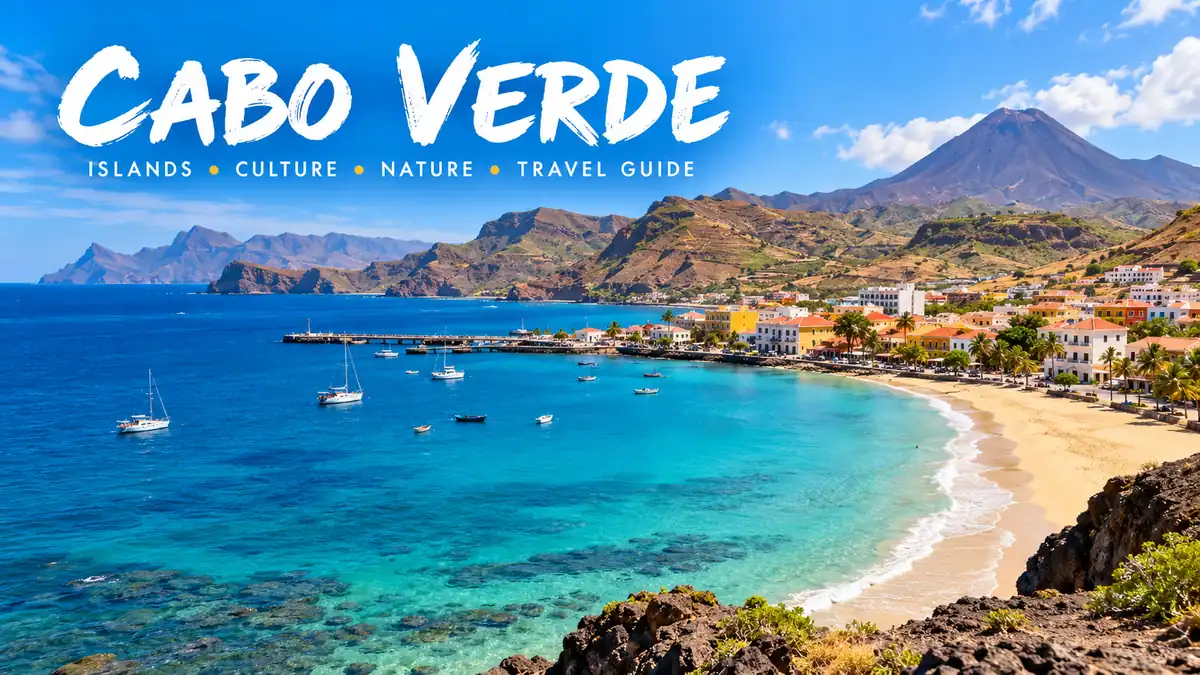
Cabo Verde is easy to picture as a beach destination, but that description barely captures it. This Atlantic archipelago combines volcanic mountains, desert landscapes, historic towns, Creole culture, distinctive music, hiking trails, fishing communities, and long stretches of sand within a relatively small island nation.
Located roughly 500 kilometers off the west coast of Africa, cabo verde consists of ten main islands, nine of them inhabited. Praia, on Santiago Island, is the capital. Portuguese is the official language, while Cabo Verdean Creole is central to everyday life and local identity. The country had an estimated population of 527,326 in 2025. World Bank
Quick answer: Cabo Verde is a ten-island Atlantic archipelago off West Africa known for year-round sunshine, volcanic scenery, beaches, Creole culture and music. Sal and Boa Vista are major beach destinations, while Santiago, São Vicente, Santo Antão and Fogo offer history, culture, hiking and dramatic landscapes.
Where Is cabo verde?
Cabo Verde lies in the Atlantic Ocean west of Senegal and the African mainland. Although geographically part of Africa, its island setting has helped create a culture shaped by African and Portuguese influences as well as centuries of Atlantic migration and trade.
The country covers a relatively small land area, and natural resources are limited. Only a small portion of its land is suitable for agriculture, while drought and water scarcity have long influenced settlement, farming and economic development. World Bank
The archipelago is traditionally divided into two groups.
Barlavento Islands
The northern, or Windward, group includes:
- Santo Antão
- São Vicente
- Santa Luzia
- São Nicolau
- Sal
- Boa Vista
Santa Luzia is uninhabited.
Sotavento Islands
The southern, or Leeward, group includes:
- Maio
- Santiago
- Fogo
- Brava
Each island has a noticeably different character. That diversity is one reason travelers who only see a resort area can leave with a very different impression from those who travel between several islands.
The Main Islands of cabo verde
Choosing the right island matters more than simply deciding to visit Cabo Verde. A traveler looking for a resort beach holiday may prefer Sal or Boa Vista, while someone interested in mountain trekking would probably find Santo Antão more rewarding.
| Island | Known For | Best Suited To |
|---|---|---|
| Santiago | Praia, history, local culture | Culture and history |
| Sal | Beaches, resorts, water sports | Beach holidays |
| Boa Vista | Sand dunes and extensive beaches | Relaxation and nature |
| São Vicente | Mindelo, music and nightlife | Culture and music |
| Santo Antão | Mountains and valleys | Hiking |
| Fogo | Volcano and dramatic landscapes | Adventure |
| São Nicolau | Mountains and quieter communities | Off-the-beaten-path travel |
| Maio | Quiet beaches | Slow travel |
| Brava | Green scenery and small settlements | Peaceful exploration |
Santiago
Santiago is the largest island and home to Praia, the national capital. It is a strong starting point for understanding Cabo Verde beyond its resorts.
The island combines urban life, mountains, agricultural valleys, beaches and significant historic sites. Cidade Velha, formerly Ribeira Grande, is particularly important.
UNESCO inscribed the Historic Centre of Ribeira Grande, now known as Cidade Velha, on the World Heritage List in 2009. It remains Cabo Verde’s only inscribed World Heritage property as of 2026. UNESCO World Heritage Centre
Sal
Sal is among the islands most closely associated with international tourism. Its dry landscape contrasts with clear Atlantic water and broad sandy beaches.
Santa Maria is its main tourism center, with hotels, restaurants, diving operators and water-sports facilities. The island is particularly appealing to travelers who prioritize beaches and straightforward resort infrastructure.
Pedra de Lume, where salt pans occupy an old volcanic crater, reveals another side of Sal’s history. The Salines of Pedra de Lume also appear on Cabo Verde’s UNESCO Tentative List. UNESCO World Heritage Centre
Boa Vista
Boa Vista is another major center of Cabo Verde’s beach tourism. Its expansive sandy landscapes, dunes and coastline give it a different atmosphere from the mountainous western islands.
Travelers commonly choose Boa Vista for quiet beach time, resort stays and outdoor experiences rather than busy city sightseeing.
Tourism remains heavily concentrated in Sal and Boa Vista, illustrating how differently the visitor economy is distributed across the archipelago. World Bank
São Vicente
São Vicente is best known for Mindelo, one of the country’s major cultural centers.
Music, restaurants, nightlife, colonial-era architecture and a lively waterfront give Mindelo a character quite different from Cabo Verde’s resort areas. It is also an important gateway for travelers continuing to nearby Santo Antão.
Santo Antão
For hikers, Santo Antão can be one of the highlights of cabo verde.
Its steep mountains, deep valleys, cultivated terraces and winding roads are strikingly different from the flatter, drier landscapes of Sal and Boa Vista.
The Cova, Paúl and Ribeira da Torre natural area is included on Cabo Verde’s UNESCO Tentative List. UNESCO World Heritage Centre
Fogo
Fogo is dominated by Pico do Fogo, the country’s extraordinary volcanic landmark.
The communities and landscapes around Chã das Caldeiras provide one of Cabo Verde’s most unusual travel experiences. Parque Natural do Fogo–Chã das Caldeiras has been placed on the country’s UNESCO Tentative List. UNESCO World Heritage Centre
Fogo is a better match for travelers interested in geology, hiking and local communities than those seeking a conventional resort holiday.
What Is cabo verde Famous For?
Cabo Verde is best known internationally for beaches and warm weather, but its identity extends much further.
Its most recognizable characteristics include volcanic landscapes, Atlantic beaches, Creole culture, music, hiking, seafood and a strong connection with its global diaspora.
The contrast between islands is particularly memorable. A single trip can potentially combine desert-like terrain, green mountain valleys, historic settlements and volcanic scenery.
Morna Music
Music is one of the strongest expressions of Cabo Verdean identity.
Morna is closely associated with themes such as love, longing, separation and sodade, a concept often connected with yearning or nostalgia. Its emotional quality reflects a society shaped in part by migration and island life.
UNESCO added Morna, musical practice of Cabo Verde to the Representative List of the Intangible Cultural Heritage of Humanity in 2019. ICH UNESCO
Other musical traditions, including funaná and coladeira, add to the country’s rich cultural landscape.
A Short History of cabo verde
The islands were uninhabited before Portuguese settlement began in the 15th century. Their strategic location in the Atlantic subsequently made them important in maritime trade.
Ribeira Grande on Santiago—today’s Cidade Velha—became an important early European colonial settlement in the tropics. Its surviving heritage helps explain the archipelago’s place in Atlantic history. UNESCO recognizes Cidade Velha for its exceptional historical significance. UNESCO World Heritage Centre
Cabo Verde achieved independence from Portugal in 1975.
Since then, the country has developed a reputation for institutional and political stability. Peaceful political transitions have been a notable feature of its modern development. World Bank
Language and Culture
Portuguese is Cabo Verde’s official language, particularly in government, formal education and official communication.
In daily conversation, Cabo Verdean Creole—often called Kriolu—is widely used. Creole varieties differ between islands, reflecting the country’s geography and historical development.
Cabo Verdean culture combines African and European influences while possessing a distinct identity of its own.
Music is especially prominent, but cultural life also appears through festivals, dance, food, storytelling, religious traditions and community celebrations.
Travelers who spend time in Praia, Mindelo or smaller island communities will generally encounter a different side of the country from what is visible inside international resorts.
Food to Try in cabo verde
Cabo Verdean cooking reflects the realities of island life. Fish and seafood are naturally important, while corn, beans, vegetables and meat also feature in traditional meals.
Cachupa
Cachupa is perhaps the country’s most famous dish.
Recipes vary, but it is generally a slow-cooked preparation based on corn and beans accompanied by ingredients such as vegetables, fish or meat. Different households and islands have their own versions.
A richer preparation is often described as cachupa rica.
Leftover cachupa may also be fried for breakfast, creating a satisfying meal with a very different texture from the original stew.
Seafood
Depending on location and season, visitors may encounter tuna and other locally caught fish as well as shellfish.
Food experiences can vary considerably between resort districts and local neighborhoods, so travelers interested in Cabo Verdean cuisine should consider eating beyond hotel restaurants when practical.
Climate and the Best Time to Visit cabo verde
Cabo Verde has a generally warm, dry climate influenced by its Atlantic location.
Temperatures are relatively pleasant through much of the year, which contributes to the country’s appeal as a winter-sun destination.
There is no single best month for every traveler. The ideal period depends on what you intend to do.
Beach travelers may prioritize sunshine and warm temperatures. Hikers may prefer conditions that make long days outdoors more comfortable. Surfers and wind-sport enthusiasts have different considerations again.
Rainfall is limited and can vary significantly by island, elevation and year. Mountainous islands may look surprisingly green in places, while islands such as Sal can appear extremely arid.
Wind can also be a defining part of the experience, particularly on exposed beaches.
What to Pack
Light clothing works well for most daytime conditions, but a few additions are useful:
- Comfortable walking or hiking shoes
- Sun protection and sunglasses
- A reusable water bottle
- Swimwear
- A light layer for cooler or windy evenings
- A wind-resistant outer layer for exposed areas
- Appropriate footwear for volcanic or mountain terrain
Do not assume every island requires the same packing list. Hiking Santo Antão and spending a week on a Sal beach involve very different conditions.
Beaches and Water Activities
Beaches are a major reason people search for cabo verde.
Sal and Boa Vista have some of the country’s best-known stretches of sand and the most developed beach-tourism infrastructure. Swimming, surfing, windsurfing, kitesurfing, diving and snorkeling may be available depending on the island and local conditions.
Atlantic conditions deserve respect, however. Strong wind, waves and currents can make a beach look safer than it actually is.
Travelers should follow local warnings and advice rather than assuming that calm-looking stretches of coastline are suitable for swimming.
Hiking and Outdoor Adventures
Cabo Verde is an underrated hiking destination.
Santo Antão is the standout choice for mountain walking, with routes passing through valleys, villages and agricultural terraces.
Fogo offers a completely different experience dominated by volcanic terrain.
Santiago and São Nicolau also provide opportunities for travelers who want to explore on foot rather than spend an entire trip at the coast.
Good footwear, sufficient water and realistic route planning are essential. Heat and elevation can make relatively short distances more demanding than they appear on a map.
Getting to and Around cabo verde
International travelers typically arrive by air. Which airport makes the most sense depends on the island itinerary.
Travel between islands can involve domestic flights and ferries. This is one part of trip planning that deserves extra flexibility.
The World Bank’s 2026 economic assessment identifies unreliable and costly inter-island air and maritime connections as an important challenge for the country. It notes that connectivity problems affect residents, businesses and tourism development across the archipelago. World Bank
For visitors, the practical lesson is simple: avoid creating an itinerary with extremely tight connections between different islands.
Weather and transport changes can disrupt carefully planned schedules.
If an international departure is important, allowing extra time on the island from which the flight leaves can reduce unnecessary risk.
How Many Days Do You Need?
A short trip of about four or five days is enough to explore one island at a relaxed pace.
Around one week works well for a deeper single-island experience or, where transport schedules cooperate, a simple two-island combination.
Ten to fourteen days gives much more freedom to experience contrasting parts of the archipelago.
Trying to visit too many islands is a common planning mistake. Distances on a map can look small, but inter-island logistics mean Cabo Verde does not function like one compact resort destination.
For a first visit, two complementary islands often make more sense than racing through four or five.
For example, São Vicente and Santo Antão combine urban culture with mountain scenery, while Santiago and Fogo combine history with volcanic landscapes.
Is cabo verde Expensive?
Travel costs vary significantly according to island, accommodation style, transport choices and season.
A resort-based holiday can have a very different budget from an independently organized trip involving guesthouses, local restaurants and several islands.
Inter-island travel is another factor. Moving repeatedly between islands can increase the total cost and logistical complexity.
Cabo Verde imports many goods because of its limited agricultural resources and island geography. That can influence the price and availability of some products.
For travelers trying to control costs, a slower itinerary focused on one or two islands can be more practical than frequent domestic flights or ferry journeys.
Tourism and the Cabo Verdean Economy
Tourism is not merely a visitor activity in Cabo Verde; it is central to the national economy.
The World Bank estimates that tourism contributes roughly a quarter of GDP directly and substantially more when indirect economic effects are considered. The country recorded 1.18 million tourist arrivals in 2024, and tourism remained a major driver of economic growth in 2025. World Bank
In 2025, Cabo Verde’s real GDP grew by an estimated 6.3%, helped by strong tourism activity and expanded flight capacity. World Bank
That success also creates vulnerability.
Tourism activity is highly concentrated geographically, especially in Sal and Boa Vista, and European visitors account for the overwhelming majority of international arrivals. The World Bank has highlighted diversification, climate resilience and better connections between islands as important long-term priorities. World Bank
For travelers, exploring locally owned restaurants, guides, accommodations and services beyond major resort areas can also provide a broader understanding of the islands.
Nature, Water and Environmental Challenges
Cabo Verde’s beauty exists alongside significant environmental constraints.
Freshwater is limited, agricultural land is scarce, and drought has historically affected food production. Climate change adds further pressure to an already vulnerable island environment. World Bank
The ocean is also economically important. Fishing, marine resources and tourism all contribute to what is often described as Cabo Verde’s blue economy.
The World Bank has identified sustainable fisheries, aquaculture and better management of marine resources as potential areas for more diversified economic development. World Bank
Visitors can reduce their own footprint through straightforward choices: conserving water, avoiding unnecessary single-use plastics, respecting protected landscapes and marine wildlife, and using established trails in sensitive environments.
Practical Tips for Visiting cabo verde
A successful trip usually starts with accepting that this is an archipelago rather than a single uniform destination.
Research individual islands before booking. Sal cannot represent everything Cabo Verde offers, just as mountainous Santo Antão cannot represent the beach-resort experience of Sal.
Leave flexibility around domestic transport. If several islands are involved, build breathing room into the itinerary rather than scheduling every connection tightly.
Carry appropriate sun protection and drinking water when exploring outdoors. Dry conditions and Atlantic winds can disguise how much sun exposure you are getting.
Learning a few Portuguese or Kriolu expressions can also make everyday interactions easier and more rewarding.
Most importantly, balance famous attractions with ordinary local life. Markets, neighborhood restaurants, fishing communities, music venues and smaller towns can provide as much insight into Cabo Verde as its major beaches.
Why cabo verde Is More Than a Beach Destination
The biggest misconception about cabo verde is that its islands offer essentially the same experience.
They do not.
Sal and Boa Vista deliver the sandy coastline and resort infrastructure many visitors expect. Santo Antão offers dramatic mountain trekking. São Vicente brings music and urban culture. Santiago combines the capital with some of the country’s most important history, while Fogo is defined by its volcanic landscape.
Cidade Velha connects visitors with centuries of Atlantic history, while morna expresses a cultural identity so distinctive that UNESCO recognizes it as intangible cultural heritage. UNESCO World Heritage Centre
That variety is what makes Cabo Verde particularly interesting. Rather than trying to see every island, choose the experiences that matter most to you and give each destination enough time. A thoughtful itinerary reveals an archipelago with far more depth—geographically, historically and culturally—than its reputation for sunshine and beaches alone suggests.
