

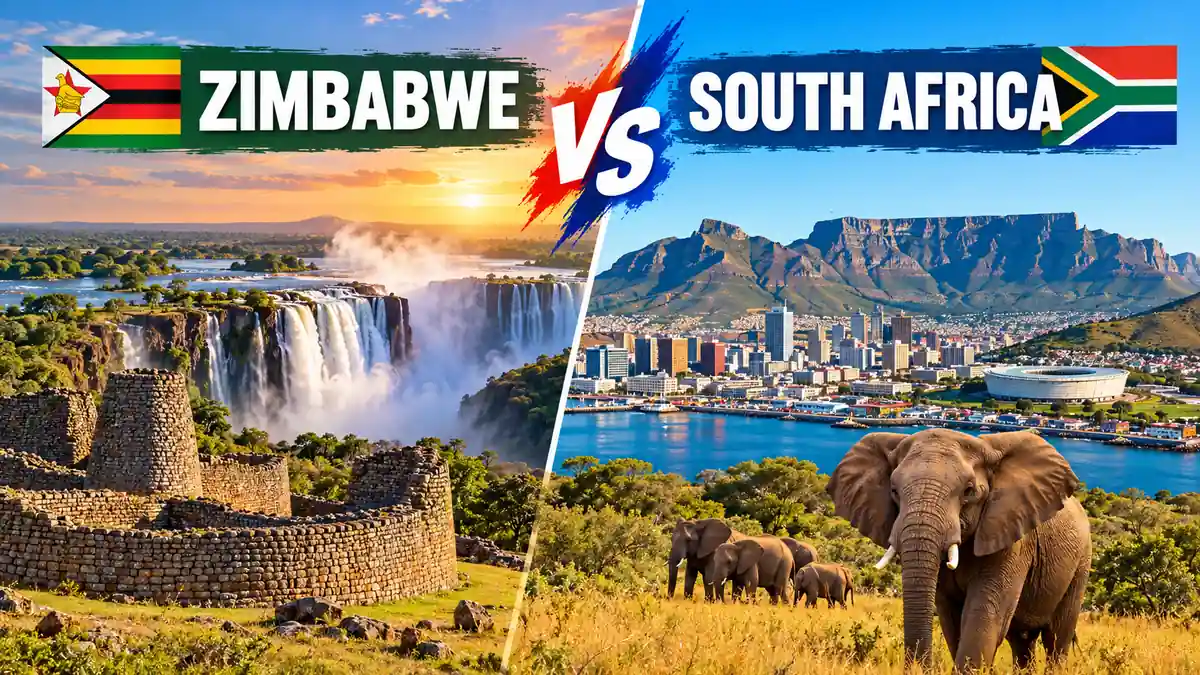
Zimbabwe and South Africa are neighboring countries in Southern Africa with strong historical, economic, and cultural connections. Yet they differ considerably in population, economic development, geography, infrastructure, and living conditions.
The zimbabwe vs south africa comparison shows that South Africa has a larger population, a substantially bigger economy, and more developed transport and industrial infrastructure. Zimbabwe, meanwhile, has significant mineral resources, agricultural potential, remarkable natural attractions, and a younger population. Both countries face distinct economic and social challenges.
Understanding these differences requires looking beyond economic rankings. Their shared history, migration patterns, cultural traditions, and natural environments reveal how closely connected these two nations are.
zimbabwe vs south africa: Quick Comparison
The following table summarizes the major differences between Zimbabwe and South Africa using recent available statistics.
| Category | Zimbabwe | South Africa |
|---|---|---|
| Official name | Republic of Zimbabwe | Republic of South Africa |
| Capital | Harare | Pretoria (administrative), Cape Town (legislative), Bloemfontein (judicial) |
| Population (2025) | 16.95 million | 64.75 million |
| Total area | 390,757 km² | 1,221,037 km² |
| GDP (2025) | $51.22 billion | $427.18 billion |
| GDP per capita (2025) | $3,021 | $6,598 |
| GDP growth (2025) | 8.1% | 1.1% |
| Life expectancy (2024) | Approximately 63 years | Approximately 66 years |
| Currency | Zimbabwe Gold (ZiG); foreign currencies also circulate | South African rand (ZAR) |
| Independence or democratic transition | 1980 | 1994 democratic transition |
| Major cities | Harare, Bulawayo | Johannesburg, Cape Town, Durban, Pretoria |
| Geographic position | Landlocked | Atlantic and Indian Ocean coastlines |
Population, GDP, growth, and life-expectancy figures are drawn from the World Bank’s latest available country indicators.

Data
+1
South Africa’s economy is approximately 8.3 times larger than Zimbabwe’s, while its population is about 3.8 times greater.
However, these differences do not automatically mean that every South African enjoys a higher standard of living. Income inequality, unemployment, access to public services, and regional development create considerable variation within both countries.
Geography and Location: How Do Zimbabwe and South Africa Differ?
Zimbabwe and South Africa share a border, but their geographical characteristics are significantly different.
Zimbabwe’s Geography
Zimbabwe is a landlocked country surrounded by South Africa, Botswana, Zambia, and Mozambique.
Its landscape includes high plateaus, mountain ranges, river valleys, and savanna ecosystems.
Important geographical features include:
- The Zambezi River along much of the northern border.
- Victoria Falls, shared with Zambia.
- The Eastern Highlands near Mozambique.
- Lake Kariba, one of the world’s largest artificial reservoirs by volume.
- Hwange National Park, known for elephants and other wildlife.
Much of Zimbabwe lies on an elevated plateau, giving many regions a more moderate climate than their tropical latitude might suggest.
Harare, the capital, is located in the country’s northeastern highveld.
South Africa’s Geography
South Africa occupies the southern tip of the African continent and has coastlines along the Atlantic and Indian Oceans.
Its landscapes are more geographically varied, including coastal plains, mountain ranges, grasslands, semi-arid interior regions, and deserts.
Notable geographical features include the Drakensberg Mountains, the Karoo, Table Mountain, and the Cape of Good Hope.
South Africa surrounds the independent country of Lesotho and shares borders with Namibia, Botswana, Zimbabwe, Mozambique, and Eswatini.
Its coastline supports major ports, international trade, fishing industries, and coastal tourism.
Which Country Is Bigger?
South Africa covers approximately 1.22 million square kilometers, compared with Zimbabwe’s 390,757 square kilometers.
This makes South Africa roughly 3.1 times larger geographically.
WorldFactbooks
+1
The larger territory provides South Africa with more extensive coastal access and varied climatic zones, while Zimbabwe’s inland location makes regional transport corridors particularly important for international trade.
Population and Demographics
Population size affects labor markets, infrastructure planning, healthcare, education, and domestic consumer demand.
According to 2025 World Bank figures, South Africa has approximately 64.75 million residents, compared with Zimbabwe’s 16.95 million.
Data
Population Comparison (2025)
Millions of people, World Bank
0 million20 million40 million60 million80 millionZimbabweSouth Africa
Population Growth and Age Structure
Zimbabwe has a considerably younger population.
Recent demographic estimates place Zimbabwe’s median age at approximately 18 years, compared with around 29 years in South Africa.
This youthful population creates opportunities for future workforce growth but also increases demand for schools, jobs, housing, and healthcare.
South Africa has a more urbanized population, with a larger proportion of residents living in metropolitan areas.
WorldFactbooks
Major Cities and Urban Development
South Africa’s principal urban centers include Johannesburg, Cape Town, Durban, Pretoria, and Gqeberha.
Johannesburg is a major financial and commercial center, while Cape Town is important for tourism, technology, and government.
Zimbabwe’s main cities include Harare, Bulawayo, Mutare, Gweru, and Masvingo.
Harare serves as Zimbabwe’s political and commercial capital, while Bulawayo has historically been an important industrial and railway center.
Urban development differs in scale, but both countries experience challenges involving housing, infrastructure maintenance, and unequal access to services.
Economy: Is South Africa Richer Than Zimbabwe?
South Africa has a significantly larger and more diversified economy than Zimbabwe. It is an important industrial, financial, and commercial center in Africa.
Zimbabwe’s economy is smaller and depends heavily on mining, agriculture, trade, and services.
GDP and Economic Growth
Gross domestic product (GDP) measures the total value of goods and services produced within a country.
GDP Comparison (2025)
Nominal GDP in billions of US dollars, World Bank
$0$150B$300B$450BZimbabweSouth Africa
The World Bank reports the following figures for 2025:
| Economic indicator | Zimbabwe | South Africa |
|---|---|---|
| Nominal GDP | $51.22 billion | $427.18 billion |
| GDP per capita | $3,021 | $6,598 |
| Annual GDP growth | 8.1% | 1.1% |
| Modeled unemployment rate | 9.3% | 32.4% |
Data
South Africa produces substantially more economic output and has a higher GDP per capita.
Zimbabwe, however, recorded faster economic growth in 2025. Growth rates must be interpreted carefully because a smaller economy can expand rapidly from a lower base.
Unemployment figures also require caution. Informal employment, subsistence farming, and differences in labor-market structures mean that a lower unemployment estimate does not necessarily indicate better-paying or more secure jobs.
Major Industries in South Africa
South Africa has a broad economic base covering several major sectors.
Mining: The country produces platinum-group metals, gold, coal, manganese, chromium, and other minerals.
Manufacturing: Automotive production, chemicals, food processing, machinery, and metal products contribute to industrial activity.
Financial services: Johannesburg is a major African financial center, supported by banking, insurance, investment services, and the Johannesburg Stock Exchange.
Agriculture: Major products include maize, citrus fruits, grapes, sugarcane, and livestock.
Tourism: Wildlife reserves, beaches, historical sites, and major cities attract international and regional visitors.
This diversity gives South Africa access to several sources of economic activity, although electricity constraints, infrastructure problems, and unemployment remain significant challenges.
Major Industries in Zimbabwe
Zimbabwe possesses substantial natural resources and agricultural potential.
Its important industries include:
- Gold, platinum, lithium, chrome, and diamond mining.
- Tobacco, maize, cotton, and horticultural production.
- Food processing and other manufacturing.
- Retail trade, transportation, and tourism.
- Construction and financial services.
Mining plays an important role in Zimbabwe’s export earnings. The country’s lithium and platinum resources also connect it to international supply chains.
Agriculture remains economically and socially significant, particularly for rural households.
However, rainfall variability, financing constraints, infrastructure limitations, and currency instability have historically affected production.
Currency and Inflation Differences
South Africa uses the South African rand, abbreviated ZAR.
Zimbabwe introduced Zimbabwe Gold, commonly called ZiG, in April 2024 as part of efforts to stabilize its monetary system. The US dollar and other foreign currencies have also circulated in Zimbabwe’s multicurrency economy.
Currency stability influences household purchasing power, import costs, business investment, and savings.
South Africa has an established central banking framework under the South African Reserve Bank, while Zimbabwe’s Reserve Bank has faced more persistent monetary stability challenges.
For meaningful comparisons of inflation, figures should refer to the same period and measurement methodology.
History and Political Development
Zimbabwe and South Africa experienced European colonial rule and prolonged struggles over political representation, racial inequality, and independence.
Their political histories are closely connected but followed different paths.
Zimbabwe’s Historical Background
The territory now known as Zimbabwe was home to powerful African civilizations long before European colonization.
The Great Zimbabwe civilization, associated with the ancestors of the Shona people, flourished between approximately the 11th and 15th centuries.
Its monumental dry-stone architecture remains an important symbol of African history.
National Museums & Monuments of Zimbabwe
During the colonial period, the territory became Southern Rhodesia under British colonial influence.
Following a prolonged liberation struggle, Zimbabwe gained internationally recognized independence on April 18, 1980.
Robert Mugabe became the country’s first prime minister and later served as president.
His long administration was marked by major political and economic changes, including land redistribution, disputes over governance, and severe economic instability.
Emmerson Mnangagwa succeeded Mugabe as president in 2017.
South Africa’s Historical Background
South Africa’s modern history was shaped by Dutch and British colonial expansion, conflicts over land and resources, and the institutionalization of racial segregation.
Apartheid became official government policy in 1948.
Under apartheid, racial classification determined political rights, residential areas, educational opportunities, and access to many public services.
The African National Congress (ANC), alongside other organizations and activists, played a central role in resisting apartheid.
Nelson Mandela became an internationally recognized symbol of the struggle against racial segregation.
South Africa held its first national democratic election based on universal adult suffrage in April 1994.
Mandela subsequently became the country’s first Black president.
Government and Political Systems
Both countries are republics, but their constitutional structures differ.
Zimbabwe has an executive presidency, with the president serving as head of state and government.
South Africa operates under a parliamentary system in which the National Assembly elects the president.
South Africa also has nine provinces and a distinctive arrangement involving three capital cities.
Both countries participate in the African Union and the Southern African Development Community (SADC), which promotes regional cooperation and economic integration.
Culture, Languages, and Everyday Life
Cultural comparisons between Zimbabwe and South Africa reveal both shared traditions and significant diversity.
Languages Spoken in Zimbabwe
Zimbabwe recognizes 16 official languages under its constitution.
Widely spoken languages include Shona, Ndebele, and English.
Shona is spoken by a large proportion of the population, while Ndebele is especially important in western Zimbabwe.
Other recognized languages reflect the country’s diverse communities.
English is commonly used in government, formal education, business, and official documentation.
Languages Spoken in South Africa
South Africa recognizes 12 official languages, including South African Sign Language.
Major spoken languages include isiZulu, isiXhosa, Afrikaans, English, Sepedi, Setswana, and Sesotho.
Language distribution varies considerably by province.
English is prominent in business, higher education, and national media, but it is not the first language of most South Africans.
Traditional Food and Cuisine
Food provides an accessible example of cultural similarities.
In Zimbabwe, sadza, a thick porridge commonly prepared from maize meal, is a staple food. It is often served with vegetables, meat, or relish.
Other popular foods include muriwo, traditional leafy vegetables, and various grilled meat dishes.
In South Africa, pap is a similar maize-based staple. Braai, a social tradition centered on cooking meat over an open fire, is particularly prominent.
Other well-known South African dishes include bobotie, bunny chow, boerewors, and chakalaka.
Both countries have strong traditions of communal meals, family gatherings, music, dance, and storytelling.
Music and Sports
Zimbabwe is known for musical traditions involving the mbira, alongside contemporary genres such as sungura, gospel, and Zimdancehall.
South Africa has internationally influential music styles including amapiano, house, kwaito, and traditional choral music.
Football is popular in both countries.
Cricket and rugby also have significant followings, although South Africa has a larger international rugby profile.
Zimbabwe and South Africa regularly compete in regional and international cricket, adding another dimension to their sporting relationship.
Tourism and Natural Attractions
Both countries offer major wildlife destinations, cultural heritage sites, and varied landscapes.
Their tourism experiences overlap in some areas but differ in scale and geographical variety.

Victoria Falls
One of the world’s most spectacular waterfalls, located along the Zambezi River between Zimbabwe and Zambia. Visitors can experience viewpoints, rainforest scenery, and river-based activities.

Great Zimbabwe National Monument
A UNESCO World Heritage Site preserving monumental stone structures and the history of an influential precolonial African civilization.

Kruger National Park
A major wildlife destination known for elephants, lions, leopards, buffalo, rhinoceroses, and extensive safari landscapes.

Cape Town
A coastal city known for Table Mountain, beaches, historic neighborhoods, cultural attractions, and nearby wine-producing regions.
Zimbabwe’s additional attractions include Hwange National Park, Mana Pools National Park, Matobo Hills, and Lake Kariba.
South Africa also offers the Garden Route, the Drakensberg Mountains, the Cape Winelands, and numerous coastal destinations.
Official tourism and conservation organizations identify these sites as important parts of the two countries’ tourism sectors.
Zimbabwe Parks And Wildlife Management Authority
+3
Which Country Is Better for Wildlife Safaris?
Both countries provide opportunities to observe Africa’s iconic wildlife.
South Africa has a larger established tourism infrastructure, including extensive accommodation options and accessible safari destinations.
Zimbabwe offers internationally significant wildlife areas, including Hwange and Mana Pools, with opportunities for guided safaris and wilderness experiences.
The best choice depends on the desired landscape, season, accessibility, and type of wildlife experience.
Quality of Life, Healthcare, and Education
Economic output alone does not determine quality of life.
Access to healthcare, reliable electricity, education, transportation, housing, and employment also matters.
Healthcare Systems
South Africa has a larger healthcare sector, with both public and private medical facilities.
Major cities have specialist hospitals, universities, and medical research institutions.
However, the quality and accessibility of healthcare vary substantially across income groups and locations.
Zimbabwe also operates public and private healthcare services, but some facilities face challenges involving staffing, equipment, funding, and medical supplies.
Rural access can be difficult in both countries.
The World Bank’s 2024 figures indicate life expectancy of approximately 66 years in South Africa and 63 years in Zimbabwe.
Data
Education and Universities
Zimbabwe has a longstanding educational tradition, with institutions such as the University of Zimbabwe and the National University of Science and Technology.
South Africa has a larger higher-education sector that includes the University of Cape Town, University of the Witwatersrand, Stellenbosch University, and University of Pretoria.
Both countries offer public and private educational opportunities.
South Africa’s larger economy supports a broader university research infrastructure, while Zimbabwe continues to develop its educational and technical training capacity.
Employment and Household Living Standards
South Africa generally offers a larger formal employment market across finance, manufacturing, technology, healthcare, and professional services.
Yet its unemployment rate remains exceptionally high.
Zimbabwe has a smaller formal labor market, and many households depend partly on informal trading, agriculture, or self-employment.
Living standards vary considerably within each country.
A high salary in Johannesburg may come with substantial housing and transportation costs, while a lower nominal income in a Zimbabwean town may be associated with different household expenses.
Comparisons should consider purchasing power, access to services, job security, and household circumstances rather than salaries alone.
Trade, Migration, and Relations Between Zimbabwe and South Africa
Zimbabwe and South Africa are closely connected through regional trade, labor migration, transportation, and family relationships.
Bilateral Trade
South Africa is an important supplier of manufactured goods, machinery, and industrial products to Zimbabwe.
Zimbabwe exports minerals, agricultural products, and other commodities to South Africa.
According to an August 2026 South African government statement, bilateral trade reached approximately R81 billion in 2025.
South African exports to Zimbabwe were roughly eight times the value of imports from Zimbabwe, illustrating the imbalance in their trade relationship.
South African Government
Both countries participate in SADC, which promotes regional economic integration and trade cooperation.
The Beitbridge Border Crossing
The Beitbridge border post connects Zimbabwe and South Africa across the Limpopo River.
It is one of Southern Africa’s important commercial and passenger transport crossings.
The route links South Africa’s ports and industrial centers with Zimbabwe and countries farther north.
SADC has supported efforts to improve border coordination, customs processing, and transport efficiency.
SADC
+1
Migration Between the Two Countries
Migration is an important part of the relationship between Zimbabwe and South Africa.
Zimbabweans have moved to South Africa for employment, education, family reunification, and other opportunities.
South Africa’s larger economy has historically attracted workers from neighboring countries.
Migration also creates policy challenges involving documentation, labor protections, access to public services, and social integration.
Cross-border relationships contribute to cultural exchange, remittances, regional commerce, and family networks.
zimbabwe vs south africa: Major Advantages and Challenges
Neither country can be described as better in every respect.
Their strengths and challenges reflect different economic structures, histories, and development priorities.
| Area | Zimbabwe | South Africa |
|---|---|---|
| Economic scale | Smaller, with opportunities for expansion | Larger and more diversified |
| Natural resources | Significant gold, platinum, lithium, and agricultural resources | Extensive mineral and industrial resources |
| Tourism | Victoria Falls, wildlife, and cultural heritage | Wildlife, coastlines, cities, and varied landscapes |
| Infrastructure | Developing and upgrading key systems | More extensive but facing maintenance challenges |
| Labor market | Smaller formal sector and substantial informal activity | Larger formal sector but very high unemployment |
| Demographics | Younger population | Larger and more urbanized population |
| International trade | Relies heavily on regional corridors | Benefits from major seaports and industrial networks |
Zimbabwe’s Main Strengths
Zimbabwe benefits from mineral deposits, fertile agricultural areas, cultural heritage, and proximity to regional markets.
Its relatively young population could support long-term economic development if investment in education, employment, infrastructure, and productive industries continues.
The country also possesses internationally recognized tourism assets.
Zimbabwe’s Main Challenges
Key challenges include currency stability, investment constraints, infrastructure development, access to finance, and vulnerability to drought.
Improving productivity and expanding formal employment remain important development priorities.
South Africa’s Main Strengths
South Africa benefits from a large domestic market, financial institutions, diversified industries, international trade connections, and established universities.
Its ports and transport corridors also support economic activity across Southern Africa.
South Africa’s Main Challenges
Persistent unemployment, inequality, poverty, infrastructure maintenance, and public-service delivery are major concerns.
Economic size does not eliminate these problems, and development outcomes differ substantially between regions and communities.
Which Country Is More Developed: Zimbabwe or South Africa?
South Africa is generally more economically developed than Zimbabwe when measured by GDP per capita, industrial diversification, infrastructure, and access to several modern services.
However, development is multidimensional.
The Human Development Index (HDI), produced by the United Nations Development Programme, combines indicators relating to health, education, and income.
South Africa has generally ranked above Zimbabwe on this measure, although both countries face significant development challenges.
South Africa’s larger economy also gives it greater capacity in sectors such as finance, manufacturing, higher education, and international transport.
Zimbabwe’s natural resources and demographic profile provide potential for future development, but realizing that potential depends on productivity, institutions, investment, and stable economic conditions.
A useful distinction is that economic size describes how much a country produces, while development describes a broader set of human and institutional outcomes.
Final Verdict: zimbabwe vs south africa
The zimbabwe vs south africa comparison highlights two neighboring nations with shared regional connections but different economic and demographic profiles.
South Africa has the larger population, stronger overall economic output, broader industrial base, and more extensive infrastructure.
Zimbabwe has a younger population, valuable natural resources, important agricultural industries, and globally recognized natural and historical attractions.
Both countries contribute to Southern Africa’s economic and cultural landscape, and their trade and migration relationships make their futures closely connected.
For a meaningful comparison, the most useful approach is to examine individual indicators—such as income, employment, education, healthcare, and economic growth—rather than relying on a single ranking to determine which country is better.
